
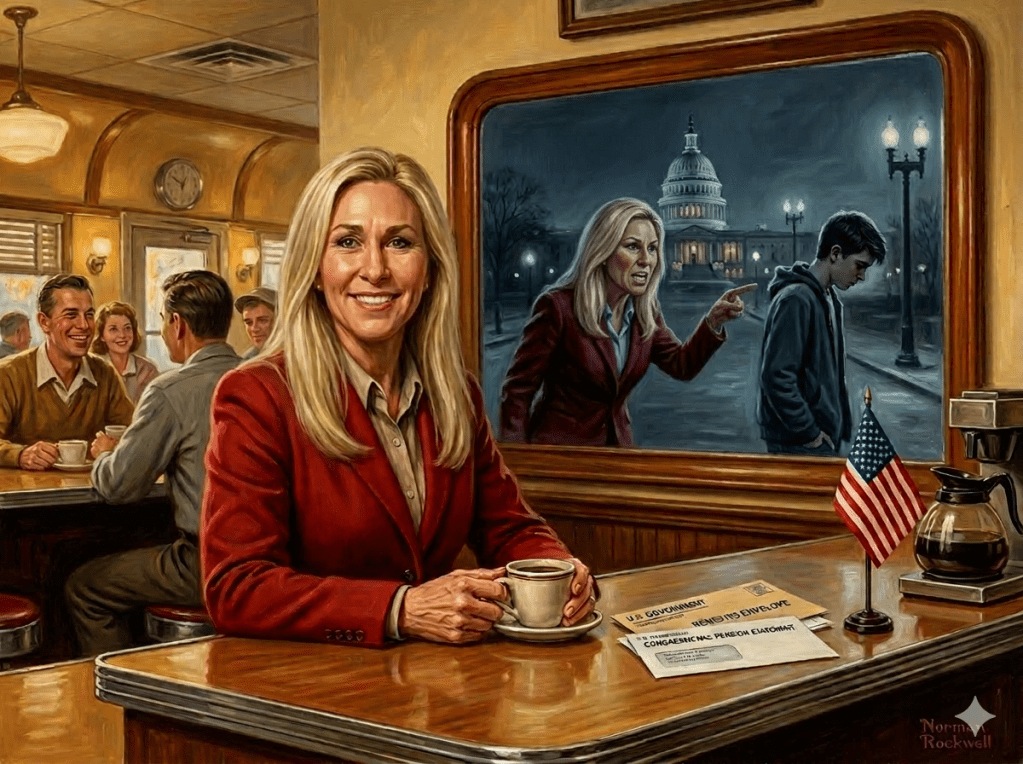
From QAnon True Believer to Stateswoman Cosplay — A Complete Profile
Something strange happened to Marjorie Taylor Greene. The most reliably unhinged member of Congress — a woman who stalked a teenage shooting survivor through the Capitol, endorsed satanic murder conspiracy theories online, and appeared to call for the execution of Democratic politicians — suddenly started sounding almost… reasonable. She went on The View. She appeared on Bill Maher. She apologized for “toxic politics.” She cried about healthcare costs. She broke with Donald Trump. She resigned.
So what exactly happened? Did she get therapy? Find religion? Start reading? Or is this the most calculated political rebrand since Richard Nixon came back from the dead?
The answer is more complicated — and more revealing — than either of those options. To understand who Marjorie Taylor Greene is now, you have to understand who she actually was. And that story starts earlier than most people realize, in a CrossFit gym, on a Facebook page that almost no one was watching.
The Origin Story: Nobody Was Watching
Marjorie Taylor Greene was born in Milledgeville, Georgia in 1974, graduated from the University of Georgia with a business degree in 1996, and spent the next two decades running her family’s construction company. Until 2016, she did not vote in presidential elections, did not attend rallies, did not post about politics. She was, by every measure, a private citizen with zero political identity.
Then Trump happened — and with him, QAnon.
The radicalization timeline is traceable, and it matters enormously for understanding everything that came after. Feeling she couldn’t trust CNN or Fox News to explain the Russia investigation, she started searching the internet for answers. “What I did was I started looking up things on the Internet, asking questions, like most people do every day,” she later explained. It sounds almost innocent. The problem is where those searches led.
By late 2017 — two years before she had any political ambitions and three years before she ran for Congress — she had discovered QAnon on 4chan. In a video posted that year, she called the anonymous figure known as “Q” a “patriot” and declared: “There’s a once-in-a-lifetime opportunity to take this global cabal of Satan-worshipping pedophiles out, and I think we have the president to do it.”
She also began writing articles for a fringe website called American Truth Seekers, eventually authoring roughly 59 pieces promoting QAnon theories, suggesting Hillary Clinton had murdered political enemies, and questioning whether mass shootings were orchestrated to dismantle the Second Amendment. Again — this was before anyone was paying attention. There was no political brand to build. No donors to attract. No votes to win. No audience whatsoever.
That fact matters more than almost anything else in this story.
The Conspiracy Record: What She Actually Posted
The documented record of what Greene posted, shared, and endorsed between 2017 and 2019 is important to lay out — not to dwell on it gratuitously, but because it forms the evidentiary foundation for every question that follows about who she really is. These weren’t offhand comments. They were sustained, years-long, publicly documented positions.
On Mass Shootings
On February 14, 2018, a gunman opened fire at Marjory Stoneman Douglas High School in Parkland, Florida. Seventeen students and staff members were killed. In a 2018 Facebook post, Greene stated the shooting was “an organized false flag operation.” She made similar claims about the December 2012 Sandy Hook Elementary School shooting in Newtown, Connecticut, where twenty children between the ages of six and seven, and six adult staff members, were murdered.
The families of those victims spent years being harassed by conspiracy theorists who had convinced themselves the murders never happened, that the grieving parents were “crisis actors,” that the children never existed. Greene was among those adding fuel to that fire, from the comfort of her Facebook page.
The Parkland Survivor Confrontation
In March 2019 — barely a year after Parkland — Greene traveled to Washington during Senate gun control hearings. She found David Hogg, then 18 years old and a Parkland survivor who had become a gun safety advocate, and followed him through the streets near the Capitol while filming herself doing it. She called him a “coward” for not engaging. She accused him of being paid by George Soros. In a separate gun group interview, she described him as being “like a dog. He’s completely trained.” In online posts, she had previously called him “#littleHitler” and “a bought and paid little pawn.”
She also appeared to endorse the “Frazzledrip” conspiracy — one of the darkest corners of the QAnon mythology — which baselessly claimed Hillary Clinton and aide Huma Abedin had committed ritual child murder. She shared posts claiming the Rothschild family was using space lasers to start California wildfires to clear land for a high-speed rail project. She liked posts calling for Nancy Pelosi to receive “a bullet to the head.” She responded to a suggestion that Obama and Clinton be hanged by writing: “Stage is being set. Players are being put in place. We must be patient.” She called Pelosi “guilty of treason” — a crime, she helpfully noted, “punishable by death.”
She claimed the 9/11 attacks were a hoax. She said Charlottesville was “an inside job.” She suggested Ruth Bader Ginsburg had been replaced by a body double. She claimed the Christchurch mosque shootings in New Zealand — where 51 people were killed — were a false flag.
All of this was posted publicly, under her own name, before she ran for office. No audience. No brand. No upside. Just a private citizen who believed it.
How a Conspiracy Theorist Became a Congresswoman
Here is where the story takes its most revealing turn — because the path from “angry citizen with a camera” to “Member of Congress” was not a master plan. It was reactive. It was driven by wounded ego. And it happened fast.
In March 2019, Greene went to Washington as a private gun owner wanting to be heard during those Senate hearings. She was ignored. Republican staffers brushed past her. Republican legislators didn’t meet with her. Meanwhile, she watched the same senators who wouldn’t give her five minutes roll out the red carpet for David Hogg, a teenager she believed was a fraud being used as a political pawn.
That humiliation appears to have been the trigger. As Britannica summarized it: “If Greene was not going to be heard in Congress as a citizen, then she was determined to have her say as a member.”
Within weeks of those Capitol visits, she filed to run for Congress. She also, in those same weeks, livestreamed herself shouting through Alexandria Ocasio-Cortez’s mail slot demanding she “face the American citizens that you serve,” and filmed herself trying to confront Muslim Representatives Ilhan Omar and Rashida Tlaib, demanding they retake their oaths on a Bible.
She originally filed to run in Georgia’s 6th district, where she lived. House Freedom Caucus members steered her toward the 14th district in northwest Georgia — safer, deeper red, open seat. She relocated and ran there even though she hadn’t previously lived in the district. She won. Washington assumed she would be a one-term curiosity quickly forgotten.
Washington was wrong. Stripped of her committee assignments in her first weeks by a 230-199 House vote, she promptly raised $3.2 million in her next fundraising quarter — unheard of for a House freshman. The attention economy had confirmed its most reliable rule: in the right media environment, there is no such thing as bad publicity.
The Psychology: True Believer, Opportunist, or Something Worse?
This is the question everyone asks, and it’s actually the wrong framing. It assumes “true believer” and “political opportunist” are mutually exclusive. They aren’t. And in Greene’s case, the evidence strongly suggests both engines were running simultaneously — which makes her considerably more dangerous than either type alone.
What the Research Says
Psychology research consistently identifies three core needs that conspiracy theories fulfill: existential (the need to feel secure and in control), epistemic (the need to understand a chaotic world), and social (the need to feel special, chosen, part of an in-group that sees what others don’t). When all three are threatened at once — which they were for Greene in her early 40s, navigating a failing marriage, a sold gym, a political landscape that felt incomprehensibly corrupt — the conspiracy rabbit hole offers all three simultaneously.
Research also consistently links conspiracy belief to narcissism — specifically the combination of an exaggerated self-view with a need for external validation — and to what researchers call Manichean thinking: the belief that the world is a war between pure good and pure evil, and that you personally are on the right side of it. The dark triad traits of narcissism, psychopathy, and Machiavellianism predict conspiracy belief, particularly for the most antisocial varieties: Sandy Hook denial, Holocaust denial, the specific conspiracy theories that require believing that murdered children were faked.
Greene’s pre-congressional behavior fits this profile precisely. She didn’t just read conspiracy theories. She drove to Washington to confront people. She filmed herself doing it. She wrote 59 articles. She moderated extremist Facebook groups. She harassed a teenager. This is not passive belief — it’s someone who has found a grand narrative that gives her a heroic identity and a cosmic mission, and is acting on it with complete conviction.
Was the Crazy Real?
Yes. The most compelling evidence is the simplest: the pre-political record. The Frazzledrip post. The execution fantasies. The shooting denialism. The 59 fringe articles. All of this predates any political ambition by years. In 2017 and 2018, nobody was watching. There was no brand to build, no donors to attract, no votes to win. A pure cynic doesn’t post satanic murder conspiracy theories to an audience of zero. A person who actually believes it does.
Is the Pivot Fake?
Almost certainly more fake than real — and this is where most people’s instincts are correct. Here’s the tell: every single disavowal she has offered is framed as victimhood, never genuine moral accountability. She was “sucked in” by the internet. She was “a victim, just like you” of social media. She was “allowed to believe things that weren’t true.”
She has never once said: “I caused real harm to real people — including families of murdered children — and I am genuinely sorry for that.”
That is not the language of someone who has reckoned with what they did. That is the language of someone protecting their ego while performing accountability for a new audience. The pivot accelerated precisely when Trump showed her polling data proving she couldn’t win statewide. It deepened when he publicly humiliated her. It culminated in a carefully calibrated media tour designed to reach audiences that would never have consumed her previous content.
The ideology was real. The harassment was real. The execution fantasies were real. The pivot is calculated. In a broken political ecosystem, authentic extremism and cynical brand management aren’t just compatible — they’re symbiotic.
Smart or Instinctual? Closer to Trump Than Anyone Wants to Admit
Like Trump, Greene operates primarily on instinct. She doesn’t have deep policy architecture. She doesn’t do nuance. What she has is an extraordinary gut feel for the attention economy — the understanding that outrage is currency, that conflict generates reach, and that the most extreme position in the room wins the news cycle. She didn’t need a consultant to figure this out. She felt it and acted on it before anyone told her it was a viable political strategy.
Where she differs from Trump is self-preservation instinct. Trump genuinely does not experience embarrassment — he will defend a losing position until the earth’s crust cools. Greene, under sufficient pressure, pivots. She dropped QAnon the moment she needed mainstream votes. She dropped Trump the moment he became a personal liability. That pivot-ability suggests a layer of calculation sitting above the raw instinct that Trump genuinely lacks.
But she also makes impulsive errors a truly strategic operator wouldn’t. Calling Lauren Boebert a “little bitch” on the House floor and getting expelled from the Freedom Caucus — the Freedom Caucus, which contains Lauren Boebert — is not smart politics. That’s impulse. Trump’s conspiracy theories are almost always vague enough to maintain deniability. He says “people are saying.” Greene posted specific endorsements of specific atrocities under her full legal name.
Verdict: instinctual with a business brain layered on top. Smart enough to read the room and move. Not disciplined enough to avoid self-inflicted wounds. Somewhere between Trump and a genuine strategist — which, in modern American politics, is plenty dangerous enough.
The Pension and Healthcare: Hypocrisy With a Spreadsheet
If you want a single image that captures everything about who Marjorie Taylor Greene actually is beneath the populist warrior branding, here it is: she resigned from Congress on January 5, 2026 — five years and three days after she was sworn in. The five-year mark is the exact threshold required to vest a congressional pension and lock in lifetime access to federally subsidized healthcare. She cleared it by seventy-two hours.
That was not a coincidence.
The Pension
Under the Federal Employees Retirement System, Greene secured a deferred pension of approximately $8,700 per year, starting at age 62, projected to total more than $265,000 over her lifetime. The National Taxpayers Union Foundation noted the timing immediately. Even Trump ally Laura Loomer piled on: “It’s all about the money for her. Always has been.”
The Healthcare — This Is the Real Story
The pension got the headlines. The healthcare is worth considerably more. Members of Congress who complete five years of service are eligible to continue purchasing coverage through the Federal Employees Health Benefits program in retirement — with the federal government covering 72% to 75% of the premium cost. Permanently. A comprehensive family health plan that would cost an unsubsidized private citizen $25,000 or more per year costs a former member of Congress roughly $6,000 to $7,000. Taxpayers cover the rest. For the rest of her life.
Greene spent five years voting against the Affordable Care Act, railing against government healthcare subsidies as taxpayer-funded handouts, and representing a poor, rural district where her own constituents were among the most dependent on ACA marketplace subsidies in the country. Her congressional health insurance is purchased through the very DC ACA marketplace she spent years trying to destroy — with 72% of the cost covered by the taxpayers she spent five years lecturing about fiscal responsibility.
The stinging footnote: in 2025, one of the reasons Greene broke with Trump was her outrage over ACA subsidy expiration. She wrote publicly that her own adult children’s insurance premiums were going to double. She understood, viscerally and personally, exactly what losing those subsidies does to real families. She lived it through her own kids. And she spent her congressional career voting for the policies that would have taken those subsidies away from the constituents she was paid to represent — while quietly ensuring she would never face that problem herself.
She didn’t leave a single taxpayer-funded benefit on the table. That’s not an anti-establishment crusader. That’s hypocrisy with a spreadsheet.
What Comes Next — Are We Done With Her?
Probably not. The only open question is what form the return takes.
She passed on running for Senate in 2026, reportedly after Republicans showed her polling suggesting she’d hand Democrat Jon Ossoff a second term. She flirted publicly with a gubernatorial run, wore a “Make Georgia Great Again” hat at the state Republican convention, then passed on that too — writing cryptically that “one day” she might run “purely out of the blessing of the wonderful people of Georgia,” just not in 2026.
Multiple sources told TIME magazine she privately discussed running for president in 2028. She denied it loudly and repeatedly. On 60 Minutes, she told Lesley Stahl she had “zero plans, zero desire to run for president.” Her boyfriend posted: “MTG has NO plans to run for President in 2028. I AM YOUR SOURCE.”
Politicians who have zero presidential ambitions do not generally hold press conferences to announce that they have zero presidential ambitions.
The more likely scenario is that she is positioning herself as the post-Trump heir to a specific flavor of populist grievance politics — anti-interventionist, anti-establishment, genuinely angry about healthcare and economic inequality — stripped of the most cartoonishly toxic MAGA elements. Whether that’s authentic evolution or calculated rebrand, it is a real political space that will exist after Trump leaves the stage. And she is one of the few figures on the right with the name recognition and the outsider credibility to occupy it.
The Bottom Line
Marjorie Taylor Greene is not stupid. She is not simply a performer. She is not simply a true believer. She is something American politics produces with some regularity but rarely this clearly: a person whose genuine pathology happened to be politically marketable, who amplified it strategically for profit and power, and who is now repackaging it for whatever comes after Trump.
The conspiracy beliefs were real. The online posts endorsing political violence were real. The harassment of grieving families and a traumatized teenager were real. And the pivot is calculated. The most unsettling part is not that those facts are in tension with each other. It’s that they aren’t.
In a political ecosystem this broken, you can genuinely believe that Hillary Clinton is a Satanic child murderer and simultaneously time your congressional resignation to the day to capture maximum taxpayer-funded benefits. You can scream about government waste and make sure the government covers 75% of your health insurance premiums for life. You can stalk a teenager through the Capitol and then go on The View a few years later and call yourself a victim of social media.
None of it is contradictory if the through-line is simply: what is best for Marjorie Taylor Greene right now?
That has always been the answer. The conspiracy theories were real — and also useful. The MAGA loyalty was genuine — and also profitable. The pivot is strategic — and may also reflect real disillusionment. She contains multitudes, all of them pointed in the same direction.
The record doesn’t vanish because she’s on The View now. It just waits.
— eventhatsodd.com
Sources: Wikipedia, Encyclopaedia Britannica, The Intercept, NPR, Newsweek, TIME Magazine, National Taxpayers Union Foundation, Congressional Research Service, CNN KFile, Rolling Stone, NBC News, Psychology Today, National Geographic, Government Executive, Becker’s Payer Issues, Atlanta News First
 Even that's Odd
Leave a comment