
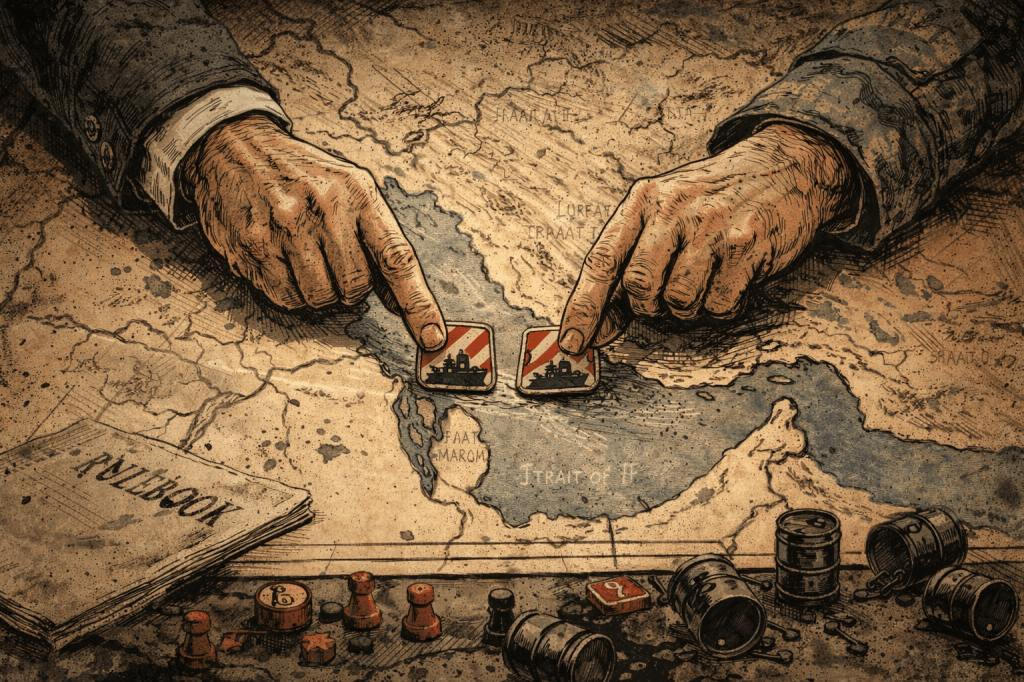
Like most people, I’ve been watching this story with a mix of disbelief and exhaustion that is quickly becoming the default setting for following American foreign policy. I want to be upfront: I’m not a foreign policy expert. I don’t pretend to understand all the moving parts, and I’m genuinely open to the possibility that I’m missing something. But what I’m seeing looks less like geopolitics and more like someone flipping over the board because they didn’t read the rules before they started playing.
Let’s recap.
On February 28th, the United States and Israel launched an air war against Iran. Whatever your position on the wisdom of that decision, it happened. Now, Iran has one card in its hand that is genuinely consequential — not tanks, not nukes, not a blue-water navy. The Strait of Hormuz: 21 miles wide at its narrowest point, carrying roughly 20% of the world’s seaborne oil trade and 20% of global LNG shipments. It is their move. It has always been their move. And yet.
Iran began blocking shipping traffic through the Strait on February 28th — the same day the war started. Not a week in. Day one.
I don’t know who was in the room when the decision to go to war was made. I don’t know what intelligence assessments were on the table or what the war planners projected. What I do know is that the administration’s subsequent behavior suggests this particular outcome came as a genuine surprise. Because what happened next was a frantic effort to get it open again.
This weekend, in what was described as the highest-level diplomatic engagement between the US and Iran in 47 years, Vice President JD Vance led a delegation to Islamabad for 21 hours of face-to-face negotiations — the goal being, in no small part, to get Iran to agree to open a strait that the United States apparently did not anticipate they would close.
The talks collapsed.
Iran’s demands included the right to continue peaceful uranium enrichment, war reparations, sanctions relief, and — critically — continued Iranian control of the Strait of Hormuz, including the right to charge tolls for passage. The US wasn’t having it. Vance left Islamabad saying simply: “They have chosen not to accept our terms.”
What happened next is the part I keep re-reading to make sure I’m understanding it correctly.
Trump announced that the United States Navy would begin a blockade of the Strait of Hormuz, blocking “any and all Ships trying to enter, or leave” until Iran opens it.
Read that back slowly.
Iran closed the Strait. The US went to negotiate it open. The talks failed. So now the US is… also closing the Strait.
The stated logic, as best I can parse it: Trump framed the blockade as an effort to stop Iran from “policing the strait and benefiting economically” while the rest of the world suffers, calling it “WORLD EXTORTION” in his characteristic all-caps Truth Social style. The implicit logic is that if the US controls the closure, Iran loses its leverage. Maybe. Alternatively, you now have two nuclear-adjacent powers blockading the same 21-mile waterway simultaneously, with the IRGC warning that any military vessels approaching will be “dealt with harshly and decisively.”
Oil crossed $104 a barrel Sunday night. Iran’s chief negotiator Mohammad Bagher Ghalibaf responded by posting a photo of gas station prices near the White House with the caption: “Enjoy the current pump figures. With the so-called ‘blockade,’ soon you’ll be nostalgic for $4–$5 gas.”
The Iranian Parliament Speaker is dunking on us with a photo of a Sunoco.
There’s also the NATO angle, which deserves its own mention. Throughout this war, Trump has publicly criticized the alliance for not coming to assist — the same alliance he spent years undermining, questioning, and threatening to abandon. He expressed deep disappointment that NATO didn’t show up: “We’re very disappointed with NATO, we’re very, very disappointed they didn’t come.” The allies he told weren’t really allies didn’t act like allies. File that under “told you so” for literally everyone but him.
I keep coming back to the board game thing. Not Risk specifically — more like someone sat down to play chess, flipped over all the black pieces because they were only planning to use the white ones, and then got upset when their opponent started picking up pieces off the floor.
The Strait of Hormuz was always on the board. It was always Iran’s most obvious move. The fact that we’re now 44 days into a war, with oil above $104 a barrel, stock futures sliding, and the US Navy about to blockade the same waterway we went to war to keep open — that’s not bad luck. That’s not Iran being unreasonable. That’s what happens when you don’t think past move one.
I could be wrong. I genuinely hope someone with more information than me has a plan here that I’m not seeing. But right now, from where I’m sitting watching gas prices crawl toward the ceiling, it sure looks like nobody flipped to the back of the box before they started.
 Even that's Odd
Leave a comment