
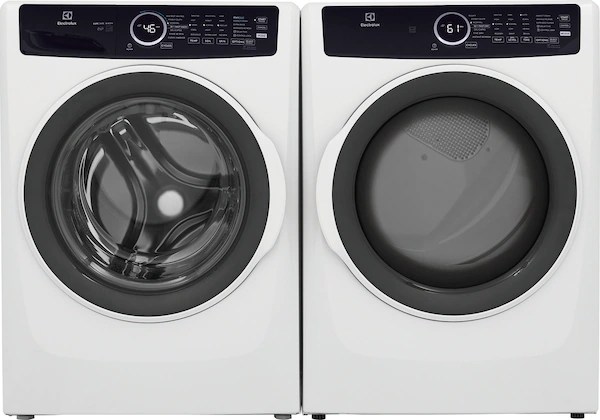
When You’re Forced Into A Matching Set
Let’s talk about being backed into an appliance corner. With limited laundry room space, we needed to stack our washer and dryer. And because stacking kits apparently cannot be universal (heaven forbid!), we were forced to get an Electrolux dryer to match our new washer.
Enter the Electrolux Front Load Perfect Steam™ Gas Dryer with Instant Refresh (Model ELFG7437AW)—a name longer than the time it takes the machine to actually dry clothes.
I generally prefer the simplest appliances possible—fewer features mean fewer things to break. But we went up one level to match the washer, so we got the fancy steam feature that I will never, ever use. That steam line will remain forever disconnected, a monument to unnecessary features.
The Interface: Buttons That Aren’t Really Buttons
Like the washer, the dryer sports those super-sensitive touch buttons that make you feel like you’re trying to disarm a bomb. Too gentle? Nothing happens. Too firm? You’ve just start-pause-started your cycle. The blue/white calculator-style display continues the retro-not-in-a-good-way aesthetic.
The Door Reversal Saga (Or: How I Learned to Hate Square-Head Screws)
Of course, the door came installed opposite to what would work best in our space. No big deal, right? Wrong.
First off, the screws are some bizarre square head or “Quadrex” bit that looks deceptively like a #2 Phillips—just similar enough to ensure you’ll strip several heads before figuring this out. Then there’s the delightful discovery that the holes aren’t pre-threaded, despite using fine-thread machine screws. WITH POINTS. What mad scientist designed these?
They don’t self-tap properly, so I had to use an M5x0.8 tap to create proper threads. And when I inevitably stripped some screws, I discovered these specialty fasteners aren’t available at my hardware store OR the big box stores. Fortunately, my local appliance store came through and helped me out with replacement screws from their shop, saving me from having a doorless dryer.
The LP Conversion Learning Curve
Since we have propane, we needed the LP conversion kit. Our appliance store installed it, but we encountered some initial issues with the flame shutting down after firing briefly.
The team at our local appliance store was responsive and made multiple visits to resolve the issues. They adjusted the orifice and later replaced the thermostat and gas valve which fixed the noise problem, though we still had some challenges with drying performance.
The Factory Service Call Experience
Still facing long drying times, we called Electrolux directly, who sent a factory technician. This visit was… less than satisfying. When I compared our drying times to our 12-year-old LG, he told me:
“You can’t compare different brands as they use different technology.” (Apparently the laws of thermodynamics vary by manufacturer?)
“Newer dryers are DESIGNED to run longer because that saves energy.” (In what universe does running a gas appliance LONGER save energy?)
“If it gets warm, it’s functioning as intended.” (Bar. Set. Low.)
He also couldn’t address the LP conversion even if that was causing problems.
His only useful advice? The timed dry setting bypasses the sensors, which might explain why our old LG’s timed dry worked better than this “advanced” machine’s auto-sensing.
The Great Drying Time Experiment
My wife, bless her, created a chart and methodically tested each setting until finding something semi-acceptable. The results? Loads that dried in 50 minutes on medium heat in our ancient LG now need AT LEAST 60 minutes on HIGH in the Electrolux—and often require additional time.
Oh, and the minimum time you can add? 30 minutes. Because apparently precision is overrated.
Design Flaws That Make Me Question Everything
Beyond the dismal drying performance, this machine has some head-scratching design issues:
- Like the washer, it pushes clothes toward the door, causing them to fall out when opened
- The dryer sheets end up in the lint trap instead of doing their job
- The lint trap is double-sided and requires two hands to clean (while pressing against my body, ensuring I wear as much lint as I remove)
- The door gasket is larger than the door opening, creating a lint/debris trap around the edge that’s impossible to clean
- According to online reviews, the lint trap sometimes dislodges completely and gets pulled into the drum, potentially damaging clothes and clogging the exhaust
But hey, it’s quieter than our old LG! So I can barely hear it NOT drying my clothes for twice as long.
Update: It gets much louder as lint starts building up on the vent fan. Poor lint trap design.
The Verdict: New Isn’t Always Better
Pros:
- Matches our washer (the bar is low, folks)
- Relatively quiet operation
- Less gap between washer and dryer with the stacking kit
- Lint trap catches a lot of lint (when it stays in place)
Cons:
- Takes FOREVER to dry clothes, defying both our experience and the laws of physics
- Clothes push to the front of the machine
- Lint trap doubles as a dryer sheet cemetery
- Can’t set for less than 30 minutes (the 18-minute speed dry is just for show)
- The drum is painted, not stainless steel (hello, future chipping!)
- Those infuriating touch controls
Our Old LG Dryer: The One That Got Away
In contrast, our 2010 LG Gas SteamDryer (Model DLGX2502W) was a reliable workhorse for 13 years. Its tactile knob and buttons provided satisfying feedback. It dried clothes quickly and effectively—50 minutes on medium heat did the job for most loads. It wasn’t perfect (the lint filter could have trapped lint better), but it understood its primary function was to, you know, DRY CLOTHES.
Practical Tips for Fellow Dryer Shoppers and Owners
- Before you buy:
- Don’t assume newer models are better – read reviews focusing specifically on drying performance
- Consider whether you truly need matching sets, especially when stacking options exist for mixing brands
- Ask about the gas conversion process if you use propane – some brands handle this better than others
- If you own an Electrolux dryer:
- Use the Timed Dry setting instead of the auto-sensing options for more reliable results
- Run on high heat when possible (contrary to energy-saving recommendations)
- Clean the lint trap after EVERY load, and check for lint accumulation around the door gasket
- When reversing the door, use the correct bit size (square/Quadrex) to avoid stripping screws
- For any dryer:
- Clean your exterior vent regularly – restricted airflow dramatically affects performance
- Consider using wool dryer balls instead of dryer sheets to avoid lint trap issues
- Keep track of normal drying times so you can identify when performance starts to decline
- Don’t overload – even the best dryers struggle with excessive load sizes
The Takeaway
If your current dryer works, cherish it. If you’re in the market for a new one, think twice before assuming newer means better. And if you’re considering this particular Electrolux model, maybe reconsider how much you value your time.
At least the matching set looks nice together—even if one of them is dramatically underperforming. Kind of like that couple you know where one person is clearly carrying the relationship. In this case, our washer isn’t exactly a superstar either, but at least it cleans clothes in a reasonable timeframe.
Have you experienced similar frustrations with newer appliances performing worse than their predecessors? Share your appliance horror stories in the comments!
P.S. A sincere thanks to our local appliance store who has been responsive and helpful throughout this process. The issues with this particular model aren’t their fault, and I’d happily shop with them again. Sometimes even good retailers are at the mercy of manufacturer designs.
New Model of the LG
https://www.lg.com/us/washers-dryers/lg-wm4000hwa-front-load-washer
https://www.lg.com/us/washers-dryers/lg-dlgx4001w-front-load-gas-dryer
@Electrolux, @ElectroluxUSA, @ElectroluxGroup, @LGUSAppliances, @LG_Electronics,@LGUS
 Even that's Odd
Leave a comment