
We had to go to Portugal in early February for Jennifer’s AIMA residency appointment, which is the kind of thing you don’t get to schedule. They tell you the date, you show up. We figured if we had to be in Portugal anyway, we’d escape the sub-zero temperatures at home, pull the kids out of school for a week, and make a family trip out of it. Trading single-digit temps for Portuguese drizzle in the 50s seemed like a reasonable trade.
Spoiler: the kids missed school and it was worth it. Also we ended up at the wrong AIMA office, but that’s not on us — AIMA had the wrong address in their own correspondence and only fixed it in one place. More on that later.
We flew TAP from Newark because it’s about the same distance from us as JFK, and JFK is a nightmare so Newark wins by default. I hadn’t flown TAP in years. Five-hour flight, decent food, tight three-across seats, entertainment that was better on the way back than on the way there. Newark Terminal B continues to be the worst part of the worst-rated terminal in the New York area, and TAP gets stuck in the worst part of that. Of course we got routed through the line without PreCheck, which is the line we paid PreCheck specifically to avoid. The food options are bleak and the prices are airport prices. We’ve learned to eat before the gate or pack our own.
One real advantage of Newark long-term parking: they’ll charge your EV while you’re away. The shuttle is a little annoying and the lot itself feels sketchy, but the EV thing is enough to make it worth it.
We landed in Lisbon at 5 AM, which is exactly the wrong time. I’d booked a car through the TAP app with a company called Klass Wagon that claimed to be at the terminal. They were not. They were at a sketchy off-airport lot, which they reach by sending a shuttle bus that took 45 minutes to show up. The car was fine, the rental went through, but I will not be doing this again. Pay the extra to rent at the terminal. The math on the savings only works if you’re flying during normal hours, and ours apparently never are.
It was upper 40s when we landed, which after the arctic week we’d just left felt like summer. The forecast said rain and 50s every day and the forecast was correct, every day. (Why don’t we use Celsius and the 24-hour clock like the rest of the civilized world? I have no answer.)
We had one night booked at Casa do Jasmim by Shiadu in Lisbon, mostly because I wasn’t going to drive 2-3 hours to Porto on zero sleep. We arrived around 6 AM and the room wasn’t going to be ready until 3 PM. We should have booked the night before so we could at least shower and dump our bags, but we didn’t, because life is already expensive and we were trying not to make it worse. We left our bags at the front desk and went to find parking.
European parking is an entirely different category of activity from American parking. There were maybe two inches of clearance on either side of the car. Europeans are born with a spatial-relations gene we don’t have. I will never not be impressed by it.
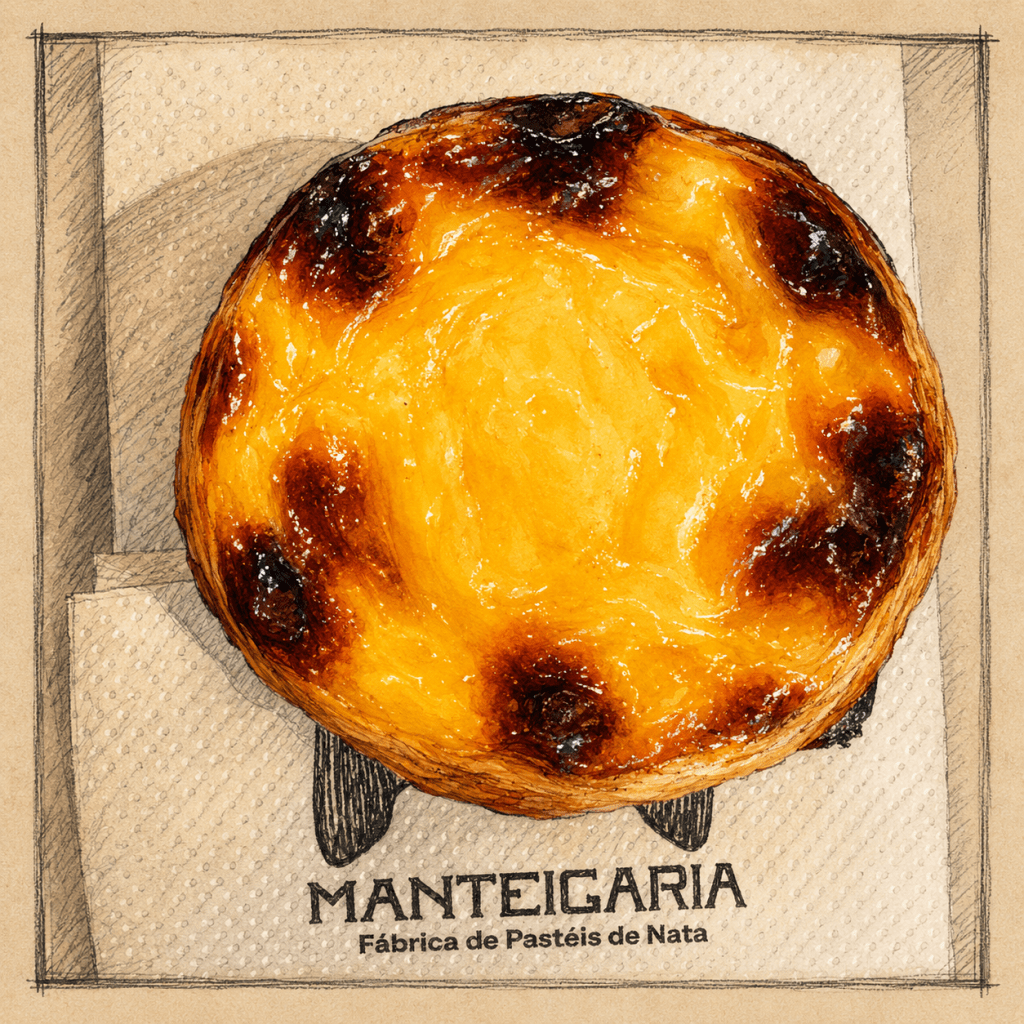
Jennifer and Henry napped in the car. Elias and I went looking for coffee. We found a café and I had my first pastel de nata of the trip. It was fine. Not great. I’d had better at Grand Central Station in Manhattan, which I realize sounds insane but is true. A block further we walked into Manteigaria, which I would later understand is the chain — it’s everywhere, and it’s the one. Warm, flaky, the custard set the way it’s supposed to. We had two each. This was the first of approximately 847 pastéis de nata I would eat that week.
A few other things from that first sleep-deprived shuffle around Lisbon: the public bathrooms take coins, which I didn’t have. Bring euro coins. The Jardim Botânico is free on Sundays and was beautiful even in drizzle. The Museu da Eletricidade — an old power station converted into a museum down in Belém — was unexpectedly great, all preserved generators and coal systems and industrial architecture. The MAAT next door is a better building from the outside than from the inside. And we learned, the hard way, that many Portuguese restaurants close from 3 to 7 PM and dinner doesn’t really start until 7 or 8. By the time the four of us collapsed into the hotel room (they let us check in early, no fee, which was kind of them), Elias fell asleep at 4 PM, I fell asleep at 5, and we all slept through a heavy overnight storm until past 9 the next morning.
The next day was the drive to Porto. We had friends there who’d moved over for their own residency process and we’d planned a few days with them, with two stops on the way.
Óbidos turned out to be the highlight of the trip. It’s a small walled medieval town with a castle, and you can walk the entire perimeter of the walls. The weather even held for most of it. It’s touristy and worth it anyway.
After that we stopped at Ceramirupe, a ceramics factory shop, because we needed a housewarming gift for our friends in Porto and Jennifer is constitutionally incapable of walking past a ceramics shop. We bought the housewarming gift and then a stack of mugs and pasta bowls and other things for ourselves, which we would now have to carry back across the Atlantic. The factory had an orange tree and a lemon tree outside, and there were fallen oranges on the ground, so we picked some up. Beautiful navel oranges. Elias grabbed a giant lemon. It was pouring. On the way out we passed a church with another orange tree, so I made Elias pick a few more. When you find oranges, you pick oranges.
We drove through Aveiro, which is sometimes called the Venice of Portugal. It is not the Venice of Portugal. It is a perfectly nice town with some Art Nouveau buildings and a few canals.
We got to our Airbnb on Rua de Manuel II in Porto in the dark. The entry system involved entering a code, going upstairs to unlock a box to get a key, then coming back down to retrieve a garage remote. All the streets around it were one-way in the wrong direction. The apartment itself was fine — nothing special — and the supermarket downstairs would have been very convenient if we’d ever managed to be home before it closed. We did not.
Porto is a city you can spend several days walking around in. We did. Some of the things that stuck with me:
The Mercado do Bolhão is excellent — fresh fruit, cheese, fish, meat, the whole production. The fruit in Portugal generally is incredible, which is partly that it’s actually in season and partly that they haven’t done to their food what we’ve done to ours.
Livraria Lello — the famous bookstore that supposedly inspired Harry Potter — requires advance tickets and is genuinely beautiful. Dramatic staircase, ornate everything. Worth the ticket price. The old department store right next door was, to my eye, even more interesting. Nobody was in it.
We walked the upper deck of the Ponte Luís I bridge across the Douro in a serious wind and rain, took the tram down to the waterfront on the Gaia side, walked along the port wine cellars, and crossed back on the lower deck. Two completely different views of the same bridge.
The Torre dos Clérigos has a light show in the adjacent church that’s worth catching, and there’s good gelato right next to Livraria Lello, and after we ate it our friends walked us all the way back to the apartment to work off the calories, which the kids complained about the entire way.
We had dinner with our friends a couple of times. Our kids had gone to Montessori school together for years, so the boys had known each other since they were small, and that’s the kind of friendship that holds even after lives diverge. Their house in Foz do Douro near the ocean is amazing. The restaurant on the water we were supposed to meet at was closed for renovations, but we found a different one with the same view, and the Atlantic was angry and impressive even in February.
Bulha, a Portuguese restaurant in Porto where the walls are covered in writing, was good without being remarkable. Solid traditional food. Worth eating at if you’re already in the neighborhood.
We did one day trip from Porto, to Guimarães, which has both a palace and a castle. The Palace of the Dukes of Braganza is impressive — wood ceilings, period furniture, although one section was actively leaking, which is not great for a building you’re meant to be preserving. The Castle of Guimarães, on the other hand, is mostly ruined walls you can walk around, and was underwhelming after Óbidos. We figured out the order by accident — we went to the castle first, where they told us we had to buy tickets at the palace, so we went to the palace, then back to the castle. We ate sandwiches in the car. One of them had a sheep’s cheese that was way past my tolerance for cheese gameyness. The kids ate it.
We then drove out to Viana do Castelo on the Costa Verde, mainly because they have a funicular. The funicular itself is great. The town center is lovely once you find it, which involves either going through a shopping mall or going the wrong way and walking along several highways. We picked wrong. We eventually got there and they have a local pastry that’s like a powdered-sugar donut filled with the same custard they put in pastéis de nata, and it’s excellent.
The next morning we drove back to Lisbon for Jennifer’s AIMA appointment, which we had to make on time. We did not make it on time. The reason we did not make it on time is that AIMA had given us the address for the Lisbon office in their correspondence, but the appointment was actually in Cascais, about 30 minutes outside the city. They’d only fixed the address in one place. We figured this out an hour early — which would have been plenty of time, except we were an hour early at the wrong location.
We raced to Cascais. The Cascais office is in an unmarked building in an odd location and not easy to find. We were late. It worked out anyway — Jennifer got in front of the right person, the paperwork was processed, the permit was approved. There was a Manteigaria at the AIMA office, which I would normally have made a thing of, but for the only time on the trip we skipped the pastel de nata. We were too keyed up.
We checked into the Wild Apart Hotel, which was the nicest place we stayed all week — modern, clean, a long narrow room with a fold-out sofa for the kids behind a curtain, a kitchenette, and the sink outside the bathroom in a way that turned out to be much more useful than it sounds.
Lisbon is actually much nicer than I remembered. They’ve rebuilt a tremendous amount since I was last here, when you could still see significant earthquake damage. The historic stuff is gorgeous. The newer stuff is suspect. There’s a lot of concrete, a lot of heavy mass, a lot of buildings that feel less like Western Europe and more like something east of Berlin. I had a running theory, which I told everyone who would listen, that the architects must have come from somewhere in the former Soviet bloc. (I looked this up when I got home. They did not. The vast majority of modern Portuguese architecture is by Portuguese architects, including their Pritzker winner Álvaro Siza. I was wrong about who designed it. The feeling is real though — Lisbon really does have a lot of brutalist and post-revolution concrete housing that genuinely looks like it could be sitting in Kyiv. I just incorrectly assigned credit.)
The thing that goes with this, which surprised all of us, is that spoken Portuguese sounds way more Slavic than Romance. We kept catching ourselves trying to figure out what language we were overhearing and being genuinely confused. It turns out there’s a real linguistic reason for it: European Portuguese is stress-timed like Russian, drops unstressed vowels until you end up with these consonant clusters, and uses a lot of “sh” sounds. If you’ve ever wondered why Portuguese sounds like nothing else among the Romance languages, that’s why. Close your eyes on a Lisbon café terrace and you could almost convince yourself you were in Kyiv. Which made the brutalist concrete riff land for me twice over, even if the architects part wasn’t right.
We walked the Avenida da Liberdade, which is meant to evoke Paris and does, mostly. We walked down to Belém, took the obligatory photo with the giant LISBOA sign in the plaza, saw the Belém Tower, walked past an old sardine shop selling beautifully packaged tinned fish that I should have bought more of. We stumbled into a set of old Roman baths that had been uncovered during construction and turned into an archaeological exhibit — the kind of thing that just exists on a normal street in Lisbon, with people walking past it on their way to lunch. A few blocks later we found a cathedral that had been destroyed in the earthquake and turned into an open-air museum, with some on-display mummies that looked, unsettlingly, like children.
Jennifer wasn’t feeling well one morning, so the kids and I did Parque Eduardo VII, which has good views, beautiful trees, and oddly enough a prison at one end. Henry slipped in the mud while they were horsing around. He could have made it a disaster and didn’t. He found a not-great bathroom, washed his hands and feet, and we moved on. Good kid.
Last dinner of the trip was at La Pom — Portuguese-influenced food with a modern lean, very good. We took a walking detour to look at street art and graffiti on the way back. We ended up next to the Águas Livres Aqueduct, which was closed but visible from the side and impressive anyway.
Last day we tried to visit the Lisbon castle and discovered it was closed, parallel-parked the car in a slot designed for a scooter, walked the neighborhood, had one final pastel de nata which is probably the proper way to end a trip to Portugal. Drove out to a coastal town with a boardwalk along the Atlantic and walked along it for an hour and a half. The castle there was a bust but the boardwalk wasn’t.
The flight home was delayed an hour and a half on the tarmac in pouring rain. We landed at Newark around 11:40 PM and waited half an hour for the off-airport parking shuttle in roughly -10°F weather. (I’d called when we landed; they said “5 minutes.” I called again; they said “5 minutes.” This continued.) We got home at 2:30 AM. The kids had school the next morning.
Worth it.
The kids walked medieval castle walls. They ate fresh fruit out of a centuries-old market. They picked oranges off trees in the rain. They saw mummies and Roman baths and an angry Atlantic and a converted-palace apartment that belonged to people their parents had known since before they were born. Jennifer got her residency permit. I ate enough pastéis de nata to last a year.
We’re going back.
The Reference Version
At-a-glance route. Lisbon (1 night) → Óbidos → Porto (4 nights) → Guimarães day trip → Cascais (AIMA) → Lisbon (2 nights) → fly home.
The trip. First week of February 2026. Nine days on the ground in Portugal — a Lisbon–Porto–Lisbon loop pegged to an AIMA residency appointment we had to attend. Two adults, two kids (13 and 12). TAP nonstop from Newark to Lisbon.
Where we stayed. Casa do Jasmim by Shiadu, Lisbon — small, friendly, breakfast included, let us check in well before the posted 3 PM time without a fee, which was kind. One-night stop on arrival. Airbnb on Rua de Manuel II, Porto — fine and forgettable. The entry system involved a code on the door, a lockbox upstairs for the key, then back downstairs to retrieve a garage remote. All streets around it were one-way in the wrong direction. The supermarket downstairs would have been very convenient if it were ever open by the time we got home. It wasn’t. Wild Apart Hotel, Lisbon — the nicest place we stayed all trip. Modern, well laid out. Long narrow room with a fold-out sofa for the kids behind a curtain. Table and kitchenette. Sink outside the bathroom (just toilet and shower inside), which sounds odd but is actually more functional than it sounds when four people share one bathroom.
Getting there. TAP nonstop EWR–LIS, about 5 hours. Tight three-across seats. Decent food. Entertainment was better on the return than the outbound. Newark Terminal B continues to be the worst terminal in the worst-rated airport in the New York area; TAP gets stuck in the worst part of that. Eat before the gate, food options at the gate are bleak and expensive. PreCheck doesn’t help if you get routed through the line that doesn’t honor it. Newark long-term parking has one genuine advantage if you drive an EV: they’ll charge it while you’re away. The shuttle is slow and the lot looks sketchy, but the EV charging makes it worth it. Coming home, expect a 30-minute wait for the shuttle even when they say “five minutes.” Upgrade your mobile plan to include international service before you leave — Maps and navigation are not optional in a country where the streets do what they want.
Renting the car. Pay the extra to rent at the airport terminal. We booked a cheaper rental through the TAP app with an off-airport company (Klass Wagon) and any savings disappeared into a 45-minute wait for an off-site shuttle bus at 5 AM. The math on off-airport only pencils out if you’re arriving at civilized hours. Lisbon airport itself is decent; boarding is a process, and on arrival you sometimes get bused from the tarmac.
Day 1 (Sun, Lisbon). Land at 5 AM. Off-airport rental debacle. Drive to Casa do Jasmim; room not ready until 3 PM, dropped bags at front desk. Coffee and first pastel de nata at the first café we found (fine, not great). Manteigaria a block farther (excellent — this is the chain you want). Jardim Botânico — free on Sundays, beautiful even in drizzle. Drove down to Belém for the Museu da Eletricidade in the converted Central Tejo power station (unexpectedly great industrial architecture and preserved machinery) and the MAAT next door (better from the outside than from the inside). Got back to the hotel for early check-in. Elias asleep at 4 PM, Thomas at 5, everyone slept through a heavy overnight storm until past 9.
Day 2 (Mon, Lisbon → Porto). Pack up, drive north. Stop in Óbidos — small walled medieval town, walk the entire perimeter of the walls. Surprise highlight of the trip. Stop at Ceramirupe ceramics factory for a housewarming gift; leave with mugs, pasta bowls, and oranges and a lemon picked off the trees outside. Pass through Aveiro (sometimes called the Venice of Portugal; isn’t). Arrive Porto in the dark. Navigate the multi-step Airbnb entry. Dinner at Bulha (Sá da Bandeira) — solid traditional Portuguese, walls covered in writing. Sleep.
Day 3 (Tue, Porto). Slept in. Found a café with a Manteigaria nearby for breakfast pastéis de nata. Mercado do Bolhão — fresh fruit, cheese, fish, meat. Buy fruit. Uber to Foz do Douro to meet friends. The waterfront restaurant we were supposed to meet at was closed for renovations; found a different one with the same view. The Atlantic in February is angry and impressive. Walked back to their house, hung out, ordered dinner in. Uber back to the apartment. Supermarket closed.
Day 4 (Wed, Porto). Livraria Lello (the bookstore that supposedly inspired Harry Potter) — advance tickets required, dramatic staircase, ornate everything, worth the ticket. The old empty department store right next door is, to me, more interesting; nobody was in it. Wandered toward the Douro. Ponte Luís I bridge upper deck across in serious wind and rain. Tram from the bridge top down to the waterfront on the Gaia side. Walked along the port wine cellars. Back across the bridge on the lower deck — completely different view. Wandered the Ribeira side. Evening with friends: walked through their old apartment in the old part of Porto (a converted palace, up for sale). Torre dos Clérigos light show in the adjacent church. Gelato right next to Livraria Lello. Friends walked us all the way back to the apartment to work off the calories, which the kids complained about every step.
Day 5 (Thu, Porto day trip). Drive to Guimarães. Do the Palace of the Dukes of Braganza first — that’s where you buy tickets for both the palace and the castle. Wood ceilings, period furniture; one section is actively leaking, which is not a great sign for a place meant to be preserving things. Then the Castle of Guimarães, which is mostly ruined walls and underwhelming after Óbidos. Sheep’s-cheese sandwiches in the car (gamey; kids ate it). Drove on to Viana do Castelo on the Costa Verde. Drove to the top first (the Santuário de Santa Luzia was closed), took the funicular down into town. The funicular drops you in a confusing tangle of highways. Going left was wrong; the right way requires walking through a shopping mall to reach the old town, which makes no sense. Eventually got to the town center, which is lovely. Local pastry — powdered-sugar donut filled with pastel de nata custard. Excellent. Funicular back up, drive back to Porto. Dinner with friends at an inexpensive Italian place near their house (Portuguese restaurant prices feel like the US ten years ago). Uber back to the apartment.
Day 6 (Fri, Porto → Cascais → Lisbon). Up at 8, earliest we’d been up all week, still a bit late. Drive directly to Lisbon for Jennifer’s AIMA appointment. See AIMA note below — the office was actually in Cascais, not Lisbon, and we went to the Lisbon office first. Raced to Cascais, made the appointment late but it worked out. Drove into Lisbon, checked into Wild Apart Hotel. Walked Avenida da Liberdade (meant to evoke Paris and mostly does). Dinner at the cavernous pizza place across the street from the hotel — pizza good, pasta good, kids happy. Back to the hotel.
Day 7 (Sat, Lisbon). Walking day. Down to Belém. Photo with the giant LISBOA sign in the plaza. Belém Tower. Old sardine shop selling beautifully packaged tinned fish (should have bought more). Historic tram cars. Stumbled into the Roman baths exhibit — uncovered during construction, built over, turned into an archaeological site, people walking past it on their way to lunch. A few blocks later, a cathedral destroyed in the 1755 earthquake turned into an open-air museum, with on-display mummies that looked unsettlingly like children. Jennifer wasn’t feeling well in the morning, so the kids and Thomas did Parque Eduardo VII — good views, beautiful trees, and a prison oddly at one end. Henry slipped in the mud horsing around and handled it like a champ. Last dinner of the trip at La Pom — Portuguese-influenced modern, very good. Walking detour for street art on the way back. Ended up at the Águas Livres Aqueduct (closed but visible from outside, impressive anyway).
Day 8 (Sun, Lisbon → home). Tried to visit the Lisbon castle (Castelo de São Jorge); discovered it was closed. Parallel-parked the car in a slot designed for a scooter, the kind of parking job that takes seven attempts and an audience. Sunday, so no meter fee. Walked the neighborhood, sunny for once. Last pastel de nata, which is the right way to end this trip. Drove out to a coastal town northeast of the airport with a castle (a bust) and a boardwalk along the Atlantic (not a bust). Drove through an industrial area to find parking, walked the boardwalk for about ninety minutes, light rain at the end. Returned the car at the off-airport lot. Flight delayed on the tarmac about an hour and a half in pouring rain. Landed Newark around 11:40 PM. Half-hour wait for the parking shuttle in roughly -10°F (called when we landed, told “five minutes,” called again, told “five minutes,” continued). Home at 2:30 AM. Kids had school the next morning.
What worked. Pegging the trip to an appointment we couldn’t move and building a real vacation around it. Óbidos as a Lisbon-to-Porto driving stop. Manteigaria as the default-best pastel de nata everywhere it appears. Walking the Ponte Luís I bridge upper deck out, tram down, lower deck back. Wild Apart Hotel in Lisbon. February timing — nothing crowded anywhere. Letting the rainy days slow the pace; we slept more than we expected and didn’t miss much.
What we’d do differently. Rent the car at the airport terminal. Book a Lisbon hotel for the night before arrival so you can shower and dump bags instead of waiting nine hours for a room. Pack euro coins for bathrooms and parking meters before leaving the US. Eat dinner before the Newark gate. Skip Aveiro and the Guimarães castle (do the palace, leave). Confirm the AIMA office location in writing in two separate places — see below.
Things to know. Portuguese restaurants close from about 3 PM to 7 PM and dinner doesn’t really start until 7 or 8. Public bathrooms take coins. Street parking in Lisbon is generally free on Sundays. Parking by the hour ran roughly €10–15 for a few hours in our experience. European parking spots are about two inches wider than your car; the Portuguese spatial-relations gene is real, we don’t have it. February weather is reliably rain and 50s — not miserable, but plan for it and bring layers. Portuguese food quality is genuinely high — they’ve banned a lot of additives the US still allows, fruit is in season, markets are great. Costs feel roughly like the US ten years ago. Upgrade your mobile plan for international data before leaving home.
The AIMA note. If you have an AIMA appointment, confirm the office location in writing in two separate places before you leave home. Ours was listed with the Lisbon office in one piece of correspondence and the Cascais office (about 30 minutes outside the city) in another. We drove to the wrong one an hour early. The Cascais office is in an unmarked building in an odd location and not easy to find when you’re late and keyed up. It worked out for us. You may not be as lucky.
The language. Portuguese doesn’t sound like Spanish or Italian. It sounds, to most ears that haven’t heard it before, surprisingly like a Slavic language. This isn’t your imagination. European Portuguese is stress-timed (like Russian), drops unstressed vowels until you get consonant clusters, and uses a lot of “sh” sounds. Close your eyes on a Lisbon café terrace and you could almost convince yourself you were in Kyiv.
Booking links recap. Casa do Jasmim by Shiadu (Lisbon). Wild Apart Hotel (Lisbon). TAP Portugal. Manteigaria. Livraria Lello (Porto). Mercado do Bolhão (Porto). Museu da Eletricidade / Central Tejo (Belém). Ceramirupe. Óbidos castle and walls. Torre dos Clérigos (Porto).
 Even that's Odd
Leave a comment