
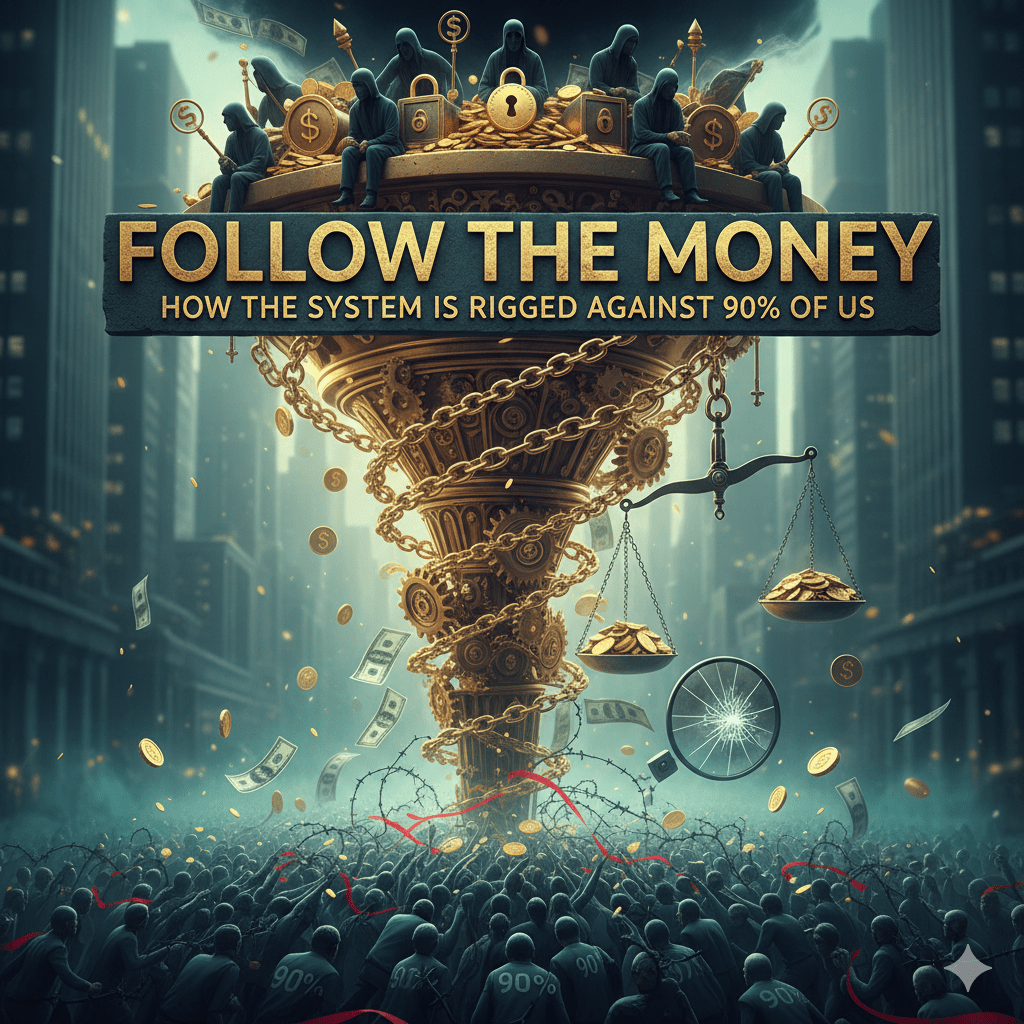
This is Part 3 in a series. Part 1 showed where America ranks among developed nations (spoiler: badly). Part 2 explained how language is weaponized to keep you from noticing. Now let’s follow the money and see exactly who’s picking your pocket while you argue about Dr. Seuss.
Now That You Can See Through The Language Game…
Remember in Part 2 when we talked about trigger words? How the moment you hear “socialism” or “free market” or “redistribution,” your brain stops analyzing and starts reacting?
Keep that defense up. Because this post is going to trigger every single one of them.
We’re about to trace where your money actually goes in the American system. And the beneficiaries have spent decades conditioning you to yell their favorite trigger words the moment anyone points this out.
So when you feel that reaction coming – that urge to yell “but that’s socialism!” or “that’s just how capitalism works!” – pause. Check yourself. Ask: “Am I thinking, or am I reacting?”
Because what follows isn’t opinion. It’s accounting.
Healthcare: The $4 Trillion Magic Trick
The Setup (from Part 1):
- Americans pay $12,555 per person annually (#1 in the world by far)
- We rank 36th in life expectancy
- We rank 32nd in infant mortality
- We have the worst maternal mortality rate among developed nations
- 66.5% of our bankruptcies are medical (other developed nations: effectively 0%)
The Question: Where does the $12,555 go if it’s not producing health?
The Answer: It goes to people whose job is not to provide healthcare.
Follow The Money:
Insurance Company CEOs:
- UnitedHealth Group CEO: $20.9M (2022)
- Cigna CEO: $20.96M (2022)
- Elevance (formerly Anthem) CEO: $20.9M (2022)
Their job description: Collect premiums. Deny claims. Post record profits.
You might think: “That’s how insurance works! They have to manage risk!”
Cool. Now explain why health insurance companies in other countries don’t have CEOs making $21 million. Explain why their “risk management” doesn’t result in 66.5% of bankruptcies being medical.
Oh right, because in other countries, health insurance is either non-profit or government-run, and its purpose is to pay for healthcare, not to extract maximum profit while providing minimum coverage.
But I’m sure someone just called that “socialism” and stopped reading.
Pharmaceutical Companies:
Insulin costs about $5 to produce. In the US, it sells for $300. In Canada, it’s $32.
You might think: “But drug development is expensive! They need to recoup R&D costs!”
Weird, because pharma spends more on marketing than R&D. And the median pharma CEO makes $18.5M annually. And somehow other countries manage to develop drugs without charging $300 for insulin.
But sure, the problem is definitely that we don’t give pharmaceutical companies enough money. I’m certain that if we just paid more for insulin, our life expectancy would finally surpass Slovenia’s.
Hospital Systems:
Increasingly owned by private equity, which buys hospitals, cuts staff, closes unprofitable departments (like maternity wards in rural areas – who needs those?), and bills aggressively.
Standard private equity playbook:
- Buy hospital using debt
- Cut costs to increase margins (fire nurses, close departments)
- Extract 10-15% profit for investors
- Leave with your money when patient outcomes decline
You might say: “But hospitals need to be profitable to stay open!”
Funny how hospitals in other countries stay open without private equity ownership. Funny how their maternal mortality rates aren’t 3-10x worse than peer nations.
The Real Number:
Healthcare is 18% of US GDP – about $4.3 trillion annually.
That’s not “healthcare spending.” That’s extraction disguised as healthcare spending.
You’re not paying for healthcare. You’re paying for:
- Insurance company profits
- Pharmaceutical company profits
- Private equity returns
- Pharmacy Benefit Manager margins (3 companies control 80% of prescriptions and keep “rebates” instead of passing them to you)
- Administrative bloat (33% of healthcare spending is administrative – other countries: 10-15%)
And then, after paying all that, you still go bankrupt when you get sick.
The Language Defense:
Any attempt to point this out will be met with: “That’s socialism!” or “Government can’t run healthcare!” or “Do you want the DMV running your healthcare?”
Notice what those responses do? They don’t address the data. They don’t explain why we pay 3x more for worse results. They just trigger your emotional conditioning so you stop looking at who’s taking your money.
Meanwhile:
- Veterans Affairs (literal government healthcare): Better outcomes than private insurance, lower costs
- Medicare (government insurance for seniors): Administrative costs 2%, private insurance: 17%
- Every other developed nation (universal coverage): Better health outcomes, half the cost
But sure, the problem is definitely too much government involvement, not too much profit extraction.
Mass Incarceration: Charging You To Cage The Poor
The Setup (from Part 1):
- US incarceration rate: 531 per 100,000 (#1 in the world)
- We have 4% of global population, 25% of global prisoners
- We incarcerate at 5-15x the rate of other developed nations
- Our homicide rate (6.4 per 100,000) is still 3-30x higher than countries that barely imprison anyone
The Question: If we’re locking up way more people than anyone else, shouldn’t we be safer?
The Answer: It was never about safety. It’s about profit.
Follow The Money:
Private Prison Companies:
CoreCivic and GEO Group run detention facilities under contracts that include “occupancy guarantees” – meaning governments promise to keep beds 90% full or pay penalties.
Read that again: States contractually agree to keep prisons full or pay fines.
You might think: “Well, if crime goes down, we should have fewer prisoners and that’s good!”
The private prison industry thinks: “If crime goes down, we lose money. Better lobby for longer sentences and more criminalization!”
Totally normal. Very capitalism. Much free market.
Prison Service Contractors:
Inside prisons, everything is a profit center:
- Phone calls: $1 per minute (because prisoners’ families are a captive market – literally)
- Commissary items: Marked up 100-300% (Ramen that costs $0.25 outside costs $1 inside)
- Healthcare: $5 for a Tylenol (can’t exactly go to a competing provider when you’re locked in a cage)
Prison Labor:
Inmates produce goods while earning $0.14-0.63 per hour. Alabama prisoners made $450 million worth of goods in 2023. Their pay? About $0.35/hour.
You might think: “But that’s slavery!”
The 13th Amendment thinks: “Yep! We literally left an exception for this: ‘Neither slavery nor involuntary servitude, except as a punishment for crime…’”
So we took slavery, called it “criminal justice,” and turned it into a profit center. Land of the free!
The Real Number:
The prison industry generates $80+ billion annually. From taxpayers. To lock people up. Who then work for pennies. Creating products that compete with free labor. Suppressing wages for everyone.
And it doesn’t make us safer – it makes us less safe, because prisons create better criminals (68% recidivism rate within 3 years, compared to 20-30% in countries that focus on rehabilitation).
The Language Defense:
Any criticism of mass incarceration gets: “Soft on crime!” or “What about the victims?” or “Don’t do the crime if you can’t do the time!”
Notice: None of that addresses whether this actually works. Other countries imprison far fewer people and have far less crime. The data shows more incarceration = more crime, not less.
But “tough on crime” is a hell of a drug. Sounds so strong. So decisive.
Pity it doesn’t actually reduce crime. But it does generate $80 billion in profit, so surely that’s just a coincidence.
Military Spending: Welfare For Defense Contractors
The Setup (from Part 1):
- US military spending: $968 billion (#1 in the world)
- More than the next 10 countries combined
- 37% of all global military spending
- We spend 3x more than China, 6x more than Russia
The Question: With all that spending, we must be really good at winning wars, right?
The Answer: LOL. LMAO, even.
Follow The Money:
Defense Contractors:
Top 5 companies rake in the bulk of that $968 billion:
- Lockheed Martin: $67B revenue, CEO compensation $27.3M
- Raytheon: $67B revenue, CEO compensation $22.6M
- General Dynamics: $42B revenue
- Northrop Grumman: $39B revenue
- Boeing Defense: Included in Boeing’s $77B total revenue
These companies don’t just build weapons. They build dependency:
The F-35 Fighter Jet Program:
- Projected cost when started (2001): $233 billion
- Current projected cost: $1.7 TRILLION over its lifetime
- Production spread across: 47 states, 300+ congressional districts
Why spread it across so many states? So no member of Congress can vote against it without “killing jobs in their district.”
That’s not defense strategy. That’s political engineering to guarantee eternal funding.
You might think: “But we need a strong military to stay safe!”
Cool. Explain why we spend 3x more than China but can’t win wars in Afghanistan or Iraq. Explain why the Pentagon has failed every audit since 1990 and can’t account for $2.3 trillion.
The Real Number:
Studies show $8 billion in clean energy infrastructure creates more jobs than $8 billion in military spending. But those jobs don’t concentrate wealth in defense contractors and their shareholders.
Also, “support clean energy” doesn’t hit the same as “support the troops,” so we keep shoveling money into cost overruns while troops qualify for food stamps at current pay rates.
The Language Defense:
Any suggestion of reducing military spending gets: “Don’t you support the troops?” or “You want America to be weak!” or “What about China?”
Notice: None of this addresses whether the spending is effective. We’re not suggesting troops get paid less – we’re asking why contractor CEOs make $27 million while troops need food stamps. We’re asking why cost overruns are features, not bugs.
But “support the troops” is perfect linguistic armor. Can’t criticize the spending without “attacking the troops.” Brilliant.
Meanwhile, actual troops aren’t getting this money. Contractors are.
Student Debt: The $1.77 Trillion Generational Trap
The Setup (from Part 1):
- US student loan debt: $1.77 trillion
- Average debt at graduation: $37,000-38,000
- More total debt than every other developed nation combined
- Student loans cannot be discharged in bankruptcy (unique among debt types)
The Question: How did education become a debt trap found nowhere else in the developed world?
The Answer: We made it profitable.
Follow The Money:
Student Loan Servicers:
Companies like Navient (formerly Sallie Mae) earn fees for collecting payments. Their incentive? Maximize the total interest paid.
How? Steer borrowers toward forbearance (pausing payments but accruing interest) instead of income-driven repayment plans that might result in eventual forgiveness.
Their profit is directly tied to you paying more, for longer.
For-Profit Colleges:
Consumed 25% of federal student aid while enrolling only 10% of students. Their business model:
- Recruit students (often veterans with GI Bill benefits – free government money!)
- Provide substandard education
- Collect federal loan disbursements
- Student graduates with debt and worthless degree
- Profit!
98% of for-profit college revenue comes from federal student loans. They’re not in the education business. They’re in the federal loan extraction business.
But Here’s The Real Trick:
Student loans are bundled into securities called SLABS (Student Loan Asset-Backed Securities) and sold to investors.
The more debt exists, the more valuable these securities become.
This is why student loan forgiveness faces fierce opposition – it would destroy the value of these securities. The debt itself is the profitable asset.
You might think: “But people chose to take out loans! Personal responsibility!”
Right. 18-year-olds made informed financial decisions about loans they can never discharge, for education they were told was mandatory, at prices that increased 200% while wages stayed flat, in a job market that requires degrees for jobs that didn’t used to require them.
Super fair. Very freedom. Much choice.
Meanwhile, boomers who went to college when tuition was $400/semester (about $4,000 today) lecture millennials about “working your way through school” while current tuition averages $35,000/year.
Fun math: To pay $35,000 in tuition working minimum wage ($7.25/hr): 4,828 hours, or working 40 hours/week for 2.4 years straight. Without paying for rent, food, or anything else. While being a full-time student.
But sure, the problem is definitely avocado toast.
The Language Defense:
Any discussion of student debt relief gets: “Personal responsibility!” or “I paid mine, why should they get forgiveness?” or “That’s unfair to people who already paid!”
Notice what this does? Makes generations fight each other instead of asking: Why is the US the only developed nation where this is a problem?
- Germany: Free tuition
- Denmark: Free tuition + paid to study
- Finland: Free tuition
- Norway: Free tuition
- France: ~$200/year tuition
- UK: Higher individual debt but income-contingent repayment that doesn’t start until you earn enough
The US: $1.77 trillion in inescapable debt that can follow you to the grave.
But any attempt to change this is “unfair to people who suffered,” as if the goal of society is to ensure future generations suffer equally rather than improve.
The Pattern: It’s The Same Con Every Time
Look at what we just documented:
Healthcare:
- We pay the most → Get the worst results → Money goes to profits, not health
Incarceration:
- We lock up the most → Have the most crime → Money goes to private prisons, not safety
Military:
- We spend the most → Can’t win wars → Money goes to contractors, not defense
Education:
- We borrow the most → Results comparable to countries where it’s free → Money goes to loan servicers, not education
Same pattern:
- American system is an extreme outlier
- We get worse results despite paying more
- Money flows upward to concentrated industries
- Both parties accept donations from these industries
- Any criticism triggers language defenses that stop analysis
Who Actually Benefits? Let’s Name Names.
Healthcare Extraction: ~$4.3 trillion annually
- Insurance companies: UnitedHealth, Cigna, Aetna, Elevance
- Pharmaceutical companies: Pfizer, Merck, J&J, AbbVie
- Pharmacy Benefit Managers: CVS Caremark, Express Scripts, OptumRx (3 companies control 80%)
- Private equity hospital owners: KKR, Blackstone, Apollo
- Collectively employ 3,000+ lobbyists (6 per member of Congress)
- Donate to both parties
Prison Industry: ~$80 billion annually
- Private prison companies: CoreCivic, GEO Group
- Prison service contractors: Securus (phones), Keefe Group (commissary), Corizon (healthcare)
- Companies using prison labor: Various (mostly undisclosed but includes furniture, textiles, call centers)
- Donate to state and federal candidates, both parties
- Focus lobbying on maintaining mandatory minimums
Defense Contractors: $968 billion annually
- Top 5: Lockheed Martin, Raytheon, General Dynamics, Northrop Grumman, Boeing
- Employ 800+ lobbyists
- Campaign contributions split roughly 50/50 between parties
- No matter who wins elections, contracts continue
Financial Sector (Student Loans): $1.77 trillion in outstanding debt
- Loan servicers: Navient, Nelnet, MOHELA
- Investment banks holding SLABS: Various
- For-profit colleges: Various (many have shut down after scandals)
- Largest donor to both parties
- Employ 2,500+ lobbyists
Notice something?
These aren’t “left” or “right” industries. They donate to both parties. They extract from everyone. They don’t care about your politics.
They care about maintaining the extraction.
The Bottom Line
In Part 1, we showed you the rankings. America fails at nearly everything that matters to regular people while excelling at wealth concentration.
In Part 2, we showed you the language game. How trigger words are used to stop you from analyzing what’s happening.
Now you can see the mechanism:
You pay more. You get less. Specific industries extract the difference. Both parties take their money. Language defenses prevent you from discussing it.
It’s not complicated. It’s just:
- Expensive
- Ineffective
- Profitable for people who aren’t you
- Defended by rhetoric that keeps you fighting each other instead of them
“But That’s Just Capitalism!”
Is it though?
Capitalism requires:
- Competition (we have monopolies)
- Transparent pricing (costs are hidden)
- Freedom to enter/exit markets (insurance tied to employment, can’t discharge student debt)
- Consequences for failure (banks get bailouts)
What we have isn’t capitalism. It’s extraction protected by regulatory capture, defended by linguistic conditioning, and funded by both political parties.
You know what’s actually capitalist? Saying:
- “Healthcare markets don’t function, let’s try something else”
- “Private prisons create incentives for incarceration, let’s end that”
- “Defense contractors are running cost overruns, let’s enforce contracts”
- “Student loans can’t be discharged, that’s not how debt markets work”
But good luck saying any of that without triggering someone’s conditioning.
Next Time
Now that you can see who’s taking your money and how they’re doing it, let’s examine the most brilliant con of all:
Employer-based health insurance.
It’s not just extraction. It’s not just inefficient. It’s a system that traps you in your job, prevents you from negotiating for higher wages, stops you from starting a business, and affects conservative and liberal workers exactly the same.
Part 4: The Healthcare Trap – Modern Serfdom
Because nothing says “freedom” like being terrified to quit your job because your kid has diabetes.
If this made you angry, good. The question is: Are you angry at me for showing you, or angry at the people robbing you?
Share this if you think others should see where their money actually goes. The first step in ending extraction is recognizing it exists. The second step is refusing to let them divide us about whether we should be furious about it.
Sources
- Healthcare spending & CEO compensation: OECD Health Statistics 2023, CMS National Health Expenditure Data, SEC filings, company proxy statements
- Private prison data: CoreCivic and GEO Group annual reports, sentencing project data
- Prison labor wages: Prison Policy Initiative, “State of Incarceration” 2023
- Military spending: Stockholm International Peace Research Institute (SIPRI) 2024, Department of Defense budgets
- Defense contractor data: Company 10-K filings, SEC reports
- F-35 costs: Government Accountability Office reports
- Student loan data: Federal Reserve, Department of Education, College Board
- Lobbying numbers: OpenSecrets.org, Center for Responsive Politics
- International comparisons: OECD, World Bank, various government statistics agencies
 Even that's Odd
Leave a comment