
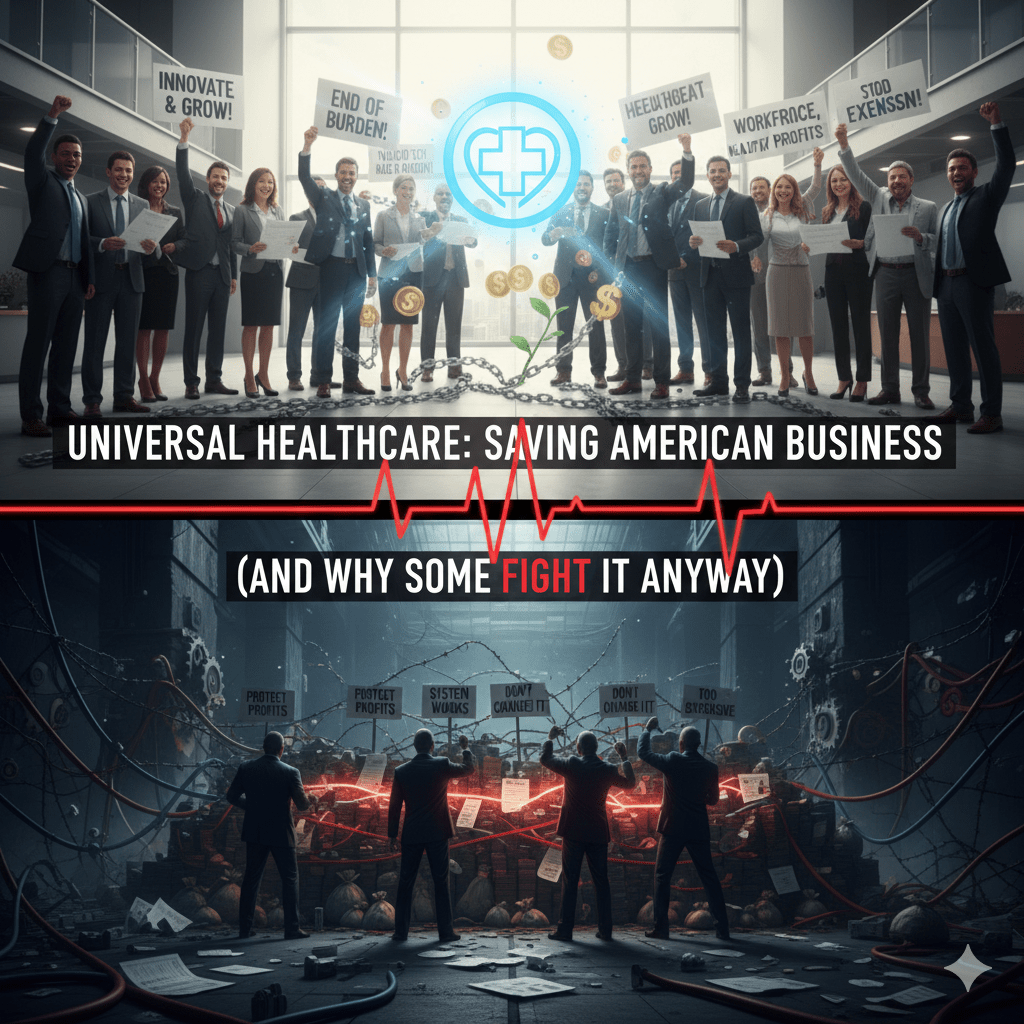
This is Part 6B in our series on healthcare reform. Part 6: Healthcare Solutions covered the big picture. Now let’s talk about why universal healthcare is the most pro-business policy we could implement – and why some large corporations oppose it anyway.
The Current System Costs American Business $1+ Trillion Annually
Let’s start with a simple truth that every business owner knows:
The current healthcare system costs American businesses over $1 trillion dollars annually in direct costs, administrative burden, and lost productivity.
This hurts small businesses most, but it also costs large corporations enormous amounts they could be investing in growth, innovation, wages, or shareholder returns.
So why don’t all businesses support universal healthcare?
Because some large corporations benefit from a different advantage: employer-based healthcare gives them power over workers and prevents small business competition.
They’d rather pay billions extra for healthcare if it means maintaining market dominance.
Let’s look at the numbers for both small and large businesses.
What Healthcare Costs Small Businesses Right Now
Direct Costs: The Bleeding Edge
For a small business with 10 employees (2024 numbers):
Insurance premiums:
- Average cost per employee (family coverage): $21,000/year
- Employer typically pays 70%: $14,700 per employee
- For 10 employees: $147,000/year
Administrative burden:
- HR time managing enrollment, changes, COBRA: 40-60 hours/year × $50/hour = $2,000-3,000
- Broker fees: $1,500-3,000/year
- Payroll system costs for benefits administration: $500-1,000/year
- Compliance costs (ACA reporting, COBRA, HIPAA): $1,000-2,000/year
- Total administrative burden: $5,000-8,000/year
Hidden costs:
- Employee turnover when workers leave for better benefits: $30,000-50,000 per replacement (recruiting, training, lost productivity)
- Reduced productivity from employees delaying care due to high deductibles: Unquantifiable but real
- Owner time spent on benefits = time not spent growing business
Grand total for 10-employee business: $152,000-160,000/year
That’s $15,200-16,000 per employee in healthcare costs.
The Small Business Death Spiral
Scenario 1: Startup Can’t Launch
You want to start a business:
- You have a great idea and customers ready
- You need 5 employees to operate
- Salary costs: $250,000/year (5 × $50,000 average)
- Healthcare costs: $75,000/year (5 × $15,000 employer share)
- Healthcare is 30% of your total labor cost
Question: Can you start a business where healthcare alone costs $75,000 before you have any revenue?
Many entrepreneurs answer: No.
Result: Business never forms. Five jobs never created. Economy grows slower.
Scenario 2: Can’t Grow
Your small business has 8 employees:
- Current healthcare cost: $120,000/year
- You want to hire 2 more employees to expand
- New employees cost: $100,000 salary + $30,000 healthcare = $130,000
- Expected additional revenue: $150,000
- Net benefit: $20,000
But:
- Healthcare costs increase 5-8% annually (unpredictable)
- One employee has expensive medical claim, premiums jump 15% next year
- Suddenly you’re losing money on expansion
Result: Don’t hire. Stay small. Economy grows slower.
What Healthcare Costs Large Businesses Right Now
Direct Costs: Death By A Thousand Cuts (Times 100,000 Employees)
For a corporation with 10,000 employees (2024 numbers):
Insurance premiums:
- Large corporations negotiate better rates due to size: ~$18,000/employee (vs. $21,000 for small)
- Employer pays 70-75%: $13,500 per employee
- For 10,000 employees: $135 million/year
Administrative costs:
- Full benefits department: 20-30 staff @ $80,000 average = $1.6-2.4 million/year
- Benefits technology platforms: $500,000-1 million/year
- Consultants and audits: $200,000-500,000/year
- Compliance and legal: $500,000-1 million/year
- Total administrative burden: $3-5 million/year
Additional costs:
- COBRA administration (former employees): $500,000-1 million/year
- Wellness programs (trying to reduce costs): $1-2 million/year
- Employee assistance programs: $500,000/year
- Total additional: $2-3.5 million/year
Grand total for 10,000-employee corporation: $140-143 million/year
That’s $14,000-14,300 per employee.
Why Large Corporations Pay Less Per Employee
Large corp advantages:
- Negotiating leverage – Insurers want their business, offer 15-20% better rates
- Self-insurance option – Can absorb risk, avoid insurance company profit margins (saves another 10-15%)
- Economies of scale – One benefits manager per 500 employees vs. small business owner doing it between customer calls
- Access to better networks – Can negotiate directly with hospital systems for better rates
But even with these advantages, they’re still spending $140+ million annually on healthcare.
That’s money that could go to:
- R&D and innovation: $140 million/year
- Employee wages: $14,000 raise per employee
- Capital investment: New facilities, equipment, technology
- Shareholder returns: $140 million in dividends
- Debt reduction: Pay down corporate debt
- Market expansion: Enter new markets, acquire competitors
How Large Corporations Use Healthcare As A Weapon
Here’s why some large corporations actually like the current system despite the cost:
Advantage #1: Traps Workers
The mechanism:
- Offer comprehensive healthcare ($18,000 value per employee)
- Workers become dependent on coverage (especially with chronic conditions, kids with special needs)
- Workers can’t leave without risking family healthcare
- Result: Lower turnover, don’t have to compete on wages
The math:
- Turnover reduction: 5-10% lower than small businesses
- Average cost to replace worker: $50,000 (recruiting, training, lost productivity)
- For 10,000 employee company: 500 fewer replacements/year
- Savings from reduced turnover: $25 million/year
Is $25 million in turnover reduction worth spending $140 million on healthcare?
No. But it’s worth it if it also:
- Suppresses wages (workers can’t negotiate because trapped)
- Prevents competition (small businesses can’t match benefits)
- Maintains market dominance
Advantage #2: Prevents Competition
Small businesses can’t compete:
- Small business pays $15,000+ per employee for worse coverage
- Large corp pays $13,500 per employee for better coverage
- Small business loses talent to large corps
- Small businesses stay small or fail
- Large corps maintain market share without actual innovation
Example:
- Tech worker at small startup: $80,000 salary + $5,000 high-deductible insurance
- Same tech worker at Microsoft: $80,000 salary + $13,500 comprehensive insurance
- Total compensation difference: $8,500/year in Microsoft’s favor
- Microsoft doesn’t have to pay higher wages to compete
Advantage #3: Wage Suppression
The tactic:
- Annual review: “We’d love to give you a $5,000 raise”
- “But healthcare costs went up $3,000 per employee”
- “So we’re going to give you $2,000 and call it even”
- Worker accepts because can’t leave (healthcare trap)
Alternative universe without employer-based insurance:
- “Healthcare costs went up” is meaningless (not tied to employment)
- Worker demands full $5,000 raise or threatens to leave
- Worker can actually leave (not trapped by healthcare)
- Employer has to pay market wages
What Universal Healthcare Would Mean For Small Business
Let’s use a 7.5% payroll tax model (similar to many universal healthcare proposals):
Small Business (10 employees): The Transformation
Current system:
- Healthcare cost: $152,000/year
- Administrative burden: Massive (owner does it)
- Unpredictable (costs rise 5-8% annually)
Universal healthcare:
- Payroll: $500,000/year (10 employees × $50,000 average)
- Healthcare payroll tax: 7.5% = $37,500/year
- Administrative burden: Zero (no enrollment, no COBRA, no compliance, no broker)
Net savings: $114,500/year
What that means:
- Can hire 2 more employees with the savings ($114,500 = 2 × $50,000 salaries + $14,500 taxes)
- Or invest in growth, equipment, marketing
- Or actually pay yourself a living wage as owner
- Can compete with large corporations on talent (no insurance disadvantage)
Startup Success Rate: Transformation
Current system:
- Need $75,000 for healthcare to hire 5 employees
- Many startups never launch
Universal healthcare:
- Need $18,750 for healthcare payroll tax (7.5% of $250,000 payroll)
- $56,250 more capital available for actual business
Result:
- More businesses start
- More jobs created
- More innovation
- Faster economic growth
What Universal Healthcare Would Mean For Large Business
Large Corporation (10,000 employees): The Math
Current system:
- Healthcare cost: $140-143 million/year
- Administrative burden: $3-5 million/year (benefits department)
- Total: $143-148 million/year
Universal healthcare:
- Average salary: $70,000/employee (includes all levels)
- Total payroll: $700 million/year
- Healthcare payroll tax: 7.5% = $52.5 million/year
- Administrative burden: Zero (no benefits department needed)
Net savings: $90-95 million/year
What that means for a 10,000-employee corporation:
- $9,000-9,500 savings per employee
- Can invest $90 million in R&D, expansion, wages
- Or return to shareholders as dividends
- Can close entire benefits department, reallocate staff
- Predictable costs (no surprise premium increases)
But They Lose Control
Here’s why some large corporations oppose it anyway:
What they lose:
- Worker trap – Employees can leave anytime (not dependent on company healthcare)
- Wage suppression tool – Can’t substitute benefit increases for wage increases
- Competitive advantage – Small businesses can now compete for talent
- Market dominance protection – Easier for startups to form and scale
What they gain:
- $90+ million in direct savings
- No administrative burden
- Predictable costs
- Healthier, more productive workforce
- Can focus on actual business instead of managing healthcare
The question: Is maintaining control over workers worth forfeiting $90 million in savings?
For some corporations: Yes, because market dominance is worth more than $90 million For most corporations: No, they’d rather have the money
This is why you see split opinion among large businesses on universal healthcare.
The Productivity Gains (All Businesses Benefit)
Beyond direct cost savings, universal healthcare improves productivity:
Healthier Workforce
Current system:
- 44% of Americans skip medical care due to cost
- Chronic conditions go untreated
- Preventable diseases become expensive emergencies
- Workers perform below capacity due to untreated health issues
Universal healthcare:
- Everyone gets preventive care
- Chronic conditions managed early
- Fewer emergency situations
- Healthier workforce = more productive workforce
Estimated productivity gain:
- 5-10% improvement in worker productivity
- For 10,000 employee corp at $70,000 average salary: $35-70 million/year additional output
Reduced Absenteeism
Current system:
- Workers delay care until crisis point
- More sick days, more emergency absences
- Average: 4-5 sick days per employee per year
Universal healthcare:
- Preventive care reduces illness
- Early treatment prevents emergencies
- Average: 2-3 sick days per employee per year
Result:
- 2 fewer sick days per employee = 20,000 additional work days for 10,000 employees
- Value: ~$40-50 million in recovered productivity
Employee Satisfaction and Retention
Current system:
- Healthcare stress is top workplace complaint
- Workers stay in jobs they hate due to insurance
- Resentment = lower productivity
Universal healthcare:
- Healthcare stress eliminated
- Workers stay because they want to, not because they’re trapped
- Higher satisfaction = higher productivity
Estimated impact:
- 10-15% improvement in employee satisfaction scores
- Reduced turnover (even without trap) = higher retention of institutional knowledge
The Macroeconomic Benefits (All Businesses Win)
More Business Formation
Current system:
- Healthcare costs prevent ~25% of potential entrepreneurs from starting businesses
- Lost: Hundreds of thousands of potential businesses per year
Universal healthcare:
- Remove healthcare barrier
- 25% increase in business formation = 500,000+ new businesses annually
- Those businesses create jobs, drive innovation, increase competition
Result: Healthier economy benefits all businesses (more customers, more suppliers, more innovation)
More Job Mobility
Current system:
- Workers trapped in jobs, can’t move to better opportunities
- Companies keep mediocre employees (can’t replace without offering insurance)
- Talent allocation is inefficient
Universal healthcare:
- Workers move to jobs that best match skills
- Companies can hire best talent without insurance barrier
- More efficient talent allocation = higher productivity economy-wide
Result: Better talent matching = higher productivity = more economic growth
Simplified Payroll and Compliance
Current system:
- Every business manages healthcare benefits
- Massive duplicated effort
- Compliance burden (ACA, COBRA, HIPAA, ERISA)
- Mistakes = penalties
Universal healthcare:
- Single payroll tax (like Social Security)
- Zero compliance burden beyond basic payroll
- No mistakes possible (no forms, no enrollment)
Result: Billions of hours freed up for productive work instead of benefits administration
International Comparison: US vs. Universal Healthcare Countries
Let’s see how US businesses compete against businesses in universal healthcare countries:
Germany (Universal Healthcare Since 1883)
German business healthcare costs:
- 7.3% employer payroll tax
- 7.3% employee contribution
- Total: 14.6% of wages
- Average wage: $55,000
- Total cost: $8,030 per employee per year
US business healthcare costs:
- Small business: $15,000+ per employee
- Large business: $13,500-14,000 per employee
German business advantage: $5,000-7,000 per employee
Result:
- German businesses more competitive internationally
- Can invest more in R&D, wages, expansion
- US businesses at disadvantage
Switzerland (Universal Since 1996)
Swiss business healthcare costs:
- Individual mandate (employees buy insurance themselves)
- Employer contribution: Optional, typically 50% of premium
- Average employer contribution: $4,000/year
US business healthcare costs:
- Small business: $15,000 per employee
- Large business: $13,500-14,000 per employee
Swiss business advantage: $9,000-11,000 per employee
Japan (Universal Since 1961)
Japanese business healthcare costs:
- 4.985% employer contribution
- 4.985% employee contribution
- Average wage: $38,000
- Employer cost: $1,894 per employee per year
US business healthcare costs:
- Small business: $15,000 per employee
- Large business: $13,500-14,000 per employee
Japanese business advantage: $11,600-13,100 per employee
And Japan has:
- Life expectancy: 84.5 years (US: 76.4)
- Infant mortality: 1.8 per 1,000 (US: 5.6)
- Zero medical bankruptcies
The Real Numbers: What Businesses Would Pay Under Universal Healthcare
Let’s be specific about different universal healthcare models and what businesses would actually pay:
Model 1: Medicare For All (7.5% Payroll Tax)
Small business (10 employees, $50,000 average wage):
- Current cost: $152,000/year
- Universal cost: $37,500/year (7.5% of $500,000 payroll)
- Savings: $114,500/year (75% reduction)
Medium business (100 employees, $60,000 average wage):
- Current cost: $1,500,000/year
- Universal cost: $450,000/year (7.5% of $6 million payroll)
- Savings: $1,050,000/year (70% reduction)
Large corporation (10,000 employees, $70,000 average wage):
- Current cost: $143 million/year
- Universal cost: $52.5 million/year (7.5% of $700 million payroll)
- Savings: $90.5 million/year (63% reduction)
Model 2: Public Option (Pay Into System Like Current Insurance)
How it works:
- Government offers Medicare-like plan
- Businesses buy into it like current insurance
- But: 2% administrative overhead (vs. 17% private)
- And: Negotiating power drives down costs
Small business (10 employees):
- Current cost: $21,000 per employee = $210,000 total (family coverage)
- Public option cost: ~$12,000 per employee = $120,000 total
- Savings: $90,000/year (43% reduction)
Large corporation (10,000 employees):
- Current cost: $18,000 per employee = $180 million total
- Public option cost: ~$12,000 per employee = $120 million total
- Savings: $60 million/year (33% reduction)
Model 3: Regulated Universal (Swiss/Netherlands Model)
How it works:
- Private insurance, heavily regulated
- Mandatory coverage (individual mandate)
- Employers optionally contribute 50% of premium
- Income-based subsidies (not employment-based)
Business impact:
- Can choose to contribute or not
- If contribute: ~$4,000-6,000 per employee (50% of premium)
- If don’t contribute: $0 (employees buy own insurance with subsidies)
- No administrative burden (employees manage own insurance)
Most businesses would contribute some amount to attract talent, but:
- Costs are predictable
- No administrative burden
- No compliance requirements
- Can adjust contribution based on profitability
The Opposition: Who Fights Universal Healthcare and Why
Large Corporations That Oppose It
Who:
- Companies with low-skill, high-turnover workforces (retail, food service, hospitality)
- Companies that rely on trapping workers (Amazon warehouses, Walmart)
- Companies facing intense competition from smaller players
Why:
- Lose worker control (can’t trap people with healthcare)
- Lose competitive advantage (small businesses can compete)
- Would rather maintain dominance than save money
Examples:
- Retail giants that offer minimal benefits but can absorb costs
- Corporations that actively lobby against single-payer despite potential savings
Large Corporations That Support It
Who:
- Companies in competitive industries (tech, manufacturing)
- Companies with high-skill workforces (where healthcare trap doesn’t work anyway)
- Companies competing internationally (healthcare costs hurt competitiveness)
Why:
- Save enormous amounts of money ($50-100 million+ annually)
- Eliminate administrative burden
- Level playing field internationally
- Focus on actual business instead of benefits management
Examples:
- Tech companies (Microsoft, Google have supported reform)
- Auto manufacturers (GM, Ford have supported reform – competing with foreign automakers that don’t pay healthcare)
- Small business associations (universally support reform)
Small Business: Universal Support
Every major small business organization supports universal healthcare:
- National Federation of Independent Business (NFIB): Supports reform
- Small Business Majority: Strongly supports universal coverage
- Main Street Alliance: Advocates for Medicare For All
- Chamber of Commerce small business surveys: 70%+ support universal coverage
Why unanimous support?
- Healthcare costs are crushing small businesses
- Can’t compete with large corporations on benefits
- Administrative burden falls on owners
- Unpredictable costs prevent growth
- Universal healthcare fixes all of this
The Bottom Line For Business
Let’s summarize with clear numbers:
Small Businesses (Under 50 Employees)
Current system:
- Pay $15,000-21,000 per employee
- Massive administrative burden
- Unpredictable costs
- Can’t compete with large corps
- Many don’t offer insurance at all (penalty: $2,000+ per employee)
Universal healthcare:
- Pay 7.5% payroll tax (~$3,750-5,250 per employee for $50,000-70,000 salaries)
- Zero administrative burden
- Predictable costs
- Level playing field
- Savings: 70-80% reduction in costs
Result: More small businesses start, existing ones grow faster, more jobs created
Large Corporations (1,000+ Employees)
Current system:
- Pay $13,500-18,000 per employee
- $3-5 million administrative costs
- Unpredictable annual increases
- Use as worker control tool
Universal healthcare:
- Pay 7.5% payroll tax (~$5,250-7,500 per employee for $70,000-100,000 salaries)
- Zero administrative burden
- Predictable costs
- Lose worker control (some see this as a feature, some as bug)
- Savings: 50-60% reduction in costs
Result: More money for investment, wages, dividends, expansion
The Economy Overall
Current system:
- $1+ trillion spent on business healthcare
- Massive duplicated administrative effort
- Healthcare costs suppress wages
- Healthcare prevents business formation
- US businesses less competitive internationally
Universal healthcare:
- ~$300-400 billion spent on business healthcare (payroll tax)
- $600-700 billion savings redirected to productive investment
- Wages rise (no healthcare cost excuse)
- Business formation increases 25%+
- US businesses more competitive internationally
What This Means For You As A Business Owner
If you’re a small business owner:
Universal healthcare is the single best policy for your business.
- Cut costs 70-80%
- Eliminate administrative headache
- Compete with large corporations
- Grow without healthcare barrier
- Attract talent without insurance disadvantage
Support it loudly. This helps you.
If you’re a large corporation executive:
Universal healthcare saves your company $50-100+ million annually.
- Redirect to R&D, wages, dividends
- Eliminate benefits department
- Predictable costs
- Healthier, more productive workforce
The only reason to oppose it: You value worker control and preventing competition more than $100 million in savings.
Ask yourself: Is that really the business you want to be?
If you’re a worker:
Universal healthcare helps your employer AND helps you.
- Your employer saves money (could mean higher wages)
- You’re not trapped (can leave for better opportunities)
- Your healthcare doesn’t change if you lose job
- Small businesses become viable alternative employers
This is a win-win-win scenario.
Next Time
We’ve completed the healthcare arc. Every angle covered:
- The problem (rankings, costs, outcomes)
- The extraction (who profits)
- The trap (worker control)
- The solutions (what works)
- The business case (saves money for all)
Now let’s move to the next system rigged against regular people:
Housing: How Zoning, NIMBYism, and Investment Firms Made Homeownership Impossible
Part 7: The Housing Crisis
If you’re a business owner and this showed you how much universal healthcare would save your business, share it.
The healthcare industry spends $1+ billion lobbying against reform. Small businesses need to be just as loud supporting it.
Because this isn’t left vs. right. This is good business vs. bad business.
Sources
- Employer healthcare costs: Kaiser Family Foundation 2024 Employer Health Benefits Survey
- Small business formation data: Kauffman Foundation Entrepreneurship reports
- International business healthcare costs: OECD Health Statistics, country-specific business organization reports
- Administrative cost data: Harvard Medical School, Annals of Internal Medicine
- Productivity studies: Bureau of Labor Statistics, academic studies on healthcare access and productivity
- Corporate healthcare spending: Company 10-K filings for publicly traded corporations
- Small business organization positions: NFIB, Small Business Majority, Main Street Alliance policy statements
- Job mobility studies: NBER working papers on job lock
 Even that's Odd
Leave a comment