
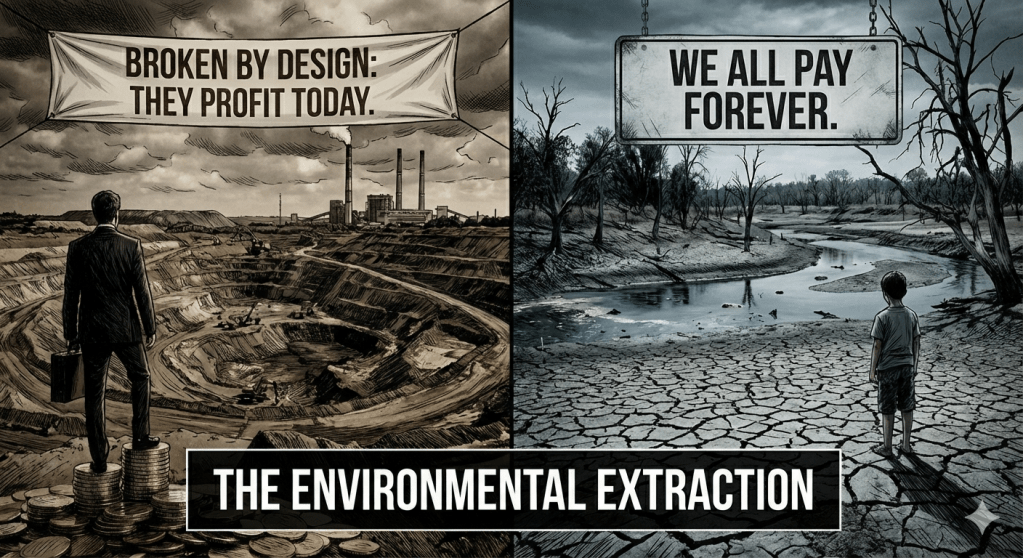
How Systems Are Rigged Against the Bottom 90%
In 1977, Exxon’s own scientists warned executives that burning fossil fuels would cause catastrophic climate change. The company had some of the best climate research in the world. They knew. In 1988, they stopped their climate research program and started funding climate denial instead. Not because the science changed—because the profits were at stake.
This is extraction at civilizational scale.
THEY KNEW
James Black stood before Exxon executives in 1977 and delivered news that should have changed everything. Black was one of Exxon’s senior scientists, and his presentation was clear: carbon dioxide from burning fossil fuels was accumulating in the atmosphere and would cause global warming with “dramatic environmental effects.”
This wasn’t speculation. Exxon launched one of the most sophisticated climate research programs in the world. Between 1977 and 1985, the company spent millions studying climate change. Their scientists published peer-reviewed papers. They equipped a company supertanker with CO2 monitoring equipment to measure ocean absorption. Their research was cutting-edge.
And it confirmed what Black had warned: they were causing catastrophic climate change.
In 1982, an internal Exxon memo projected that atmospheric CO2 would double by 2060, causing global temperatures to rise by 3°C and sea levels to rise significantly. The memo warned of “globally catastrophic effects” including the flooding of major cities.
They knew. In detail. Decades ago.
Shell’s internal documents from the 1980s warned of exactly the same impacts. A 1988 Shell report titled “The Greenhouse Effect” predicted that climate change could cause “destructive floods, hurricanes, and droughts” and that sea-level rise could make “some areas uninhabitable.” The report was marked “confidential” and distributed only to senior executives.
Chevron knew. The American Petroleum Institute—the oil industry’s largest trade group—produced a report in 1980 warning that continued fossil fuel use would cause temperature increases “bringing widespread economic and social disruption.” The coal industry sent a report to President Lyndon Johnson in 1966 warning of climate change from fossil fuel combustion.
The pattern is clear: the fossil fuel industry had the best climate science in the world. Their own scientists—the people they trusted enough to hire and fund—told them exactly what would happen. The companies had a choice: change course or maximize profits while they could.
On June 23, 1988, NASA scientist James Hansen testified before Congress about climate change, bringing the issue into public consciousness. Major media outlets covered it. The threat was becoming public knowledge.
That same year, Exxon disbanded its climate research program.
Not because the science was uncertain. Because it was too certain. Because their own research confirmed they were causing civilizational-level harm. Because continued research would create a paper trail. Because the smart business move was to stop learning and start denying.
In 1989, just one year after killing their climate research, Exxon helped found the Global Climate Coalition—an organization dedicated to questioning climate science and fighting regulations. The transition was complete: from funding research to funding denial.
This wasn’t ignorance. This was strategy.
THE COORDINATED DENIAL CAMPAIGN
The tobacco industry faced a problem in the 1950s: their own research proved that cigarettes caused cancer. They could have warned consumers, changed formulations, or pivoted their business. Instead, they launched what became known as the “doubt playbook.”
An internal tobacco industry memo laid out the strategy: “Doubt is our product since it is the best means of competing with the ‘body of fact’ that exists in the mind of the general public.”
They didn’t need to disprove that cigarettes caused cancer. They just needed to create the appearance of scientific debate. Fund some scientists to question the research. Publish “alternative” studies. Get media coverage showing “both sides.” Delay regulation for decades while the bodies piled up and the profits rolled in.
The fossil fuel industry didn’t just study this playbook. They hired the same people and used the exact same strategy.
Between 1998 and 2006, ExxonMobil gave $676,500 to the Heartland Institute, a think tank that became a leading voice questioning climate science. The Competitive Enterprise Institute received over $2 million from Exxon during the same period. The American Enterprise Institute, the Cato Institute, and the Heritage Foundation all received fossil fuel industry funding.
What did these think tanks do with the money?
They published “research” questioning climate science. They provided “expert” witnesses to testify against climate legislation. They produced op-eds for major newspapers casting doubt on the scientific consensus. They trained spokespeople in how to question climate science without appearing to deny it outright. They coordinated messaging across multiple organizations to create the appearance of widespread scientific debate.
Let’s be specific about the people involved:
Willie Soon, a physicist at the Harvard-Smithsonian Center for Astrophysics, received at least $1.2 million from fossil fuel interests between 2005 and 2015. He published papers questioning climate science and was frequently cited by climate skeptics as evidence of scientific debate. He did not disclose his fossil fuel funding in his papers.
Fred Singer, another physicist frequently cited as a climate expert, received funding from Exxon, the Heartland Institute, and other fossil fuel-backed organizations. His think tank, the Science and Environmental Policy Project, consistently questioned climate science.
Patrick Michaels, a climatologist, disclosed in a 2010 CNN interview that 40% of his funding came from the fossil fuel industry. He was a frequent media presence arguing against climate action.
These weren’t fringe cranks operating alone. This was a coordinated infrastructure funded by the world’s most profitable corporations.
The Global Climate Coalition, active from 1989 to 2001, coordinated the industry’s response to climate science. Its members included ExxonMobil, Chevron, Shell, Ford, General Motors, and dozens of other major corporations. The organization spent millions lobbying against climate regulations and funding research to question climate science.
In 1995, an internal memo from the Global Climate Coalition acknowledged that “the scientific basis for the Greenhouse Effect and the potential impact of human emissions of greenhouse gases such as CO2 on climate is well established and cannot be denied.” The organization disbanded in 2001 after this memo leaked. Not because the science had changed—because they got caught admitting they knew the science was solid while publicly denying it.
In 1998, the American Petroleum Institute circulated a “Global Climate Science Communications Plan” that explicitly outlined a strategy to undermine public certainty about climate science. The memo stated: “Victory will be achieved when average citizens ‘understand’ (recognize) uncertainties in climate science” and when “recognition of uncertainties becomes part of the ‘conventional wisdom.’”
This is documented. Tax returns showing who funded which organizations. Court cases where internal documents were subpoenaed. Investigative journalism comparing public statements to internal communications. Congressional testimony under oath.
They knew the science was solid. They funded campaigns to make the public think it wasn’t. And it worked for decades.
THE REGULATORY CAPTURE
Scott Pruitt was the Attorney General of Oklahoma when he sued the EPA fourteen times on behalf of oil and gas companies. His office had an email address specifically for oil industry lobbyists to send him draft letters, which he would then send to federal regulators on official state letterhead as if they were his own words.
In one case, a lawyer for Devon Energy wrote a three-page letter criticizing EPA air quality regulations. Pruitt’s office sent it to the EPA nearly word-for-word on the Attorney General’s letterhead. When this was exposed through open records requests, it revealed a systematic pattern: the Oklahoma AG’s office was essentially an extension of the oil industry’s legal department.
In 2017, Donald Trump appointed Scott Pruitt to run the EPA.
The man who had sued the EPA on behalf of oil companies was now in charge of the EPA. He immediately began rolling back emissions standards, withdrawing the United States from the Paris Climate Agreement, weakening mercury and air toxics standards, and reducing methane regulations. He lasted eighteen months before ethics scandals forced him out, but the damage was done.
This wasn’t incompetence. This was the system working exactly as designed.
Philip Cooney worked as a lobbyist for the American Petroleum Institute before being appointed Chief of Staff for the White House Council on Environmental Quality under George W. Bush. In that position, he edited government climate science reports to downplay the risks and emphasize uncertainty. When his edits were exposed in 2005, he resigned.
He was immediately hired by ExxonMobil.
The pattern across administrations is identical: industry insiders appointed to regulatory positions, regulations weakened or eliminated, climate science reports edited or suppressed, public health sacrificed for industry profits.
And while regulatory capture happens, the same companies receiving favorable treatment also receive direct taxpayer subsidies. The fossil fuel industry gets approximately $20 billion per year in federal subsidies—tax breaks, royalty relief, and research funding. These are companies posting record profits in the tens of billions, and they’re getting taxpayer handouts.
State-level regulatory capture is even more blatant. Louisiana has an 85-mile stretch between Baton Rouge and New Orleans with over 150 petrochemical plants. It’s known as “Cancer Alley.” The population is approximately 90% Black. Cancer rates in some areas are 50 times the national average. Life expectancy is 20 years lower than the Louisiana state average.
The state government prioritizes industry permits over resident health. Companies knew the health impacts—that’s why they sited the plants in predominantly Black communities where land was cheaper and political resistance was weaker. State regulators approved the permits anyway.
This is regulatory capture combined with environmental racism. It’s also proof that these companies know their operations cause harm—if petrochemical plants were safe, they wouldn’t concentrate them in Black communities. The siting pattern itself is an admission of knowledge.
THE POLITICAL CAPTURE – BOTH PARTIES
During the 2020 election cycle, the oil and gas industry donated $139 million to political candidates. Republicans received $84 million. Democrats received $55 million.
Both parties took the money.
The top recipients in 2020 included Dan Sullivan (R-Alaska) at $771,000, Steve Daines (R-Montana) at $740,000, Cory Gardner (R-Colorado) at $723,000, and John Cornyn (R-Texas) at $627,000. But Democratic senators and representatives also received millions in fossil fuel donations.
Watch what passes with bipartisan support: fossil fuel subsidies get renewed every year. Pipeline approvals go through. Drilling permits on federal lands get approved. Regulatory rollbacks pass or aren’t challenged.
Watch what fails: carbon taxes are blocked. The Green New Deal goes nowhere. Aggressive climate legislation gets watered down or killed entirely.
The bipartisan consensus is clear: keep the fossil fuel industry profitable.
Republicans deny climate change openly. They block climate legislation explicitly. They serve industry without pretense.
Democrats acknowledge climate change. They talk about climate action. They take fossil fuel money. They approve drilling permits. They water down climate legislation. They serve industry quietly.
President Obama talked about climate change, then approved the Keystone XL pipeline initially and expanded offshore drilling. President Biden ran on a promise of “no more drilling on federal lands,” then approved the Willow Project—a major oil drilling operation in Alaska. In his first two years, Biden approved more drilling permits on federal lands than Trump did in his first two years.
Why? Political pressure. Industry lobbying. Campaign donations. Both parties dependent on fossil fuel money.
The voting record is clear: when fossil fuel profits are at stake, both parties protect them. When climate action threatens those profits, both parties ensure it doesn’t happen.
This isn’t a failure of politics. This is politics working exactly as money intended.
THE EXTERNALIZED COSTS – YOU PAY
Hurricane Ian hit Florida in 2022. Damage: $113 billion. Hurricane Ida hit Louisiana in 2021. Damage: $75 billion. Hurricane Harvey hit Texas in 2017. Damage: $125 billion. Hurricane Maria devastated Puerto Rico in 2017. Damage: $90 billion. Hurricane Irma hit Florida in 2017. Damage: $50 billion.
In just five years, five hurricanes caused $453 billion in damage.
Climate change doesn’t create hurricanes, but it makes them worse. Warmer ocean temperatures provide more energy. Higher sea levels mean worse storm surge. More atmospheric moisture means heavier rainfall. The fossil fuel industry’s products are directly intensifying these disasters.
Who pays for the damage?
FEMA—funded by taxpayers—has spent over $60 billion on disaster relief since 2017. Insurance companies pay out billions, then raise premiums or withdraw from high-risk states entirely. Homeowners lose coverage or pay triple the previous rates. Local governments spend billions rebuilding infrastructure. Individuals lose homes, possessions, businesses, sometimes lives.
Who doesn’t pay? Fossil fuel companies. They caused the intensification of these disasters. They profit from continued extraction. They pay exactly zero dollars in disaster costs.
You pay. Through taxes funding FEMA. Through insurance premiums. Through destroyed property. Through rebuilding costs. Through lives disrupted or ended.
California’s wildfire costs follow the same pattern. The 2018 fires—including the Camp Fire and Woolsey Fire—caused $148.5 billion in damage. The 2020 fires cost $12.6 billion. The 2021 fires cost $3.1 billion. The trend is clear: fires are getting more frequent and more severe.
Climate change creates the conditions for mega-fires. Higher temperatures dry out vegetation. Extended droughts create fuel. Earlier snowmelt lengthens fire season. These aren’t natural disasters—they’re climate-amplified disasters.
CAL FIRE’s annual budget is $3.7 billion, paid by California taxpayers. Federal firefighting costs over $2 billion per year, paid by federal taxpayers. Pacific Gas & Electric declared bankruptcy from wildfire liability, then passed the costs to customers through higher rates. Homeowners watch their insurance premiums triple—if they can get insurance at all.
And now the insurance crisis is accelerating. In 2022, six insurance companies left Florida entirely. The remaining insurers raised premiums an average of 42%. The state-backed “insurer of last resort” is insolvent. Homeowners are being forced into inadequate coverage or going without insurance entirely.
In California, State Farm stopped writing new homeowner policies in 2023. Allstate did the same. Farmers Insurance pulled out of Florida. The insurers that remain are raising rates 30-50%.
What’s happening is simple: climate change is making disasters more frequent and severe. Insurance companies calculate risk. The risk is becoming uninsurable. They’re withdrawing from entire states.
If you own a home in Florida or California or any high-risk state, you’re watching your property value tank as insurance becomes unavailable. When the next disaster hits, you’ll either be uninsured or paying premiums that make homeownership unaffordable.
And when you can’t get private insurance, taxpayers bail out through disaster relief. The costs get socialized. The profits stay private.
But the externalized costs go far beyond disaster relief.
Air pollution from fossil fuel combustion kills approximately 350,000 Americans every year. The economic cost—medical expenses and lost productivity—is estimated at $820 billion annually. Who pays that? Individuals through medical bills. Taxpayers through Medicare and Medicaid. Employers through health insurance costs.
Who caused it? The fossil fuel industry. Who pays for it? Not the fossil fuel industry.
One in twelve children in America has asthma. The condition is directly linked to air pollution from traffic and power plants. Annual cost: $82 billion. The burden falls disproportionately on Black and Latino communities living near highways and industrial facilities.
Cancer clusters tell the same story. Cancer Alley in Louisiana has cancer rates 50 times the national average in some areas. Communities near fracking operations report water contamination and increased health problems. Neighborhoods near refineries show elevated rates of cancer and respiratory disease.
The cost appears as medical bills, lost productivity, destroyed communities, and shortened lives. The cause is industrial pollution. The companies responsible pay nothing.
Water contamination follows the same extraction model. Fracking contaminates groundwater with methane and chemicals. Some communities have flammable tap water—you can literally light it on fire. Coal ash ponds—containing arsenic, mercury, and lead—leak into groundwater at 1,400 sites across the country. PFAS “forever chemicals” used in industrial processes are now in the drinking water of over 200 million Americans.
The cleanup cost for PFAS contamination alone is estimated at over $1 trillion. Who pays? Taxpayers and individuals forced to buy bottled water or install filtration systems. Who caused it? Chemical manufacturers who knew PFAS didn’t break down in the environment and sold them anyway. Who profits? Those same manufacturers are still selling PFAS.
This is the extraction model perfected: privatize all profits, externalize all costs, capture the regulators, ensure no accountability.
THE SCALE OF EXTRACTION
In 2022, the top five fossil fuel companies posted record profits:
- ExxonMobil: $55.7 billion
- Chevron: $35.5 billion
- Shell: $39.9 billion
- BP: $27.7 billion
- ConocoPhillips: $18.7 billion
Total: $177 billion in profit. In one year. From five companies.
That same year, the United States experienced $165 billion in climate disaster costs. Eighteen separate billion-dollar disasters. Record FEMA spending. Record insurance losses.
The equation is perfect: they profit $177 billion, the public pays $165 billion in damages. They externalize the costs, privatize the profits, and the system ensures this continues.
But the yearly numbers don’t capture the full scale. ExxonMobil has generated over $2 trillion in profits since 1977—the year their scientists warned them about climate change. The global climate damage caused by fossil fuel emissions over that same period is estimated at over $5 trillion.
They kept $2 trillion. The world pays $5 trillion. This is intergenerational theft.
The global scale is even more staggering. Annual worldwide climate costs are approximately $650 billion. The fossil fuel industry’s annual global revenue is $4.5 trillion. They extract $4.5 trillion, the world pays $650 billion in damages, and the gap keeps growing.
Every year. Forever. Until we stop them.
ENVIRONMENTAL RACISM
If you want proof that fossil fuel and chemical companies know their operations cause harm, look at where they site their facilities.
Cancer Alley in Louisiana is an 85-mile stretch containing over 150 petrochemical plants. The population is approximately 90% Black. Cancer rates in some areas are 50 times the national average. Life expectancy is 20 years lower than the Louisiana state average.
Companies didn’t choose these locations randomly. Land was cheaper. Communities had less political power. Resistance would be weaker. Regulators would approve permits more readily.
If petrochemical plants were safe, companies wouldn’t concentrate them in Black communities. The siting pattern itself proves they know the harm they cause. They just ensure the harm falls on people with the least power to fight back.
Flint, Michigan—57% Black—experienced a water crisis that poisoned children with lead. The government prioritized cost savings over public health. Children suffered brain damage. The crisis went on for years before it was addressed nationally. A predominantly white community? This would never have been allowed to happen.
Southwest Detroit—50% Latino—has a Marathon Petroleum refinery in a residential neighborhood. Asthma rates are triple the state average. The refinery generates hundreds of millions in profit. The community pays with their health and lives.
The Houston Ship Channel hosts the largest petrochemical complex in the United States, surrounded by predominantly Black and Latino neighborhoods. Air quality is among the worst in the nation. Cancer rates are elevated. Industry response: nothing.
Academic research and the EPA’s own studies document this pattern: polluting facilities are disproportionately sited in communities of color. Companies deliberately place harm where political power is weakest. The mechanism is environmental racism. The proof is the pattern itself.
THE DISTRACTION – INDIVIDUAL RESPONSIBILITY
In the early 2000s, BP launched a major advertising campaign introducing the concept of the “carbon footprint.” They created an online calculator so you could measure your personal carbon footprint. The messaging was clear: “What’s YOUR carbon footprint?” Focus on your individual choices. Drive less. Recycle more. Make greener consumer decisions.
This was brilliant corporate strategy: shift responsibility from the corporations producing emissions to the individuals consuming their products.
The plastic industry did the same thing with recycling. They heavily promoted recycling programs and the recycling symbol while knowing that plastic recycling largely doesn’t work. Only about 9% of plastic ever produced has been recycled. The industry knew this. They promoted recycling anyway because it accomplished two goals: it made consumers feel good about using plastic, and it shifted responsibility for plastic waste from manufacturers to consumers.
While you carefully sort your recycling, the industry produces 400 million tons of new plastic every year.
The individual responsibility framing pervades climate discourse. “Go green!” Buy different products. “Reduce your carbon footprint!” Bike to work. “Recycle!” Sort your trash properly.
Meanwhile, just 100 companies are responsible for 71% of global emissions. The fossil fuel industry alone accounts for approximately 50% of emissions. Your individual choices are statistically irrelevant compared to systemic production.
What would actually matter: regulating those 100 companies. Ending fossil fuel subsidies. Carbon pricing. Transitioning to renewable energy. System change, not individual virtue.
But systemic change threatens profits. Individual responsibility messaging protects profits. So guess which one gets promoted?
What fossil fuel companies don’t want you focused on: their $20 billion in annual subsidies. Their $139 million in campaign donations. Their regulatory capture. Their decades of deliberate denial. Their record profits while the planet burns.
They want you focused on your personal carbon footprint. Not their corporate carbon profit.
INTERNATIONAL COMPARISON
The European Union has implemented carbon pricing. Renewable energy accounts for 38% of EU electricity as of 2022. Member nations have coal phaseout timelines. Emissions regulations are strict and enforced. Climate action is happening despite fossil fuel lobbying.
Costa Rica runs on 99% renewable electricity. They’ve implemented reforestation programs. They’re exceeding their climate goals. A small country proving that political will can overcome industry resistance.
Why can these countries act while the United States can’t?
Political systems matter. Parliamentary systems make it easier to pass climate legislation. Multi-party systems give Green parties actual influence. Many countries have public campaign financing or strict limits on corporate political spending. Regulators are more independent from industry.
The United States is different. Fossil fuel money flows to both parties. The Supreme Court’s Citizens United decision allows unlimited corporate political spending. Regulators move between industry and government positions. The two-party system means both parties must serve major donors to remain competitive.
The result: the United States has 4% of the world’s population but produces 15% of global emissions. The richest country in the world takes the least climate action. The nation most responsible for historical emissions is least willing to address them.
This isn’t because Americans don’t care. Polls consistently show 70% support for climate action. It’s because the political system is captured by the industry that profits from inaction.
THE BIPARTISAN BETRAYAL
Here’s what both parties agree on, even when they won’t say it explicitly:
Republicans deny climate change openly. They block all climate legislation. They approve every drilling permit. They took $84 million from the fossil fuel industry in 2020. They serve industry without pretense.
Democrats acknowledge climate change. They talk about climate action. They took $55 million from the fossil fuel industry in 2020. They approve drilling permits quietly—Biden approved more in his first two years than Trump did. They water down climate legislation. They serve industry while maintaining plausible deniability.
President Obama talked about climate, then approved Keystone XL initially and expanded offshore drilling. Industry pressure and donations shaped policy.
President Biden campaigned on “no more drilling on federal lands.” Then he approved the Willow Project in Alaska. Then he approved more drilling permits than Trump. Why? Industry pressure. Donations. Political calculation.
The pattern is bipartisan: both parties protect fossil fuel profits.
What passes with bipartisan support: fossil fuel subsidies, pipeline permits, drilling approvals, weak regulations.
What doesn’t pass: carbon taxes, aggressive emissions reductions, fossil fuel phaseouts, meaningful climate action.
Republicans block openly. Democrats block quietly. The result is identical: no threat to industry profits.
THE COST TO FUTURE GENERATIONS
We’re already experiencing 1.1°C of warming as of 2024. Even if all emissions stopped today, we’re committed to 1.5°C or more due to lag effects in the climate system. Sea level rise will continue for centuries. Extreme weather will intensify for decades. Ecosystem collapse is already underway. Hundreds of millions of climate refugees will be displaced.
In 1977, Exxon knew. In 2024, that’s 47 years of inaction. By 2050, catastrophic impacts are unavoidable. By 2100, we face a civilization-level crisis if we continue on the current trajectory.
Those 47 years represent what was stolen. We could have transitioned to renewable energy starting in 1977. We could have avoided the worst impacts. We could have protected future generations.
Instead, Exxon executives chose quarterly profits over human civilization. They made that choice for all of us. They privatized the profits for themselves and shareholders. They externalized the costs to everyone else. Forever.
Your children will ask questions. “You knew?” Yes. “And you did nothing?” They lied to us. “They made how much profit?” Hundreds of billions. “And nobody stopped them?” Both parties protected them.
The answers are inadequate. The crime is permanent. The extraction is complete.
WHY THIS IS THE ULTIMATE EXTRACTION
Compare climate extraction to the other systems we’ve documented:
Healthcare extraction: You pay double what other countries pay. Insurance companies profit from your illness. It’s terrible. But it’s contained to your lifetime. It can be fixed with policy changes. Medicare for All would end it.
Housing extraction: Private equity prices you out of homeownership. You pay rent forever. Your wealth goes to landlords. It’s terrible. But it’s reversible. Policy changes could restore affordable housing.
Education extraction: Student debt traps you for decades. It delays life milestones. It transfers your future earnings to loan servicers. It’s terrible. But the debt could be cancelled. Public education could be funded. It’s fixable.
Climate extraction is different.
You can’t opt out. Everyone is affected regardless of choices or location. You can’t pay it off. The consequences are permanent and compound over time. You can’t vote it away. Both parties are captured by the industry. You can’t escape. It’s global and affects every ecosystem.
Climate extraction affects everyone who will ever live.
Healthcare extraction hurts you financially. Climate extraction makes the planet less habitable for your children and every generation after.
Housing extraction keeps you poor. Climate extraction creates climate refugees by the hundreds of millions.
Education extraction limits your opportunities. Climate extraction collapses the systems that create opportunities.
This is extraction at civilizational scale. Irreversible. Permanent. Global. Intergenerational.
The business model is perfected:
- Know you’re causing harm (documented since 1977)
- Fund denial to prevent regulation (documented through leaked memos and tax returns)
- Capture regulators and politicians (documented through appointments and voting records)
- Maximize profits ($177 billion in one year from just five companies)
- Externalize all costs to the public ($165 billion in US disaster costs the same year)
- Ensure no accountability (both parties protect the industry)
- Repeat until the planet becomes uninhabitable
They got the profits. We get the bill. Forever.
THE EQUATION
ExxonMobil made $55.7 billion in profit in 2022. The United States spent $165 billion on climate disasters that same year. They knew this would happen in 1977. They chose profits over planet. Both parties protect them. You pay the costs. Your children will pay the costs. Their children will pay the costs.
This is extraction at civilizational scale.
And it continues because while we’re arguing about bathrooms and pronouns and whatever culture war distraction they’re feeding us this week, they’re drilling, profiting, and passing the bill to everyone who will ever live.
They extracted a livable climate from future generations. You can’t buy it back. You can’t vote it back with captured parties. It’s gone.
That’s not market failure. That’s not regulatory oversight. That’s not even corruption in the traditional sense.
That’s the system working exactly as designed—just not for you, not for your children, and not for the survival of human civilization.
They knew. They lied. They profited. Politicians protected them. Both parties took their money. You paid. Your children will pay. Everyone will pay.
The extraction is complete. The climate is changed. The future is compromised. And the companies responsible are posting record profits.
This is what extraction looks like when you run it all the way to its logical conclusion: corporate profit today, civilizational collapse tomorrow, and a political system so thoroughly captured that it can’t even respond to existential threats.
Welcome to the ultimate extraction. Population: everyone who will ever live.
 Even that's Odd
Leave a comment