
February in Portugal: When Life Gives You Rain and Residency Appointments
We had to go to Portugal in early February for an AIMA residency appointment (you don’t get to pick the date), so we figured we’d escape the sub-zero temperatures at home and make it a family trip. The kids would miss a week of school, but honestly, trading single-digit temps for Portuguese drizzle in the 50s seemed like a fair exchange.
The Short Version: We flew TAP Air Portugal from Newark, spent a night in Lisbon, drove to Porto to visit friends who’d moved there, explored both cities in persistent rain, ate approximately 847 pastéis de nata (I counted), visited Óbidos, Guimarães, and Viana do Castelo, nearly missed our AIMA appointment by being at the wrong office, and somehow managed to haul fragile ceramics from Ceramirupe all the way home. The kids discovered that Portuguese burgers are just like American burgers, Portuguese McDonald’s is just like American McDonald’s, and that their dad will stop at literally every pastel de nata shop he sees.
What Worked: The food is fantastic and fresh (they actually ban the junk we allow in US food), costs are reasonable (maybe where we were 10 years ago), walking everywhere burns off the pastry calories, and the fruit markets are incredible. Portugal takes food seriously.
What Didn’t: The weather was exactly as forecasted—rain and 50s every single day. Also, European parking requires a spatial relations gene Americans simply don’t have. And if you’re renting a car, just pay extra to get one at the terminal instead of dealing with off-site shuttle buses at 5 AM.
The Verdict: Despite the rain, grumpy moments, wrong AIMA offices, and spending half our time trying to keep the kids from eating nothing but burgers, it was absolutely worth it. Portugal is beautiful even when it’s wet, the people are friendly, and there’s something magical about medieval castle walls, centuries-old bookstores, and fresh orange juice squeezed while you wait. Plus, Jennifer got her residency permit approved, which was kind of the whole point.
Full detailed trip report below for those who want the play-by-play, all the practical tips, and to understand just how obsessed I became with pastél de nata.
A Rainy Family Week in Portugal: Lisbon, Porto, and Everything In Between
Or: How We Survived a Week of Portuguese Weather, AIMA Bureaucracy, and Our Kids’ Burger Addiction
We had to go to Portugal the first week of February for an AIMA residency appointment—and when I say “had to,” I mean you don’t get the luxury of scheduling these things. So we decided to make a family trip out of it, escape the sub-zero temperatures at home, and pull the kids (13 and 12) out of school for a week. Sure, they’d miss classes, but trading arctic temperatures for Portuguese drizzle seemed like a reasonable parenting decision.
Getting There: TAP Air Portugal and Newark’s Least Impressive Terminal
We flew TAP Air Portugal from Newark because it’s the easiest airport for us to reach—about the same distance as JFK, but JFK is such a nightmare that Newark wins by default. I hadn’t flown TAP in years, and it was… acceptable. The seats were a little tight (three across with a center aisle, so not a huge plane), and even with Economy Plus on the way there, we didn’t really notice much difference. The flight was only 5 hours though, which was nice, and the food service was decent. The seats had entertainment screens, though the selection on the outbound flight wasn’t as robust as the return.
Since we have an EV, we park in Newark’s Long Term Parking because they’ll charge your car while you’re away. They have a shuttle to the terminals, which is a little annoying, and you’re in a sketchy airport parking area, but it’s worth it for the convenience. Terminal B at Newark is not the best, and for TAP we got stuck in the worst part of the terminal. To make matters worse, we had to go through the security line that didn’t have TSA PreCheck—which we’d specifically gotten to make traveling with kids easier. Oh well.
That section of Terminal B is severely limited on food options, and like all airport food, everything costs about three times what it should. We usually try to eat something before we get on the plane or bring food just in case what they serve is inedible. That part of Terminal B really needs updating, but it’s where they stick the smaller foreign airlines like TAP and SAS (we fly out of the same terminal when we go to Sweden).
The flight left at about 6 PM—and seriously, why don’t we use the 24-hour clock and the metric system like the rest of the civilized world?—and we landed a little early around 5 AM local time.
Arrival in Lisbon: The Off-Site Car Rental Experience
I’d booked a car through the TAP app when I purchased the tickets with Klass Wagon, because they claimed to be at the terminal. Spoiler: they were not. They had to send a shuttle bus for us, and the car rental place was in the same kind of sketchy area where we park at Newark. We waited maybe 45 minutes for the shuttle to show up, and the rental process itself was a bit odd, but it all worked out. The car was fine and met our needs.
However, I will be booking a car right at the terminal next time. I’m not convinced the off-site rental saves you that much money, and it only makes sense if you’re flying during regular hours—which our flights apparently won’t be. Lesson learned.
It was warm for us when we landed, even though it was only in the upper 40s. (Again, why no Celsius?) Coming from arctic temperatures at home, upper 40s felt like summer. We’d checked the weather before leaving—just to see what to expect and pack properly—and it said rain and 50s every single day. That’s pretty much exactly what we got, especially that first day.
Day 1: Lisbon on Zero Sleep
Our plan was to visit friends in Porto (about a 2-3 hour drive), but I didn’t want to tackle that drive on zero sleep. I tend to struggle sleeping on planes, so we’d booked one night at Casa do Jasmim by Shiadu in Lisbon.
Arriving around 6 AM is always a challenge at smaller hotels. We’d really should have booked a room for the night before so we could at least shower and dump our bags, but we were trying to save money—because life is expensive anyway—so we didn’t. The room wasn’t going to be ready until 3 PM, so we left our bags at the hotel and went to find parking.
This was Sunday, and I think street parking is free, but they failed to mention that. Instead, they directed us to a public lot. I later downloaded an app that worked for street parking when we returned to Lisbon for the AIMA appointment. The lot they suggested was tight—in typical European fashion, there were about two inches to spare on either side of the vehicle. People in Europe are born with a superior gene for spatial relations and driving in tight quarters. It’s truly impressive. The lot was just the facade of a building with the rest being an open parking area.
Jennifer and Henry decided to nap in the car, but I was too restless. Elias and I went exploring to find coffee and breakfast.
The Great Pastel de Nata Quest Begins
Before this trip, I was already familiar with pastéis de nata. By coincidence, I’d tried them at Grand Central Station in Manhattan, and they were fantastic. Because of that, we were specifically looking for good bakeries in Portugal. I’d upgraded my mobile plan to include international service so I could use my phone for maps and navigation—smart move, as it turned out.
Elias and I found a café nearby and stopped in. It had a variety of desserts, so I tried a pastel de nata along with coffee. The coffee was very good, but the pastry was just okay—definitely not as good as what I’d had at Grand Central.
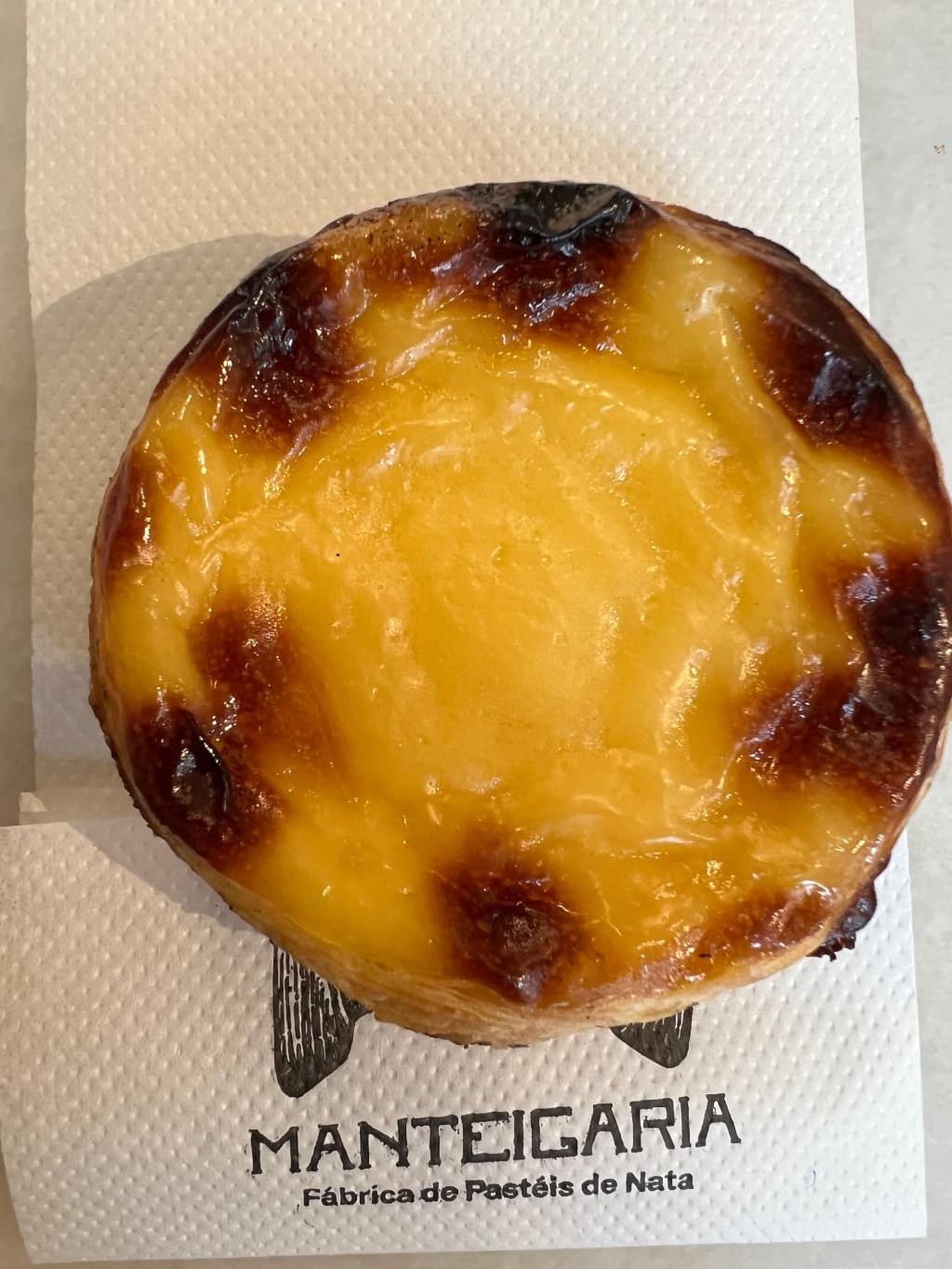
We still had plenty of time to kill, so we kept walking. It was drizzling—not a downpour, but not ideal weather either. Just a bit farther down the street, we came across Manteigaria, one of the most highly recommended pastel de nata bakeries in Lisbon. When you see a place like that, you have to stop. We each had one (maybe two), and they were absolutely delicious—warm, flaky, and far better than the first ones we tried.
We continued walking and passed several restaurants, including a burger place. As usual, the kids gravitated toward burgers. They do try new things, but they always seem to fall back on burgers eventually. This would become a theme.
Cash Is King (Especially for Bathrooms)
At one point, Elias needed to use the bathroom. We found a public one, but it required coins, and I didn’t have any change. That’s one thing to note about Portugal: cash, especially coins, is still commonly used. It’s a good idea to carry euros for public restrooms, parking meters, or small street purchases. We also noticed street fruit markets everywhere—the fruit in Portugal is fantastic, fresh, and inexpensive, sold by very friendly locals.
We headed back toward the hotel to see if the room might be ready early. Elias used the bathroom there (crisis averted), but the room wouldn’t be ready until 3 PM. So back out into the rain we went.
We found another café and stopped for fresh-squeezed orange juice, which was excellent. I had yet another pastel de nata and coffee since I hadn’t slept on the plane. By this point, travel fatigue was setting in, and Elias was getting a bit grouchy.
The Botanical Gardens: Free on Sunday
It was just before 10 AM when we walked past the Jardim Botânico (Lisbon Botanical Garden). Because it was Sunday, admission was free, and the gates were about to open. We waited a few minutes and went in.
Even with the drizzle, the gardens were beautiful. Portugal has a mild, temperate climate, and the vegetation—palm trees, impressive old trees, and lush greenery—was vibrant even in February. Elias was a good sport at first, but eventually his patience wore thin.
I brought him back to the car where Jennifer and Henry were still napping. He didn’t actually sleep—mostly watched TV—but he was clearly hitting a wall. When Jennifer and Henry woke up around late morning, we still had hours before check-in.
Museums by the Water: Power and Technology
To pass the time, we drove down to the waterfront museum area in Belém. There’s an old power station that’s been converted into the Museu da Eletricidade (Central Tejo), and nearby is the MAAT—Museum of Art, Architecture and Technology.
We started with the power station museum, which was fascinating. The massive machinery, generators, coal systems, and exposed piping were all beautifully preserved and very clean. The industrial architecture alone made it worth the visit.
The MAAT was less impressive inside, though the building itself is worth seeing. On a nice day, the rooftop would be great, but the weather kept us mostly indoors.
Restaurant Hours: A Warning
By then it was past lunchtime, and this is important to know: many restaurants in Portugal close between 3 and 7 PM, and dinner is eaten quite late. We ended up going back to the burger place Elias had wanted earlier—I think it was called Vico. We parked nearby and ordered. The order got a little mixed up, but that was on us. They accepted cards, which made things easy.
After that, we walked back to the hotel in heavier rain. We arrived around 2:15 or 2:30 PM, and luckily our room was ready early. Normally there’s a €15 early check-in fee, but they waived it for us.
Casa do Jasmim was a small boutique hotel, and breakfast was included. Even the night before, the smell of them preparing breakfast was amazing and made the whole place feel welcoming.
The Great Sleep-Through
Once we got to the room, exhaustion hit us like a truck. Elias fell asleep around 4 PM, I fell asleep around 5 PM, and we all slept straight through until after 9 AM the next morning. That night was very stormy with heavy rain and strong winds, but we slept through it all. We woke up to some breaks in the clouds and a bit of sun.
The next morning’s breakfast was excellent—fresh fruit, papaya, pastries, and of course, more pastéis de nata.
On the Road: Lisbon to Porto (Eventually)
After breakfast, I went to get the car. It started pouring again just as I headed out. The parking ticket from the day before had gotten wet, and I was worried it wouldn’t work. I made sure I had cash just in case, which was smart because the payment machine’s card reader didn’t work. Parking for a few hours had been around €10-15.
We packed up, loaded the car, and headed toward Porto to meet our friends who were also going through the residency process. Along the way, we planned to detour to see some sights.
Óbidos: The Highlight Stop
On the drive, we spontaneously stopped at Óbidos, a small walled medieval town with a castle. Walking along the old city walls ended up being a highlight of the entire trip. The weather held for most of our visit, only starting to rain again toward the end. The town is incredibly well-preserved, and you can walk the entire perimeter of the walls. It’s touristy but worth it.
Ceramirupe: Fragile Souvenirs in the Rain
After Óbidos, we stopped at Ceramirupe, a ceramics factory shop. We needed a housewarming gift for our friends in Porto (they’d just moved into their new home), and we also got some mugs, pasta bowls, and other ceramics for ourselves.
The factory had an orange tree and a lemon tree right outside. We picked some oranges off the ground that had fallen—beautiful navel oranges—and Elias grabbed a giant lemon. It was pouring rain, which made the whole experience a bit ridiculous, but also memorable. The real adventure would be carrying all this fragile stuff back home.
On the way out, we also stopped at a church that had an orange tree, so I made Elias pick some more oranges. When life gives you Portugal, you pick oranges.
Aveiro: The “Venice of Portugal” (Sort Of)
After the ceramics shop, we passed through Aveiro, which has Art Nouveau architecture and canals. It’s sometimes called the “Venice of Portugal,” though that’s overselling it a bit. Still, the architecture was lovely, and it was worth driving through.
Porto: Arriving in the Dark
We finally made it to our Airbnb on Rua de Manuel II in Porto—the listing was something like “Porto Velho Apt.” We got there in the dark, which made finding it a challenge. The entry system was complicated: you had to enter a code, go up to the apartment, unlock a box to get the key, retrieve the garage remote, then come back down.
To make matters worse, all the streets around the apartment were one-way in the wrong direction. We drove around for a while before finally figuring it out.
The apartment was okay—nothing special. There was a supermarket downstairs, which should have been convenient, but we kept missing it because it closed by the time we got home each evening.
First Night in Porto: Bulha
That first evening, we went out to dinner at Bulha Sá da Bandeira, a Portuguese restaurant where the walls are covered in writing. The food was good—nothing spectacular, but solid traditional Portuguese fare.
The next morning, we slept in fairly late. Actually, that was one nice thing about the trip: between the rainy weather and general exhaustion, we ended up sleeping early and sleeping in. It turned into a good sleep vacation, and honestly, the rainy weather meant we weren’t missing much.
Porto: Pastéis de Nata and Markets
The next day, we walked around the neighborhood looking for a café. Of course, we had to get pastéis de nata. The first café we found had good reviews, but the pastry wasn’t that great. The other pastries were mediocre too. Still, I got my pastel de nata and coffee (the coffee is universally good), and we walked around the neighborhood some more.
We found a Manteigaria (the same excellent bakery chain from Lisbon) and got more pastéis de nata. These were much better.
We were right near the Mercado do Bolhão, and exploring that market was fantastic. Fresh fruits, cheeses, meats, fish—everything you could want. The food in Portugal is incredibly fresh. They’ve banned many of the red dyes and preservatives that the US allows. There’s limited processed food, which is refreshing. Portugal has a really good approach to food quality.
Foz do Douro: Ocean Views and Restaurant Failures
After our neighborhood walk, we Ubered over to Foz do Douro, near where our friends live on the beach. We were supposed to meet them at a restaurant right on the ocean, but unfortunately it was closed for renovations.
We walked around a little, caught up, and ended up going to another restaurant also right on the ocean. We could see the angry Atlantic waves crashing—impressive even in bad weather. The lunch was really good, and it was great to catch up with them.
We went back to their house afterward. Our kids had gone to Montessori school together for years, so they’d been friends for a long time. We’d become friends with the parents through all that, as tends to happen. Their house was amazing, and we had a great time hanging out. We ordered food in for dinner, then Ubered back to our apartment. Of course, the supermarket was closed again.
More Porto: Livraria Lello and Rainy Walks
The next day, we did more of the same—went to a different café that had a Manteigaria and got more pastéis de nata (I wasn’t keeping count anymore, but it was a lot). We went back to the market to get fresh fruit.
After breakfast, we set out to explore Porto properly. We walked everywhere—I think we ended up doing about 14,000 steps a day, which is just what happens when you’re exploring a city on foot.
Livraria Lello: The Harry Potter Bookstore
One of our main destinations was Livraria Lello, the famous bookstore that was supposedly an inspiration for the shop in Harry Potter. You have to buy tickets to go in, which you can purchase online. I think it’s one of the most famous tourist attractions in Porto.
Jennifer had already been, so she didn’t go in with us. The bookstore is absolutely beautiful—stunning architecture, a dramatic staircase, ornate details everywhere. We got some nice photos, and it was worth the ticket price. Really impressive.
Right next door, there’s an old department store that was actually even more interesting to me. The vintage architecture and old-world charm made for some great photos.
The Bridge Walk and Tram Ride
From there, we wandered through Porto’s streets without a specific plan, making our way toward the Ponte Luís I bridge. Our goal was to walk across to the other side where there’s a tram.
We walked across the upper level of the bridge on a very windy, rainy afternoon. The views were spectacular despite the weather. On the other side, we took the tram down from the top of the bridge to the waterfront below. The tram ride itself was an experience—steep, historic, and a bit nerve-wracking.
We explored that side of Porto (Gaia) for a while, walking along the waterfront where all the port wine cellars are. Then we walked back across the lower level of the bridge, which gave us a completely different perspective.
From there, we explored more of Porto on the Ribeira side, visiting churches and just wandering. I don’t think we had a specific end goal—just experiencing the city.
Evening with Friends: The Old Apartment and Light Show
In the evening, we met up with our friends again. They showed us their old apartment that they’d put up for sale in the old part of Porto. It was in a converted palace—really an amazing, beautiful historic building.
From there, we went to see Torre dos Clérigos, the famous baroque tower. There was a light show in the adjacent church, which was interesting and worth seeing.
After the light show, we walked to get gelato right next to Livraria Lello. The gelato was excellent, and since we’d indulged, we walked all the way back to the apartment to try to work off some of those calories and pastéis de nata. The kids complained the entire way, naturally.
Day Trip: Guimarães
The next morning, we went to Manteigaria for breakfast (pastéis de nata and coffee for me, chocolate croissants for the kids, Jennifer doesn’t like the custard so she got something else). After that, we stopped at the market to get sandwiches and fruit for lunch because we were doing a day trip.
We got the car out and drove to Guimarães, which has both a palace and the Castle of Guimarães. Parking was a bit of an adventure—a guy in the parking lot (just some random guy, I think, collecting money) tried to tell us we had to go to the palace first, then the castle. He didn’t speak English, and we didn’t understand, so we went to the castle first. They told us we had to go to the palace to buy tickets first. So back we went.
Palace of the Dukes of Braganza
The palace was impressive. I’m not sure if it was maintained or restored (we never read the plaques), but either way, they’d done a nice job. The wood ceilings, period furniture, and grand halls were beautiful. Unfortunately, they had one section that was leaking—not great for preservation.
After the palace, we went to the castle. The Castle of Guimarães was a bit underwhelming compared to the palace—mostly just ruins where you walk around the walls. That first castle we’d stopped at (Óbidos) was actually more impressive.
After the castle, we ate our sandwiches in the car. One of them had sheep’s cheese that was way too strong and gamey for me. The kids seemed to like it, but I couldn’t handle it.
Viana do Castelo: Funicular and Convoluted Routes
From Guimarães, I suggested we head to another beach town. The weather wasn’t great—actually pouring—but we went to Viana do Castelo on the Costa Verde.
They have a funicular that goes up to the Santuário de Santa Luzia, so we drove to the top first (the sanctuary was closed), then took the funicular down into town. This is where things got weird.
The funicular ends right at a bunch of highways, and there’s no clear passageway into the town. You have to figure it out yourself. We went left when we should have gone right. The “right way” requires going through a shopping mall to get to the old town, which makes absolutely no sense. It seems like this setup would hurt local businesses and confuse tourists, but that’s how they designed it.
We eventually found our way to the town center, which was very nice. They have a special local pastry—sort of like a powdered sugar donut filled with the same custard they use in pastéis de nata. We tried one at a coffee shop, and it was good.
We took the funicular back up, got in the car, and headed back to Porto. That was our last full day there.
Back to Lisbon: The AIMA Appointment Disaster
The next morning, we packed up and left Porto. We had Jennifer’s AIMA appointment that day, and we had to be there on time. We left around 8 AM (or maybe 8:30—we were running a little late), which was the earliest we’d been up all trip.
We drove directly back to Lisbon. Unfortunately, we ended up at the wrong AIMA office. Our lawyer had initially given us the address for the Lisbon office, but the appointment was actually in Cascais, a town about 30 minutes away.
We didn’t realize this until we were already at the Lisbon office. We’d arrived an hour early and were having coffee when we reached out to our lawyer to ask where he was. That’s when he told us the appointment was in Cascais.
We raced there. The Cascais office was hard to find—no sign, tucked away in an odd location. But even with us being late, it all worked out. Jennifer found our lawyer, got her paperwork taken care of, and got her residency permit approved.
Interestingly, they had a Manteigaria at that AIMA office, but I think that was the only time we saw one and actually skipped getting a pastel de nata. We were too stressed about being late.
Wild Apart Hotel: The Nicest Place We Stayed
After the appointment, we drove to our next accommodation in Lisbon: the Wild Apart Hotel. It was very modern and updated—definitely the nicest place we stayed. The room was long and narrow, with a fold-out sofa for the kids separated by a curtain. There wasn’t really a lounging area like the Porto apartment, but it had a table and kitchenette. The sink was outside the bathroom (just the toilet and shower), which was actually nice.
They had an elevator, which we didn’t use (we took the stairs), and a public lobby space where you could sit and wait for people.
Exploring Lisbon: The Good, The Bad, and The Ugly Architecture
After checking in, we went out to explore Lisbon. We walked down to the main boulevard area—I think it’s called Avenida da Liberdade, meant to evoke Paris. They built it after the earthquakes knocked down a lot of buildings.
Lisbon is actually much nicer than I remembered. They’ve rebuilt a lot since I was last here, when there was still significant earthquake damage visible. The problem is the newer architecture—it’s suspect. It really feels like all the architects from Eastern Europe and Russia came to Portugal and designed these incredibly ugly buildings. I don’t think they had any requirements to maintain the historic aesthetic, though I believe they’ve started implementing those now. What’s left of the old architecture is lovely. It’s just unfortunate that so much was replaced with such ugly designs.
We walked to the waterfront in Belém, where they have a giant “LISBOA” sign in the plaza. It was almost impossible to get a picture without people in it—tourists constantly swapped out at the sign. I finally got one shot with it clear.
We saw the Belém Tower and walked around. There was another pastel de nata shop (naturally, we stopped), and we visited an old sardine shop that sells beautifully packaged tinned fish. We saw the historic tram cars and just randomly wandered through the streets.
Roman Baths Discovery
At one point, we came across old Roman baths that had been uncovered during construction or renovation. They’d built a structure over them and turned the site into an archaeological exhibit. It was fascinating to stumble upon—one of those unexpected discoveries that makes wandering worthwhile.
Ruined Cathedral
As we walked back toward our hotel, we found an old cathedral that had been destroyed in the earthquake. Only the support walls were standing, turned into an open-air museum. They had some mummies on display—what looked like kids, which was a bit unsettling but historically interesting.
Dinner at the Cavernous Pizza Place
We ended up at a pizza place across the street from the Wild Apart Hotel. This place was gigantic—absolutely cavernous. Again, the Portuguese dinner schedule (places only opening at 7 PM) influenced our timing.
The pizza was good, the pasta (which the kids wanted) was good—everyone seemed happy. After that, we just went back to the apartment and called it a night.
Jennifer’s Sick Day and the Park Adventure
The next morning, Jennifer wasn’t feeling well, so the kids and I went out for breakfast. We ended up walking back to the area near Casa do Jasmim, our first hotel, and went to the Manteigaria nearby. The kids complained about the walk, but we brought breakfast back for Jennifer.
She still wasn’t feeling well and went back to sleep, so I took the kids out exploring. We actually had some sun, which was nice.
Parque Eduardo VII
The Wild Apart Hotel was right by Parque Eduardo VII, a large park, so I told the kids we were walking through it. The park was interesting—beautiful trees, landscaping, and views. Oddly, there was a prison on one end, which was an interesting urban planning choice.
The park sits on the main boulevard that goes all the way down to the water. We wandered around, found another LISBOA sign, and I got the kids to pose for a photo.
Then Henry slipped and fell in the mud. They’d been messing around, and he got muddy. We had to find a place for him to wash his hands and feet. Eventually we found a bathroom in the park—it didn’t work great, but he cleaned up. The impressive thing was that Henry was a good sport about it. He could have been whiny and demanded to go back to the room, but he just dealt with it and moved on. Good kid.
In the park, they had these giant tensile fabric roofs covering what looked like a private club with tennis courts—maybe a country club or something. Really fancy and clearly not for regular people, but architecturally interesting.
Mexican Food in Lisbon
We ended up at a Mexican restaurant for lunch. The food was actually good—better than I expected. They had a smart system where they encourage you to review them right away if you enjoyed your meal by providing a QR code. Clever marketing.
By late afternoon, Jennifer was feeling better and wanted something to eat. Finding a sandwich for her proved difficult because that area didn’t have as many markets or small shops as our other Lisbon location.
Street Art Walk
After meeting up with Jennifer, we went for a walk to see some of Lisbon’s famous street art and graffiti. We wandered through different neighborhoods, checking out various pieces. It was a nice walk through parts of the city we hadn’t seen yet.
We ended up near the Águas Livres Aqueduct. We couldn’t actually walk on it because it was closed (we’d missed the hours), but we walked alongside it, which was still impressive.
Last Dinner: La Pom
For our last night, we went to La Pom, which was actually close to Casa do Jasmim and the Manteigaria where I’d gotten Jennifer’s breakfast. The food was very good—not exactly traditional Portuguese, but Portuguese-influenced with a modern twist. Great way to end the trip.
Last Day: Castle Attempts and Coastal Walks
The next day was our last in Portugal, and our flight wasn’t until around 6:40 PM—kind of late, which meant getting home very late, but that’s how it worked out.
We ended up checking out of the apartment late and drove up to the castle in Lisbon. Unfortunately, it was closed. But we’d driven up there anyway, so we found a tiny parking spot on the street. Since it was Sunday, we didn’t have to worry about paying.
The parallel parking situation was ridiculous—classic European tight quarters. It took me several attempts to get the car positioned enough so that the cable cars could pass by. But we managed, and we walked around that neighborhood. It was actually sunny for once, which was nice.
There was another pastel de nata place (of course we stopped), and this may have been our last one of the trip. Bittersweet.
Coastal Castle and Boardwalk
From there, we decided to visit a coastal town northeast of the airport that had a castle. When we got there, the castle wasn’t particularly impressive—we could just walk around it, and it wasn’t very big.
But they had a boardwalk along the water, so we ended up driving through an industrial area to find parking and walked along that boardwalk for maybe an hour and a half. It was nice to be outside, breathing in the Atlantic air. Of course, it started raining toward the end, because Portugal.
We didn’t eat lunch, but we had to get back to return the car.
The Return: Airport, Delays, and Freezing Newark
We drove the car back to the non-airport parking lot. The process went smoothly, and they brought us back with their shuttle bus to the airport.
The Lisbon airport is actually very nice. The boarding system isn’t great, and when you land, you sometimes have to take a bus from the tarmac (which we’d done on arrival), but at least our departure had an actual gate.
They had a bunch of food choices—typical expensive airport food, but decent options. They had pastéis de nata (naturally). The kids kept asking for McDonald’s or Burger King (they’re everywhere in Portugal), but we wouldn’t let them have it during the regular trip.
I finally told them that if they wanted to try it, the airport would be the only time they could have it, and then they’d have to stop asking. So they had it. They didn’t say it was any better than American fast food. Usually when I’ve had American chains overseas, the food is actually fresher because they have different restrictions and don’t allow the same junk the US allows. Portugal takes food seriously.
The Flight Home
The flight was fine. TAP had good entertainment options on the return—much better than the outbound flight. We had some traffic delays before takeoff. It was pouring rain, so we ended up sitting on the plane for maybe an hour and a half after pushback before we could actually take off.
We landed at Newark late—around 11:40 PM, about an hour behind schedule. Then, because we do the off-airport long-term parking, we had to wait for the shuttle bus.
I’d called them when we landed, and they said it’d be there in 5 minutes. It was freezing—literally around -10°F. We waited for half an hour in the arctic cold. I called again, and they kept saying “5 minutes.” This was after midnight by now.
We have Global Entry, which should make things faster, but even that was a bit of a nightmare this time. We finally got home around 2:30 AM.
The kids had to go to school the next day.
Final Thoughts: Would We Do It Again?
Despite the rain, the wrong AIMA office, the burger obsessions, the complaints about walking, and the freezing Newark parking lot saga, it was absolutely worth it.
Portugal is beautiful even when it’s soaking wet. The food is incredible and fresh—they actually ban the junk we allow in the US. The costs are reasonable, maybe where we were 10 years ago. The people are friendly. The history is everywhere you look.
We got to see our friends in their new life in Porto. We walked medieval castle walls. We ate more pastéis de nata than any family should. We picked oranges off trees in the rain. Jennifer got her residency permit. The kids survived being dragged around in the drizzle and actually seemed to enjoy parts of it (when they weren’t asking for burgers).
And honestly, escaping sub-zero temperatures for a week of 50-degree rain? I’d take that trade any day.
Practical Tips Summary:
- Car Rental: Pay extra for terminal pickup instead of off-site
- Cash: Carry euros, especially coins, for bathrooms and parking
- Restaurant Hours: Many close 3-7 PM, dinner is late
- Weather: Check forecast, pack accordingly, expect rain
- Parking: Download parking apps, street parking often free on Sundays
- Food: It’s fresh, delicious, and they take it seriously
- Walking: You’ll do 14,000+ steps a day, wear good shoes
- Pastéis de Nata: Stop at every Manteigaria you see
- EV Parking at Newark: Long-term lot will charge your car
- Kids: They will ask for burgers. Repeatedly.
Photos and detailed itinerary map coming soon…
 Even that's Odd
Leave a comment