
January 9, 2026
The Signs I Missed
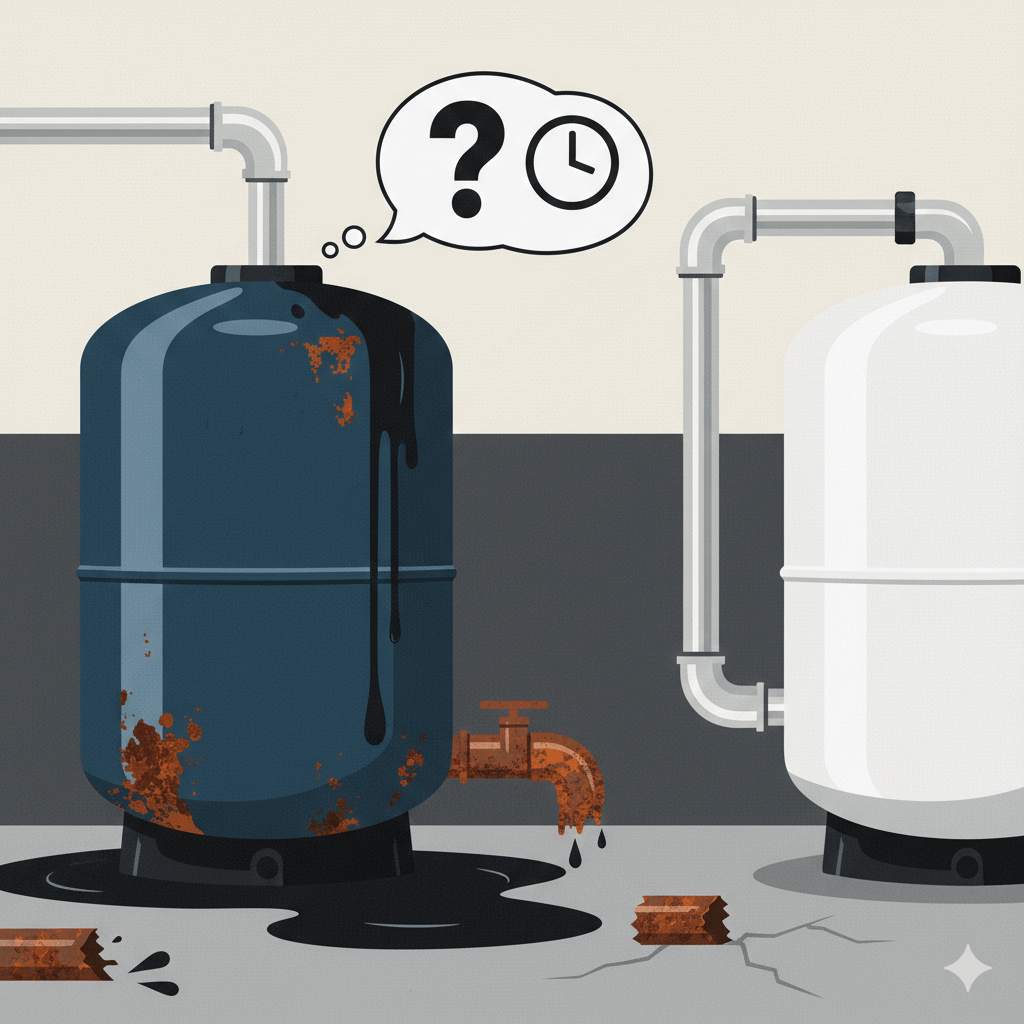
Looking back, I think the well tank bladder had been broken since at least summer 2024. It might have been failing for a year or two before that.
What I was noticing: the water pressure would drop a little, then go back up when the pump kicked in. I thought the pressure had just gotten out of adjustment, so I checked the pressure in the tank. It was a little low, and the pump was kicking on earlier than it should have.
Now, of course, mistakes were made.
The Clue I Completely Overlooked
Here’s the thing that should have been a dead giveaway: when I checked the pressure, water came out of the valve.
Did I recognize this as a sure sign the bladder had been breached? No. No, I did not.
Why? Because I have a small Kubota tractor with liquid ballast in the rear tires, and some liquid can come out when you check tire pressure. So it stupidly did not seem odd when water came out of the well tank pressure valve.
I convinced myself that adjusting the pressure had solved the issue. Somewhat.
The Pump That Wouldn’t Stop
I kept suspecting something was wrong, but I was perplexed. My pressure adjustment seemed to help, so maybe everything was fine?
I don’t sit in our living room very often when people are taking showers. But once the weather gets colder and the holidays roll around, we spend much more time in that room. That’s when I was actually present during showers and people running water in the kitchen.
And I realized: the pump kept kicking in after a very short amount of time. Something was really not right. It would even kick on sometimes when someone just flushed a toilet.
I kind of put it out of my mind and tried to ignore it. But it kept bugging me. Finally, I searched for “how to tell if the bladder is bad.”
This time I actually found the answer: if water comes out when you check the pressure, the bladder is bad.
Oh.
The Test
Let me go check the pressure one more time to make sure before I put energy into getting the tank swapped.
I put the pressure gauge on. Water shot out.
How stupid did I feel at that moment? This had possibly been the issue for all this time and I was just figuring it out now? The pump could have burned out by now, especially with the hours-long showers my kids were taking.
Sheesh.
Okay. Let’s put that mistake behind us and move on to the next mistake I would make.
The DIY Attempt
I called my plumber DP and asked when he could come swap the tank. He told me he’d just sold his last tank in my size, so he’d have to source one and get back to me.
Okay, so it wasn’t a super emergency because we still had water. The pump was just running constantly, which was stressing out my OCD ADHD simple brain now that I knew what was actually wrong.
There was a connection joint on the water tank, so I thought: maybe I can just unscrew the connection and attach a new tank myself? Maybe I should try that?
I looked up what tanks Lowe’s and Home Depot had in stock. I had a 33-gallon tank but wanted to size up because of the crazy teenage shower stage my kids are in. I found a 52-gallon tank in stock at the Lowe’s closest to my house.
But of course it wasn’t straightforward. The larger tanks had a 1¼” opening, but I think my tank had a 1″ connection. There was possibly going to be an incompatibility issue. I started looking at Lowe’s for a 1″ to 1¼” adapter.
And of course—would you know it—Lowe’s had no such thing.
Demonstrating the Thickness of My Skull
This was another moment for me to demonstrate just how dense my skull is.
I think they had a 1¼” T fitting (which I would have needed), but I decided in my infinite wisdom: I’ll buy the tank, see if I can get the old tank disconnected at that joint, and then maybe go to a real plumbing supply place if needed. Lowe’s has a great return policy, so I didn’t have to worry about returning the tank if I couldn’t use it.
So: First mistake—not realizing the well tank was bad. Second mistake—buying a tank without the proper fittings.
But to be fair to myself, I didn’t have all the tools I would have needed to confidently disconnect everything from the T to actually swap the whole assembly. I was only going to attempt my stupid-but-at-the-time-logical approach if I could get that connection joint loose.
And just to explain it better: it wasn’t a single-unit T fitting. It had a connection point before it got to the base of the tank, so I had some hope that my plan might actually work.
Well, I tried. (After buying a tool, of course. Every time I have to fix something, I have to buy a new tool. That’s the deal.)
I could not get it to budge, and it started to feel like I would break something. I didn’t want to apply heat because it looked like there might be a gasket, and I didn’t want to ruin it in case I needed to put everything back together. I also backed off because I didn’t want to break it and then we really wouldn’t have any water at all.
At least it was working. Sort of.
The Honest Plumber
This all didn’t take very long to figure out. I reached back out to the plumber and told him I hadn’t found a tank yet. I told him I had one from Lowe’s if he could install that, or if I should return it and get one from a plumbing supply.
He said I should use a real one from a supply house.
I asked if I got a tank first thing the next morning, could he install it? He agreed.
This is so not normal in today’s world. Plumbers like to mark up equipment and make money on the parts. But this guy is honest. I’d talked with him before when I was considering switching to a heat pump water heater, and even though I didn’t end up switching (partly because of our conversation), I got a good vibe from him and felt he was trustworthy.
I had a trade account at a few plumbing supply places because of my own boiler repairs and from when we were building the house. I called the one that opened early. They had a 44-gallon tank and a T kit with a new pressure switch, gauge, etc.
The one thing I was disappointed in: the T wasn’t the two-part version shown on the manufacturer’s site. It was just the standard one-piece T. But I wasn’t going to stress about it.
I let the plumber know the tank was ready when he was. He said he’d let me know.
The Install
I got a text around 1 PM that one of his guys was heading over.
The guy came and he was pleasant. I’d already set up a bucket, hoses, and a sump pump for when I’d tried to do it myself, so I showed him where everything was. Not really hard to see—it was all right there.
He was done in a few hours. I was outside doing chores and saw him trying to muscle the old tank up the basement stairs. I went to help carry it up. It was still super heavy.
He explained that once the bladder breaks, the trapped water doesn’t drain out. They have to drill holes in really big tanks to get the water to drain.
The Rusty Water Revelation
I wanted to make the tank easier to move, and I also wanted to see if I could get that connection to release now that the tank was garbage anyway.
I got my wrench and tried. The whole bottom of the tank started to bend. Eventually I just got the T off as a whole unit, not at the connection point. Oh well. At least now I knew it wouldn’t have worked as planned.
But here’s what got my attention: the water coming out was all rusty.
Connecting the Dots: The Two-Tank Problem
In my Water Wars post (Part 5 of This New Old House series), I documented our complicated water filtration saga. It took us 11 years to figure out our well water problems—hard water, iron staining, sulfur smell, sediment. We eventually built up a ridiculous seven-stage filtration system including an iron filter, multiple particle filters, and a water softener.
But even after getting the iron filter installed in 2022 and fixing the water treatment, we’d still occasionally see rust coloration. I’d chalked it up to residual iron in the pipes working its way out of the system.
Seeing that rusty water pour out of the old well tank, something clicked.
Our well tank bladder had been broken for who knows how long—possibly a year or two. During that time, water was sitting in the tank, mixing with any accumulated sediment and iron deposits from 15+ years of well water flowing through it. That contaminated water was getting pushed back into our system every time the pump cycled.
And it wasn’t just the well tank.
We’d replaced our boiler with a Navien combi unit in November 2024 (see that post for the full story). The old system had an indirect water heater tank that had also been collecting iron and sediment for 15 years. Even after the iron filter was working properly, we’d still get rust coloration in our hot water because that indirect tank was essentially a reservoir of contaminated water.
So we had TWO tanks—the well tank and the indirect water heater—both contributing to ongoing water quality issues even after we’d fixed the actual water treatment. The iron filter was doing its job on incoming well water, but these two old tanks were re-contaminating the system downstream.
The Evidence: Cleaner Filters
Here’s how I know both tanks were the problem: the filter after the well tank is staying cleaner, longer.
Before the well tank replacement, that first Big Blue particle filter (the 50-5 micron one right after the pressure tank) would get noticeably dirty relatively quickly. I’d see sediment buildup, sometimes with a reddish tint from iron.
After replacing both the well tank and switching to the combi boiler (which eliminated the indirect tank), that filter is staying significantly cleaner. The water coming out of the well tank is cleaner because there’s no broken bladder allowing water to sit and stagnate with old iron deposits. And the hot water doesn’t have that reservoir of contaminated water from the indirect tank.
It’s one of those things where you don’t realize how bad something was until after you fix it and see the difference.
The Timeline of Failure
Let me piece together what was probably happening:
2010-2022: Well water flows through a broken/aging well tank bladder and an indirect water heater, both slowly accumulating iron and sediment. We’re fighting mysterious water quality issues the entire time.
2022: We finally install an iron filter. Water quality improves significantly, but we still see occasional rust coloration. We assume it’s just residual iron working its way out of the pipes.
2023-2024: The well tank bladder is clearly failing (I just don’t realize it). Water is sitting in the tank longer, mixing with accumulated deposits, getting pushed back into the system. Pump is running more frequently.
November 2024: Boiler dies, we replace it with a Navien combi boiler, eliminating the indirect water heater tank. Hot water quality improves.
January 9, 2026: Well tank bladder completely fails. I finally figure it out (after ignoring obvious signs). We replace the tank. Filters start staying cleaner.
The lesson: even after you fix your water treatment, you still have to deal with years of accumulated contamination in any tanks or reservoirs in your system.
Lessons Learned
1. If water comes out when you check the pressure valve, the bladder is broken. No exceptions. Not even if you have a tractor with liquid ballast tires that makes you think this is normal.
2. If your pump is kicking on too frequently, don’t just adjust the pressure and hope for the best. Actually diagnose the problem.
3. Old tanks are reservoirs of old problems. Even after you fix your water treatment, tanks that have been accumulating sediment and iron for years will continue to re-contaminate your system.
4. When you replace your water treatment system, consider whether your well tank and water heater tank are also part of the problem.
5. Sometimes the answer to “why is this still happening?” is “because you fixed the cause but not all the effects.”
6. Just call the plumber. The Lowe’s tank and DIY attempt were a waste of time. (Though I learned something, so maybe not a complete waste?)
The Current Status
We now have:
• A new 44-gallon well tank with a functioning bladder
• A Navien combi boiler (no indirect tank to accumulate sediment)
• The same ridiculous multi-stage filtration system
• Filters that stay cleaner longer
• Actually clean water with no rust staining
• A pump that only runs when it should
It only took 15 years to get here.
Final Thoughts
Mistakes were made. Lessons were learned. Those lessons will probably be forgotten by the next time I need to know what’s wrong with something.
But for now, the water is clean, the pump works properly, and I can check off “well tank replacement” on my list of house systems that needed upgrading.
Next up: probably something else will break. That’s how this works.
Related posts: Part 5 – Water Wars: The Filter Saga (for the full water treatment story), Emergency Boiler Replacement (for the Navien combi boiler installation that eliminated the indirect water heater)
 Even that's Odd
Leave a comment