
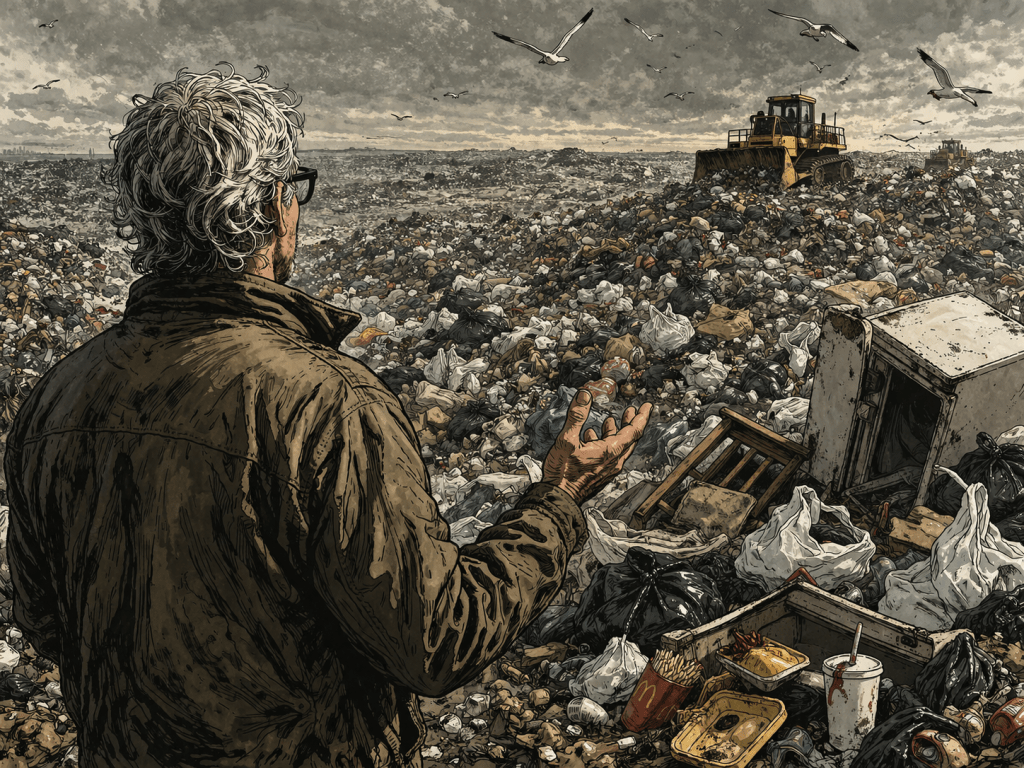
There’s a moment every six weeks or so that snaps me back to reality. I load up the car, drive to our local transfer station, hand Dan a coupon, and drop off a single 44-gallon bag of trash. One bag every four to six weeks. And I think — okay, we’re doing our part. We compost, we recycle obsessively, we reuse packaging like it owes us money.
Then I drive away and start doing math I probably shouldn’t do.
Because here’s the thing: globally, we are generating about 2.1 billion tonnes of municipal solid waste every single year. Not a typo. And that number is projected to nearly double — to 3.8 billion tonnes — by 2050. Which is a number so large it stops meaning anything, like when astronomers tell you the nearest star is 4.2 light-years away and you’re just supposed to nod and act like you processed that.
I grew up in the Hudson Valley. Every little township had its own dump — often parked right next to a river, which even as a kid seemed like a spectacularly bad idea. You’d see these vent pipes sticking out of closed landfills, little methane smokestacks poking up through grass that now had a hiking trail running around it. ‘Look kids, don’t touch the pipe, that’s the toxic fume exhaust — but isn’t this a lovely walk?’ Progress, I guess.
Those dumps closed. Got capped. Turned into ‘parks.’ And then quietly everybody forgot about them, because the garbage trucks just kept coming and the bag kept going to the curb and you didn’t have to think about it anymore.
That’s the whole racket. Out of sight, out of mind. Except I can’t stop thinking about it.
The Numbers Are Genuinely Insane
Let’s start with New York City, since it’s the easiest to wrap your head around — or at least try to. NYC generates roughly 13,000 tons of residential waste every single day. Just the city. The five boroughs. Every day. 81% of it goes to landfills or incinerators, mostly outside the state. Every year, the diesel trucks haul that garbage a combined distance equivalent to driving around the Earth over 300 times.
Now zoom out to the whole country. The US generates — hold onto something — about 951 kilograms of municipal solid waste per person per year. That puts us in the top three worst in the developed world, per the 2025 Global Waste Index. That works out to roughly 870,000 metric tonnes per day, nationally.
This is the part where you need a visual, because the numbers stop feeling real.
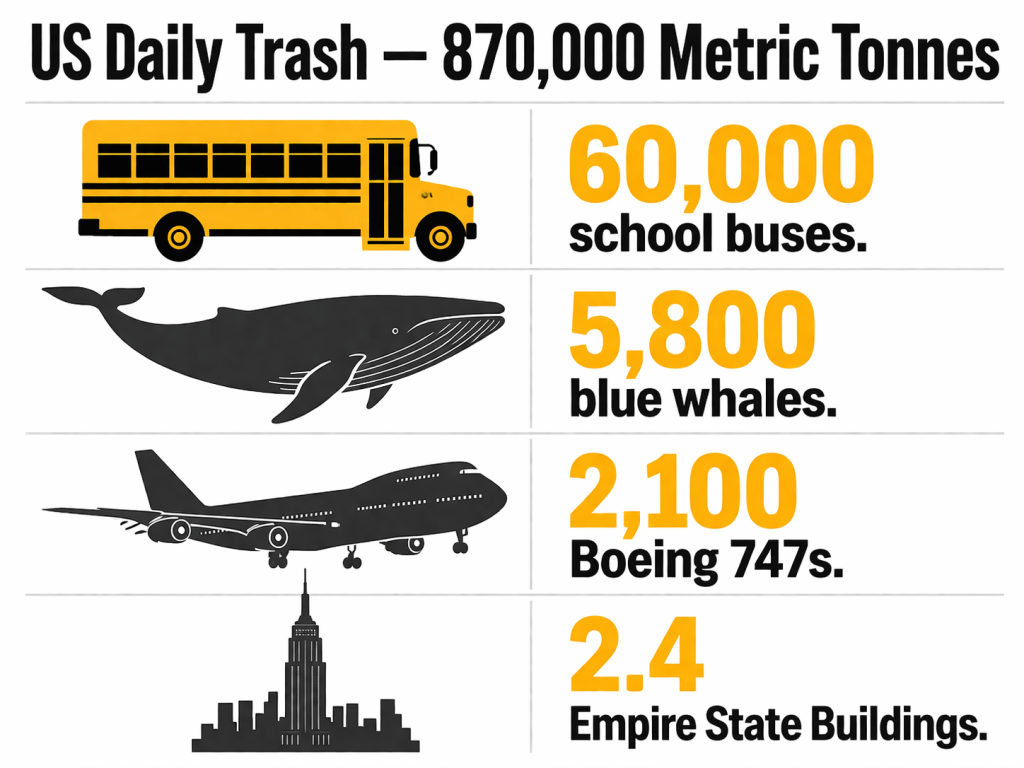
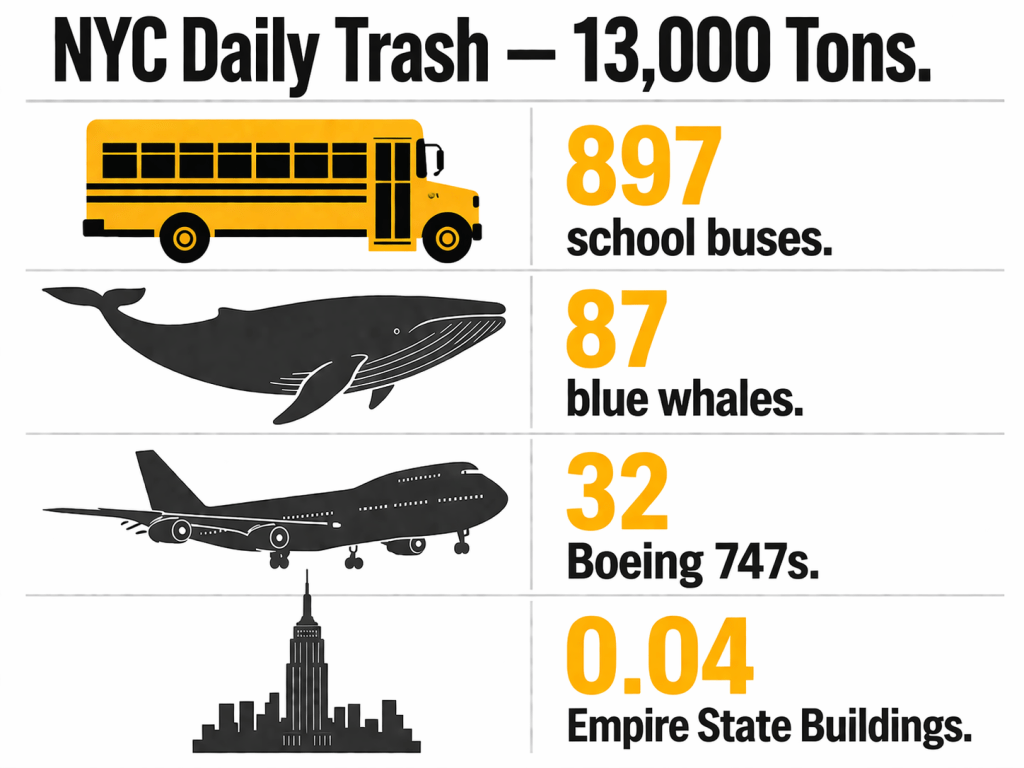
870,000
metric tonnes / US daily
13,000
tons / NYC daily
~30%
US recycling rate
That interactive counter is measuring real time. While you’ve been reading this paragraph, roughly another 10,000 tons have been generated nationally. It doesn’t stop. There’s no weekend off.
What Does That Actually Look Like?
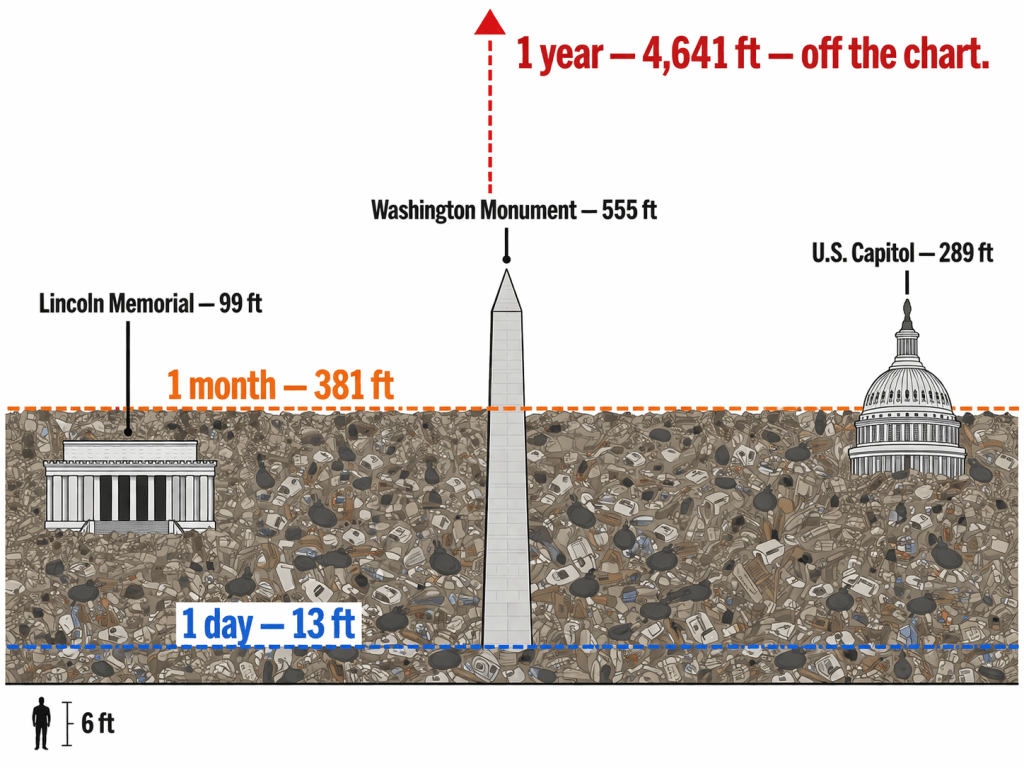
Numbers in the hundreds of thousands are hard to picture. So let’s use a landmark everybody knows: the National Mall in Washington DC — that 309-acre strip from the Lincoln Memorial on the west end to the Capitol on the east, with the Washington Monument rising from the center. Monuments, museums, America’s symbolic front yard.
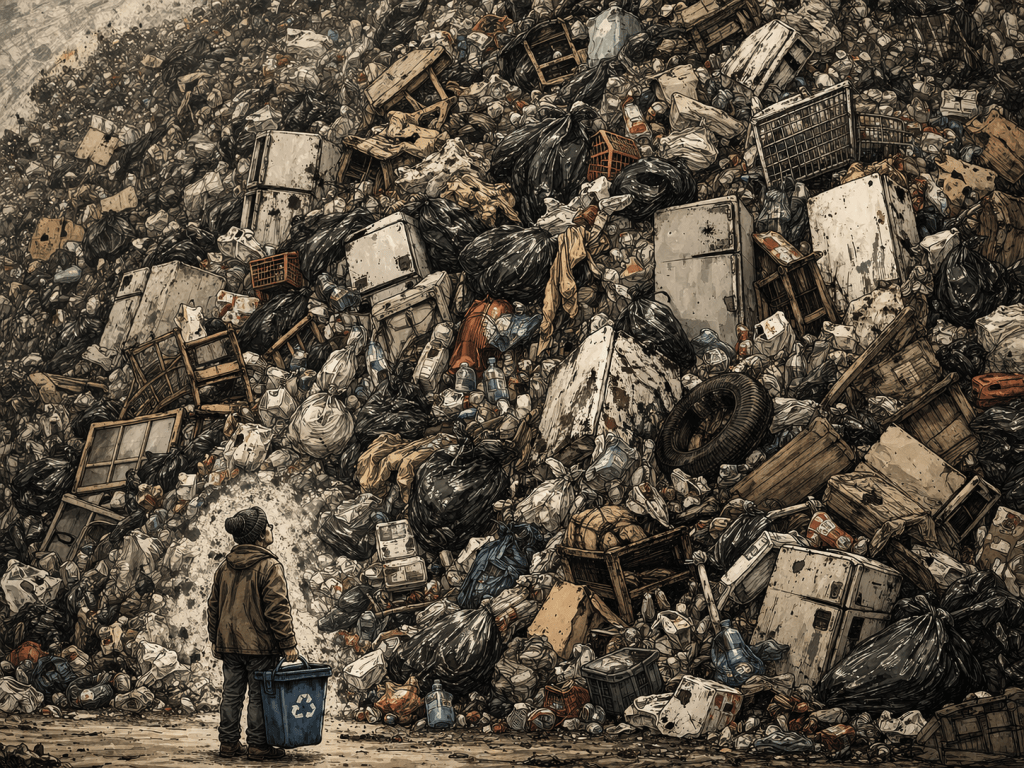
Spread one day of US trash — 870,000 metric tonnes — evenly across that 309 acres, and the pile sits 13 feet deep. Taller than a basketball hoop. The Lincoln Memorial, the Washington Monument, the Capitol dome — all standing there completely clear, towering above it. Which honestly might be the most unsettling version of this image: a 13-foot wall of garbage blanketing the entire Mall, and the monuments don’t even notice.
Now let a month go by. Thirty days of American trash on that same footprint stacks to 381 feet. The Lincoln Memorial — 99 feet tall — has been swallowed since about day eight. The Capitol dome, standing at the east edge at 289 feet tall, is now buried under 92 feet of garbage. The Washington Monument at 555 feet is the last thing standing, just the top third of the obelisk still poking above the trash line.
A full year? 4,641 feet. There is no monument left. There is no reference point. The number just disappears off the top of any chart you try to draw it on.
And here’s the kicker that makes NYC almost look quaint: New York City’s entire 13,000-ton daily output, spread across that same 309-acre Mall, would only be about 2 inches deep. One of the largest cities on the planet barely registers against the national number.
Put another way: NYC is the opening act. The rest of the country is the show.
Where Does It Actually Go?
Most people have a vague mental model: truck comes, takes it away, done. But the logistics of American trash disposal are genuinely staggering — and getting more expensive and absurd by the year.
NYC’s non-recyclable waste gets trucked to Pennsylvania, Ohio, and Virginia — most of which are at or near capacity. The recycling gets sorted (by hand, at facilities with one of the highest injury rates of any job in the country), with a decent chunk of it ending up in landfills anyway because the market for recycled materials collapsed when China stopped taking our plastic in 2018.
Globally, less than 20% of waste is actually recycled. Only 9% of plastic specifically. The rest gets landfilled, incinerated, or dumped openly — the last option being tragically common in lower-income countries that generate far less waste than we do but are getting buried in ours.
Those old township landfills I grew up near? They didn’t disappear. They just got capped and greenwashed with a hiking trail. The methane vents are still venting. Landfills are the third-largest source of methane emissions in the US — and methane is 25 times more potent a greenhouse gas than CO2. So while everybody is (rightfully) talking about tailpipe emissions and coal plants, we’ve also got essentially thousands of slow-motion underground fart machines spread across the landscape.
There are also over 1,000 documented large methane leaks from landfills worldwide since 2019. Not small leaks. Large ones. ‘Huge’ is the word the researchers used.
The Recycling Myth
This is uncomfortable to say, but recycling — as practiced in the United States — is largely a story we tell ourselves to feel better about consuming things.
The bins exist. The trucks come. And then… a lot of it goes to a transfer station and eventually a landfill anyway, because the materials aren’t clean enough, the market for them doesn’t exist, or the economics just don’t pencil out. Contamination rates in residential recycling bins are brutal. That pizza box with cheese on it? Ruins an entire truckload of paper.
I’m not saying don’t recycle — you absolutely should. But it’s not the answer. It’s a partial answer to a problem that’s about volumes and systems and producer incentives, not just consumer behavior.
The US recycles about 30% of its waste. Japan recycles about 19%, but incineration handles most of the rest — only 1% goes to landfill. South Korea has a 54% recycling rate. Germany processes 90% of its bottom ash from incineration to recover metals for reuse.
And then there’s us: 30% recycled, nearly half landfilled, and a per-capita trash output that went up — from 811 kg to 951 kg per person — between the last two major global waste indexes. We are generating more trash per person than we were three years ago. That is not a direction.
The Incineration Conversation We Won’t Have
Here’s where I’ll probably lose some people, but it needs to be said.
Sweden sends less than 1% of its trash to landfills. How? They burn roughly 54% of their household waste in waste-to-energy facilities, with enough recovered heat to warm nearly half of all Swedish homes. Their incineration plants run at 85% efficiency. They actually import waste from Norway and the UK because they don’t generate enough domestic trash to keep their plants running.
Copenhagen has an incinerator with a ski slope on the roof. It’s an attraction. The plant handles waste from 600,000 residents and 68,000 businesses, generates electricity for 60,000 homes, and heats 100,000 households. It’s genuinely impressive.
Now — is incineration perfect? No. There are real debates about carbon emissions, dioxin output, and whether it undercuts recycling incentives. Denmark is actually closing seven incinerators because they’ve become so reliant on burning that it’s killed their recycling momentum. Fair point. The EU is pulling funding for new ones. Also fair. Nothing about this problem is clean.
But here’s the thing I keep getting stuck on: we’ve got thousands of landfills venting methane, leaching chemicals into groundwater, and eating up land — and we’re not even having a serious national conversation about alternatives. Not burning for energy. Not expanded composting infrastructure. Not mandatory producer responsibility laws that put the cost of packaging disposal back on the people who made the packaging.
Some people hear ‘incineration’ and the conversation ends. And I get it — every incinerator ever proposed has been planned for a lower-income neighborhood, because that’s how industrial siting works in this country, and that’s a real and legitimate concern. But the alternative isn’t ‘we just keep trucking it to Ohio.’ The alternative has to be something.
The Florida Problem (And Why It’s Coming Here)
You know what Florida is doing with wastewater now? They’re cleaning sewage water and routing it back into the drinking supply. Not because they want to. Because they’ve run out of options. The aquifers are depleted, the population keeps growing, and the water has to come from somewhere.
A reporter drank it live on NPR. Said it was fine. I believe them. And I still would hesitate.
But here’s the point: that’s where you end up when you kick problems down the road long enough. You run out of road. And then you’re drinking treated sewage and trying to convince people it’s normal, because it is normal at that point — because there’s no other choice.
Trash is going to get there too. The landfills in Pennsylvania and Ohio aren’t going to absorb New York’s garbage forever. The fresh kills of the next generation are going to require real solutions — and those solutions are going to be easier and cheaper to deploy before the crisis point than after it.
Forever chemicals. Microplastics. Pharmaceutical residue in groundwater. These aren’t hypothetical. They’re in the water table right now, and nobody really knows at what scale. Because we’ve been capping landfills with liner systems and hoping they hold for decades, and the long-term data is thin.
The Part Nobody Wants to Read
We love to talk about climate change. It’s on the news. It’s in political platforms. It has a vocabulary and a whole apparatus of public discourse around it — good and bad — which means at least it’s being discussed.
Trash doesn’t have that. Trash is unglamorous. It smells. Nobody wants to be the politician who runs on a waste management platform. Nobody goes to the March for Garbage. And so the problem compounds, quietly, while we put our bags at the curb and forget about it.
Meanwhile: 2.1 billion tonnes this year. 3.8 billion by 2050. A mountain of garbage 13 feet deep across the National Mall, every single day, just from us.
I drop off my one 40-gallon bag every five weeks and I feel like I’m doing something. And I am — every bit matters at the margins. But I’ve also done the math now, and I can’t unknow it. My one bag is a rounding error in an accounting problem that has no current solution.
That’s not defeatism. That’s just a clear-eyed look at the scale of the thing. Which is the only way you ever actually fix anything.
Sources: UNEP Global Waste Management Outlook 2024, Global Waste Index 2025 (Sensoneo), DSNY Municipal Refuse Statistics, EPA Volume-to-Weight Conversion Factors, Yale Environment 360, BioCycle.net, NYLCV, DevelopmentAid
 Even that's Odd
Leave a comment