
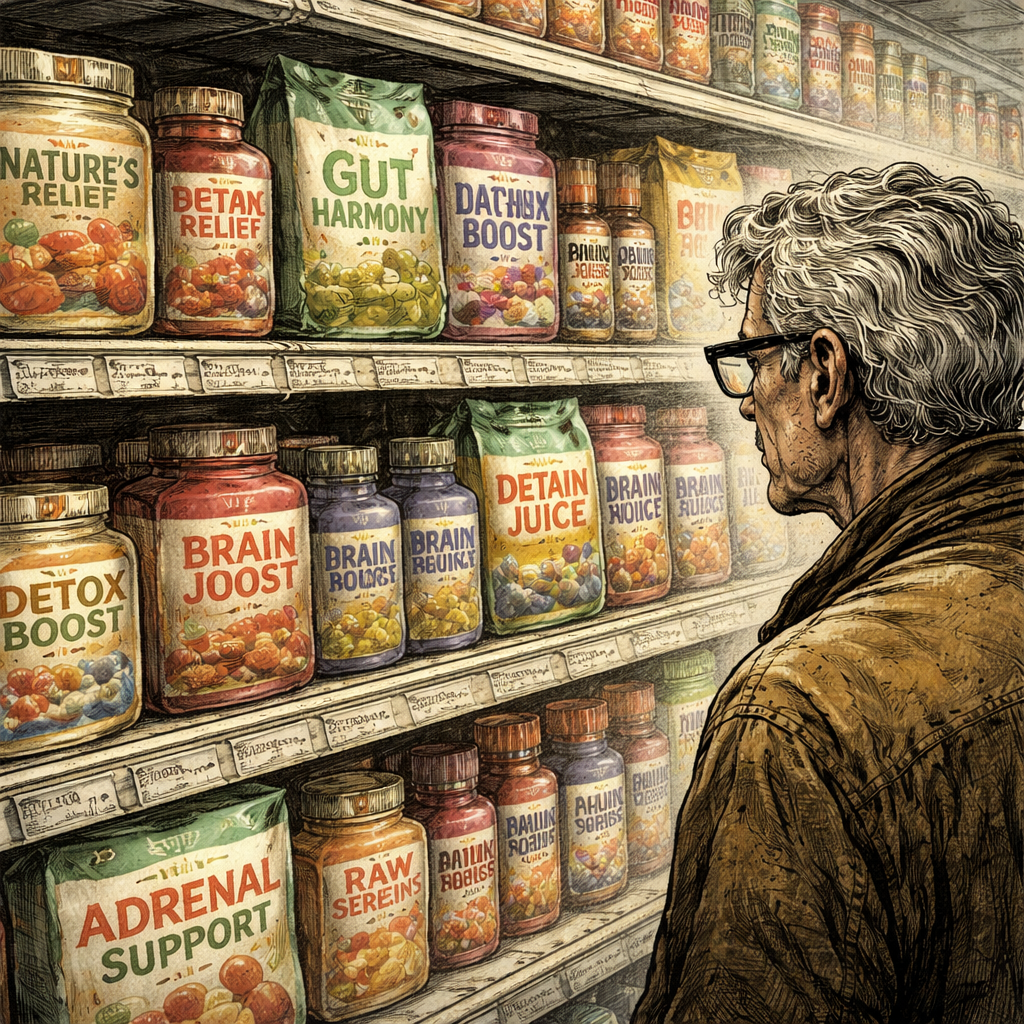
For years, I walked past products screaming NON-GMO! and thought… so what?
I’ll be upfront: I’m not the sharpest tool in the shed. I’m also an optimist — or maybe a pessimistic optimist? An optimistic pessimist? I’ve never quite nailed that down, and honestly, that tracks with the fact that I spent years vaguely confused about something a significant portion of the population treats as an existential food crisis.
Here was my logic: if I eat something that had its genes modified, I’m just… digesting it. The genes get broken down. I’m not “uploading” the modification into my body. Meanwhile, I was genuinely worried about the stuff that actually gets dumped on my food — pesticides, forever chemicals, microplastics. The genetic backstory of my corn seemed like the least of my problems.
So I did what any confused optimistic pessimist eventually does: I looked it up.
Turns out, I wasn’t entirely wrong. But I also wasn’t entirely right. And the real story is actually kind of interesting.
My instinct about the eating part held up. All food has DNA in it. When you eat a genetically modified corn kernel, you’re not uploading new instructions into your cells any more than eating a strawberry makes you part strawberry. Your digestive system breaks everything down — proteins, fats, carbs, nucleic acids, the whole thing. The FDA and WHO both say currently marketed GM foods that have passed safety review haven’t been shown to pose greater health risks than comparable non-GM foods. So the primal “gene bad, unnatural, impure” fear? Mostly vibes.
The actual revelation, when it came, was this: the legitimate concerns about GMOs aren’t really about eating them. They’re about why they were modified. And that splits the story into two very different things.
Want to modify something so it tastes better, stays fresh longer, has more nutritional value, resists pests without needing chemical sprays, or survives drought? Modify the hell out of it. That’s a Healthy GMO — HGMO. Yes, I’m making up an acronym. Bear with me. WHO specifically notes that some pest-resistant GM crops can actually reduce insecticide use in certain farming systems. That’s not scary — that’s genuinely useful. A plant that bugs don’t like is not the same thing as a plant that’s dangerous to you.
Then there’s the other kind, and this is the one that finally got me. Some crops are genetically modified specifically to survive being drenched in herbicide. Not for your benefit. Not for better taste or nutrition. So that industrial farms can carpet-bomb a field with Roundup and only the weeds die. The plant you’re eventually going to eat just sits there absorbing it. The runoff hits the water supply. And whether or not glyphosate is technically in the “forever chemical” category, this does not feel like a win for humanity. Call that one Unhealthy GMO — UGMO. Still making up acronyms. Still worth bearing with me. That’s a real concern, not because the gene was modified, but because of what it was modified to do and who benefits from it. Spoiler: not you, not the farmer, not the local watershed.
While I was down this rabbit hole, I also hit the seed patent issue. Large ag corporations can engineer seeds so the plants they produce don’t yield viable seeds for replanting. Farmers have to buy new seeds every season. It’s basically the subscription model applied to agriculture — except instead of losing access to your Spotify playlist, you lose the ability to grow food without a corporate middleman. This is the part where you realize that “GMO panic” is often really about something else entirely: monopolistic consolidation of the food supply, regulatory capture, and the fundamental weirdness of a world where a corporation can patent a seed.
(Quick sidebar: navel oranges don’t have seeds and have to be propagated by grafting — which is also wildly “unnatural” by the standards of the non-GMO crowd. Nobody’s slapping a warning label on those. Just saying.)
“Non-GMO” has become a marketing term that functions a lot like “gluten-free water” — technically true, completely designed to trigger a purity instinct, and frequently used to charge you more money for something that has nothing to do with your actual health. A bag of organic cane sugar can be proudly stamped Non-GMO! and still be nutritionally terrible. A product can scream NON-GMO while loaded with refined ingredients, emulsifiers, and other things you’re probably actually more worried about. The label tells you almost nothing useful about whether the food is good for you. It’s nostalgia with a farmer’s market font.
If we were designing food labels for actual adults, you’d want to know things that matter — whether the food ripens slower so you waste less of it, whether it has more protein or fiber, whether it tastes better or stays fresh longer. You’d want to know whether it was engineered to use less insecticide or designed for large-scale chemical weed control — the difference between an HGMO and a UGMO, on the label, in plain language. You’d want to know about likely pesticide exposure, any nutritional changes, any allergy-related protein changes. Instead we get “Contains Bioengineered Ingredients” — the USDA’s official required label — which is about as informative as “Contains Food.” Thanks, I’ll file that one.
Where I actually landed after looking it up: “GMO” describes a method, not an outcome. And consumers, reasonably, care about outcomes. A strawberry modified to taste better is not the same thing as soy engineered to survive herbicide drenching. Lumping them together under one scary label is either terrible science communication or deliberate misdirection by people who profit from consumer confusion.
I don’t care that something was modified. I care how and for what.
Make it healthier, tastier, longer-lasting, or less chemical-dependent? Great. Modify away. That’s your HGMO — go nuts. Engineer it to survive a chemical bath so a corporation can sell more herbicide and patent the seed so farmers can’t replant? Hard pass — and maybe put that on the label instead of a vague “bioengineered” disclosure that tells us nothing. That’s your UGMO. And it’s a problem.
The actual food anxieties worth having, in something like order: how processed the food is, how often you eat it, chemical contamination and packaging, your overall diet pattern, and the alcohol-sleep-exercise trio, which absolutely dwarfs most speculative food effects. GMO panic, as currently practiced, is mostly a badly-framed version of legitimate concerns about industrial agriculture, corporate consolidation, and who actually controls our food supply.
Houston, we have a problem. But GMOs are somewhere around number 47 on the list.
Featured Image Prompt: Editorial illustration with dark satirical Americana energy. Rendered as rough ink-and-wash with dry-brushed linework, aggressive cross-hatching, controlled ink splatter used with intention. A lean middle-aged man with silver-white wavy hair and rectangular dark frames stands in a grocery store aisle, eyeing a wall of products screaming “NON-GMO!” with a skeptical, mildly bewildered expression. Behind him, shelves stretch into the distance stacked with marketing buzzwords. Desaturated color palette with amber and olive accents. Punk editorial mood. Expressive caricature with naturalistic human proportions. Heavy laid-paper texture. 4:3 aspect ratio. No text.


Leave a Reply