
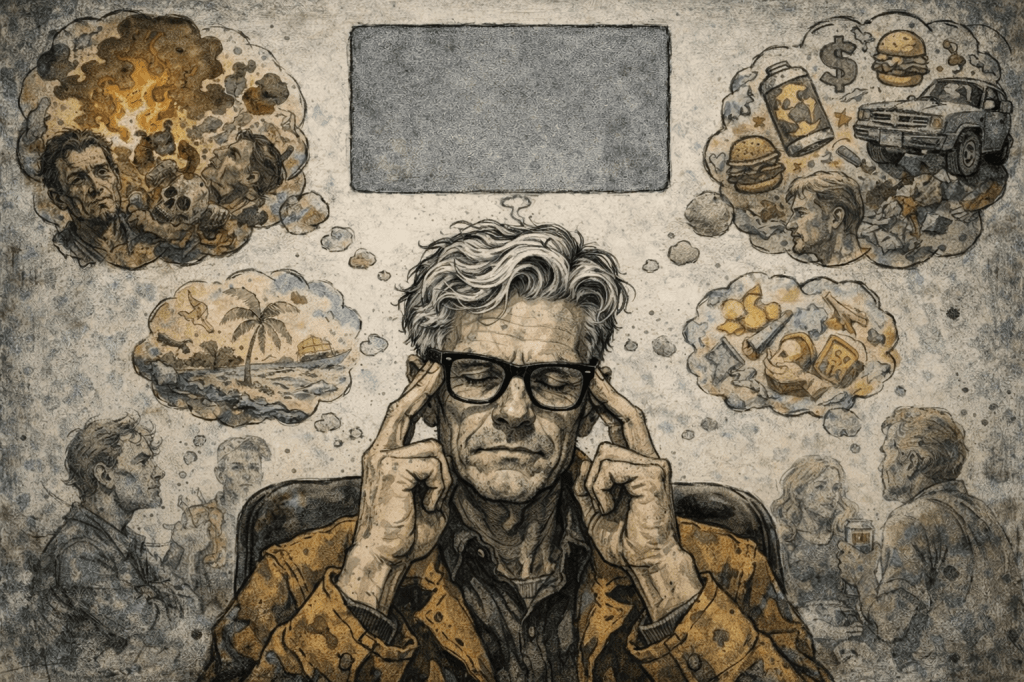
There I was on 87, Ubering one of my kids to a travel baseball tournament in New Jersey — kid in the back with headphones on, or asleep, which amounts to the same thing. Half-listening to NPR because it’s either that or the silence where my own thoughts live. And a Radiolab episode came on and I had a moment.
Not a pull-over moment. But close.
The episode was about aphantasia. It was reported by a Radiolab producer named Sindhu Gnanasambandan — and the reason she made it is because she has it herself. She’d been working on an entirely different episode about memory when a neuroscientist asked her to close her eyes, picture a red apple, and describe what she saw. She saw nothing. Blank. She thought the exercise was figurative. It wasn’t. The host asking the question was clearly seeing it vividly, and Sindhu was just sitting there going: yeah. I know. I can’t either.
And I’m in the car going: same.
Because I cannot do it either. Or — I can almost do it. Sort of. I get fragments. Flashes. It’s less like seeing a picture and more like trying to develop film in a bathtub with the lights on. You get the suggestion of a shape, maybe an outline, maybe a color that might be right — and then it dissolves. You can’t hold it. I always assumed I just wasn’t concentrating hard enough. Turns out that’s not what’s happening. That’s just the ceiling.
For most of my life, I assumed “mind’s eye” was a figure of speech. Like when people say “picture that” they mean something like “consider that” — not that they’re literally projecting a rendered image in their head like a movie they can pause and zoom in on. Finding out that’s actually what most people are doing was genuinely disorienting. Like learning that everyone else has been hearing a soundtrack while they read and you’ve just been doing it in silence.
About 4% of the population has aphantasia. The term was only coined in 2015 by a professor at the University of Exeter — named for Aristotle’s word for the mind’s eye, “phantasia,” with an “a” dropped in front to denote its absence. Ed Catmull — president of Pixar, that Pixar, the company that made a career out of making you cry about animated toys — has aphantasia. Blake Ross, co-creator of Firefox, came out about it in 2016 and apparently broke a small corner of the internet. John Green — the novelist, the guy who wrote The Fault in Our Stars — apparently has it too, which I find both comforting and absurd. The man writes in imagery for a living. Researchers initially assumed people with aphantasia would mostly end up in scientific and technical fields, and the data does lean that way. The people with extremely vivid mind’s eyes — hyperphantasia — tend toward creative industries. So I am, apparently, an outlier.
The confusing part — I dream visually. Clear, narrative, recurring locations — I have an entire inner geography of places that don’t exist. Researchers say this is actually pretty common for people with aphantasia. Waking imagery and dream imagery appear to run on somewhat separate systems. Which means my brain is apparently hoarding the good visual software for when I’m asleep and can’t use it productively. Helpful.
The memory thing hit differently once I had a name for it. My long-term memory is selectively weird — some things I recall with strange clarity, whole swaths of time are just gone. I always assumed that was a character flaw, that I wasn’t paying enough attention, wasn’t present enough. But there’s research suggesting that visual imagery is a significant part of how episodic memories get encoded and retrieved. If the image doesn’t form and stick, the memory doesn’t quite stick the same way. That goes a long way toward explaining certain things.
My wife remembers everything. Every room she’s ever been in, every color, every arrangement. She also navigates by visual landmarks — she’ll tell me to turn at the blue house with the striped mailbox and I will have absolutely no idea what any of those words mean in sequence. She’s not wrong. I just don’t retain the visual reference. We’ve had variations of this argument for 25 years and neither of us is going to win it.
The face recognition thing is supposed to be a known problem for people with aphantasia — the research flags it specifically. And yet I’m actually good with faces. I’ll recognize someone from years ago across a room before I can even produce their name. Names I’m terrible at. The name doesn’t have an image to attach to. But the face itself somehow sticks. I have no explanation for this. I’m just reporting what I observe.
Now pile dyslexia on top of it. I invert numbers and letters. It’s gotten more manageable over time through a lifetime of workarounds, but it’s still there. And I was a bad speller growing up — not careless bad, genuinely bad in a way that didn’t respond to effort.
Part of that has an explanation I only discovered recently. Around second or third grade in Miami, my school introduced something called ITA — the Initial Teaching Alphabet — a 44-character phonetic system designed to make learning to read easier before transitioning kids to standard English. It was used in US schools through the early 70s and then quietly phased out because the transition didn’t work. A lot of kids who went through it have never been able to spell correctly since. I didn’t know until recently that I was part of an educational experiment that didn’t pan out.
German was also my first language. My parents were immigrants; my father’s parents spoke only German, and I spent a lot of time with them. I started kindergarten at four — my birthday is November 30th, which made me the youngest kid in my class by a significant margin every single year. And German has consistent phonetic rules while English is chaos. My brain may have spent its formative years trying to apply one system’s logic to a language that has none.
A friend recently described how his daughter’s reading difficulties were diagnosed: your brain reads through prediction, like a language model, guessing the most probable next word based on what came before. For some people those probability weights are miscalibrated, and the guessing keeps misfiring, and the result is frustration and avoidance. That framing recontextualized a lot for me. Maybe the ITA trained my prediction system on an alphabet that doesn’t exist in adult English. Maybe two competing language systems laid down conflicting rules early on. And maybe a brain that can’t anchor words to visual images — the aphantasia piece — left me without the backup system most spellers rely on without knowing it. Whatever algorithm underlies reading and spelling, mine got scrambled from multiple directions at once.
And then there’s ADHD, which at this point I mostly use as a blanket explanation for everything I can’t otherwise account for. But is the ADHD causing the attention issues, or is the aphantasia causing them because I can’t anchor things visually, or is the dyslexia creating the frustration that looks like attention problems? Are they all just different expressions of a brain that organized itself differently and we’re only now getting around to mapping the territory? I genuinely don’t know. Nobody seems to fully know.
Here’s the part I keep coming back to: I spent 25 years working in visual media. Broadcast television. Motion graphics. Creating things people looked at. And I apparently was not terrible at it.
What I think happened is adaptation. Without a reliable internal image to work from, I compensated with structure and sequence. I work problems out in logical steps because I can’t hold a visual mockup in my head and rotate it. What I can do is understand a system, map the relationships between the parts, and build toward something methodically. That turns out to be a reasonable set of skills in a production environment. Maybe not what you’d expect from someone who can’t picture a red apple, but here we are.
There was a trip years ago — driving through the south of France with my siblings, early morning, through lavender fields, and there was this farmhouse against the sunrise with a full moon still sitting in the sky behind it. I remember that I found it beautiful. I believe the house was some shade of blue — French blue, maybe. I remember the feeling of the moment. But the image itself? Dissolved a long time ago. Filed under: things I know happened.
Maybe I’m overthinking all of this and this is just the modern social media version of discovering you have a syndrome. Maybe. But the lavender field thing — I’m sure about that one. I just can’t see it anymore.
The episode that started this: Radiolab — Aphantasia. It also ran as part of Science Vs on Spotify. Worth a listen either way, especially if you just tried to picture a red apple and got nothing.


Leave a Reply