
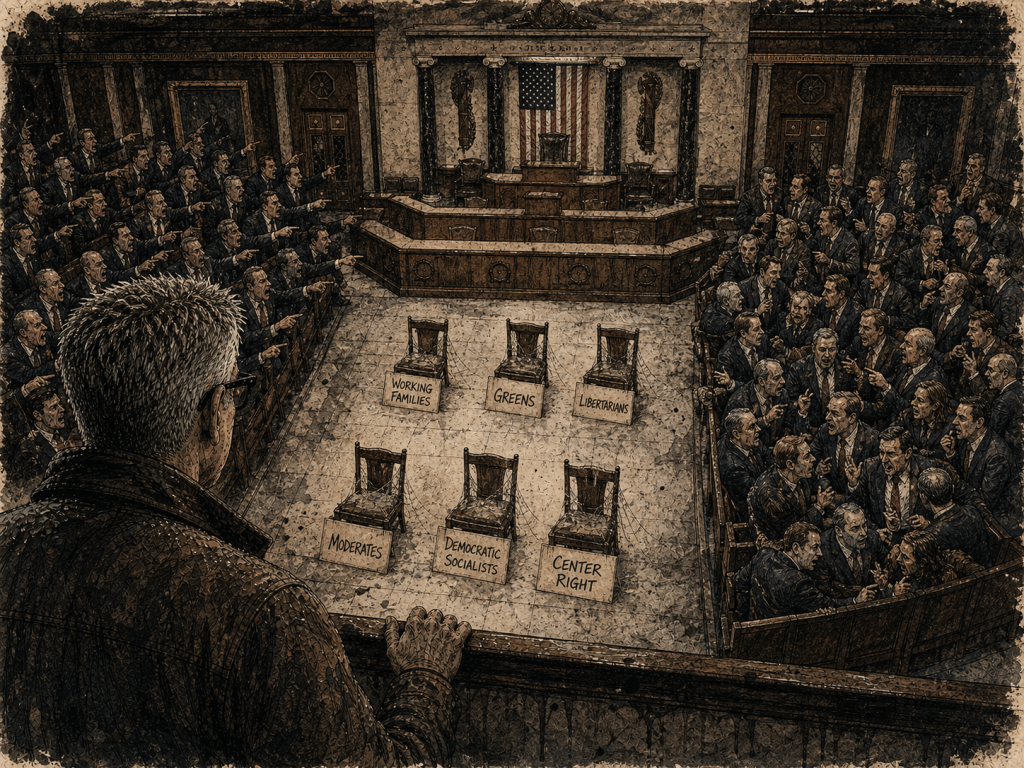
A new US party structure, by way of Germany, the Netherlands, New Zealand, and the Nordics.
Three things need to change if we want a country that actually moves instead of just performing motion for the cameras:
- Kill the Electoral College.
- Reweight the Senate so a Wyoming voter isn’t carrying about sixty-seven times the weight of a Californian.
- Break up the two-party stranglehold.
The first two are arguments for another day. This one is about the third — because the two-party system isn’t some sacred American invention. It’s a side effect of how we vote. Winner-take-all districts plus a presidential system that crushes any third option before it gets a heartbeat. Almost no other functioning democracy does it this way, and most of them aren’t this paralyzed.
Quick caveat before we go any further. Even inside that third question, there are two huge mechanical roadblocks I’m setting aside for separate posts. Citizens United turned campaign finance into a market where whoever spends the most buys the most speech, and fifteen years of compounding damage means you can’t run a competitive race without selling pieces of yourself to people who already have all the money and want more. The Republican rolling ban on ranked-choice voting — nineteen states as of March 2026, every single one out of a Republican-controlled legislature, plus a bill sitting in Congress right now trying to kill it in federal elections too — is the active legal effort to make sure no third option ever gets traction. Both are real and both are doing serious damage. Each deserves its own post. This one is a thought experiment about what the field could look like if those weren’t in the way.
So before we talk about what an American multi-party landscape might look like, let’s see how the rest of the grown-ups handle it.
First, Why Is It Even Called “Right” And “Left”?
Because of a seating chart. Seriously.
In the summer of 1789, the French Estates-General turned itself into the National Assembly and started arguing about what to do with King Louis XVI. The deputies who wanted to keep the king, the church, the aristocracy, and the whole pre-revolution machinery intact sat to the right of the chair. The deputies who wanted to burn the whole thing down and start over sat to the left. One royalist baron at the time explained that he tried sitting in different spots to stay independent and got heckled into submission — “I was compelled absolutely to abandon the left or else be condemned always to vote alone.”
That’s it. That’s the whole origin story. Not ideology — geography. Pro-king on the right, anti-king on the left. The press picked it up, the seating stuck through every successive French assembly, and by the mid-1800s “la droite” and “la gauche” had become shorthand across Europe for opposing political camps. The terms didn’t really enter American political vocabulary until the early 20th century, which is funny when you consider how locked in we are with them now.
So here’s the question — are these words still doing useful work?
“Right” actually still kind of fits, in a depressing way. The original right-wingers wanted to preserve the king, the church, the inherited hierarchy, and the existing distribution of property and power. The modern American right wants to preserve a particular racial and religious hierarchy, the inherited distribution of wealth, and the institutions that protect both. Different king. Same instinct. Consistent for 236 years.
“Left” is doing way more work than the word can carry. It now has to cover a center-left Democrat who wants to expand the ACA, a Working Families voter who wants stronger unions, a Democratic Socialist who wants Medicare for All, a Green who organizes around climate first, and an anarchist who doesn’t want a state at all. Those are not the same direction. They’re not even necessarily the same map. Calling all of them “left” is like calling everything north of Tennessee “the North.” Technically true, not actually useful.
Which might be why it so often feels like the right is wrong and the left is lost. The right has narrowed itself down to a smaller and smaller ideological core but votes lockstep behind it. The left is bigger, more diverse, more humane on paper, and spends most of its energy fighting itself in primaries — then handing the keys every other cycle to people who genuinely don’t believe in democracy.
A multi-party system doesn’t fix that automatically. But it does give those five or six different left-of-center directions their own boats and their own ballot lines, instead of forcing them all onto the same deck to fight over the rudder. And it forces them to coalition when the math demands it — which means they cooperate over real shared priorities, instead of pretending to be a single ideology they aren’t.
The labels are stuck. The seating chart isn’t.
Germany: Six Parties, A Threshold, A Firewall
Germany runs proportional representation. You get two votes — one for a local candidate, one for a party. The party vote determines how many seats each party gets in the Bundestag. To get any seats, you have to clear 5% of the national vote. That keeps single-issue vanity parties out without crushing real options.
The relevant parties right now:
- CDU/CSU — center-right Christian Democrats, currently leading the government
- SPD — center-left Social Democrats, the oldest party in the country
- AfD — far-right, took 20.8% in the last election and every other party still refuses to coalition with them (they call this the Brandmauer — the firewall)
- Greens — climate plus civil rights, originally out of the peace movement
- Die Linke — democratic socialists
- FDP — free-market liberals, currently below the threshold
Almost no one wins outright. So they coalition. Right now CDU/CSU and SPD — historic rivals — are running the country together because the math demands it. That used to be unusual. It’s becoming normal.
The point: a 5% threshold keeps the ballot from turning into a buffet, but proportional representation means real opinions get represented. You can’t splinter the vote into nothing, but you also can’t get steamrolled by one party that “won” with 47% of the vote.
The Netherlands: Fifteen Parties, Constant Negotiation
The Dutch take it further. Parliament has 150 seats and the threshold is essentially one seat, around 0.67% of the vote. So they have D66, PVV, VVD, CDA, GroenLinks-PvdA, JA21, BBB, SP, the Animal Party, the Christian Union, the Reformed Political Party, DENK, Volt, 50PLUS, Forum for Democracy. I’ll stop.
The new government, sworn in in February 2026, is a three-party minority coalition holding 66 of 150 seats. The Prime Minister, Rob Jetten, has to negotiate every single piece of legislation with opposition parties to pass anything. Sounds like a recipe for permanent gridlock.
It’s not. Because the culture expects coalition-building. Dutch politicians know they’ll be governing with someone they ran against, so the rhetoric stays inside certain limits. You can’t burn every bridge when next month’s bill needs three of those bridges still standing.
Downside: this latest government took 117 days to form. Upside: when they pass something, it’s actually been worked out.
New Zealand: They Voted Their Way Out of First-Past-The-Post
This is the one Americans should pay the most attention to. Until 1996, New Zealand had a system like ours — winner-take-all districts, two big parties trading power. They held a referendum and dumped that system for Mixed Member Proportional.
Now you get two votes: one for your local rep, one for the party you want represented in parliament. The party vote determines the share of the 120 seats. To enter parliament, a party needs 5% of the party vote or one electorate seat. In 2011 they held a second referendum asking voters if they wanted to go back. They didn’t.
The result: coalition governments are the norm, no one party can run wild, and small parties — Greens, ACT, Te Pāti Māori — actually have leverage.
The lesson is that the system change can come from the voters. They didn’t wait for the two ruling parties to give up their advantage. They went around them.
The Nordics: Consensus by Design
Denmark, Sweden, Norway, Finland, Iceland — proportional representation, multiple parties, coalition governments. A single-party majority is so rare it’s basically a unicorn. Sweden’s Social Democrats have won an outright majority once since 1945. That was 1968.
Political scientists call these “consensual democracies.” The argument is simple: when you know you have to coalition with someone, you can’t scorch the earth. Tomorrow’s enemy is next week’s partner. You moderate. You negotiate. You stay inside certain rhetorical bounds because the math forces you to.
The parties cluster into roughly the same shapes you see in Germany — center-left social democrats, center-right liberals or conservatives, greens, far-right populists, left-socialists, and a centrist or agrarian middle. That same cluster keeps showing up across all of these countries. Six or seven flavors of opinion, repeated.
Which is suspicious, isn’t it. Because we have those same flavors of opinion here. We just keep getting told we only have two.
What An American Eight-Party System Could Look Like
Here’s where I started — and what I want to actually think through. My rough list, placed left to right:
The Red Hatters (Fazi) Party (sits on the right end). White Christian nationalism, anti-immigration, anti-democracy when democracy gets inconvenient, performative cruelty as policy. Currently calling themselves MAGA, having taken over most of the GOP and brought along the Tea Party, the Christian nationalists, and the openly fascist fringe that the rest of them stopped pretending wasn’t there. Already exists. Most of the Republican Party is here now.
Libertarians (right of center, off-axis). Minimal government, free markets, civil liberties, drug legalization, non-interventionism. Already exists. Locked out by two-party math.
Center Right. What old-school Republicans used to be, and where the ones who didn’t roll into MAGA would go if they had a home. Fiscal restraint, business-friendly regulation, strong defense, socially moderate. The Liz Cheney / Mitt Romney / Murkowski wing without having to apologize every morning for the lunatics they’re chained to.
Moderates. The technocrats. Whatever works. Probably gets the largest single share of the vote in a real PR system because most Americans actually live here, even if our current system pretends they don’t.
Center Left. Modern Democrats — affordable healthcare, climate action, labor rights, civil rights. The current Democratic establishment, more or less.
Working Families. Bernie’s coalition minus the socialist label. Pro-union, anti-corporate consolidation, economic populism, healthcare as a right.
Democratic Socialists. AOC’s wing. Medicare for All, tuition-free public college, public housing, wealth tax, public banking.
Greens. Climate policy as the organizing principle, plus participatory democracy and decentralization. Already exists. Locked out by math, again.
That’s eight, which is roughly a German setup plus one. And it lines up pretty well with the actual distribution of political opinion in this country — which right now is being squeezed into two boxes that satisfy almost nobody, and rage-feeding the people stuck inside them.
The Hard Part
Adding parties doesn’t fix anything by itself. You also have to fix the math.
That means proportional representation. Ranked-choice voting at minimum. A threshold around 5% so the ballot doesn’t become a phonebook. It probably also means moving toward a more parliamentary structure where the executive emerges from coalition rather than getting elected separately and then spending four years fighting a Congress that hates them.
And it means a culture shift. The reason German and Nordic politics works is partly the rules and partly the expectation. Politicians know they’ll have to govern alongside the people they criticized last week. Voters reward coalition-building instead of punishing it as betrayal. We don’t have that culture. We have a culture where compromise is treason and any concession to the other side is a sign of weakness or corruption. That doesn’t change overnight. But it absolutely doesn’t change at all under the current rules, because the current rules reward maximalism. The louder and meaner you are, the more your base loves you, the safer your seat is.
Change the math, the culture follows. Maybe slowly. Maybe ugly. But it follows.
Get rid of the Electoral College. Reweight the Senate. Break the two parties. Then maybe — maybe — we get a country where ideas get tried instead of just yelled about.
Most won’t get it. That’s been the point all along.


Leave a Reply