
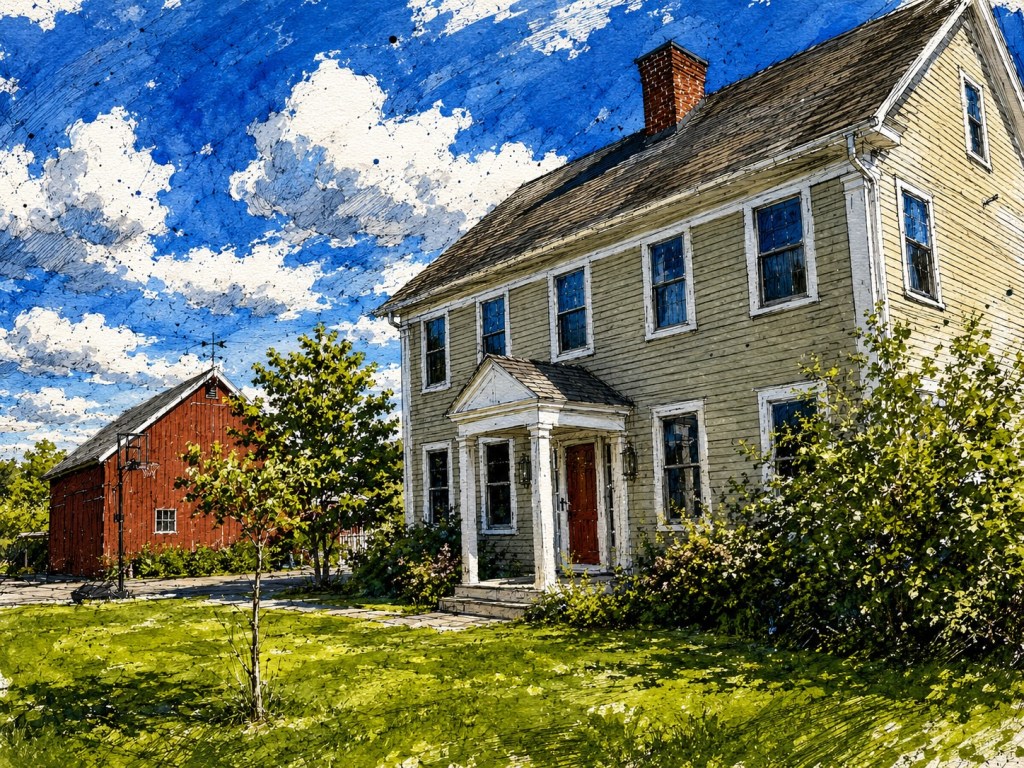
This New Old House, Part 23: Mistakes Were Made. Lessons Were Learned.
So here we are. The end of the road. Or at least the end of the story as I’ve been telling it.
If you’ve read this series from the beginning, you know we built a Connor Homes kit colonial on 14 raw acres in Gardiner, New York starting around 2009. You know about the clay, the chimney, the concrete countertops, the windows we regret, and the framing contractor who worked on speed rather than precision. You know Jennifer’s fingerprints are on every good decision this house has and that my fingerprints are on most of the ones we’d redo.
If you’ve been keeping score on the grades I’ve given us throughout this series, you might expect the final overall grade to reflect all of that. And look — we made plenty of mistakes. Some we caught. Some we only discovered after living here for years. But here’s the thing: if we had stumbled upon this house already built, exactly as it is today, with the barn and the porches and everything we’ve added since? We would have been ecstatic. We would have thought we found something special. Because we did. We built it. Grade: A+.
That said — if you’re thinking about doing something like this yourself, especially building on raw land, especially building something that feels like it belongs somewhere rather than something that rolled off a production line — I have some things to tell you. Consider this the checklist I wish someone had handed me in 2008.
Phase 1: The Land
This is where it starts and where most people underestimate everything.
The checklist:
- Research the development status of the land before you fall in love with it. Is it ready to build on, or does it still need utilities brought in?
- Commission a survey. Know your property lines before you do anything else.
- Do a perc test. Not after you buy — before. This is non-negotiable.
- Check for wetlands. In New York, this can kill a build plan entirely or push your footprint somewhere you didn’t want it.
- Evaluate soil. Get a core sample done. Sinkholes and ledge rock are not things you want to discover after closing.
- Assess drainage. How does water move across and off the property? Where does it pool?
- Look at road access. Can a concrete truck get in? A crane? Delivery vehicles? If the road is unpaved, narrow, or steep, budget for gravel and logistics headaches.
- Understand the zoning. Setbacks, lot coverage, what you can and can’t build, ADUs — know it all before you commit.
- Talk to the town early. Permits, driveway permits, utility permits — there’s a sequence and it takes longer than you think.
What we learned:
We had clay. A lot of it. That meant the standard septic field wasn’t an option — we had to go above-ground, which added significant cost. Nobody hands you that information upfront. You find it out when the engineer does the perc test and suddenly your budget has a new line item. Research the geology of the area before you buy. Talk to neighbors who’ve built. Call the county health department. Do your homework on what a failed perc test or a clay-heavy soil profile actually means for your wallet.
On drainage: we got lucky with the natural grade of our land, but we still ended up having to think hard about where water goes around the foundation. Plan for gutters from day one. Do not treat gutters as an afterthought. Water and foundations are not friends.
On access: more property means more grading, more site work, more time, and more money before a single piece of framing goes up.
Phase 2: Financing and Legal
The checklist:
- Get pre-approved for a construction loan before you do anything else. Seriously. Before the architect, before the land purchase, before the daydreaming.
- Understand the difference between a construction loan and a traditional mortgage and how the draw schedule works.
- Build a contingency into your budget. Not 5%. Closer to 20%. Everyone says it’ll cost more than you think. Everyone is right. You will ignore this advice. Do it anyway.
- Review your deed for easements, right-of-way, and any restrictions.
- Hire a real estate attorney. This is not a DIY moment.
- Confirm zoning allows your intended use, structure type, and any outbuildings you’re planning.
What we learned:
The cost overruns will happen. I knew they would happen. I thought knowing that would help me prepare for them. It didn’t. The gap between what you budget and what you spend is real and it is humbling. I would do it again. I would still probably underestimate. But at least I’d know that going in and build a bigger buffer.
Phase 3: Design and Planning
The checklist:
- Decide early: architect-designed custom, design-build, kit/panelized, or modular. Each has real tradeoffs on customization, cost, and construction quality.
- If you’re going kit or panelized (as we did with Connor Homes), understand exactly what the package includes and what it doesn’t. The gap between the kit and a finished house is substantial.
- Orient the house on the lot intentionally. Think about sun angles, prevailing winds, views, and solar gain in winter. A little geometry upfront pays off for decades.
- Design for how you’ll actually live, not how you imagine you’ll live.
- If you’re building in phases or planning additions later (barn, porches, garage), rough in the layout now. Leave the right clearances. We got lucky on our barn placement. Don’t rely on luck.
- Nail down your must-haves vs. nice-to-haves before construction starts. Changes mid-build are expensive.
- Think about your basement from day one, not as an afterthought.
What we learned:
We went with a kit colonial and I stand behind that decision for what we were trying to do. The bones of the house have character. But if I were starting over, I’d be looking hard at craftsman-style, probably a smaller footprint but done smarter — what I’d call a large small house or a small large one, depending on your perspective.
We came in about 4 feet short on each dimension. Not a disaster. But a little more square footage would have bought us more flexibility in bedroom layout and given us room to breathe around the chimney. Speaking of which —
The chimney. Center-of-house chimney is dramatic. It’s a real feature. It draws comments. But it consumes floor plan space that you can’t get back, and ours was done by our concrete contractor as a side deal to save money. Hire specialists for specialized work. Always. Every time. The chimney was not done the way we wanted it. The brick, the mortar — we didn’t get what we asked for. Being more specific in your specs upfront will save you significant pain on the back end.
Phase 4: Site Prep and Foundation
The checklist:
- Clear and grade the site. Understand what that actually costs before you start.
- Drill your well and test the water before you build around it.
- Complete the septic design and installation as early as possible — it affects your footprint.
- Pull your driveway permit. This takes longer than you expect and the town has opinions.
- Move utilities. Coordinate early with the utility companies.
- Choose your foundation type. Full basement, crawl space, slab — each has implications.
- Pour the basement deeper than you think you need. Even if you say you’ll never use it, build it like you will. You’ll change your mind.
- Insulate the foundation walls and pour a concrete floor, not just a dirt floor. Spray foam in the walls, rigid foam under the slab if you can manage it.
- Install proper drainage around the footings. This is not the place to cut corners. Use the right pipe — not everything sold at the big box stores is appropriate for below-grade drainage under load.
- Plan the basement egress now, not later. An exterior door that walks out at grade is infinitely better than Bilco doors and stairs going down. If you have any slope on the site, you probably have an opportunity to make this work.
- Install the largest foundation windows you can. This is a three-for-one decision: egress compliance if you ever convert the space to living area, actual natural light so the space is usable, and in some jurisdictions finished basement square footage is assessed differently for taxes — the window sizing can affect whether that space counts. Know your local rules before you pour.
What we learned:
Not all drain pipe is equal. There are materials sold in home improvement stores that should not be used for certain below-grade applications. Your contractor may not tell you this. Ask specifically. Specify the pipe. Put it in the contract.
Build your basement to be used. We didn’t. Our only access right now is through Bilco doors down steps. It works fine for how we use it. But there was an opportunity to carve out a walk-out when we were grading anyway. Hindsight.
Phase 5: Framing and Envelope
The checklist:
- Vet your framing contractor carefully. Get references from recent projects. Visit those projects.
- Specify your framing tolerances. In writing. Framing crews work on speed. Speed and precision are not the same thing.
- Consider whether a panelized or prefab framing system would give you better dimensional accuracy.
- Once the envelope is closed, run dehumidifiers. Continuously. Before drywall, before paint, during drywall, during paint.
- Spray foam insulation: understand the tradeoffs. It performs well but there are concerns about off-gassing and the long-term debate around hot attic applications. We went hot attic (foam on the rafters, not the ceiling deck). The jury is still out.
- If you’re building tight, plan your ventilation system from the start. You need a way to exchange air. ERV or HRV — spec it early, don’t add it as an afterthought.
- Windows: this is not where you cut costs.
What we learned:
Here’s the thing about framing contractors: close enough is their professional standard. That’s not a dig — it’s just the reality of the trade. Stick framing is fast work and fast work is approximate work. The reason our framing came out as well as it did is that we were working with a panelized kit system. The panels came pre-engineered and dimensionally accurate. The framers were essentially assembling something that had already been figured out. If we had gone stick-built, I think we would have had real problems. The kit system protected us from the tolerance gap that lives in most framing crews.
If I were doing another build from scratch, I would find a way to make prefab work for the design I wanted. Get the bones done right in a controlled environment. Don’t leave dimensional accuracy up to guys working on speed in a field.
Moisture is the enemy you don’t see coming. When you’re building, there is moisture in the lumber, in the drywall compound, in the paint. If you close the envelope tight with spray foam and don’t run dehumidifiers aggressively through that whole process, you will get movement in your materials as they dry out over time. We ended up with gaps in our wide-plank floors. Some of that is just the nature of wide plank — go into an old house and you’ll see the same thing. But we could have reduced it with better moisture management early on.
Windows: Avoid the Architect Series. We did not avoid the Architect Series. We have spent years managing the consequences of that decision. If I had to do it again, I’d go Marvin. I’d go triple pane if the budget allowed. I would not try to save money on windows in a climate like ours. The windows are the thermal envelope. Treat them like it.
Phase 6: Mechanical Systems
The checklist:
- HVAC: decide your system strategy before framing, not after. Where the ducts go affects framing decisions.
- Size everything properly. Get a Manual J load calculation done by someone who knows what they’re doing.
- Plumbing: run dedicated lines for your exterior hose bibs directly from the source with independent shutoffs so you can winterize them without killing the whole house.
- Plan at least two plumbing zones in the house. Make sure at least one bathroom is on each zone.
- Hot water: understand your options (tank, tankless, heat pump water heater, indirect off your boiler) and their tradeoffs before you commit.
- Septic: make sure it’s properly sized for the house. Ask specifically.
- Electrical: plan your panel capacity for the future, not the present. Electric vehicles, heat pumps, induction — these things draw power. Leave room.
What we learned:
Mini splits: don’t. I know they’re everywhere. I know people love them. I don’t think people will still love them in 15 years. Run ductwork. Do it right the first time.
Forced hot air in a cold climate: also don’t. I know that’s a strong position. I stand by it. We went hydronic and I’d make that same call again, a hundred times. The ideal system, if I were building today, would be a heat pump hydronic setup — radiant or European-style panel radiators with individual room controls, supplemented by an air-to-water heat pump for shoulder seasons, with a backup for the deep cold. The technology is getting there. Mitsubishi and some of the European manufacturers are further along on this than people realize, but the cold-climate hydronic heat pump hasn’t fully arrived for residential yet. When it does, that’s the move.
Fossil fuels: we’re still on propane. I’m not proud of it. Solar offset is the path I’m watching.
For your plumbing fixtures: if you’re using architectural salvage, inspect the surfaces before installation. A tub that needs resurfacing should be resurfaced before it goes in, not after. And there are methods of resurfacing that are better than others — the spray-on approach has a shorter lifespan than the poured method. Ask, verify references, do it right.
Phase 7: Finishes and Selections
The checklist:
- Kitchen cabinets: spend more than you think you need to. Inset doors, solid construction, quality hardware. You will use these every day for 20 years.
- Countertops: concrete is viable. I’d recommend it. I would not necessarily recommend doing it yourself unless you’re prepared for the process.
- Bathroom floors: tile. In a house that’s mimicking historic character, wood in the bathroom feels right. It’s not right. Tile the floors.
- Shower tile: minimize grout lines. Subway tile, large format tile, anything that reduces the grout surface area you’ll be maintaining forever.
- Exterior trim: PVC. Make sure whoever installs it has experience with it. It moves with temperature in ways that wood doesn’t and the install technique matters.
- Siding: fiber cement. Hardy board. Something that doesn’t require you to re-engineer what already works. Avoid re-engineered traditional materials.
- Porches: build them bigger than you think you need. Then build them bigger than that.
- Roofing: if you’re staying in the house, buy good shingles. The cheap ones will need replacing sooner and you’ll know you cut that corner every time you look at it.
- Appliances: buy from a local dealer who’s been around. Warranties mean nothing if the company goes out of business. Online appliance deals are not always the deals they appear to be.
What we learned:
Plan on replacing major systems and appliances in 5 to 10 years. All of them. Even brand new. This is not how you think about it when you’re building a new home. You think: new house, no repairs. That’s not the world we live in. HVAC air handlers, appliances, water heaters — they are not built to last. Accept it, budget for it, and find a good local HVAC and plumbing outfit and keep their number in your phone.
The Overall Grade
So what’s the verdict?
If I’m being honest — and 22 parts of this series have been nothing but — I’d build this house again. I’d know more going in. I’d be more specific with every contractor. I’d hire specialists for specialized work instead of making deals. I’d get the windows right. I’d build the basement to be used. I’d add four feet in each direction.
But I’d build it again.
The house is genuinely great. Not perfect. Great. And if we stumbled across it on the market — this specific house, this land, this barn, these porches — we would think we found something. Because we did. We built it.
Overall grade: A+
If you want to read the full series from the beginning, start here. If you have questions about any of it, the comments are open. Godspeed to anyone about to do this.
 Even that's Odd
Leave a comment