
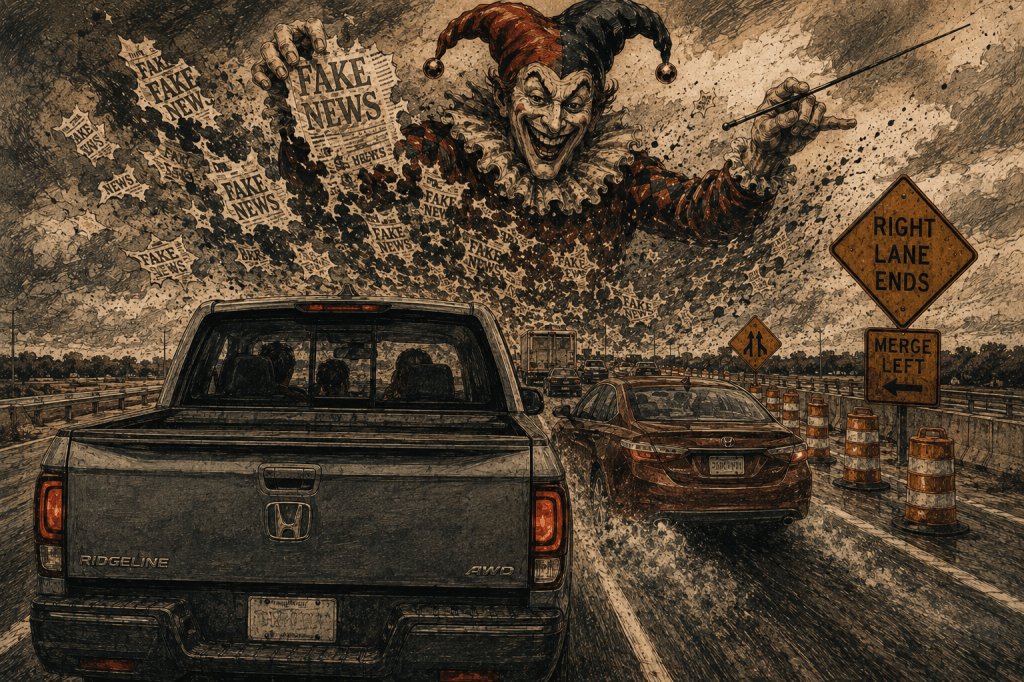
For the odyssey is trickster, agent of chaos.
A couple of things have been on my mind. One of them annoys and fascinates me at the same time; the other is the part I just find fascinating — perception and perspective.
I saw a piece recently about naive realism, and how we all suffer from it. The core of it is simple: we perceive that we’re right and other people are wrong.
What triggered it for me was somebody referencing George Carlin’s bit about driving. Your driving is perfect, and everybody else on the road is an asshole — anyone slower than you is an idiot, anyone faster is a maniac. For the most part, that fits. That’s naive realism in a nutshell.
But then there are the specific instances where it shifts, and it stops being perception. It becomes reality.
The bridge
Where we live, there’s a bridge we have to cross to reach the town where a lot of our doctors are. It’s an older bridge, and they reconfigure it depending on the time of day. It was never set up for the traffic it gets, so there’s always a problem. They’ll close the right lane and funnel everybody left, and a line builds up. Then you get the people who ignore the signs — they know the right lane is closed, but they ride it all the way down to the front to cut in.
There was one time, my kids were younger, and we were in the usual jam because the whole thing bottlenecks. You’re crawling, the limit’s like 25, and eventually you get to the point where it zippers — except it isn’t really supposed to zipper, and people who live in the area know that.
I was going over the bridge, there was no space, and this guy cut in and nearly caused me to crash into him. There was absolutely no room. It was so abrupt, so sudden, so needlessly reckless that I couldn’t contain myself — I try not to curse in front of my kids, but I just said, “Fucking asshole.”
That wasn’t naive realism about the way he was driving. That was reality. He was reckless.
And that’s what makes driving the perfect example of the whole thing. You’re going the perfect speed. Anybody flying past you is a lunatic, anybody crawling is an idiot — either way, they’re just wrong.
From the road to everything else
It’s the same way we navigate politics. Anybody more liberal than you is a lunatic; anybody more conservative is too. Their ideas will never work. Wrong in both directions.
It’s a human flaw — part of how we get through the day, how we live inside our own heads. It’s easier to be the one who’s right, to believe your way is the correct way. Some people are introspective enough to catch themselves doing it, but a large portion of the population can’t, and that causes a lot of problems. People are going to fight, and their ability — or inability — to stay open to other ideas really shapes the outcome.
It feels especially prevalent right now, because there’s a very disruptive force at work. There’s good and bad in that disruption, and what we do with it from here is what matters. Part of the problem is that not everybody even sees it as a disruption, and there’s real frustration in that.
This is just my opinion, and I’ll run it through a fact-check of my own. It’s interesting to pull information from AI — it tends to be colored in every direction, and it lands on consensus even when the consensus is narrow. But there’s still some validity in it, and it does try to be unbiased. Anyway.
Is the media actually biased?
Naive realism led me straight to this, which I was going to make its own post, because it really gets me. It’s alarming, and it’s very much a sign of the times.
There’s this whole attack on the free press. News you don’t like is “fake news.” “They’re only covering it because they’re liberal.” So I asked the obvious question: is the media really biased, or is it something else?
What kept coming up was this: perceived media bias is real. Not “media bias is real” — perceived media bias. That’s the distinction.
So why is coverage considered biased, and why does it make people so angry? Some of it is naive realism straight up: your view is right, everything else is wrong. That alone is going to trigger people.
But a lot of it comes down to what gets covered and who does the covering. Reporters tend to live in urban areas and tend to be more educated, so they’ve been exposed to more. They travel, they see different parts of the world, they live in dense media centers packed with people — and, you could say, in closer proximity to suffering. Their perspective — and this is my perspective on their perspective — gets shaped by that exposure.
Being exposed to different things opens your eyes. You see what other people are going through. You live right on top of your neighbors; you can’t get away from people. In a rural environment, if you’re not traveling, you’re in a smaller bubble, and that bubble limits your reality — your worldview. You’re not exposed to those things, and the unknown is fearful.
So the people who go into journalism tend to come from those denser environments and cover those perspectives more. You can see that people are suffering, so you cover it. If you were never exposed to it, you wouldn’t. They lean toward more liberal, progressive coverage simply by the nature of their lived experience.
From where I stand, that exposure doesn’t corrupt them — it rounds them out. If you live around other people, get to know them, and see what’s actually happening, your perspective should be more well-rounded, not less. So when they don’t cover somebody’s narrow view, they get labeled biased — when in some ways they’re probably less biased, because of that exposure. Actual bias and perceived bias are two different things.
That said, here’s the real question: do you develop biases from your experiences? Yes — you can’t get away from that. You can fight the naive realism, you can try to hold perspective, but there aren’t always two sides to a story. Sometimes things are just wrong. Different viewpoints exist, but that doesn’t make them right, and it doesn’t mean you have to cover them or give them validity.
Take an election. The one that’s won had no fraud in it; the one that’s lost was “stolen,” full of fraud. So how does it work one time and not the other? There’s no proof, no evidence, no validity in the argument. “But you’re not covering this side of it.” There is no side of it. There’s what happened and what didn’t happen, and what didn’t happen didn’t happen — so it’s not a story. The fact that people are saying it happened, that’s the story.
The trickster
We’ve reached a level of insanity that, hopefully, triggers something — a positive reaction, a positive outcome.
There was one more thing I saw that doesn’t perfectly fit here but stuck with me. Somebody was talking about the Odyssey and the trickster — the agent of chaos. The trickster is part of every society, and it will either destroy that society or give it the chance to prepare itself.
That’s where we are right now. With the falsehoods and everything else, we’re heading down a path — and we’ll either come out of it better, or it’ll destroy us.
Claude Fact Check
The following is an independent fact-check of the claims and references in this post, run by Claude. It’s here for transparency, not to change the argument.
Naive realism is a real, established concept — accurately described. The term was coined by social psychologist Lee Ross and colleagues in the 1990s. It’s the tendency to believe we see the world objectively “as it is,” free of bias — and therefore to assume that anyone who disagrees must be uninformed, irrational, or biased.
The George Carlin quote is accurate. Carlin’s line is: “Have you ever noticed that anybody driving slower than you is an idiot, and anyone going faster than you is a maniac?” It’s one of his best-known bits.
“Perceived media bias is real” — correct, and it has a name: the hostile media effect. Research shows that strong partisans tend to view even neutral or balanced coverage as biased against their own side. It was first demonstrated in a 1985 study by Vallone, Ross, and Lepper, using coverage of the 1982 Beirut events, where both pro-Israel and pro-Arab viewers rated the same footage as slanted against them. Worth noting: the “Ross” in that study is the same Lee Ross who coined naive realism — so the two ideas in this post are directly linked in the research.
Journalist demographics — directionally accurate, with nuance. Surveys support the general picture that journalists (and news-trusting audiences) skew more urban, more college-educated, and more Democratic-leaning. Pew finds urban residents and college graduates place higher value on journalists’ role than rural or less-educated Americans, and separate industry surveys have found the share of journalists identifying as Republican has fallen to low single digits. Two caveats: exact figures vary by survey and year, and the post’s causal claim — that exposure broadens rather than biases coverage — is an interpretation, not a settled empirical finding.
The trickster as “agent of chaos” — accurate use of the archetype. In mythology and literary theory, the trickster uses cleverness and disruption to upend the status quo. The archetype is dual: an agent of both chaos and transformation — capable of destroying an order or forcing it to renew itself. That matches the post’s framing. (In the Odyssey, Odysseus himself is often read as a trickster figure — cunning, deceptive, a boundary-crosser.)
On the election claim: The post’s point — that there’s no evidence for the “stolen election” fraud narrative — aligns with the findings of courts, election officials, and audits regarding the 2020 U.S. election, in which no evidence of fraud sufficient to change the outcome was found.
Bottom line: the factual references in this piece — naive realism, the Carlin bit, perceived/hostile media bias, journalist demographics, and the trickster archetype — all check out. The connections drawn between them, and the conclusions about media and society, are the author’s own perspective, clearly framed as such.


Leave a Reply