
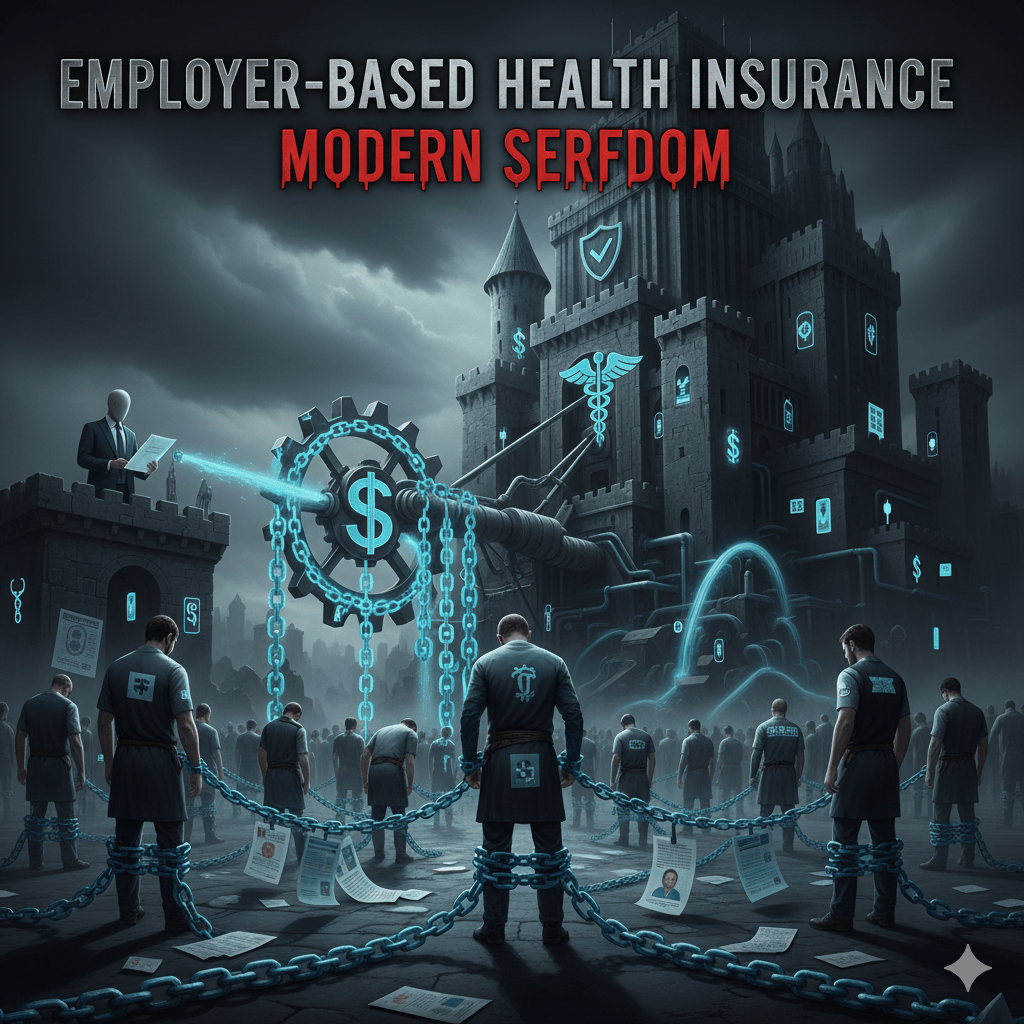
This is Part 5 in a series exploring how American systems are rigged against regular people. Part 1: The Rankings | Part 2: Language Manipulation | Part 3: Follow the Money | Part 4: Congressional Healthcare
The Most Brilliant Trap Ever Designed
Imagine if your grocery store access was tied to your job.
You work at your current employer, you can shop at Kroger. But if you quit? No more groceries until you find another employer. And if that new employer uses a different grocery network? Hope you like the food at their approved stores.
Sounds insane, right?
That’s exactly how American healthcare works.
And it’s not an accident. It’s not “just how it evolved.” It’s the most effective tool ever created to prevent workers from:
- Quitting jobs they hate
- Negotiating for higher wages
- Starting their own businesses
- Organizing for better conditions
- Taking time off to care for family
- Retiring before 65
It’s a system of control disguised as a benefit.
And both conservative and liberal workers are trapped in it equally.
How We Got Here (The Short Version)
1943: World War II wage controls
The government froze wages to prevent inflation during wartime. Employers couldn’t offer higher pay to attract workers.
The workaround: Offer health insurance as a benefit instead. It wasn’t counted as wages, so it bypassed the freeze.
1954: Tax code change
Employer-provided health insurance became tax-deductible for companies and tax-free for workers.
The result: Health insurance became tied to employment.
What should have happened in 1945: End this temporary wartime policy when the war ended.
What actually happened: It became permanent because employers realized it was a brilliant tool for worker control, and insurance companies realized it was a captive market.
80+ years later: Americans assume this is normal while literally every other developed nation looks at us like we’re insane.
How The Trap Works
The Fear Factor
Scenario: You hate your job.
Your boss is a micromanaging nightmare. Your coworkers are incompetent. You’re underpaid. You see a better opportunity across town offering $15,000 more per year.
But:
Your kid has Type 1 diabetes. The insulin and supplies cost $1,200/month without insurance. Your current employer plan covers it with a $50 copay.
Your calculation:
- New job offers insurance, but with 90-day waiting period
- Can you afford 3 months of $1,200/month out of pocket? That’s $3,600
- What if the new insurance doesn’t cover your kid’s insulin brand as well?
- What if the new company’s insurance has a different pharmacy network?
- What if you get there and they fire you during the probation period?
Result: You stay in the job you hate.
That’s not a voluntary employment relationship. That’s coercion.
The Wage Suppression Tool
Scenario: Your employer offers you a raise.
“We’d love to give you $10,000 more per year, but healthcare costs are going up. Instead of the raise, we’re going to maintain your current family coverage. Without that, your premiums would increase $3,600/year.”
Translation: “We’re not giving you a raise, but we’ll frame it like we did you a favor.”
But it’s worse than that:
Because your employer pays for most of your insurance, you can’t easily evaluate if this is a fair trade. How much does the insurance actually cost? What’s the employer’s actual contribution? You’ll never see those numbers clearly.
Meanwhile:
Your employer knows EXACTLY how much they’re paying. They negotiate group rates. They see the total cost. They know that every dollar they put toward healthcare is a dollar they don’t have to put toward wages.
And they know you can’t leave because your kid needs insulin.
Result: Your wages stay flat while your employer uses healthcare as a negotiating weapon.
The Entrepreneurship Killer
Scenario: You have a great business idea.
You’ve worked in your industry for 10 years. You know you could run things better than your current employer. You’ve saved $50,000 to start your own small business.
But:
- Individual market insurance for a family: $1,200-1,500/month = $14,400-18,000/year
- Your spouse has a chronic condition requiring regular medication: $800/month without insurance
- Total healthcare cost if you leave your job: $24,000-28,000/year
- Your $50,000 savings just became $22,000-26,000 after one year of healthcare
Can you bootstrap a business to profitability in one year with $25,000 while also supporting a family?
Maybe. But probably not.
Result: Your business never gets started because you can’t afford to lose employer-based insurance.
Meanwhile:
Your employer doesn’t lose an experienced worker who might become a competitor. Your industry doesn’t get innovation from new small businesses. The economy doesn’t get the jobs you would have created.
And this is called “free market capitalism.”
The “Job Lock” Data
This isn’t theoretical. We have the numbers:
Studies show:
- 1 in 4 workers stay in jobs they want to leave due to health insurance
- “Job lock” affects 3.5-5 million workers annually
- Entrepreneurship rates are lower in the US than in countries with universal healthcare
- Workers with employer-based insurance change jobs 40% less frequently than those without
- States that expanded Medicaid saw 5.6% increase in self-employment (people could start businesses without losing coverage)
Translation: Millions of people are trapped in jobs they hate, working for less than they’re worth, not starting businesses, because losing health insurance is too risky.
How This Affects You (Even If You Don’t Realize It)
You’re Paid Less
Here’s how:
Your employer pays ~$7,000/year for single coverage, ~$21,000/year for family coverage (2023 average).
That money comes from the same pool as your wages. It’s part of your total compensation.
But you don’t see it as income. So when your employer says “we can’t afford raises,” they’re not mentioning the $21,000/year they’re already paying for your insurance.
If healthcare wasn’t tied to employment:
That $21,000 could be:
- Direct wage increase
- Better retirement contributions
- Actual raises that keep pace with inflation
- Performance bonuses
Instead, it’s paid to insurance companies who then spend 17% of it on administrative costs, 6% on profit, and deny your claims 20% of the time.
You Can’t Negotiate
In a real negotiation, both parties can walk away.
Your employer knows: You can’t walk away if it means losing healthcare.
Result: Every negotiation is tilted toward your employer because they hold the healthcare gun to your head.
Want to ask for a raise? “Healthcare costs are up, sorry.” Want better hours? “At least we offer good insurance.” Want to work remotely? “Our insurance plan requires you to be in-state.”
You’re not negotiating from equal footing. You’re negotiating as a hostage.
You’re Less Productive
Stay with me here:
When workers are trapped in jobs they hate, they don’t do their best work. They do the minimum required to not get fired.
Multiply this across millions of workers:
- Lower productivity
- Lower innovation
- Higher stress (which causes more health problems, which costs more money)
- Higher turnover costs (even when people are trapped, they eventually leave)
If people could leave bad jobs without losing healthcare:
- Bad employers lose workers and have to improve
- Good employers attract better talent
- Workers are more productive when they’re not miserable
- Competition for talent increases wages
Right now, employer-based insurance protects bad employers. They can treat workers poorly because workers can’t afford to leave.
What Would Change If Healthcare Wasn’t Tied To Employment?
Let’s imagine an alternate universe where healthcare is like every other developed nation: provided regardless of employment status.
(We’ll skip the specifics of “single-payer vs. public option vs. regulated private market” – those are implementation details. The key is: healthcare not tied to your job.)
For Workers (The Bottom 90%)
Immediate effects:
- Actual wage transparency
- Your compensation is your wage, not wage + mystery healthcare value
- Employers can’t hide low wages behind “but we offer good insurance”
- You can compare jobs based on actual salary
- Annual raises compete with healthcare costs
- Job mobility restored
- Hate your job? Leave. Your healthcare doesn’t change.
- Better opportunity? Take it. No waiting period.
- Abusive boss? Walk out. Your kid’s insulin doesn’t stop.
- Want to take 6 months off? Your coverage continues.
- Entrepreneurship unlocked
- Start a business without risking your family’s healthcare
- Small businesses can compete with large corporations (no insurance advantage)
- More startups = more innovation = more jobs
- Self-employment becomes viable for millions
- Retirement becomes possible before 65
- Currently: Can’t retire before Medicare age unless you’re wealthy enough to pay $1,500/month for insurance
- Without job-tied insurance: Retire when you’re financially ready, not when you hit 65
- Career changes become feasible
- Want to switch industries? Go ahead, your healthcare doesn’t reset.
- Want to go back to school? Do it without losing coverage.
- Want to take a lower-paying job you’d enjoy more? That’s actually an option now.
- Geographic mobility increases
- Insurance networks stop mattering
- Can move for family reasons without checking if your doctors are covered
- Can move to lower cost-of-living areas without losing coverage
- Can live anywhere while self-employed
- Wage negotiation power restored
- Employers lose the healthcare hostage leverage
- Workers can negotiate from actual equal footing
- Wage increases compete with actual market rates, not “healthcare costs”
- Bad employers have to improve or lose workers
- Mental health improves
- Stress from “can’t lose this job” mindset eliminated
- Ability to leave toxic workplaces
- Career choices based on fulfillment, not insurance
- Freedom to take time off when needed
For Small Businesses
Currently, small businesses are screwed:
- Can’t negotiate group rates as well as large corporations
- Spend enormous time/money administering healthcare plans
- Lose talent to companies offering better insurance
- Can’t afford to offer competitive benefits
Without employer-based insurance:
- Compete for talent based on wages and work environment, not insurance
- Zero administrative burden for healthcare
- Can start and scale without healthcare cost scaling
- Level playing field with large corporations
Studies show: Small business formation increases 25% when universal coverage is available.
For Large Employers (Who Actually Benefit From Current System)
Currently, large employers like the current system because:
- Traps workers (reduced turnover)
- Suppresses wages (healthcare substitutes for raises)
- Prevents workers from leaving to start competing businesses
- Creates dependency
If healthcare decouples from employment:
- Have to compete for talent based on actual wages and conditions
- Can’t use healthcare as a retention tool
- Workers have real negotiating power
- Have to actually be good employers
Translation: They lose control, which is why they lobby against change.
The Numbers: What You’d Actually Save
Let’s look at a typical family making $75,000/year:
Current System (Employer-Based)
Visible costs:
- Employee premium contribution: $6,296/year
- Deductible: $3,722/year
- Out-of-pocket costs: ~$1,500/year average
- Total out of pocket: $11,518/year
Hidden costs:
- Employer contribution to premium: ~$14,704/year
- This comes from money that could be wages
- Total hidden cost: $14,704/year
Lost opportunity costs:
- Can’t leave job you hate (economic value of staying: -$5,000/year in stress, lost opportunities, suppressed wages)
- Can’t negotiate effectively (estimated wage suppression: -$2,000/year)
- Total opportunity cost: -$7,000/year
Grand total cost: $33,222/year (visible + hidden + opportunity)
Universal Healthcare System (Not Tied to Employment)
Let’s use the Canadian model for comparison:
Direct costs:
- Funded through taxes (progressive, based on income)
- Family making $75,000/year pays ~$6,000/year more in taxes
- Total visible cost: $6,000/year
Hidden costs:
- Zero employer contribution needed (no more $14,704)
- This becomes direct wages instead
- Effective raise: +$14,704/year
- Net effect: +$14,704/year to your paycheck
Opportunity benefits:
- Can leave job whenever you want (+$5,000/year in mobility)
- Can negotiate wages freely (+$2,000/year)
- Can start a business (incalculable)
- Total opportunity benefit: +$7,000/year minimum
Grand total cost: $6,000/year in taxes – $14,704 in wage increases – $7,000 in opportunity = Net GAIN of $15,704/year
The Math Is Clear
Current system: $33,222/year total cost (visible + hidden + opportunity) Universal system: -$15,704/year (you actually come out ahead)
Net benefit: $48,926/year better off
“But That’s Socialism!”
Here comes the conditioning. Watch your reaction.
Response 1: Is it though?
Canada, Australia, UK, France, Germany, Japan, and 30+ other developed nations all have universal healthcare. Some are more government-run, some are heavily regulated private markets.
None of them are “socialist.” They’re capitalist economies with universal healthcare.
They all have:
- Private property
- Free markets
- Private businesses
- Billionaires
- Stock markets
They just don’t tie healthcare to employment because that’s objectively stupid.
Response 2: What we have now isn’t capitalism.
Actual free-market capitalism requires:
- Transparent pricing (healthcare has hidden costs)
- Ability to shop competitors (you can’t during an emergency)
- Freedom to enter/exit market (you’re trapped by employment)
- Competition (we have regional monopolies)
Employer-based insurance is the OPPOSITE of free market capitalism.
It’s a government-created (1954 tax code), employer-enforced, insurance-company-exploited system that prevents actual market competition.
Response 3: Follow the pattern from Part 2.
When you hear “that’s socialism,” ask yourself:
- Who benefits from you believing that?
- Insurance companies collecting premiums and denying claims
- Large employers who trap workers with healthcare
- Pharmaceutical companies charging 10x what other countries pay
Does “socialism” scare you more than being trapped in a job you hate because your kid needs insulin?
If yes, congratulations – your conditioning is complete.
What Every Other Country Figured Out
Here’s what’s wild: The US is the ONLY developed nation that ties healthcare to employment.
Not “one of the few.” Not “mostly alone.” THE ONLY ONE.
Countries with universal healthcare (not tied to jobs):
- Canada – Single-payer, funded by taxes
- UK – National Health Service, free at point of service
- France – Multi-payer, heavily regulated, universal coverage
- Germany – Regulated private insurance, mandatory coverage, income-based premiums
- Japan – Universal coverage, mix of public/private
- Australia – Medicare for All, option to buy private coverage
- Netherlands – Regulated private market, mandatory coverage
- Switzerland – Regulated private insurance, subsidies for low-income
What they all have in common:
- Healthcare NOT tied to employment
- Universal coverage
- Better health outcomes than the US
- Costs half what the US spends per person
- Zero medical bankruptcies
- Higher life expectancy
- Lower infant mortality
And they range from “very government-run” to “heavily private but regulated.”
The implementation varies. The principle is universal: Don’t tie healthcare to employment because that’s insane.
Why This Hasn’t Changed
The usual question: “If this is so obvious, why hasn’t it been fixed?”
Follow the money:
Who Benefits From Employer-Based Insurance?
- Large employers
- Traps workers (lower turnover)
- Suppresses wages (use benefits instead of raises)
- Prevents competition (workers can’t leave to start businesses)
- Insurance companies
- Captive market (can’t leave job without losing coverage)
- Employer groups easier to administer than individuals
- Can deny more claims (workers have no alternative)
- Pharmaceutical companies
- Employers negotiate prices, but workers pay at point of service
- Less price sensitivity when insurance “covers it”
- Can charge US prices 10x higher than other countries
Total annual revenue from employer-based insurance system:
- Insurance industry: $1.2 trillion
- Healthcare administrative costs: $1 trillion
- Pharmaceutical excess profits (US vs. international prices): $500+ billion
That’s $2.7 trillion per year in revenue that depends on maintaining the current system.
How Much They Spend to Protect It
Lobbying spending (annual):
- Healthcare industry: $700+ million/year
- Insurance companies: 3,000+ lobbyists (6 per member of Congress)
- Pharmaceutical companies: $400+ million/year
- Business coalitions: $200+ million/year
Campaign contributions:
- Healthcare/pharma/insurance donate to BOTH parties
- Top recipients include members who control relevant committees
- Donations don’t buy specific votes – they buy ACCESS and prevent reform
Result: Both parties accept millions from the industries that benefit from employer-based insurance.
So neither party seriously pushes to change it.
What Would Actually Fix This
The solution isn’t complex:
Option 1: Medicare For All
- Expand Medicare to cover everyone regardless of age
- Fund through taxes (progressive, based on income)
- Private insurance becomes supplemental (like in Australia)
- Healthcare costs drop by ~50% (administrative savings + negotiating power)
Conservative frame: “Government takeover of healthcare!” Reality: Medicare already exists and is more efficient than private insurance (2% admin costs vs. 17%)
Option 2: Public Option
- Government offers a Medicare-like plan anyone can buy
- Competes with private insurance
- Employers can drop coverage, workers buy public option
- Healthcare decoupled from employment
Conservative frame: “Government competing with private business!” Reality: Private insurance can compete if they’re actually providing value
Option 3: Regulated Universal Coverage (Switzerland/Netherlands model)
- Mandate everyone has coverage (already done under ACA)
- Regulate prices heavily
- Subsidize based on income, not employment
- Private companies compete on service, not price-gouging
Conservative frame: “Government overreach!” Reality: This is the MOST private-market approach, just with actual regulation
What All Options Have In Common
Healthcare is NOT tied to employment.
That’s it. That’s the key change.
The rest is implementation details that people can debate. But the fundamental principle: Your ability to see a doctor shouldn’t depend on your boss.
This Affects You Right Now
Even if you’re currently employed with “good” insurance, you’re affected:
You’re trapped:
- Can’t leave your job without risking healthcare
- Can’t negotiate for higher wages (employer uses benefits as leverage)
- Can’t start a business without enormous financial risk
- Can’t retire before 65 without paying $18,000/year for insurance
- Can’t take time off to care for family without losing coverage
You’re paying more:
- $14,000-21,000/year in hidden costs (employer contribution that could be wages)
- $6,000-11,000/year in visible costs (premiums + deductibles + copays)
- Countless opportunity costs from lost mobility, suppressed wages, prevented entrepreneurship
You’re less free:
- Your healthcare is controlled by your employer
- Your mobility is restricted by insurance networks
- Your career choices are limited by healthcare access
- Your retirement timing is dictated by Medicare eligibility
And you’re told this is “freedom” while every other developed nation looks at this system with horror.
The Bottom Line
Employer-based health insurance is:
- A relic of 1940s wartime wage controls
- A tool for controlling workers
- A system that suppresses wages
- A barrier to entrepreneurship
- A source of stress and suffering
- An economic inefficiency
- And completely unnecessary.
Every other developed nation figured out how to provide healthcare without tying it to employment.
They have:
- Better health outcomes
- Lower costs
- Zero medical bankruptcies
- More entrepreneurship
- Higher wage mobility
- Greater worker freedom
The US could fix this tomorrow. The solutions exist. Other countries have proven they work.
The only question is: Are you willing to demand it, or will you let insurance companies and large employers keep you trapped because someone told you the alternative is “socialism”?
Next Time
Now that you understand how employer-based insurance traps you, let’s look at the bigger picture:
What solutions actually work, and why you’re told they won’t.
We’ll examine:
- What policies other countries use that Americans are told are “impossible”
- Why both parties resist changes that would help 90% of Americans
- What it would take to actually fix these systems
Part 6: Solutions That Work (And Why You’re Told They Don’t)
If this made you realize you’re trapped, good. Recognition is the first step.
The second step is refusing to accept that this is normal, inevitable, or the price of “freedom.”
Share this if you’re tired of being held hostage by your employer because you need healthcare.
Sources
- Employer insurance costs: Kaiser Family Foundation 2023 Employer Health Benefits Survey
- Job lock studies: NBER Working Papers, Journal of Labor Economics
- Small business formation: Kauffman Foundation research on entrepreneurship and healthcare
- International comparisons: OECD Health Statistics 2023
- Administrative costs: Harvard Medical School study, Annals of Internal Medicine
- History of employer-based insurance: Stanford Health Policy, Economic History Association
- Lobbying spending: OpenSecrets.org, Center for Responsive Politics
- Medicare efficiency: CMS data, Medicare Trustees Report
- Healthcare system costs: CMS National Health Expenditure Data
- Medicaid expansion effects on entrepreneurship: Journal of Policy Analysis and Management
 Even that's Odd
Leave a comment