
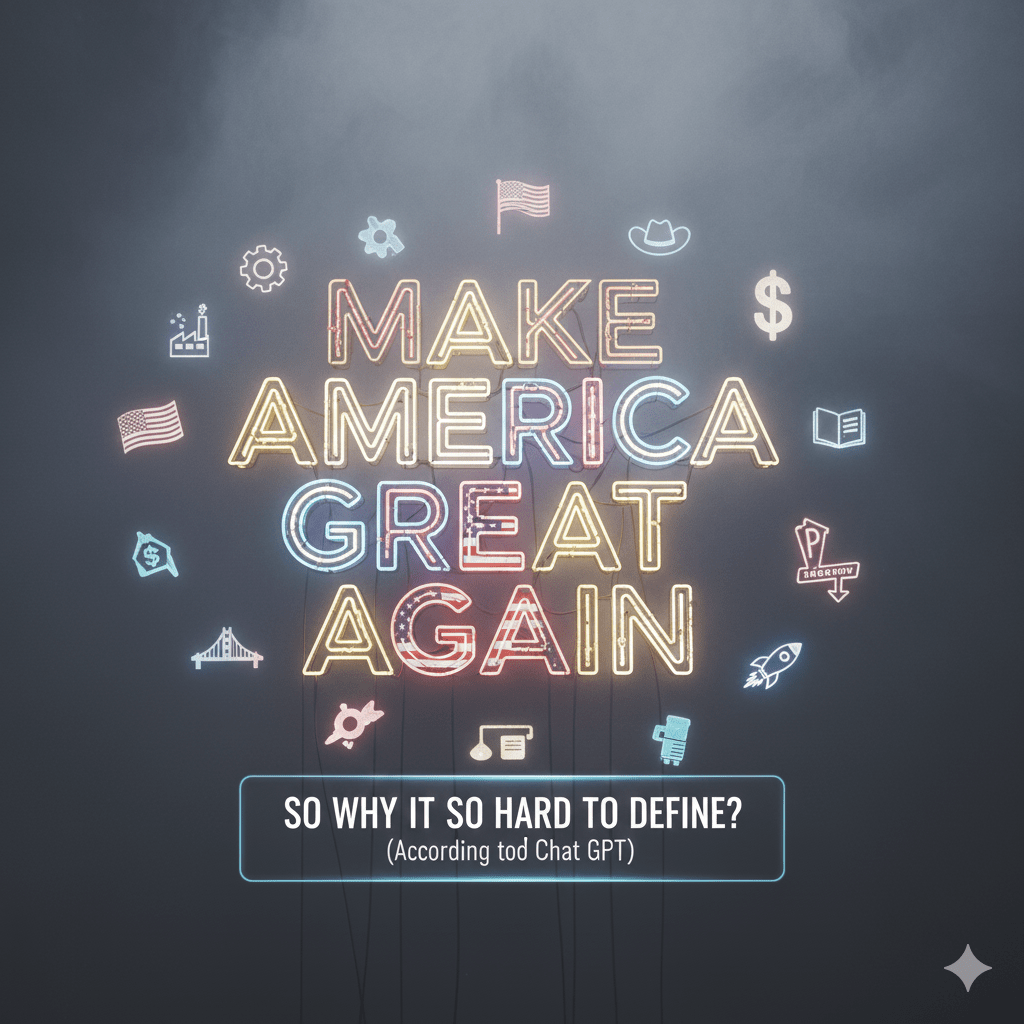
“Make America Great Again” is one of those phrases that feels like a statement of common sense. Who doesn’t want the country to be “great”?
But MAGA isn’t just a campaign line. It’s a whole movement. People get labeled “MAGA” (or “MAGA enough”). There are hats, shirts, flags, slogans, and a strong sense of in-group identity. It functions less like a policy platform you can summarize in a paragraph and more like a badge—something people wear to signal belonging, defiance, pride, frustration, or all of the above.
That’s what makes it tricky to talk about honestly. “Great” is a simple word, but it hides a lot of unanswered questions:
Great for who? Great at what? Great compared to when? And by what scoreboard?
If the movement is serious about making the country “great again,” then it has to mean something more than a mood. It has to connect to real outcomes—wages, affordability, safety, opportunity, stability, trust, global strength—something you can point to and say: this is what we’re trying to build.
So the goal of this post isn’t to debate a slogan. It’s to ask a more practical question:
What does the MAGA movement actually stand for in real-world terms—and do the strategies associated with it (America First, isolationism, tariffs, spheres-of-influence politics) realistically get us closer to the kind of “greatness” people imagine?
The catch is that “great” is doing all the work. The slogan doesn’t tell you:
- Great for whom?
- Great at what?
- Great compared to when?
- Great by which scoreboard?
That vagueness is not an accident. It’s a feature. A phrase like “Make America Great Again” can act like a Rorschach test—people hear what they already believe, then feel validated because the words are broad enough to fit many stories.
Historically, the wording has been used before (notably in Reagan’s 1980 campaign materials), which underscores the point: it’s a powerful political formula, not a precise policy program. Smithsonian Institution+1
So if we want to take the movement seriously—whether we agree with it or not—we have to translate the vibe into something testable:
What time period is the rhetoric implicitly pointing to, and what conditions actually produced it?
The “time period” people usually mean (even if they never say it)
Most nostalgia for “greatness” blends two different eras into one emotional memory. They’re related—but not the same thing.
1) “Great for regular people” (shared growth)
This is usually shorthand for the broad middle-class expansion after World War II through the early 1970s—when many Americans felt that if you worked hard, you could build a stable life.
A common way economists describe what made that period distinctive is that for decades starting in the 1940s, productivity and worker compensation tended to rise together, and then diverged in the 1970s. Bureau of Labor Statistics+2CEPR+2
That doesn’t mean everything was idyllic. It means the economy’s gains felt more widely shared than in later decades.
2) “Great because we dominated the world”
This is more about the late 1940s and 1950s—America as the centerpiece of the global economy and security order.
But it’s crucial to understand the main reason that moment was so lopsided: much of Europe and parts of Asia were rebuilding from wartime destruction. The United States helped shape the postwar global system through institutions and reconstruction programs like the Marshall Plan. Office of the Historian+3National Archives+3Office of the Historian+3
Those are very different meanings of “greatness”:
- Shared prosperity at home vs.
- Unmatched dominance abroad
People often blend them together—then argue past each other.
If “greatness” is a real goal, it needs a scoreboard
Here are a few “greatness scoreboards” that show why a slogan can feel true while meaning very different things:
A) “Do typical workers share in growth?”
That’s the productivity/compensation story: long-run alignment for a period, then divergence later. Bureau of Labor Statistics+1
B) “Are we #1 economically?”
The answer depends on what you measure:
- On current-dollar GDP, the U.S. is still the world’s largest economy in recent IMF reporting.
- On other measures (like PPP-based comparisons), the rankings can look different. Brookings
C) “Are we #1 in human well-being?”
On indices like the UN’s Human Development Index, the U.S. is high—but not #1. National Archives
This is why “great again” can’t be evaluated until someone says what “great” means in practice.
What did that “shared-growth” era actually depend on?
If we’re talking about recreating the feeling of broad prosperity—not a single year, but a set of conditions—then it’s worth noting what the postwar system looked like in reality:
It wasn’t isolationist.
The U.S. helped build a rules-based international economic system after WWII (Bretton Woods/IMF/World Bank) designed to stabilize currencies and support growth. Federal Reserve History+2Office of the Historian+2
The Marshall Plan explicitly supported European recovery and (importantly) helped create markets and trading partners, which also benefited U.S. producers. National Archives+1
So if the target is “postwar prosperity,” it’s hard to argue it came from “America alone.” The postwar model was domestic strength + international architecture, not withdrawal.
It had advantages we can’t simply copy-paste.
Some of America’s postwar dominance was structural: the U.S. emerged with an intact industrial base while many peers were rebuilding. Office of the Historian
That’s not a policy lever. That was history.
Now the hard question: do “America First,” broad tariffs, and spheres-of-influence politics recreate those conditions?
This is where the slogan meets reality.
1) “America First” can mean two different things
At its most neutral, “America First” means prioritizing U.S. citizens and interests. That’s how it’s been defined in modern official rhetoric. Trump White House Archives
But it also has an older American political lineage tied to pre-WWII non-interventionism (the America First Committee), which makes the phrase carry very different associations depending on who’s listening. Wikipedia+1
So the relevant question isn’t whether “America First” sounds good—it’s: which version is being practiced?
2) Tariffs: targeted tool or all-purpose solution?
Tariffs are not inherently irrational. Countries use them to:
- protect key industries,
- respond to unfair practices,
- pursue national security goals,
- raise revenue. Brookings+1
But broad-based tariffs come with tradeoffs that are not theoretical. Recent official and research-oriented assessments commonly point to:
- higher prices for consumers and businesses,
- disruption of supply chains,
- retaliation risk,
- drag on investment and growth. Congressional Budget Office+2U.S. Chamber of Commerce+2
In other words: tariffs can be a scalpel, but they’re often used like a hammer.
If the aim is “postwar-style broad prosperity,” you have to ask:
- Are these tariffs surgically targeted toward strategic capacity and accompanied by workforce/investment policy?
- Or are they primarily an identity signal—proof that someone is “fighting” globalization—regardless of downstream costs?
3) Isolationism vs. rebuilding the postwar conditions
If the “greatness” people want is the postwar shared-growth feeling, then isolationism is a strange vehicle for it.
The postwar system was built around:
- alliances,
- reconstruction and stable trading partners,
- global financial rules,
- predictable cross-border commerce. Office of the Historian+2Office of the Historian+2
You can argue that the system needs updating—plenty of serious analysts do. But “pull back and go it alone” is not a faithful attempt to recreate the conditions that defined the very era people romanticize.
4) “Spheres of influence” politics: stability or shrinkage?
A spheres-of-influence approach (big powers carving out regions) is sometimes sold as “realism” and “stability.”
The problem is that it can also mean:
- weaker alliances,
- more coercive regional politics,
- less predictable rules for trade and investment.
And in practice, recent reporting on “America First” strategy debates highlights exactly these tensions—between retrenchment, alliance burdens, and great-power bargaining. Reuters+1
So is it a real program—or mostly a trigger?
It can be both.
As a slogan, “Make America Great Again” is exceptionally effective because it:
- evokes pride and loss at the same time,
- implies there was a clearer social contract,
- doesn’t require the speaker to define “great.”
That makes it powerful for mobilizing people—whether the next steps actually recreate the conditions being implied.
As a governing agenda, you can evaluate it like any other:
- Does it increase the chance of broad, stable prosperity (not just GDP growth)?
- Does it reduce everyday insecurity (housing, healthcare, wages)?
- Does it strengthen the foundations of competitiveness (innovation, education, infrastructure)?
- Does it keep alliances and trade rules stable enough to avoid self-inflicted shocks?
If the core tools are primarily broad tariffs + higher uncertainty + weaker alliances, it’s fair—even in a nonpartisan way—to ask whether that realistically produces the postwar-style “shared prosperity” people think they’re voting for. Congressional Budget Office+2U.S. Chamber of Commerce+2
If “Make America Great Again” is more than a feeling, it has to mean something concrete.
Not a specific year. Not a vague memory. A measurable definition of “great.”
So here are the questions I think we should be asking—regardless of party:
- Great for who? Which Americans are supposed to feel the benefits first, and which get told to wait?
- Great at what? Jobs? Wages? Safety? Health? Education? Global strength? Freedom? Community?
- Great compared to when—and by what scoreboard? Are we talking about shared middle-class growth, global dominance, cultural cohesion, or something else entirely?
- Which policies actually recreate those conditions? Do “America First,” isolationism, broad tariffs, and spheres-of-influence politics reliably produce the outcomes people associate with “great”—or do they mostly create conflict and blame?
- What would success look like in real life? Not slogans—results.
Because if we can’t say what “great” means in measurable terms, then “great again” isn’t a plan. It’s a mood.
And moods are easy to sell, easy to weaponize, and easy to use to keep people angry—without ever having to deliver.
So before we argue about who’s right, it’s worth asking a simpler question:
What are we actually trying to achieve—and how will we know if we got there?
 Even that's Odd
Leave a comment