
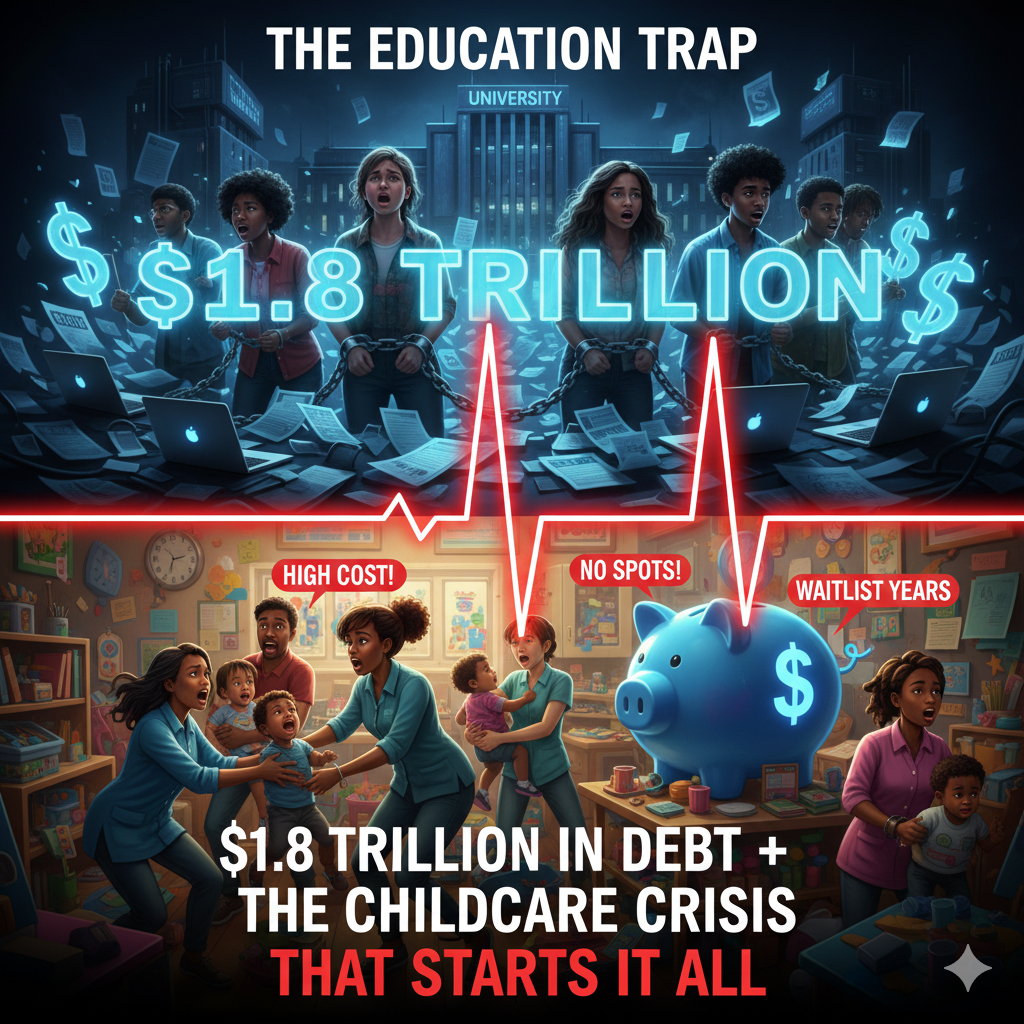
This is Part 8 in our series on systems rigged against the 90%. Part 1: Rankings | Part 2: Language | Part 3: Follow the Money | Parts 4-6: Healthcare | Part 7: Housing
The Full Lifecycle of Extraction
Have a baby: Need childcare to work → Costs $13,128/year (35% of single parent income)
Kid turns 18: Need college to get good job → Graduate with $29,890 debt on average
Graduate at 22: Spend next 10-25 years paying off debt → Delays buying home, having kids
Have kids of your own: Need childcare to work → Costs $13,128/year
Your kids turn 18: Repeat
This isn’t education. This is generational wealth extraction.
Part 1: The Childcare Trap (How It Starts)
The Numbers
National average cost of childcare (2024): $13,128/year
For two children in a center: Exceeds housing costs in 45 states
For two children in a center: Exceeds public university tuition in all 50 states
As percentage of income:
- Married couples: 10% of median income
- Single parents: 35% of median income
Federal guideline for “affordable” childcare: 7% of income
States where childcare meets that guideline: Zero
Translation: Childcare is unaffordable for every American family.
The Regional Breakdown
Most expensive:
- Washington DC: $24,243/year ($2,020/month)
- Massachusetts: $20,913/year
- California, Oregon, Maryland: 16% of married couple median income
“Cheapest” states:
- Still costs 7-12% of married couple income
- Still costs 20-30% of single parent income
- Still exceeds federal affordability guideline
For perspective:
- Average monthly childcare: $1,094
- Average monthly rent: $1,100-1,500
- Childcare costs as much as rent
The Impossible Choice
Scenario 1: Pay for childcare
- Single parent making $38,000/year
- Childcare: $13,128/year = 35% of income
- Rent: $15,000/year = 40% of income
- That’s 75% of income for childcare and rent
- Food, utilities, healthcare, transportation: 25% of income
Can’t be done.
Scenario 2: One parent stays home
- Lose one income entirely
- Fall further behind economically
- Career gap makes return to work harder
- Retirement savings gap
- Dependent on other parent (financial vulnerability)
Scenario 3: Rely on family
- If you have family nearby (many don’t)
- If they’re able/willing (many aren’t)
- Strains family relationships
- Limits job opportunities (can’t move)
Scenario 4: Work opposite shifts
- Parents never see each other
- No family time
- Marriage strain
- Exhaustion
- Kids raised by stressed, exhausted parents
There is no good option.
Who This Hurts Most
Single parents:
- 35% of income for childcare
- Often can’t work full-time (costs more than they earn)
- Trapped in poverty
- 1 in 5 parents relied on relative for childcare (Census data)
Low-wage workers:
- Childcare workers themselves earn average $33,140/year
- Would take 44-100% of their income to afford childcare for two children
- The people providing childcare can’t afford childcare
Women:
- Usually the parent who leaves workforce
- Lose lifetime earnings
- Lose retirement savings
- Lose career advancement
- Wage gap widens
What Happened to Supply
Childcare centers:
- 2019: 91,553 licensed centers
- 2020-2021: Sharp decline (pandemic)
- 2024: 94,227 centers (barely recovered)
Family childcare homes (smaller providers):
- 2019: 107,041 licensed homes
- 2024: 94,227 homes (down 12%)
- Continuing to decline
Why providers closing:
- Low profit margins (or running at loss)
- Workers paid poverty wages
- Can’t raise prices (parents can’t afford more)
- Can’t pay workers more (already losing money)
- The economics don’t work for anyone
Price Increases (2020-2024)
Childcare costs increased: 29% Overall inflation same period: 22% Childcare growing 7% faster than overall inflation
And wages aren’t keeping up.
The Economic Impact
Parents (especially mothers) leaving workforce:
- Lost tax revenue
- Lost economic productivity
- Lost career advancement
- Lost retirement savings
- Increased dependence on public assistance
Census Bureau study: Receipt of childcare subsidies keeps working married mothers in labor force
Translation: Without childcare help, many mothers can’t work.
International Comparison (Spoiler: We’re Getting Screwed)
Germany:
- Free public childcare (Kita system)
- Or heavily subsidized
- Universal pre-K starting age 3
- Result: Mothers can work, children socialized/educated
France:
- Free public preschool (école maternelle) from age 3
- Subsidized daycare for infants/toddlers
- Result: 85% of mothers with young children work
Nordic countries (Sweden, Denmark, Norway):
- Heavily subsidized childcare
- Costs capped at 3-10% of income
- High quality, well-paid workers
- Result: >80% maternal employment
US:
- Average 10-35% of income
- No universal public childcare
- Poverty wages for workers
- Result: 1 in 5 parents can’t afford it
Part 2: College – The Debt Trap (How It Continues)
The Numbers
Total US student loan debt: $1.814 trillion (2024) Number of borrowers: 42.5 million (1 in 6 American adults)Average debt per borrower: $39,075 (federal loans) Average debt for bachelor’s degree: $29,890 (class of 2024)
For context:
- Student debt is second-largest form of consumer debt (after mortgages)
- Larger than all credit card debt
- Larger than all auto loan debt
- More than all other developed nations combined
24% of borrowers say they don’t expect to EVER pay off their debt.
That’s not a loan. That’s indentured servitude.
How We Got Here: The Three-Part Trap
Part 1: Make college “mandatory”
- Good jobs require degrees
- Can’t get middle-class job without BA
- “College for all” messaging
- High school degree no longer enough
Part 2: Skyrocket the price
- 1980: Average public university $400/semester ($4,000 today)
- 2024: Average public university $11,500/semester
- Tuition increased 1200% since 1980
- Median income increased 30%
- Price growth is 40x wage growth
Part 3: Make the debt inescapable
- Can’t discharge in bankruptcy
- Follows you for life
- Wages garnished
- Tax refunds seized
- Social Security garnished (even in retirement!)
Result: Trapped in debt for decades.
The For-Profit College Scam
The setup:
- For-profit colleges (University of Phoenix, Walden, Capella, Strayer)
- Spend huge money on marketing
- Target low-income, first-generation students
- Promise jobs and career advancement
The scam:
- 98% of revenue from federal student loans
- Spend more on marketing than instruction
- Higher tuition than public universities
- Worse outcomes than public universities
- Much higher default rates
The numbers:
- For-profit schools: 10% of students, 40% of loan defaults
- 12-year default rate for-profit colleges: 52%
- For comparison: Public universities: ~20% default rate
What students get:
- $6,428 MORE debt than public university (2-year)
- $3,356 MORE debt than public university (4-year)
- Lower likelihood of employment
- Higher default rates
- Degrees often not respected by employers
Who profits:
- For-profit college executives (huge salaries)
- Shareholders
- Marketing companies
Who loses:
- Students (debt, no good job)
- Taxpayers (default costs)
Why it’s allowed:
- For-profit college lobby: Millions in political donations
- “90/10 rule”: Must get 10% revenue from non-federal sources
- This rule just incentivizes recruiting military (VA benefits count as “non-federal”)
- Minimal accountability for outcomes
The Loan Servicer Scam
How it works:
- Government contracts private companies to “service” loans (collect payments)
- Servicers paid per loan, not per successful repayment
- Incentivized to maximize interest, not help borrowers
The tricks:
- Steer borrowers to forbearance (pauses payments, interest compounds)
- Don’t mention income-driven repayment (lower payments based on income)
- “Lose” paperwork for forgiveness programs
- Apply payments incorrectly
- Give bad advice
Example:
- Borrower qualifies for $200/month income-driven payment
- Servicer says “can’t afford that? Try forbearance!”
- Borrower thinks forbearance is only option
- Interest compounds for 12 months
- Debt grows by $3,000
- Servicer gets paid
Public Service Loan Forgiveness:
- Work 10 years in public service → loans forgiven
- BUT: Servicers “lose” paperwork, don’t count payments, give wrong advice
- Result: 98% of applicants denied initially
- Fixed somewhat, but damage done
Student Loan Asset-Backed Securities (SLABS)
This is where it gets truly evil:
Private student loans are bundled into securities (like mortgage-backed securities in 2008) and sold to investors.
How it works:
- Students take out private loans
- Loans bundled into securities
- Sold to investors (pension funds, hedge funds, etc.)
- Investors get paid from loan payments
The problem:
- Debt becomes profitable asset
- Investors have financial interest in students staying in debt
- Forgiveness would destroy security values
- Creates powerful lobby against forgiveness
It’s 2008 all over again, but with student debt.
Why You Can’t Discharge in Bankruptcy
In 1976: Student loans treated like other debt (could discharge in bankruptcy)
In 1984: Reagan administration changed law:
- Private student loans can’t be discharged for 5 years
- Federal student loans can’t be discharged for 5 years
In 1998: Clinton administration changed law:
- Bankruptcy discharge requires “undue hardship” (nearly impossible standard)
- Applies to both federal and private loans
In 2005: Bush administration changed law:
- Private student loans can’t be discharged at all (same as federal)
- “Undue hardship” applied to all
The result:
- Student loans are only debt that can’t be discharged
- More protected than child support
- More protected than criminal fines
- Follow you for life, including Social Security garnishment
Why this happened:
- Banking lobby (profits from private loans)
- SLABS investors (profit from debt)
- For-profit college lobby (students need loans to pay tuition)
The Generational Impact
Boomers (college in 1970s-1980s):
- Tuition: $400/semester ($4,000 today)
- Could work part-time and pay for college
- Graduate with little or no debt
- Start careers, buy homes, build wealth in 20s
Millennials/Gen Z (college in 2000s-2020s):
- Tuition: $11,500/semester
- Can’t work enough to pay for college
- Graduate with $30,000-40,000 debt
- Spend 20s-30s paying off debt
- Can’t buy homes (trapped in housing market, Part 7!)
- Delay having children (need to afford them first)
- Delay starting businesses (need income for debt payments)
The trap completes:
- Graduate with debt
- Can’t afford house (Part 7)
- Finally afford house at 38-40
- Have kids
- Need childcare (Part 1 of this post!)
- Kids go to college, take on debt
- Cycle repeats
Who Benefits From This System
Banks/loan servicers:
- Interest payments
- Servicing fees
- Longer debt = more profit
For-profit colleges:
- $98% revenue from federal loans
- Marketing-driven enrollment
- Minimal accountability for outcomes
SLABS investors:
- Profit from debt payments
- Lobby against forgiveness
- Want students in debt forever
State governments:
- Cut public university funding 27% (2007-2012)
- Shift costs to students
- Use savings for other budget items
What Happens When You Default
Federal loans:
- Tax refunds seized
- Wages garnished (15% of wages taken)
- Social Security garnished (even in retirement!)
- Credit destroyed
- Can’t get mortgage, car loan, apartment
- Collection fees added (up to 25% of balance)
- Can’t get professional licenses (some states)
Private loans:
- Same as above, plus:
- Sued more aggressively
- Higher collection fees
- Co-signers (usually parents) also liable
Escape routes: Essentially none.
International Comparison (Again, We’re Getting Screwed)
Germany:
- Public universities: Free
- Room/board costs only: ~$800/month
- No tuition
- Graduate with minimal or no debt
France:
- Public universities: ~$200-500/year
- Quality education
- No debt crisis
UK:
- Tuition ~$12,000/year (controlled price)
- Income-driven repayment (only pay if earning well)
- Forgiven after 30 years
- Doesn’t affect credit
Australia:
- Government pays upfront (HECS-HELP system)
- Repay 0-10% of income above threshold
- No interest (only inflation adjustment)
- Never garnish wages if not earning enough
US:
- Public university: $11,500/semester = $23,000/year
- Plus room/board: Total ~$35,000/year
- 4-year degree: $140,000+ total cost
- Loans at 5-7% interest
- Can’t discharge in bankruptcy
- Garnish wages, taxes, Social Security
- Follow you for life
The Complete Extraction System
Let’s see how this plays out for a typical American family:
Generation 1 (The Parents)
Ages 18-22: College
- Take out $30,000 in student loans
- Graduate with degree
- Interest starts immediately
Ages 22-30: Early career
- Entry-level job: $40,000/year
- Student loan payment: $300/month = $3,600/year
- Can’t afford house down payment (saving $0)
- Delay having kids (can’t afford them)
Ages 30-32: Finally have first child
- Now need childcare to both work
- Childcare: $13,128/year
- Still paying student loans: $3,600/year
- Total education costs: $16,728/year on $40,000-50,000 income
- That’s 33% of gross income
Ages 32-35: Struggle years
- Both working to afford childcare
- Student loans still $20,000 balance (paid $10,000, $10,000 was interest)
- Can’t save for house
- Can’t save for kids’ college
- Living paycheck to paycheck
Ages 35-40: First home purchase
- Finally saved enough for down payment
- Student loans paid off (took 15 years!)
- Kids about to start school (childcare costs end)
- Could finally start saving… but
Ages 40-45: Kids approaching college
- Need to save for their college
- But haven’t saved anything (was paying own student loans + childcare)
- Kids will need to take out loans
Generation 2 (The Kids)
Ages 18-22: College
- Parents can’t help (were paying own loans + childcare)
- Take out $35,000 in student loans (price went up)
- Repeat entire cycle
Why This System Exists
Not because it’s good for students. Not because it’s good for families. Not because it’s good for the economy.
Because it’s profitable.
Childcare: Why No Public System
Who benefits from expensive private childcare:
- Private childcare chains
- Real estate companies (own centers)
- Nobody, really (even providers barely profit)
Who loses:
- Parents (can’t work or go broke trying)
- Children (quality varies wildly)
- Economy (mothers leave workforce)
Why no public system:
- “Too expensive” (ignoring economic losses)
- “Socialism!” (ignoring that every other developed nation has it)
- “Not government’s job” (ignoring public schools)
Real reason: No powerful lobby for it, strong ideological opposition to “government childcare”
Student Loans: Why the Debt Trap
Who benefits:
- Banks (interest, servicing fees)
- For-profit colleges (98% revenue from loans)
- SLABS investors (profit from debt)
- Loan servicers (paid per loan)
Who loses:
- Students (decades of debt)
- Families (can’t help kids)
- Economy (delayed purchases, entrepreneurship, family formation)
Why it exists:
- Banking lobby: $millions in political donations
- For-profit college lobby: $millions in political donations
- SLABS investors: Would lose money if debt forgiven
- Bipartisan acceptance of “personal responsibility” framing
Solutions That Would Actually Fix This
Childcare Solutions
Solution #1: Universal Public Childcare
The model (Germany/France):
- Free public childcare starting age 1-3
- Well-paid, trained providers
- High quality, regulated
- Funded through general taxation
US implementation:
- Universal Pre-K (age 3-5): ~$60 billion/year
- Subsidized infant/toddler care (age 0-3): ~$90 billion/year
- Total: ~$150 billion/year
How to pay for it:
- We spend $700 billion/year on military
- $150 billion is 21% of military budget
- Or: Raise top marginal tax rate 2-3%
- Or: Close corporate tax loopholes
Impact:
- Mothers can work (increase tax revenue)
- Children get quality care/education
- Economic growth (parents working and spending)
- Pays for itself through increased tax revenue and economic growth
Solution #2: Subsidized Childcare (Nordic model)
- Cap costs at 7% of income (federal affordability guideline)
- Government subsidizes the difference
- Quality standards enforced
- Pay providers living wages
Solution #3: Tax Credits (Incremental)
- Expand Child and Dependent Care Credit
- Make it refundable (helps low-income families)
- Cover actual costs, not current $3,000 max
- Pay providers directly
Student Debt Solutions
Solution #1: Free Public Universities
The model (Germany):
- Public universities funded through taxes
- Students pay only living expenses
- Graduate with zero debt
- High quality education
US implementation:
- Make all public universities tuition-free
- Cost: ~$70 billion/year (cover lost tuition revenue)
- How to pay: We currently spend $100+ billion/year on tax breaks for education
- Redirect those dollars to making public universities free
Solution #2: Debt Forgiveness
Immediate:
- Forgive all federal student debt ($1.66 trillion)
- One-time cost, or spread over years
- Frees up 42.5 million people to buy homes, start businesses, have kids
Incremental:
- $10,000 forgiveness per borrower (Biden’s canceled plan)
- Expand Public Service Loan Forgiveness (fix the bureaucracy)
- Forgive debt for defrauded students (for-profit college victims)
Solution #3: Make Loans Dischargeable in Bankruptcy
- Return to pre-1984 rules
- Treat student loans like other debt
- Gives borrowers escape route
- Forces lenders to be more careful (which reduces loans to bad schools)
Solution #4: Income-Driven Repayment (Done Right)
- Pay only 5% of income above poverty line
- Forgive after 20 years (currently exists but complicated)
- No interest if making payments
- Simple, automatic enrollment
Solution #5: Regulate For-Profit Colleges
- Require minimum job placement rates
- Require graduates to earn enough to repay loans
- Cap tuition at public university levels
- Ban or severely limit federal loan access if standards not met
- Or: Just ban them entirely (they’re predatory)
Solution #6: Cap Public University Tuition
- Federal funding tied to tuition caps
- Force states to fund public universities properly
- Cap tuition at $3,000/year (adjust for inflation from 1980)
- Make public universities actually public again
The Bottom Line
The education system in America — from childcare to college — is designed to extract maximum wealth from families.
Childcare:
- Costs 10-35% of income
- Forces mothers out of workforce
- Provides poverty wages to workers
- Exists nowhere else in developed world like this
Student Debt:
- Trap 42.5 million people in decades of debt
- Enriches banks, servicers, for-profit colleges, SLABS investors
- Can’t be escaped through bankruptcy
- Follows you for life, including into retirement
The pattern: Both systems are:
- Essential (need childcare to work, need college to get good job)
- Extremely expensive (unaffordable for most)
- Privately run (for profit, not public good)
- Poorly regulated (predatory practices allowed)
- Defended by powerful lobbies (banks, for-profit colleges, ideological groups)
The result:
- Generational wealth extraction
- Delayed homeownership
- Delayed family formation
- Reduced entrepreneurship
- Economic stagnation
And it’s completely fixable.
Every solution listed above works in other countries. We know how to make childcare affordable. We know how to make college affordable. We know how to not trap people in debt forever.
We’re just choosing not to.
Because the people who profit from the current system (banks, for-profit colleges, SLABS investors) have more political power than the people hurt by it (students, parents, families).
But the math is straightforward:
42.5 million people with student debt + tens of millions of parents struggling with childcare costs = most voters.
Eventually the majority hurt by this system will outnumber the minority profiting from it.
The question is: How much longer do we wait?
Next Time
We’ve now covered:
- Healthcare (rigged extraction, employer trap)
- Housing (artificial scarcity, investment firms)
- Education (childcare crisis + debt trap)
Next: How all these systems intersect to create the perfect trap.
Or we dive into another major rigging:
- Prison industry
- Military spending
- Political system itself
Vote in comments: What next?
If you’re trapped by childcare costs or student debt, this showed you why. If you think “personal responsibility” explains it, this showed you the rigging.
Share this if you think families deserve better than lifelong debt and unaffordable childcare.
Sources
Childcare:
- Child Care Aware of America, “Child Care in America: 2024 Price & Supply”
- US Department of Labor, National Database of Childcare Prices
- US Census Bureau, “Rising Cost of Child Care Services”
- Pew Research Center, “5 Facts About Child Care Costs in the US”
Student Debt:
- Federal Student Aid (Department of Education), Federal Student Loan Portfolio
- National Center for Education Statistics, student loan data and reports
- Federal Reserve, “Report on Economic Well-Being of US Households 2024”
- Education Data Initiative, student loan statistics
- NBER (National Bureau of Economic Research), “Effects of For-Profit Colleges on Student Outcomes and Debt”
- New York Fed, “Student Debt and Default: The Role of For-Profit Colleges”
International Comparisons:
- OECD Education data
- Country-specific government education ministry reports
- Academic research on international education financing systems
 Even that's Odd
Leave a comment