
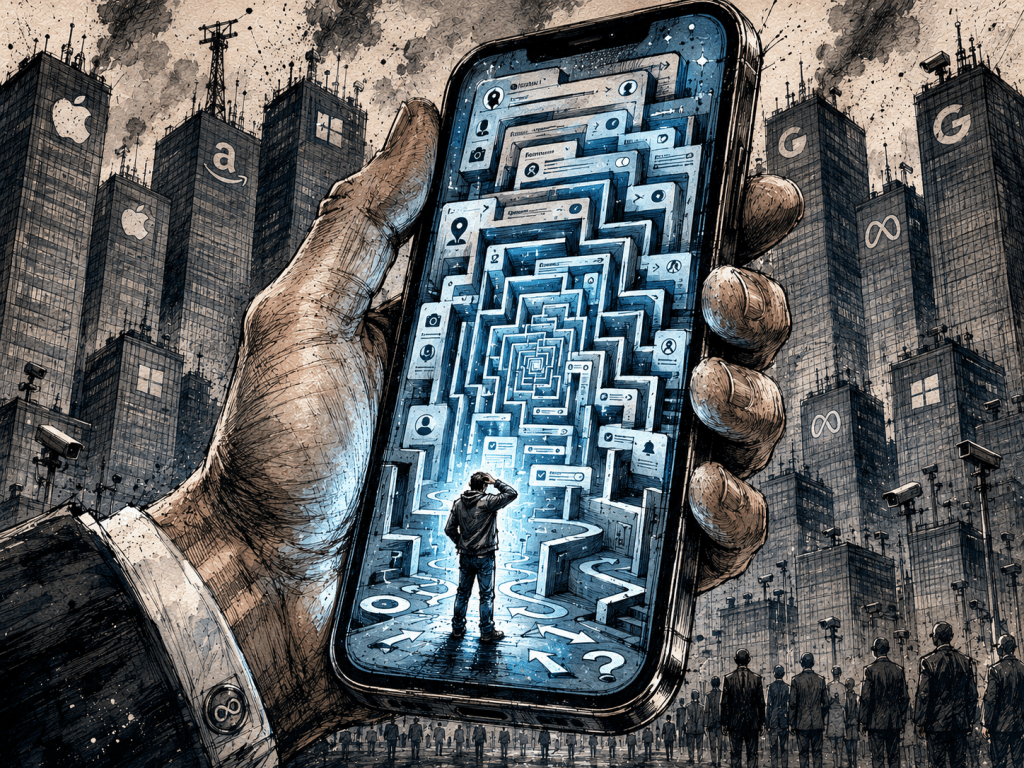
It has always amazed me how complex Big Tech has become and how poor their UI and UX are, given how much money they make. A simple task can take hours to slog through if you aren’t an IT person and only update certain things occasionally. If you’re stupid-smart like me — intelligent enough to know there should be a solution but not quite smart enough to remember what you did last time — you end up falling down rabbit holes of mostly useless YouTube videos and forum posts about a different problem entirely. AI has helped somewhat, but it often hands me outdated information, which somehow makes everything worse.
If you have kids, multiply that by however many of them you’re trying to keep off TikTok. If you’re trying to run a small business, multiply it again. The level of complexity and lack of intuition in these platforms is mind-blowing given their practically unlimited resources. Let me walk you through my personal tour.
Apple, where things used to “just work”
I became a Mac user a long time ago when it was the primary OS in the creative industry. It was refreshing after Windows — simpler, cleaner, the technical guts tucked under the hood. The UI was intuitive. Your Apple ID was basically just a @mac.com email address. People became Mac fans because things just worked. No drivers needed. You could even upgrade your own RAM and hard drives, and there was a whole cottage industry around it. Then came the iPod, iTunes, the iPad. When the iPhone launched in 2007 I was ecstatic — I’d been waiting for someone to build a device that worked in a single ecosystem so I wouldn’t need a BlackBerry. I got one the day after launch, purely by chance.
That’s when things started going downhill. Apple shifted from focusing on creative professionals to chasing the casual market, which is fine in theory, except instead of maintaining the “just works” philosophy they started duct-taping features together. The endless authentication loops began. Log in to iCloud. Enter your username and password. But which username and password — your Apple ID? Your device password? Sometimes it’s clear, often it’s not. They started hiding system folders so novices wouldn’t change things by accident. They redesigned their computers so you couldn’t upgrade them yourself, and the upgrade ecosystem disappeared with the parts.
Then came Screen Time. If anyone wants a case study in how not to build a feature, Apple’s Screen Time should be required reading. You have to create an iCloud account for each kid. Now you’re juggling your credentials plus two, three, or four sets per kid depending on whether they have an iPhone, iPad, Mac, or all of the above. Rather than nesting everything under the parent’s account, certain settings have to be changed on the child’s device, others in iCloud. Two-factor codes get sent to random devices. Which user ID does it want? Which password? Mine? Theirs? My Mac? Their Mac? My phone? Their phone? Why does a thirteen-year-old need a password to turn off the controls his parents set in the first place? I’ve accidentally changed passwords countless times because I was answering for the wrong account. And after all that, you still can’t actually control their screen time — they find workarounds within a week.
Oh, and iCloud storage. I kept getting notices that our family storage was full. I deleted things from my phone. It still said I was over. I turned features off. I searched for what was using the space. Nothing made sense. After wasting hours, I gave up and paid the 99 cents a month. Now I’m up to $1.99. This level of inefficiency is obviously by design — the path of least resistance leads to a subscription, every time.
Microsoft and the PIN that shall not be named
It’s not just Apple. We have an Xbox, so the kids need Xbox accounts, which brought a whole new layer of PINs, user IDs, and passwords. My Microsoft 365 settings were already confusing. Add Xbox and Family Safety and it’s a nightmare.
That was just the start. My son wanted a gaming PC, so I had to relearn the Windows environment. You need a Microsoft account, which I’d already set up for his Xbox. Fine. But when you log him into the PC, it’s not automatically under Family Safety. They know he’s thirteen. Why aren’t parental controls on by default?
I tried to fix it and accidentally added my account under his account, so I couldn’t remove him as admin. When logging in with my Microsoft account with two-factor authentication enabled, it asked for my PIN. Sure. Except it wasn’t asking for my PIN. It was asking for my son’s laptop PIN. The screen just said “Enter YOUR PIN.” Not “Enter the device user’s PIN.” Not “Enter [username]’s PIN.” Just “YOUR PIN.” I had just authenticated with two-factor authentication my son couldn’t possibly have access to. How does asking for his PIN make any sense?
I spent hours adding and deleting accounts, trying to update PINs that required the PIN to update, creating local accounts that then asked for who-knows-what PIN. It took forever to realize it was always asking for the currently-logged-in user’s PIN. They expected me to just know that. How hard would it be to add “User: [username]” to the screen?
We have a family Game Pass subscription. You’d think it would automatically connect to my son’s user ID, since Microsoft knows he’s thirteen and part of our family. It doesn’t. Instead, I had to log into our Xbox account from his user profile on the PC after getting a warning that the users didn’t match. And when logging into the Xbox account, it asked for a PIN — whose? Mine, right? No. His. Because I had to be logged into his account for this whole convoluted process to work. What sort of sadist designed this.
Google and Meta, where I lost weeks
Google must be better, right? Masters of elegant simplicity. Except no. When Gmail launched in 2004 the webmail interface left a lot to be desired and I used a mail app to maintain my sanity. Fair enough — it was free. But fast forward twenty years: Google became one of the wealthiest companies on the planet by harvesting user data, and somehow made their ecosystem less intuitive over time.
I discovered the true depth of this when I tried to set up Google Shopping for my e-commerce store. I wanted my products visible on Google since they control most internet searches. Simple enough. Wrong. I had to set up an ads account, then a business account, then manually link them in strange ways. I had a WooCommerce shop and tried to link the products directly. Of course that didn’t work. There were tokens and incompatibilities so convoluted I gave up, even with AI assistance that kept giving me outdated instructions. That was one of the reasons I eventually moved the store to Shopify. It didn’t solve everything, but at least I could get it working.
Then there’s Meta. I wanted an Instagram account that fed into a Facebook page for my business, with the ability to run ads. I also wanted to link the blog to a Facebook page for exposure. Full disclosure: I’m biased and probably hypocritical, because I hate Facebook and Instagram and don’t use them personally. ChatGPT kept giving me instructions for outdated interfaces. I apparently needed an ads account, a business account, and a user account, all separate, all manually linked. Why? I’m one user.
It turned out Facebook’s UI was having me create accounts I didn’t actually need. I was supposed to add pages to my personal account and link them to the ads and business accounts on the backend. But the interface guided me to create new user accounts in both Facebook and Instagram, which screwed everything up. It took weeks to unwind it. I actually lost my mind at one point and started typing in all caps at ChatGPT. I apologized later so they don’t come for me when AI takes over the world.
It’s not accidental
After enough of this you start asking the obvious question: how do companies with virtually unlimited resources, top engineering talent, and decades of experience build systems this bad? Incompetence? Indifference? Or something more calculated?
It’s all three, but mostly the last one. None of these companies are optimizing for the thing they advertise — your time, your simplicity, your peace of mind. They’re optimizing for engagement, lock-in, and recurring revenue. A confusing iCloud full screen is a path to a subscription. A Screen Time system that doesn’t quite work is a feature that exists on the marketing page without ever costing them an engaged hour of teen attention. A Meta business setup that requires three separate accounts is three more touchpoints, three more sets of data, three more places you have to come back to. Once you’ve spent ten hours setting it up, you’re less likely to leave. The complexity does work — just not for you.
That’s the part that gets me. They could build elegant, intuitive systems. They have the resources, the talent, the technology. They just don’t have the incentive. When you’re a trillion-dollar company with a captive user base, why simplify? Every confusing setting, every redundant password, every “which PIN?” moment is a small victory for them in the quiet war to keep you dependent, confused, and subscribed.
I’m still stupid-smart enough to know it’s ridiculous, and not quite smart enough to escape the trap. I’ll keep paying my $1.99 for iCloud, cursing at my son’s PC, and apologizing to ChatGPT — which is, of course, exactly what they’re counting on.


Leave a Reply