
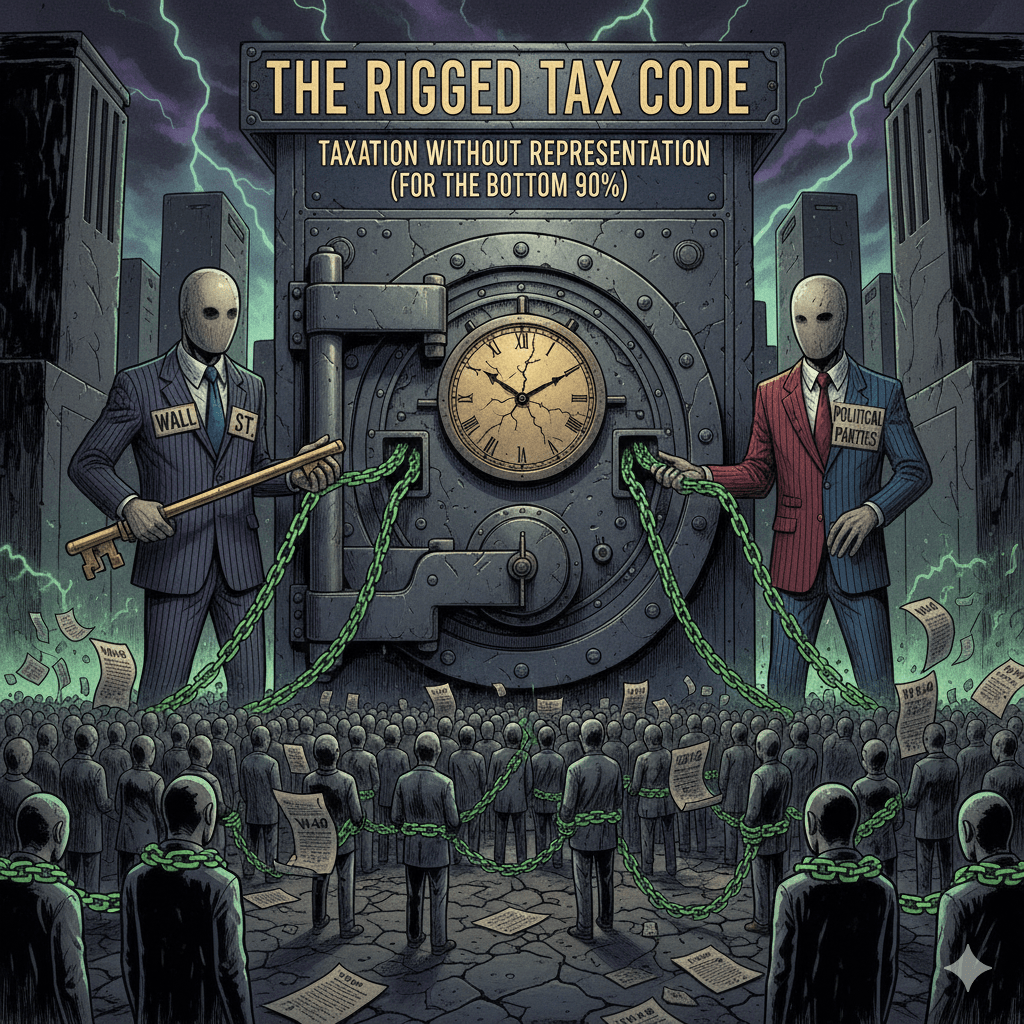
Taxation Without Representation (For the Bottom 90%)
Why Billionaires Pay Less Than Teachers, and How We Let Them Write the Rules
In 2007, Warren Buffett—then the second-richest person in the world with a net worth of $52 billion—made a bet with his office staff. He offered to pay anyone $1 million if their tax rate was lower than his secretary’s. Nobody could claim the money. Buffett’s effective tax rate that year was 17.4%. His secretary paid 30%.
This wasn’t an accounting error. It wasn’t fraud. It was the tax code working exactly as designed. Buffett’s income came primarily from capital gains and dividends, taxed at preferential rates. His secretary’s income came from wages, taxed at ordinary rates. The system is rigged—not by accident, but by deliberate policy choices made by politicians who take money from the people who benefit from those choices.
In 2021, ProPublica obtained and published IRS tax data for the wealthiest Americans. The findings were stunning, even for people who already knew the system was broken. Between 2014 and 2018:
• Jeff Bezos paid a true tax rate of 0.98% (his wealth grew by $99 billion, he paid $973 million in taxes)
• Elon Musk paid 3.27% (wealth grew $13.9 billion, paid $455 million)
• Michael Bloomberg paid 1.30% (wealth grew $22.5 billion, paid $292 million)
• Warren Buffett paid 0.10% (wealth grew $24.3 billion, paid $23.7 million)
• Carl Icahn paid 0.00% in 2016 and 2017 (wealth grew, paid nothing)
Meanwhile, a teacher making $60,000 per year pays an effective federal income tax rate of about 11%, plus 7.65% in payroll taxes, for a total of 18.65%. A nurse making $75,000 pays about 14% income tax plus 7.65% payroll tax, for a total of 21.65%.
Let that sink in. The richest people in America—people whose wealth increased by tens of billions of dollars—paid lower tax rates than teachers and nurses. Not because they’re tax cheats (though some are), but because the tax code is designed to favor investment income over work. Designed to let wealth compound tax-free. Designed to ensure that the more money you have, the less you pay as a percentage of your income.
This is not an accident. This is not a bug in the system. This is the feature. And it’s costing the bottom 90% of Americans trillions of dollars while widening inequality to levels not seen since the Gilded Age.
Capital Gains vs. Wages: Why Investment Income Is Taxed Less Than Work
Here’s the fundamental scam at the heart of the American tax code: we tax money you earn from working at higher rates than money you earn from owning things.
If you’re a teacher earning $60,000 per year, that income is subject to:
• Federal income tax: 12% marginal rate (about 11% effective rate after standard deduction)
• Social Security tax: 6.2%
• Medicare tax: 1.45%
• Total: ~18.65% of your income goes to federal taxes
If you’re a billionaire and your stock portfolio increases by $60,000 this year, you pay:
• Capital gains tax: 0% (because you didn’t sell)
• Social Security tax: 0%
• Medicare tax: 0%
• Total: 0% of your wealth increase goes to federal taxes
But let’s say the billionaire does decide to sell $60,000 worth of stock (to buy a yacht or whatever). Now they pay:
• Long-term capital gains tax: 20% (if held more than a year)
• Net Investment Income Tax: 3.8% (for high earners)
• Social Security tax: 0% (investment income is exempt)
• Total: 23.8% maximum (but usually closer to 20%)
So the teacher working 50-hour weeks and grading papers on weekends pays 18.65% on their labor. The billionaire who owns stock and waits for it to appreciate pays 0% while it grows and 20% if they ever decide to sell. And that’s assuming they sell at all—which we’ll get to shortly, because the really rich never sell. They borrow.
Why does capital gains get preferential treatment? The justification you’ll hear is that we want to encourage investment and economic growth. Lower taxes on investment income supposedly incentivizes people to invest rather than spend, which creates jobs and prosperity.
This is nonsense for several reasons:
First, rich people will invest regardless of the tax rate. What else are they going to do with their money? Put it in a mattress? When capital gains rates were higher (they’ve been as high as 39.875% in the past), wealthy people still invested. Investment levels show no correlation with capital gains tax rates. People invest to make money. Whether they keep 80% or 60% of the gains, they’re still making money.
Second, most capital gains don’t represent productive investment. If you buy Tesla stock, Tesla doesn’t get that money—another investor does. You’re just trading ownership. The only time stock purchases directly fund a company is during an IPO or secondary offering. Everything else is just rich people buying and selling pieces of paper (or bits in a computer) to each other. Taxing that at preferential rates doesn’t create jobs or build factories.
Third, the people who benefit most from preferential capital gains rates are the people who need it least. According to the IRS, 69% of all capital gains income goes to the top 1% of earners. Another 15% goes to the next 4%. The top 5% of earners receive 84% of all capital gains. Meanwhile, the bottom 50% of earners receive less than 1% of capital gains income.
So when we give preferential tax treatment to capital gains, we’re overwhelmingly benefiting the ultra-wealthy. This isn’t a middle-class tax break. It’s a giveaway to billionaires and the top 1%, paid for by higher taxes on workers.
And it costs us a fortune. The Tax Policy Center estimates that preferential rates on capital gains and dividends cost the federal government approximately $160 billion per year in lost revenue. That’s $160 billion that could fund universal pre-K, or eliminate student lunch debt, or repair our crumbling infrastructure. Instead, it goes to people who already have more money than they could spend in ten lifetimes.
Buy, Borrow, Die: How Billionaires Pay Zero Taxes While Living Like Kings
But here’s where it gets even more insidious. The preferential capital gains rate is bad enough, but the ultra-wealthy have figured out how to avoid paying even that. The strategy is called “buy, borrow, die,” and it’s perfectly legal.
Here’s how it works:
Step 1: Buy assets. You start a company or buy stock. Maybe you’re Jeff Bezos and you own Amazon stock worth $100 billion. You paid essentially nothing for this stock originally—maybe $10 million in startup capital. So you have $99.99 billion in unrealized gains.
Step 2: Borrow against your assets. Instead of selling stock (which would trigger capital gains tax), you borrow money using your stock as collateral. Banks will lend you billions at ultra-low interest rates (2-3%) because the loan is secured by your stock. You take out a $500 million loan. This loan is not taxable income—borrowed money is never taxed.
Step 3: Live off the borrowed money. You spend that $500 million on yachts, mansions, private jets, art, political campaigns, whatever you want. You’re living like a king, but your taxable income is zero. You might even claim business deductions for some of these expenses. Meanwhile, your stock continues to grow in value—maybe it goes from $100 billion to $120 billion. Still no taxes, because you haven’t sold anything.
Step 4: When the loan comes due, take out another loan. Use the new loan to pay off the old loan, plus interest. Your stock has appreciated, so you can borrow even more now. This can continue indefinitely. Loan after loan after loan, all secured by appreciating assets, all generating zero taxable income.
Step 5: Die. When you die, your heirs inherit your assets. And here’s the kicker: under current law, they receive a “step-up in basis.” This means the cost basis of your assets resets to their current market value. Remember that $100 billion in stock you bought for $10 million? Your heirs inherit it with a basis of $100 billion. The $99.99 billion in gains disappears for tax purposes. It’s as if it never happened.
Your heirs can then sell the stock and pay zero capital gains tax (because the basis just stepped up to current value). Or they can keep the stock and repeat the whole process—borrow against it, live off the loans, pass it to their heirs with another step-up in basis.
The result? Generational wealth that compounds tax-free forever. Billions of dollars in gains that are never taxed. Not deferred—never taxed. The wealth grows, gets borrowed against, passes to heirs, and the tax obligation evaporates.
This is how Elon Musk, the richest person in the world, paid $455 million in taxes while his wealth grew by $13.9 billion (a 3.27% rate). This is how Warren Buffett paid $23.7 million in taxes while his wealth grew by $24.3 billion (a 0.10% rate). This is how Carl Icahn paid zero taxes in multiple years despite being worth billions.
They’re not breaking the law. They’re using the law exactly as it was written—by lobbyists for the ultra-wealthy, passed by politicians who take money from the ultra-wealthy.
Meanwhile, the teacher making $60,000 pays taxes on every dollar. The nurse making $75,000 pays taxes on every dollar. The construction worker making $50,000 pays taxes on every dollar. Because they can’t borrow against their assets—they don’t have assets. And they can’t defer taxes until death—they need their money now to pay rent and buy groceries.
The Step-Up in Basis Scam: How $1 Trillion in Gains Disappear at Death
Let’s dig deeper into the step-up in basis, because this single provision in the tax code is responsible for one of the largest wealth transfers from the working class to the ultra-wealthy in American history.
The rule is simple: when someone dies, their heirs inherit assets at their current fair market value, not at the original cost basis. All accumulated capital gains are erased for tax purposes.
An example: Your grandfather bought a house in 1960 for $20,000. He dies in 2024 when the house is worth $800,000. His heirs (your parents) inherit the house. For tax purposes, their cost basis is $800,000, not $20,000. If they sell it immediately for $800,000, they owe zero capital gains tax. The $780,000 gain that occurred during your grandfather’s life is never taxed.
Now imagine this at billionaire scale. Jeff Bezos owns approximately $170 billion in Amazon stock (as of 2024). His cost basis is essentially zero—he paid almost nothing for those shares when he founded the company. If he sold all that stock today, he’d owe roughly $34 billion in capital gains tax (20% rate).
But if Bezos never sells and dies with that stock, his heirs inherit it with a stepped-up basis of $170 billion. That $34 billion tax obligation vanishes. Poof. Gone. The heirs can sell the stock immediately and owe nothing.
Scale this across all wealthy Americans and you get staggering numbers. According to estimates from the Joint Committee on Taxation and various tax policy analysts, the step-up in basis costs the federal government approximately $40-50 billion per year in lost revenue. Over a decade, that’s $400-500 billion. Over a generation, it’s over $1 trillion in wealth gains that are never taxed.
Who benefits? Almost exclusively the wealthy. According to the Tax Policy Center, more than half of the benefit from step-up in basis goes to the top 1% of estates. About 80% of the benefit goes to the top 5%. The bottom 60% of Americans receive virtually no benefit because they don’t have significant assets to pass on.
The justification for step-up in basis is typically that it simplifies estate administration and prevents double taxation (since estates are subject to estate tax). But this is nonsense for two reasons:
First, estate tax currently only applies to estates worth more than $13.61 million (as of 2024). That’s the top 0.1% of estates. For everyone else, there’s no estate tax to avoid “double taxation” with.
Second, many countries tax capital gains at death without collapsing into administrative chaos. Canada treats death as a “deemed disposition”—essentially a sale for tax purposes. The estate pays capital gains tax on appreciated assets before distributing them to heirs. It works fine. The complexity argument is a red herring.
The real reason for step-up in basis is that wealthy people lobbied for it, and politicians who take money from wealthy people voted for it. It’s a straightforward wealth transfer from the working class (who pay taxes on every dollar they earn) to the inheriting class (who receive billions tax-free).
Carried Interest: The Hedge Fund Manager Loophole
If you want to see the tax code’s corruption in its purest form, look at carried interest. This is a loophole so transparently unjust that even Donald Trump and Elizabeth Warren have called for eliminating it. And yet it persists, year after year, because the hedge fund and private equity industries spend tens of millions of dollars lobbying to keep it.
Here’s how it works. When you invest in a hedge fund or private equity fund, the typical fee structure is “2 and 20″—a 2% annual management fee, plus 20% of profits above a certain threshold. That 20% profit share is called “carried interest.”
The 2% management fee is clearly labor income—you’re being paid to manage the fund. It’s taxed as ordinary income at rates up to 37%.
But the 20% carried interest? The IRS treats that as a capital gain, taxed at only 20%. Even though it’s compensation for labor (you’re being paid to manage investments), even though you didn’t invest your own money (you’re taking a share of other people’s profits), even though you face no downside risk (if the fund loses money, you don’t pay the investors back—you just don’t get paid your 20%).
This is pure, unadulterated bullshit. Carried interest is compensation. It’s a performance bonus. It should be taxed as ordinary income. But it’s not, because hedge fund managers and private equity partners lobbied for special treatment and got it.
The numbers are staggering. The top 25 hedge fund managers earned a combined $32 billion in 2023 (Institutional Investor’s Alpha). Much of that was carried interest, taxed at 20% instead of 37%. The tax savings for just these 25 people? Approximately $5.4 billion. That’s more than the entire annual budget for the National Park Service.
Some specific examples:
• Ken Griffin (Citadel): $4.1 billion in 2023 earnings
• Stephen Schwarzman (Blackstone): $896 million in 2023 compensation
• Ray Dalio (Bridgewater): $1.5 billion estimated 2023 earnings
• David Tepper (Appaloosa): $1.5 billion estimated 2023 earnings
These are labor earnings—they’re getting paid to manage money. But because of carried interest, they pay 20% on most of it instead of 37%. Meanwhile, a teacher making $60,000 pays 18.65%. A hedge fund manager making $1 billion pays 20%.
The carried interest loophole costs the federal government an estimated $18 billion per year (Joint Committee on Taxation). That money goes directly into the pockets of hedge fund managers and private equity partners—the very people who least need a tax break.
Every few years, a politician proposes eliminating carried interest. Trump promised to do it in 2016. Biden proposed it in 2021. It never happens. Why? Because private equity and hedge funds contributed $128 million to federal candidates in 2022 (OpenSecrets)—$67 million to Republicans, $61 million to Democrats. Both parties take the money. Both parties protect the loophole.
Carried interest is a perfect microcosm of the tax code: a rule that makes no logical sense, benefits exclusively the ultra-wealthy, costs billions in lost revenue, has bipartisan support for elimination in rhetoric but zero action in practice, all because the beneficiaries pay millions to keep it.
The Estate Tax: From $600,000 to $13.6 Million in One Generation
The estate tax—sometimes called the “death tax” by people who benefit from its elimination—is perhaps the clearest example of how the tax code has been systematically rewritten to favor dynastic wealth.
In 1997, the estate tax exemption was $600,000. If you died with an estate worth more than that, the amount above $600,000 was taxed at rates up to 55%. The logic was simple: extreme concentrations of wealth are bad for democracy and economic mobility. Taxing large inheritances helps prevent the creation of a permanent aristocracy where wealth and power pass from generation to generation regardless of merit.
Today, in 2024, the estate tax exemption is $13.61 million per person ($27.22 million for a married couple). Only estates larger than that owe any estate tax at all. And the tax rate has been reduced from 55% to 40%.
Let’s put this in perspective. The exemption has increased by 2,168% (from $600,000 to $13.61 million), while median household income has increased by only 110% (from $37,005 in 1997 to $77,713 in 2023). The estate tax has been gutted while working families got screwed.
The result? In 1997, about 2.3% of estates owed estate tax. Today, only 0.04% of estates owe estate tax—fewer than 2,000 estates per year out of roughly 3 million deaths annually. The estate tax has gone from a tax on the wealthy to a tax on only the ultra-wealthy—and even then, it’s been weakened dramatically.
This costs real money. According to the Tax Policy Center, the 2017 tax cuts (which doubled the estate tax exemption from $5.49 million to $11.2 million, now $13.61 million with inflation adjustments) cost approximately $20 billion per year in lost revenue. That’s $20 billion per year going to the heirs of multimillionaires instead of funding healthcare, education, or infrastructure.
Who benefits? The wealthiest 0.04% of estates—people passing on more than $13.61 million. Not family farms (the average farm estate is worth $1.2 million, nowhere near the exemption threshold despite decades of propaganda about protecting farmers). Not small businesses (same issue—they’re not worth $13.61 million). Billionaires and multimillionaires.
And even among those 0.04% who do owe estate tax, effective rates are much lower than the statutory 40% because of various loopholes:
• Grantor Retained Annuity Trusts (GRATs) allow wealthy individuals to transfer assets to heirs with minimal or no gift/estate tax
• Dynasty trusts in states like Delaware and South Dakota can shelter wealth from estate taxes for generations
• Valuation discounts for family businesses and real estate partnerships reduce taxable estate values by 20-40%
• Life insurance trusts (ILITs) remove life insurance proceeds from taxable estates
Wealthy people hire estate planning attorneys who specialize in these strategies. The result is that many billionaires pay little to no estate tax despite passing on enormous wealth. Their heirs receive billions, tax-free, while a teacher’s child inherits $50,000 and that’s pretty much it.
The estate tax was designed to prevent the creation of a permanent American aristocracy. It has been systematically dismantled over 25 years by politicians who claim to care about “family values” while enabling the concentration of wealth in a tiny number of family dynasties. The Waltons (Walmart), Mars family (Mars candy), Koch family (Koch Industries)—these families pass billions from generation to generation while paying minimal estate taxes, if any.
Corporate Tax Rate: From 35% to 21% While Profits Soared
In 2017, Republicans passed the Tax Cuts and Jobs Act, the single largest corporate tax cut in American history. The corporate tax rate was slashed from 35% to 21%—a 40% reduction.
The justification was familiar: lower corporate taxes would spur investment, create jobs, and lead to higher wages. Companies would use their tax savings to expand operations, hire more workers, and increase pay. Prosperity would trickle down.
None of that happened.
What actually happened was exactly what critics predicted: companies used their tax windfall for stock buybacks and dividends, enriching shareholders (who are disproportionately wealthy) while doing little for workers.
In 2018, the first full year after the tax cuts, corporations bought back $806 billion worth of their own stock—a record. In 2019, they bought back another $728 billion. In 2020 (COVID year), buybacks dropped but were still $520 billion. Over the decade 2010-2019, S&P 500 companies spent $5.3 trillion on stock buybacks. That’s money that went to shareholders, not workers.
Meanwhile, real wage growth remained anemic. According to the Economic Policy Institute, real wages for production and nonsupervisory workers (80% of the workforce) grew by just 0.9% from 2017 to 2019. Meanwhile, CEO compensation grew by 14%. Corporate profits soared. Stock prices soared. Worker wages stagnated.
The corporate tax cut cost approximately $1.5 trillion over 10 years (Congressional Budget Office estimate). That’s $150 billion per year in lost revenue. To put that in perspective, that’s more than enough to make all public universities tuition-free ($75 billion per year), or provide universal pre-K ($30 billion per year), or eliminate the $1.7 trillion student loan debt over a decade.
Instead, that money went to shareholders. And who are the shareholders? According to the Federal Reserve, the top 10% of households own 89% of all stocks. The top 1% own 54%. The bottom 50% of Americans own less than 1% of stocks.
So when we cut corporate taxes, we’re primarily benefiting the wealthiest Americans—the very people who need help least. And we’re doing it by either increasing the deficit (which future generations will pay for) or cutting spending on programs that benefit working people.
And here’s the kicker: even after the tax cuts, many highly profitable corporations pay nowhere near 21% effective tax rate. Amazon paid $0 in federal income tax in 2018 despite $11.2 billion in profits. Netflix paid $0 in 2018 on $845 million in profits. Companies use accelerated depreciation, R&D credits, offshore profit shifting, and dozens of other loopholes to reduce their effective tax rates far below the statutory rate.
The corporate tax system is a joke. Statutory rate is 21%, but effective rates for many large corporations are in single digits or zero. Meanwhile, small businesses without teams of tax attorneys pay close to the full rate. Once again, the system is rigged to favor the largest players.
How Other Countries Tax Wealth: Turns Out It’s Possible
One of the most common arguments against taxing the wealthy more is that it’s impossible, impractical, or would cause economic collapse. This is false. Other countries tax wealth more effectively than the U.S., and their economies are doing fine.
Norway: Has a wealth tax of 1.1% on net worth above approximately $170,000. Also taxes capital gains at death (no step-up in basis). Has no billionaire exodus. Economy is strong. Social programs are well-funded. Quality of life is among the highest in the world.
Switzerland: Has cantonal wealth taxes ranging from 0.3% to 1% depending on location. High-net-worth individuals still choose to live there because quality of life, infrastructure, and stability are excellent. Wealthy people don’t flee to avoid taxes—they stay where life is good.
Canada: Treats death as a “deemed disposition”—assets are treated as sold at death, triggering capital gains tax. No step-up in basis loophole. The estate pays tax on appreciated assets before distributing to heirs. This raises significant revenue and prevents unlimited tax-free wealth transfers.
Denmark: Has high capital gains taxes (up to 42%), no preferential treatment for investment income, and strong social programs. Has one of the lowest poverty rates in the world and high economic mobility.
Netherlands: Uses a presumed return system—assumes your wealth generates a 4% return and taxes that at regular income rates. This creates an effective wealth tax of about 1.2% annually. While this has some fairness issues (as discussed earlier), it demonstrates that wealth can be taxed automatically without self-reporting.
The common thread in all these countries: higher taxes on wealth and capital, strong social programs, lower inequality, higher quality of life. They prove that you can tax wealth without causing economic collapse, billionaire exodus, or innovation decline.
The “we can’t tax wealth” argument is propaganda from people who benefit from not taxing wealth. Other countries do it successfully. We could too—if we had the political will.
Who Benefits? The Usual Suspects
Let’s name names and count money. Who benefits from the tax code being rigged in favor of investment income, carried interest, step-up in basis, gutted estate taxes, and low corporate rates?
First, billionaires. All of them. But some specific examples:
• Elon Musk: Net worth $232 billion (2024). Paid 3.27% true tax rate 2014-2018.
• Jeff Bezos: Net worth $194 billion. Paid 0.98% true tax rate 2014-2018.
• Warren Buffett: Net worth $133 billion. Paid 0.10% true tax rate 2014-2018.
• Larry Ellison: Net worth $158 billion. Oracle paid effective corporate tax rate of 9% (2018-2020).
• Mark Zuckerberg: Net worth $177 billion. Facebook/Meta paid effective tax rate of 13% (2018-2020).
Second, hedge fund and private equity managers:
• Ken Griffin (Citadel): $37 billion net worth. Benefits from carried interest loophole.
• Stephen Schwarzman (Blackstone): $46 billion net worth. Made $896 million in 2023, much of it taxed at preferential capital gains rates.
• Ray Dalio (Bridgewater): $15 billion net worth. Made $1.5 billion in 2023.
• Leon Black (Apollo): $10 billion net worth. Private equity looting benefits from low capital gains rates and step-up in basis.
Third, major corporations:
• Amazon: $514 billion revenue (2023), paid minimal federal income tax in multiple years
• Apple: $383 billion revenue (2023), uses Irish subsidiaries to avoid U.S. taxes
• Microsoft: $211 billion revenue (2023), paid 16.8% effective tax rate (below statutory 21%)
• Alphabet/Google: $307 billion revenue (2023), paid 14% effective tax rate (2022)
• ExxonMobil: $413 billion revenue (2023), benefits from fossil fuel subsidies and tax breaks
Fourth, wealthy families passing on dynastic wealth:
• Walton family (Walmart): $267 billion collective wealth, benefits from step-up in basis and gutted estate tax
• Mars family (Mars candy): $160 billion collective wealth
• Koch family: $127 billion collective wealth
• Cargill-MacMillan family: $60 billion collective wealth
And finally, the politicians who wrote these rules:
In the 2022 election cycle:
• Securities & investment firms donated $216 million to federal candidates
• Private equity & hedge funds donated $128 million
• Real estate industry donated $174 million
• Commercial banks donated $92 million
Both parties take the money relatively evenly. Republicans get slightly more from finance, Democrats get plenty too. The result is bipartisan consensus on keeping the tax code rigged in favor of wealth.
The tax code isn’t written by random bureaucrats. It’s written by lobbyists for the industries that benefit from it, passed by politicians who take money from those industries, and enforced by an IRS that’s deliberately underfunded so it can’t audit the wealthy effectively.
Solutions: How to Fix This Rigged System
Here’s the good news: fixing the tax code is not complicated. The solutions are straightforward. The only obstacle is political will—which is lacking because both parties take money from the people who benefit from the current system.
But for the sake of clarity, here’s what we should do:
Solution 1: Close the Step-Up in Basis Loophole
This is the most important reform. Treat death as a realization event—when someone dies, their assets are deemed sold at fair market value and taxed accordingly. This is how Canada does it, and it works fine.
Implementation: Include an exemption for the first $5 million in gains to protect middle-class families inheriting homes. Above that, tax the gains at ordinary capital gains rates (currently 20%). This would raise approximately $40-50 billion per year and prevent unlimited tax-free wealth transfers.
Solution 2: Tax Loans Against Assets (Close Buy-Borrow-Die)
If you borrow more than $10 million against your assets in any given year, treat it as a realization event and tax it as income. This eliminates the main strategy billionaires use to avoid taxes entirely.
Why $10 million? Because regular people might take out home equity loans or margin loans for legitimate purposes. But if you’re borrowing $10 million+ against your stock portfolio, you’re clearly living off that wealth—it should be taxed.
Estimated revenue: $25-50 billion annually. Would primarily hit the ultra-wealthy who use this strategy.
Solution 3: Raise Capital Gains Tax for High Earners
For capital gains above $1 million per year, tax them as ordinary income (up to 37% top rate). Keep the preferential 15% rate for middle-class investors with capital gains under $100,000, and a 20% rate for gains between $100,000 and $1 million.
This creates a progressive system: small investors get preferential treatment, ultra-wealthy pay the same rate as workers.
Estimated revenue: $100 billion+ annually. Would primarily affect top 1% who realize large capital gains.
Solution 4: Allow Tax-Free Reinvestment for Middle Class
For individuals with net worth under $10 million, allow them to sell assets and reinvest the proceeds tax-free (only taxed when withdrawn for spending). This removes the “locked in” problem where middle-class investors can’t rebalance portfolios without triggering taxes.
This only applies to liquid securities (stocks, bonds, funds), not real estate (to avoid the 1031 exchange problem that contributes to housing crisis).
Why this works: Wealthy people already avoid taxes through buy-borrow-die. This gives middle-class investors the same flexibility for portfolio management without helping billionaires dodge taxes (since they’re subject to Solutions 1-3 above).
Solution 5: Eliminate Carried Interest
Simple: carried interest is compensation, tax it as ordinary income. No exceptions, no phase-ins, no carve-outs. Hedge fund managers and private equity partners pay the same rate as everyone else who works for a living.
Estimated revenue: $18 billion annually. Affects only hedge fund/PE managers making millions.
Solution 6: Wealth Tax on Ultra-Wealthy
Annual tax on net worth above $50 million:
• 2% on wealth between $50M-$500M
• 3% on wealth above $500M
Implementation: Require automatic reporting of all assets by financial institutions. IRS calculates net worth, sends bill. No self-reporting. Verified against bank, brokerage, and real estate records.
Estimated revenue: $200-300 billion annually. Affects only top 0.05% of households.
Solution 7: Restore Estate Tax
Lower the exemption to $5 million (indexed to inflation) and restore the 55% top rate for estates above $50 million. This still protects family homes and small businesses while preventing dynastic wealth.
Close loopholes: eliminate GRATs, dynasty trusts, valuation discounts. Make the estate tax actually work.
Estimated revenue: $80-100 billion annually if properly implemented.
Solution 8: Raise Corporate Tax Rate to 28%
The 2017 tax cuts slashed the corporate rate from 35% to 21%. Split the difference: 28%. This is still lower than the pre-2017 rate but raises significant revenue.
Also: Close corporate loopholes. Limit accelerated depreciation. Crack down on offshore profit shifting. Ensure companies actually pay close to the statutory rate.
Estimated revenue: $100 billion+ annually.
Solution 9: Make Corporate Ownership Public
Require public registry of beneficial ownership for all corporations, LLCs, and trusts. No more shell companies hiding wealth. Delaware, we’re looking at you.
This transparency makes it much harder to hide assets and evade taxes. If we can track every worker’s W-2 income, we can track who owns every corporation.
Solution 10: Abolish the IRS for Everyone Under $10 Million Net Worth
Here’s the revolutionary idea: eliminate the IRS for 99% of Americans.
If you have net worth under $10 million: no filing, no audits, nothing. Your employer withholds taxes automatically. You’re done. Like many European countries do already.
Net worth $10M-$50M: Simple filing, minimal audit risk.
Net worth above $50M: 100% audit rate. Full IRS enforcement. Every penny accounted for.
Use the savings from not auditing teachers and nurses to hire more IRS agents who specialize in auditing billionaires. Fund the IRS properly—every $1 spent on enforcement returns $5-7 in revenue from high-wealth individuals.
This gives 99% of Americans what they want (freedom from IRS hassle) while ensuring the wealthy pay their fair share. It’s politically brilliant and practically sound.
Total estimated revenue from all solutions: $600-800 billion annually. That’s enough to fund universal healthcare, make public universities tuition-free, eliminate student debt, and still have money left over for infrastructure.
A Note on ‘They Earned It’
One argument you’ll hear against these tax reforms is that billionaires ‘earned’ their wealth and deserve to keep it—that taxing them more is punishing success. We’ll dismantle that myth in the next post, where we’ll examine how billionaire and corporate wealth was built on taxpayer-funded infrastructure, research, and education that they didn’t pay for.
Spoiler: Jeff Bezos didn’t build Amazon alone—he built it on roads we paid for, using an internet we funded, delivered via a postal system we subsidize, with a workforce we educated, protected by courts and police we fund, using GPS technology we developed. The question isn’t whether successful people should be taxed more—it’s whether they should finally start paying their fair share for the public resources that made their success possible.
We’ll also explore corporate tax avoidance in detail—because while we’ve covered individual billionaires paying 0-3% tax rates, corporations are just as guilty of dodging their obligations while profiting massively from public investment. Amazon pays $0 in federal taxes while using roads we maintain. Apple shifts profits to Ireland while relying on our court system to protect its patents. Pharmaceutical companies profit from NIH research we funded. And then they all lobby to cut the very programs that made their wealth possible.
Conclusion: The Tax Code Is Working Exactly As Designed
The American tax code is not broken. It’s working perfectly—for the people who wrote it.
Billionaires pay lower tax rates than teachers because the tax code was written to favor investment income over wages, to exempt unrealized gains from taxation, to allow unlimited borrowing against assets without triggering taxes, and to erase all gains at death through step-up in basis.
Hedge fund managers pay 20% on their labor income while nurses pay 30% because the carried interest loophole was written by the hedge fund industry and passed by politicians who take money from hedge funds.
The estate tax has been gutted from a $600,000 exemption to $13.61 million because wealthy families lobbied for decades to eliminate it, and both parties went along because both parties take money from wealthy families.
Corporate taxes were slashed from 35% to 21% because corporations spent billions lobbying for it, and the promised benefits (job creation, wage growth, investment) never materialized. The money went to stock buybacks that enriched shareholders—the top 10% who own 89% of stocks.
Every single piece of this system was designed by wealthy people, for wealthy people, and passed by politicians who depend on wealthy people for campaign contributions. And the result is exactly what you’d expect: massive and growing inequality, concentration of wealth in fewer and fewer hands, and a working class that pays higher tax rates than billionaires.
Warren Buffett’s secretary paying 30% while he pays 17.4% isn’t a mistake. Jeff Bezos paying 0.98% on $99 billion in wealth gains isn’t an accident. Carl Icahn paying zero taxes in multiple years isn’t a glitch. It’s the system working as intended.
The question is: are we going to keep accepting it?
We have the solutions. Close step-up in basis. Tax loans against assets. Raise capital gains rates for the wealthy. Eliminate carried interest. Restore the estate tax. Implement a wealth tax. Raise corporate taxes and close loopholes. Make corporate ownership public. Fund the IRS to audit the wealthy, not teachers.
None of this is radical. Other countries do it successfully. The only obstacle is political will—and political will is absent because both parties are funded by the people who benefit from the current system.
The tax scam affects all of us in the bottom 90%, regardless of political party. Red state or blue state, Republican or Democrat, public sector or private sector—we’re all paying higher rates than billionaires. The longer we let culture war nonsense distract us from the class war being waged against us, the more our money flows upward to people who already have more than they could spend in a hundred lifetimes.
Tax policy is not a partisan issue. It’s a wealth extraction issue. And until we recognize that both parties are complicit in rigging the system against us, nothing will change.
—
Next in the series: Part 19 – Union Busting: The Systematic Destruction of Worker Power
Coming up: How corporate America spent billions destroying unions, driving down wages for everyone, and eliminating the only collective power workers had to fight back against wealth extraction.
 Even that's Odd
Leave a comment