I was driving to yet another baseball tournament Saturday morning, half-awake, NPR on in the background, when a story about AI disinformation in the Iran conflict completely hijacked my brain for the next forty-five minutes.
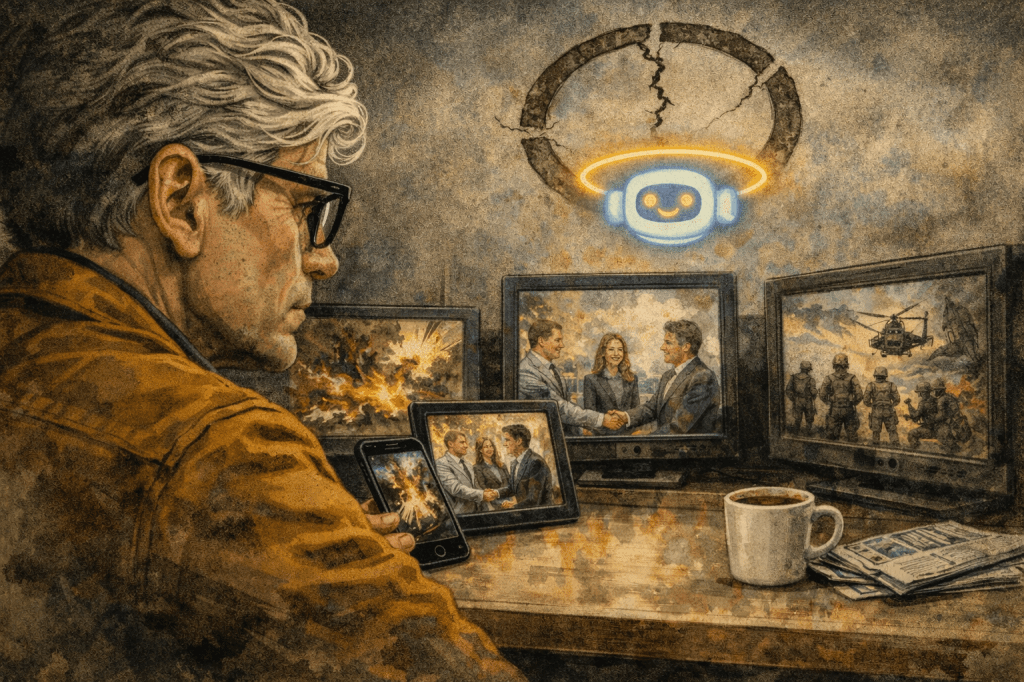
The segment was trying to walk through which images were fake and which weren’t. Iranian state TV had broadcast AI-generated photos of Israeli F-35s supposedly shot down over Iran. Pro-Israel accounts had circulated fake video of Iranians chanting “We Love Israel.” One pro-Iran disinfo campaign racked up something like 145 million views in a few days. And — the part that got me — real photographs from Tehran, actual photos of actual destruction, were being dismissed by regular people as AI fakes.
I kept losing track of which thing was supposedly real and which was supposedly fake. By the end of the segment I was no clearer than I’d been at the start. And I don’t think that was NPR’s fault. I think that’s the point.
Researchers have a name for this. They call it the “liar’s dividend.” Once enough fake stuff is circulating, you don’t have to prove anything is fake to win the argument. You just have to raise enough doubt that nobody believes anything. Real photos get called AI. AI gets called real. And if you’re someone who’d rather people not believe the real stuff, you’ve now got cover. Just say it’s fake. People will buy it because it might be.
I want to be careful with the word “fake” here, because it’s been doing two jobs for the last decade and the two jobs are not the same.
One job is real. Journalism makes mistakes. Outlets have biases. Some reporting is sloppy. Some is wrong. You can criticize that. You should criticize that. It’s a healthy thing to do.
The other job is what happened when “fake news” became a brand. Calling accurate reporting you don’t like fake. Labeling an entire free press as the enemy of the people. Sending supporters to harass reporters. That’s not media criticism. That’s the authoritarian script — the same one that runs in Russia and Hungary and everywhere else the press eventually gets folded into the state. We watched it play out here for eight years and a real chunk of the country signed on for it.
The setup is what worries me. You spend a decade telling people that everything they see in mainstream media is fake. You hollow out their ability to tell the difference. Then actual industrial-scale fake content lands on their feed, and the outlets that could in theory tell them which is which have already been stripped of the credibility to do it. Meanwhile CBS just got sold to Skydance, with the kind of money behind it that has a stated interest in friendlier coverage, and network executives are reportedly softening stories they think might make problems. The disinformation industry didn’t have to be telling the truth about the old media. It just needed enough people to half-believe it long enough.
A year or so ago there was a viral clip of two young women outside a club, mumbling some Gen Z word salad about AI. Fourteen million views. People argued about it in the comments. It was fake. The whole thing was generated by Google’s Veo 3, real-looking enough that nobody bothered to check. Around the same time AI-generated wedding photos of Tom Holland and Zendaya racked up ten million likes. Even Zendaya’s own friends thought they hadn’t been invited to the wedding. She had to go on Kimmel and explain to people that there was no wedding. “Babe, they’re AI.”
We are well past the point where “be more skeptical online” does any work as advice. The tech has lapped the advice.
The part I didn’t expect to land on, because it doesn’t sound like the kind of thing I’d say, is that there’s some research suggesting this whole thing breaks the other way.
A field experiment from the Centre for Economic Policy Research found that when people become more aware of AI misinformation, they value outlets with established credibility more, not less. The hunger for something you can trust goes up when everything around it looks suspect.
That tracks with how I’ve been navigating it personally. I don’t trust most of what comes across my feed by default anymore. When something feels like it matters, I want to see it from a place I know has an editor, a name on the byline, and a phone number you could call to yell at someone. The New York Times. NPR. PBS. The BBC. Reuters and AP underneath all of that, doing the boring expensive work of getting it right and not getting it wrong, because their entire business is being the place other outlets trust.
This is not a nostalgia argument for the three-network era. Those outlets had real blind spots, some of them serious. Cronkite reading the news at 6:30 wasn’t a perfect world. But it was a world where you couldn’t put an AI-generated image on the CBS Evening News, partly because the tech didn’t exist and partly because someone’s career would have ended for trying. That accountability structure still exists at a handful of places. And the noisier the rest of the internet gets, the more I think people who actually want signal are going to find their way back to it.
Maybe that’s optimistic. The echo chambers are loud and they are sticky. Plenty of people don’t want signal — they want confirmation, and AI can produce infinite confirmation at zero cost. The pessimistic version of this is that by the time people figure out where real reporting actually lives, enough damage will already be done that it won’t matter.
But I’m choosing the other version. Not because I’m sure of it, but because the influencer economy and the content farms and the AI-slop firehose haven’t built institutional trust and they aren’t going to. You can’t crowdsource credibility. The places that have it earned it the slow boring expensive way, by having standards and enforcing them and issuing corrections when they got it wrong. If anything is going to be left standing with a legitimate claim to “we checked this,” it’s going to look a lot like the places that were already there.
Full circle. Not because they’re perfect. Because they’re the ones who still show their work.


Leave a Reply