
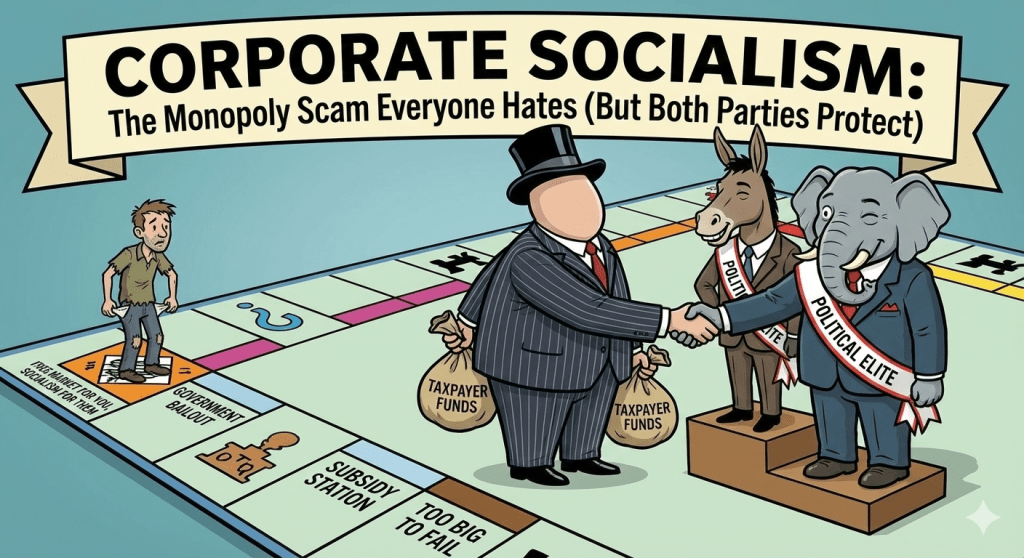
The Monopoly Scam Everyone Hates (But Both Parties Protect)
You know what socialism looks like?
It’s when the government picks one company to serve your area, eliminates all competition, and you’re forced to pay whatever they charge. You can’t shop around. You can’t choose. You can’t leave. You take what they give you or go without.
Congratulations. You’re living under Corporate Socialism. And it’s bleeding you dry.
You have the same story. Maybe it’s internet. Maybe it’s your electric company that just doubled your bill. Maybe it’s the insurance company that dropped you after 20 years of premiums because you live in California or Florida. Maybe it’s the cable company you finally told to go to hell when they raised your rate for the third time in a year.
Left, right, or middle—we all hate the same companies. Comcast. Spectrum. Optimum. Your electric utility. Your insurance company. We hate them because they treat us like captives. Which we are.
This isn’t about political ideology. Conservatives despise Comcast. Progressives despise Comcast. Moderates despise Comcast. Everyone has called customer service, waited 45 minutes, been transferred three times, and gotten nowhere. Everyone has watched service drop during a Zoom call. Everyone has seen the bill go up again with no improvement in service. And everyone knows: you can’t do anything about it. You’re trapped.
This isn’t capitalism. Capitalism requires competition, choice, the ability to take your business elsewhere. What we have is corporate socialism: government-granted monopolies where private companies extract wealth from captive customers with no accountability and no alternative.
They scream about the dangers of socialism while operating under a system where government picks winners, eliminates competition, and forces you to pay. That’s not the free market. That’s corporate welfare. Socialism for corporations, capitalism for you.
And both parties protect this system because both parties take money from these corporations.
Let’s follow the money and figure out how we got here.
1. How They Carved Up America: The Monopoly Map
Here’s how corporate socialism works: companies don’t compete for your business. They divide up territory, agree not to compete with each other, and extract wealth from captive customers.
This isn’t a conspiracy theory. It’s documented. It’s legal. And it’s happening in every sector that matters.
Cable and Internet: The industry calls them “franchise agreements.” Cities and towns grant exclusive or near-exclusive rights to cable companies to serve their area. In exchange, the cable company pays a franchise fee (typically 5% of revenue) and promises to build out infrastructure.
The result: Comcast dominates 19 states and serves 32 million customers. Charter/Spectrum dominates different territories with 31 million customers. Cox has 6 million. Altice/Optimum has 5 million. They don’t compete—they each own their territories.
Even in major cities, you typically have one, maybe two options. That’s not a market. When two companies divide territory, that’s a duopoly. When one company owns the whole area, that’s a monopoly. Either way, you lose.
Customer satisfaction scores tell the story. The American Customer Satisfaction Index ranks industries annually. Internet service providers? Dead last. Year after year. Score: 62 out of 100. For context, the IRS scores 69. People are more satisfied with the IRS than with their internet provider.
Why is service so bad? Because they don’t have to try. You can’t leave. Comcast knows this. Spectrum knows this. When you call to complain, they know you’re bluffing. Where are you going to go?
Average broadband price in the U.S.: $60-80 per month for basic service. In Europe, where there’s actual competition? $30-40 for faster speeds. In South Korea? $30 for gigabit fiber. We pay double for worse service because we have no choice.
Combined revenue of top cable/internet providers (2023): Comcast $121 billion, Charter $54 billion, Cox $13 billion, Altice $10 billion. Total: nearly $200 billion annually extracted from captive customers.
Electric Utilities: Even more entrenched. Your electric company is a regulated monopoly. You have literally zero choice. The company that serves your address is the only option. Period.
In theory, this makes sense—you can’t have five sets of power lines running to every house. Electricity is what economists call a “natural monopoly.” One provider is most efficient.
But here’s the problem: when you have a for-profit natural monopoly, the profit motive conflicts directly with service. The company makes more money by charging higher rates, cutting maintenance, and avoiding infrastructure investment. And you can’t do anything about it because there’s no alternative.
Examples of what happens when for-profit monopolies control essential infrastructure:
Pacific Gas & Electric (PG&E) in California: Deferred maintenance on power lines to boost profits. Equipment failed. Sparks flew. Wildfires burned. 85 people died in the Camp Fire (2018). PG&E filed for bankruptcy, restructured, and emerged with essentially the same monopoly. Californians still have no choice.
Texas Power Grid (2021): Deregulated market, for-profit companies, no winterization requirements. Temperatures dropped. Grid failed. 246 people died. Electric bills for those who kept power: thousands of dollars for a single week because of surge pricing. Some customers got bills for $17,000. The companies made record profits during the crisis.
Florida Power & Light: After hurricanes, bills spike. Service restoration takes weeks in some areas. FPL’s parent company, NextEra Energy, made $6.4 billion in profit (2023). Customers have no alternative provider.
This is corporate socialism: government grants monopoly status, private companies extract profit, you get screwed, and there’s no escape.
Water Utilities: Same story. Your water company is a monopoly. You have no choice. And increasingly, these utilities are being privatized—sold to private equity firms that cut costs, defer maintenance, raise rates, and extract profits.
Flint, Michigan: Switched water source to save money. Didn’t treat the water properly. Lead leached from pipes into drinking water. Poisoned thousands of children. This happened under public management, but the pattern is worse under private ownership: cut corners, boost profits, someone else deals with consequences.
The pattern across utilities: monopoly status + profit motive = bad outcomes. They don’t compete on service because they don’t have to. You’re captive. That’s corporate socialism.
2. The Insurance Scam: Profiting from Disaster While We Cover the Risk
You’ve been paying insurance premiums for 20 years. Car insurance, home insurance, health insurance. Thousands of dollars per year. Tens of thousands over time. Then disaster strikes—your house burns down, your car gets totaled, you get sick, a hurricane destroys your property.
Now the insurance company that happily took your money for two decades suddenly becomes your adversary. They delay your claim. They lowball your payout. They deny coverage based on fine print you never read. They send adjusters who find reasons to pay less. They make you fight for every dollar.
Or worse—they already dropped you. Before the fire. Before the hurricane. Before you got sick. Because you live in a “high-risk area” and they decided you’re not profitable anymore.
This is happening right now, at scale, across multiple insurance sectors. And it reveals the fundamental problem with for-profit insurance: the business model is to collect premiums and avoid paying claims. Your disaster is their loss. They profit when you don’t need them.
Home and Fire Insurance Collapse: California and Florida are in full-blown insurance crises. Major insurers are abandoning entire states because climate change is making disasters more frequent and more expensive.
California: After the 2017-2018 wildfires, major insurers started dropping homeowners en masse. State Farm, Allstate, USAA, Farmers, Chubb—all stopped writing new policies in California or drastically reduced coverage. In 2023, State Farm stopped renewing 72,000 home insurance policies. Allstate stopped writing new homeowner policies entirely.
The reason? Wildfire risk. But here’s what’s insane: these homeowners paid premiums for decades. The insurance companies collected billions. Now, when climate change is making the risk real, the companies just leave. They socialized the profits (kept premiums during good years), and they’re socializing the losses (taxpayers will cover disaster relief).
California’s FAIR Plan—the state’s insurer of last resort—now covers over 400,000 homes, up from 150,000 in 2019. This is catastrophic growth. These are people who can’t get private insurance at any price. They’re forced into a state-backed plan with limited coverage and higher premiums.
Florida: Hurricane risk. Same story. After Hurricane Ian (2022) caused $112 billion in damage, insurers fled. Six insurance companies went insolvent in 2021-2022. Others stopped writing new policies or dropped existing customers.
Citizens Property Insurance—Florida’s state-backed insurer—now covers 1.3 million policies, up from 500,000 in 2020. It’s the largest homeowner insurer in Florida. This is a state-run insurance system by necessity because private companies won’t serve the market.
Louisiana: After Hurricane Ida (2021), seven insurance companies failed. The state insurance commissioner said the market was in “crisis.” Premiums doubled for homeowners who could still find coverage.
Here’s what this reveals: insurance only works as a for-profit business when risks are predictable and manageable. When climate change makes disasters more frequent and severe, private insurers abandon ship. They won’t cover the risk because it’s not profitable.
But we still need insurance. Houses still burn. Hurricanes still hit. So what happens? Taxpayers cover it through state-backed plans and federal disaster relief. We socialize the risk while they privatized the profits during the good years.
That’s corporate socialism: private profit during stable times, public bailout during crisis.
Auto Insurance: Required by law in almost every state, which gives insurance companies captive customers. You must have it to drive legally. They know you can’t opt out.
Average auto insurance premium (2024): $2,150 per year. Up 26% since 2020. For young drivers? $4,000-6,000 annually. Insurance companies blame inflation, repair costs, and rising claims. But their profits tell a different story.
Progressive Insurance 2023 profit: $3.6 billion. Allstate 2023 profit: $5.6 billion. State Farm is a mutual company (technically owned by policyholders) but still collected $97 billion in premiums in 2023.
These companies use incredibly sophisticated algorithms to set premiums. They know exactly how much to charge to make huge profits while still being “competitive.” But when you’re required by law to buy the product, how competitive can the market really be?
And when you file a claim? They fight you. The business model is to collect premiums and minimize payouts. Your loss is their profit margin.
Health Insurance: We covered this extensively in earlier posts, but it’s worth repeating: the U.S. has the most expensive healthcare in the world and some of the worst outcomes among developed nations. Why? For-profit health insurance.
UnitedHealthcare CEO Brian Thompson made $10.2 million in 2022. The company made $22 billion in profit. And they’re notorious for denying claims. Their business model is to collect premiums, deny care, and maximize profit.
Health insurance denial rates: 15-20% initially, with many overturned only after appeals. The system is designed to make you give up. They know most people won’t fight. They profit from your exhaustion and confusion.
Across all insurance types, the pattern is the same: collect premiums during good times, fight claims or abandon customers during bad times, extract profit throughout. When the risk becomes too great, they leave and taxpayers cover the cost. Privatize profits, socialize losses. That’s corporate socialism.
3. The Deregulation Disaster: What Happens When You ‘Free’ the Market
For decades, the mantra was: deregulate. Get government out of the way. Let the free market work. Competition will drive down prices and improve service.
It was bullshit. Every major deregulation experiment in essential services has been a disaster for consumers. Because these aren’t normal markets—they’re natural monopolies or essential services where competition doesn’t work the way economics textbooks claim.
Electricity Deregulation: The Crown Jewel of Failure
California Energy Crisis (2000-2001): California deregulated its electricity market in 1996. The promise: competition would lower prices. What actually happened: energy companies manipulated the market, created artificial shortages, and caused rolling blackouts.
Enron traders had recorded phone calls bragging about stealing from “grandma Millie” by shutting down power plants to spike prices. They called the strategy “Death Star” and “Get Shorty.” They literally joked about California burning while they profited.
Cost to California: $40-45 billion in higher electricity costs. PG&E filed for bankruptcy. Residents faced blackouts. Enron collapsed (for other fraud), but the damage was done.
Texas (2021): We already mentioned this, but it deserves a deeper look. Texas has a deregulated electricity market. No mandates for winterization. No requirements to maintain reserve capacity. Pure free market.
February 2021: Temperatures dropped. Natural gas pipelines froze. Wind turbines iced over. Coal plants went offline. The grid collapsed. 246 people died—some from hypothermia in their own homes, others from carbon monoxide poisoning trying to heat with car exhaust or grills.
Customers on variable-rate plans got bills for thousands of dollars. One woman got a $17,000 bill for a single month. The companies defended it: that’s the market price during a shortage. Supply and demand.
Meanwhile, energy companies made record profits. Just Energy: $2.3 billion in charges during the crisis (later filed for bankruptcy after lawsuits). Griddy: charged customers wholesale rates that hit $9 per kilowatt-hour (normal rate: $0.12).
This is what happens when you apply free market principles to essential infrastructure. People die, companies profit, and customers get screwed. Because you can’t “shop around” when your heat is off and it’s 15 degrees outside.
Airline Deregulation (1978): Often cited as a success. And in some ways it was—ticket prices fell, more routes opened, more people could afford to fly. But at what cost?
What happened post-deregulation: Major airlines merged. American, Delta, United, and Southwest now control 80% of the domestic market. Service quality plummeted. Legroom shrunk. Fees proliferated (baggage, seat selection, meals—everything extra). Labor conditions worsened (pay cuts, pension terminations, bankruptcy restructurings that screwed workers).
Airlines made $39 billion in baggage and seat fees alone in 2023. They unbundled the product, made flying miserable, and extracted more money from customers who have fewer choices. Four airlines control most routes—that’s not competition, that’s oligopoly.
When flights get cancelled or delayed, you’re stuck. You can’t easily switch to another airline. They know this. Customer service is terrible because they don’t have to try.
Telecommunications Deregulation (1996): The Telecommunications Act promised competition and lower prices. Instead, it triggered massive consolidation.
In 1996, there were dozens of regional phone and cable companies. Now? AT&T, Verizon, T-Mobile control mobile. Comcast, Charter, Cox control cable/internet. They divided territory, raised prices, and provided terrible service.
Average cell phone bill: $127/month (2023). In Europe: $40-60 for better service. We pay double because we have an oligopoly pretending to be a competitive market.
The lesson from every deregulation experiment: essential services don’t work as competitive markets. Natural monopolies stay monopolies, just with higher prices and worse service. Deregulation was sold as “freeing” the market. What it actually did was free corporations to extract more wealth with less accountability.
4. What Should Be Public vs. Private: A Framework for Deciding
Here’s the fundamental question: which services should be publicly owned and operated, and which can be left to private markets?
This isn’t about ideology. It’s about what actually works. Some sectors function well as competitive markets. Others don’t. The key is understanding the difference and structuring systems accordingly.
Services Should Be Public When:
1. Natural Monopoly Exists: When infrastructure costs are so high that one provider is most efficient, public ownership prevents price gouging.
Examples: Electricity, water, sewage, natural gas, internet infrastructure (the physical cables). You can’t have five sets of power lines or water pipes running to every house. One network is most efficient. When that network is privately owned, the monopoly extracts wealth. When it’s publicly owned, costs stay low.
Real-world proof: Municipal broadband (city-owned internet) consistently provides better service at lower prices than private ISPs. Chattanooga, Tennessee has gigabit fiber for $70/month—half the price of private alternatives for ten times the speed.
2. Profit Motive Conflicts with Service Mission: When making money requires providing bad service or denying what people need, public ownership is essential.
Examples: Healthcare, prisons, education. For-profit health insurance makes money by denying care. Private prisons make money by keeping people incarcerated. For-profit colleges make money by saddling students with debt for worthless degrees. The profit motive directly conflicts with the mission.
3. Universal Access is Required: When everyone needs the service regardless of profitability, public provision is necessary.
Examples: Postal service, public transit, rural electricity/internet. Private companies cherry-pick profitable routes and customers, leaving everyone else stranded. USPS delivers to every address because it’s a public service. FedEx and UPS only serve profitable routes.
4. Market Failure is Guaranteed: When risks are too high or unpredictable for private insurance, public coverage is necessary.
Examples: Flood insurance, fire insurance in high-risk areas, pandemic insurance. Climate change is making disasters more frequent. Private insurers are abandoning entire states. The National Flood Insurance Program exists because private companies won’t insure flood risk. Same pattern is emerging with fire and hurricane risk.
5. Essential to Life and Safety: When failure threatens life, public ownership ensures reliability.
Examples: Fire departments, police, emergency services, public health, water, electricity. We don’t have competing fire departments bidding for your emergency. That would be insane. Same logic applies to other life-essential services.
Services Can Be Private When:
1. Competition Actually Works: When multiple providers can easily compete and customers can switch, markets function well.
Examples: Restaurants, retail, most manufacturing, clothing, consumer electronics. You can choose between dozens of restaurants. If one is bad, you go elsewhere. The market works because competition is real and switching is easy.
2. Consumer Choice is Meaningful: When you can evaluate options and make informed decisions without perfect information or facing emergency pressure.
Examples: Most goods and services you can research, compare, and purchase at your leisure. You can read reviews, compare prices, wait for sales. The purchase isn’t time-sensitive or life-critical.
3. Innovation Benefits from Competition: When rapid development and experimentation are valuable.
Examples: Technology, entertainment, most R&D-heavy industries. Competition drives innovation in smartphones, software, streaming services. Multiple companies trying different approaches leads to better products.
4. Failure Doesn’t Threaten Life or Welfare: When a company going out of business or providing bad service doesn’t create catastrophic harm.
Examples: Luxury goods, entertainment, most consumer products. If your favorite clothing brand goes out of business, you’re inconvenienced but not endangered. If your electric company goes bankrupt during winter, people die.
The Current System Gets It Backwards:
We’ve privatized essential services (healthcare, prisons, utilities, infrastructure) while keeping luxury and non-essential services private—which actually makes sense for luxury goods. The problem is we treat life-essential services like they’re optional market goods when they’re actually public necessities.
Result: We have the worst of both worlds. Monopolies in essential services that extract wealth without competition, combined with inadequate public alternatives that have been deliberately defunded.
The solution isn’t “socialism” or “capitalism.” It’s using the right tool for the right job. Competitive markets where they work. Public ownership where they don’t. Common sense, not ideology.
5. How Other Countries Do It (And Why They Don’t Have These Problems)
The United States is unique among developed nations in how thoroughly we’ve privatized essential services. Other countries maintain public ownership or strong public options in sectors we’ve handed to private monopolies.
The results speak for themselves: better service, lower costs, higher satisfaction, better outcomes.
Internet and Broadband:
South Korea: Average internet speed: 200+ Mbps. Average cost: $30/month. The government invested heavily in fiber infrastructure in the 1990s and 2000s. Now South Korea has the fastest, cheapest internet in the world.
United States: Average speed: 150 Mbps. Average cost: $60-80/month. We pay double for slower speeds because we let private companies carve up territory and charge whatever they want.
Romania: Yes, Romania. Gigabit internet for $10/month in Bucharest. They deregulated smartly, allowing multiple small ISPs to compete while maintaining public infrastructure. Result: some of the fastest, cheapest internet in Europe.
France: Orange (formerly France Télécom, partially state-owned) competes with private providers. Average cost: $35/month for high-speed fiber. Competition exists because the government mandated infrastructure sharing—private ISPs can use existing networks, so they actually compete on service and price.
Electricity:
France: Électricité de France (EDF) is 85% state-owned. Electricity prices: approximately $0.18 per kWh. Service is reliable. The grid doesn’t fail during cold snaps. No rolling blackouts. No surge pricing during crises.
United States: Average price: $0.17 per kWh, but with massive variation and gouging during crises. Texas: $9/kWh during the 2021 freeze. California: rolling blackouts during heat waves. For-profit utilities cut maintenance to boost profits, then charge customers more when infrastructure fails.
Scandinavia: What Public Infrastructure Actually Looks Like
Let’s talk about Norway, Sweden, and Denmark specifically, because the contrast with the United States is jarring.
Norway: GDP per capita $89,000 (higher than ours at $76,000). Infrastructure quality rank: #1 globally according to the World Economic Forum. Here’s what that means in practice: trains that actually run on time, roads without potholes, airports that are modern and clean, internet at 100+ Mbps average for $50/month.
The Norwegian government owns 37% of their stock market through their sovereign wealth fund ($1.4 trillion). They use this for long-term infrastructure investment, education, and healthcare. Corporate tax: 22%, and they actually collect it. Universal healthcare, free university, excellent public transit.
Sweden: Infrastructure rank top 10 globally. Stockholm’s metro system runs on time 95%+ of the time. It’s clean. It works. Compare that to New York’s subway: 65% on-time performance in 2019 (pre-COVID), falling apart, tracks catching fire, delays constant.
Denmark: Consistently ranked as the happiest country in the world. Copenhagen: 62% of residents bike to work because the infrastructure supports it—dedicated bike lanes, safe routes, integrated with public transit. Universal healthcare, free university, functioning public services.
Here’s the tell: if you travel from Scandinavia to New York, it feels like arriving in a third world country. Penn Station—the busiest train station in the Western Hemisphere—looks like a concrete dungeon from the 1960s. The subway is literally held together with duct tape. Potholes everywhere. LaGuardia Airport was regularly ranked the worst airport in America. Infrastructure failing everywhere.
And yet we’re richer. U.S. GDP: $25 trillion. We have more wealth than Scandinavia. So why does our infrastructure suck?
Because we privatized it and let corporations extract wealth instead of providing service. Because we cut taxes on corporations and the wealthy, starving public investment. Because we handed essential services to monopolies and called it “capitalism.”
Scandinavia: Strong public ownership of utilities. Actual investment in infrastructure. Corporate taxes collected. Universal services funded. Result: everything works, and people are happier.
United States: Privatized utilities. Deferred infrastructure investment. Corporate taxes dodged. Universal services defunded. Result: everything’s falling apart, and we’re told we can’t afford to fix it.
The American Society of Civil Engineers gives U.S. infrastructure a grade of C-. We have a $2.6 trillion infrastructure funding gap. Meanwhile, Norway ranks #1 globally, and you can actually see the difference when you travel there.
They didn’t achieve this through some magic Scandinavian secret. They did it by not falling for the “privatize everything” scam. They maintained public ownership of essential infrastructure. They invested in it. They taxed corporations and wealthy individuals to fund it.
And before anyone says “but they’re small homogeneous countries”—irrelevant. California has 40 million people, more than all of Scandinavia combined. We have the resources. We have the wealth. We just chose corporate socialism over public investment.
Germany: Mix of public and private utilities with strong regulation. Energiewende (energy transition) toward renewables is happening through public investment. Prices are higher (partly due to renewable transition costs), but service is reliable and grid failures are rare.
Healthcare:
We’ve covered this extensively before, but it’s worth repeating in this context.
United Kingdom: National Health Service (NHS). Public healthcare, free at point of service. Cost per capita: $4,500. Life expectancy: 81.3 years.
Germany: Public insurance with private option. Everyone must have insurance, but it’s non-profit and heavily regulated. Cost per capita: $6,700. Life expectancy: 81.1 years.
United States: For-profit insurance, employer-based system. Cost per capita: $12,555. Life expectancy: 78.9 years. We spend nearly double what other countries spend for worse outcomes. The difference? Profit extraction by insurance companies.
Public Transit:
Japan: Extensive public rail system. Trains are fast, frequent, affordable, clean, and on time. The Shinkansen (bullet train) has carried 10 billion passengers with zero fatalities. Why? Public investment and strong regulation, even where private companies operate trains.
France: SNCF (state-owned railway) plus TGV high-speed rail. You can travel from Paris to Marseille (400 miles) in 3 hours for $40-100. Frequent service, reliable, affordable.
United States: Amtrak loses money on most routes, service is slow and infrequent, infrastructure is crumbling. Why? We underfund public transit while subsidizing highways and airlines. We chose car dependency over public investment.
The Pattern:
Countries with strong public ownership or public options in essential services: Better service, lower costs, higher customer satisfaction, better outcomes.
United States with privatized essential services: Worse service, higher costs, lower satisfaction, worse outcomes, and massive corporate profits.
They’re not smarter than us. They just didn’t fall for the “free market solves everything” propaganda. They understood that essential services require public ownership or strong public alternatives.
We could have this. We chose corporate socialism instead.
6. Solutions: Breaking the Monopoly Grip
Here’s what we can do to fix corporate socialism and create actual markets or public alternatives:
A. Public Options for Natural Monopolies
For services that are natural monopolies (electricity, water, internet infrastructure), provide public alternatives that compete with or replace private monopolies.
Municipal Broadband: Allow cities to build and operate their own internet networks. More than 900 communities in the U.S. already have municipal broadband or public-private partnerships. The results are consistently better—faster speeds, lower prices, better customer service.
Example: Chattanooga, Tennessee has municipal gigabit fiber. $70/month for 1 Gbps speeds. Comcast charges $150+ for far slower service in other markets. Customer satisfaction: 97% for Chattanooga’s municipal service vs. 62% for Comcast nationally.
The obstacle: 18 states have laws restricting municipal broadband, passed after cable company lobbying. These need to be repealed.
Public Power: Expand public utility districts and municipal utilities. More than 2,000 communities in the U.S. already have public power. Their rates are consistently 10-30% lower than private utilities, and service is more reliable.
Example: Los Angeles Department of Water and Power (LADWP) serves 4 million people. Rates are lower than nearby private utilities, and they invest heavily in renewable energy without needing to maximize shareholder returns.
B. Break Up Monopolies and Enforce Antitrust
Use antitrust law to break up consolidated industries and prevent further mergers.
Cable/Internet: Break up Comcast, Charter, and Cox into regional companies that must compete. Prevent vertical integration (owning both content and distribution). This is how AT&T was broken up in 1984, creating competition that drove innovation.
Airlines: Block further airline mergers and consider breaking up the Big Four (American, Delta, United, Southwest). Four companies controlling 80% of domestic flights is an oligopoly, not a market.
Health Insurance: Break up UnitedHealthcare, which controls 15% of the national market and much higher percentages in many states. Prevent further consolidation. Better yet, move to single-payer and eliminate the profit motive entirely.
C. Mandate Infrastructure Sharing
For infrastructure with high fixed costs, require companies to share networks so multiple providers can compete on service.
Internet: Require cable companies to allow competing ISPs to use their lines (called “local loop unbundling”). This is how Europe got cheap internet—multiple ISPs compete using the same physical infrastructure.
Electricity: Separate generation from distribution. One company owns the wires (as a regulated utility or public entity), multiple companies generate power and compete on price and source (renewable vs. fossil fuel).
D. Public Insurance for Catastrophic Risks
Climate change is making certain risks uninsurable for private companies. Create public insurance systems for these risks.
Home and Fire Insurance: Expand state-backed insurance programs (like California FAIR Plan and Florida Citizens) but fund them properly and keep premiums affordable. Alternatively, create federal catastrophic insurance that covers climate-related disasters.
The alternative is mass abandonment—private insurers leave high-risk areas, property values collapse, communities are destroyed. Public insurance prevents this.
E. Re-Regulate Where Deregulation Failed
Admit deregulation was a mistake in sectors where it clearly failed, and re-impose regulations.
Electricity: Mandate winterization, maintenance standards, and reserve capacity. Texas proved that pure free-market electricity is deadly. Require utilities to prioritize reliability over short-term profits.
Airlines: Regulate fees, seat sizes, service standards. Require compensation for delays and cancellations that match European standards (EU passengers get €250-600 for delays over 3 hours). Stop letting airlines nickel-and-dime customers who have no alternatives.
F. Price Regulation for Monopolies That Must Remain Private
For monopolies that remain private, strictly regulate prices to prevent price gouging.
Utilities: Public Utility Commissions already exist but have been captured by industry. Strengthen them, make them independent, and give them real power to reject rate increases that aren’t justified by actual costs.
Pharmaceuticals: Allow Medicare to negotiate drug prices (finally happening but needs expansion). Cap prices at international averages. If a drug costs $30 in Canada, it shouldn’t cost $300 in the U.S.
G. Ban Mandatory Arbitration for Essential Services
Monopolies force customers into arbitration clauses that prevent class-action lawsuits. This lets them screw millions of customers in small amounts with no accountability.
Ban mandatory arbitration for utilities, insurance, healthcare, and other essential services. Customers must have the right to sue when they’re wronged.
H. Publicly Funded Elections
None of this happens without getting corporate money out of politics. Monopolies protect their status by buying both parties.
Comcast spent $13.7 million on lobbying in 2023. AT&T: $11.2 million. Verizon: $9.8 million. They buy politicians to prevent competition and public alternatives.
Solution: Public funding for campaigns, ban corporate donations, close the revolving door between regulators and industry. Until money is out of politics, monopolies stay protected.
These solutions aren’t radical. Most are proven systems that work in other countries or in parts of the U.S. The obstacle isn’t feasibility—it’s political will. And political will requires overcoming the corporate money that both parties depend on.
7. The Socialism Boogeyman: How They Use Fear to Protect Corporate Monopolies
Here’s the game: Every time someone proposes a public alternative to corporate monopolies, they scream “SOCIALISM!” They trot out Venezuela. They invoke the Soviet Union. They warn about government control and loss of freedom.
It’s all projection. They’re already running a socialist system—corporate socialism. Government grants monopolies, eliminates competition, and forces you to buy from one provider. That’s not capitalism. But they’ve weaponized the word “socialism” so effectively that people defend the monopolies screwing them while opposing the public alternatives that would help them.
Let’s look at exactly how this works and what they’re really defending.
Municipal Broadband: When cities try to build their own internet networks, cable companies go nuclear with the socialism attacks.
What they say: “Government-run internet is socialism! It’ll be slow, expensive, and inefficient! The government can’t run anything! This is a government takeover!”
What they’re defending: Comcast’s government-granted monopoly in your area where you have no choice, pay $80/month for mediocre service, and customer satisfaction is lower than the IRS.
What they’re trying to prevent: Municipal fiber like Chattanooga’s gigabit internet for $70/month that actually works, where customer satisfaction is 97%, where you can call and talk to a human being who lives in your city.
The reality: They spent $640 million lobbying from 2010-2020 to block municipal broadband. They passed laws in 18 states restricting or banning cities from building their own networks. Why? Because public alternatives expose the scam. When Chattanooga’s municipal broadband launched at half the price with ten times the speed, it proved that Comcast’s prices were pure profit extraction.
They’re not defending capitalism. They’re defending their government-granted monopoly against public competition.
Medicare for All: When anyone proposes single-payer healthcare, the insurance industry deploys the full propaganda machine.
What they say: “Socialized medicine! Government bureaucrats between you and your doctor! Look at Venezuela! You’ll lose your choice! Rationing! Death panels!”
What they’re defending: UnitedHealthcare denying 15-20% of claims while CEO Brian Thompson made $10.2 million. A system where medical bankruptcy affects 530,000 families annually. Where you can’t choose your doctor anyway because your employer picked your insurance plan.
What they’re trying to prevent: Medicare, which has 2% overhead (vs. private insurance’s 12-18%), 95% customer satisfaction, and covers everyone over 65 without denying claims or declaring bankruptcy. We already have socialized medicine for seniors—it’s called Medicare and it’s the most popular government program in America.
The insurance industry spent $155 million lobbying in 2023. They spent $700 million in 2009-2010 to kill the public option in the ACA. They’re not defending your freedom—they’re defending their ability to extract $50 billion in profit annually from sick people.
Public Power: When communities try to create municipal utilities or public power districts, private utilities scream socialism.
What they say: “Government-run electricity is socialism! It’ll be unreliable! Your rates will skyrocket! Venezuela!”
What they’re defending: PG&E, which deferred maintenance to boost profits, caused wildfires that killed 85 people, filed for bankruptcy, and emerged with the same monopoly. Texas power companies that let the grid fail in 2021, killing 246 people, then charged customers $17,000 for a month of electricity.
What they’re trying to prevent: Public power districts like LADWP that charge 10-30% less than private utilities with more reliable service. The 2,000+ communities across America that already have public power and consistently report higher satisfaction and lower rates.
Now Let’s Talk About Their Scare Tactics:
Venezuela: This is their go-to. Every single time. “You want public broadband? Venezuela!” “You want Medicare for All? Venezuela!” “You want public power? Venezuela!”
Here’s why it’s bullshit:
Venezuela’s problems: Authoritarian government, corruption, oil-dependent economy that collapsed when prices fell, price controls that created shortages, nationalization WITHOUT compensation that scared off all investment, economic mismanagement by an autocratic regime, U.S. sanctions that made everything worse.
What we’re proposing: Municipal broadband like the 900+ U.S. cities already have. Medicare for All like every other developed nation has. Public utilities like 2,000+ American communities already have. Democratic control, transparent budgets, proven models that work.
The comparison is insane. It’s like saying “You want public libraries? Venezuela has government-run libraries and their economy collapsed, therefore public libraries cause economic collapse.” No—authoritarianism, corruption, and economic mismanagement cause collapse. Public services don’t.
The Soviet Union: Another favorite. “Government-run anything is a slippery slope to Soviet bread lines!”
Here’s why it’s bullshit:
The Soviet Union: Communist dictatorship. No private property. No markets. No democracy. No freedom. Central planning for EVERYTHING. No competition. Totalitarian government that killed millions.
What we’re proposing: Public options that compete with private providers, or public ownership of natural monopolies. Private property still exists. Markets still exist. Democracy still exists. Freedom still exists. You’re not seizing the means of production—you’re giving people an alternative to Comcast.
Germany, France, UK, Japan, South Korea, Canada—all have stronger public ownership of infrastructure and utilities than the U.S. None are Communist. None have breadlines. All have higher quality of life than we do. The Soviet Union comparison is designed to prevent you from noticing that every successful developed nation has more public infrastructure than we do.
Cuba: Sometimes they throw in Cuba for variety. “Government healthcare is Cuba!”
Here’s why it’s bullshit:
Cuba: Communist dictatorship under U.S. embargo for 60+ years. Economy crippled by sanctions. One-party authoritarian state. No political freedom.
What’s interesting: Despite being a poor country under decades of sanctions, Cuba’s life expectancy (79 years) is nearly identical to the U.S. (78.9 years). Their infant mortality rate is LOWER than ours. They spend $2,500 per capita on healthcare, we spend $12,555. Even under embargo, with a fraction of our resources, their healthcare outcomes match ours.
But we’re not proposing Cuba’s system. We’re proposing systems like Canada, UK, Germany, France, Japan—wealthy democracies with universal healthcare that outperform the U.S. on every metric while spending half as much.
China: “Government control of industry is China!”
Here’s why it’s bullshit:
China: Authoritarian one-party state. No democracy. No free speech. Surveillance state. Government controls private industry through Communist Party influence.
What we’re proposing: Democratic public ownership of natural monopolies, with transparent budgets, elected oversight, and freedom to criticize. That’s the OPPOSITE of China’s model. We’re proposing accountability—China has none.
Also funny: The same people who invoke China to scare you about public utilities have no problem with U.S. corporations manufacturing everything in China and depending on Chinese supply chains. Apparently China is terrifying when it comes to municipal broadband, but fine when it comes to Apple’s entire production line.
The Pattern:
Notice what they NEVER compare us to: Germany. France. UK. Japan. Canada. South Korea. Norway. Sweden. Denmark. Finland.
Why? Because those are wealthy democracies with strong public ownership of infrastructure and utilities, universal healthcare, excellent public transit, and they all outperform the U.S. on quality of life, healthcare outcomes, infrastructure quality, and citizen satisfaction.
They only invoke failed authoritarian states: Venezuela, Soviet Union, Cuba, China. Countries that were dictatorships, suffered from corruption, had no democracy, and often faced U.S. sanctions.
This is deliberate. If they compared us to successful democracies with public infrastructure, you’d realize those systems work great. So they compare us to failed dictatorships to make you think public ownership = tyranny.
Meanwhile, what you’re actually living under:
• One internet provider chosen by government = Corporate Socialism
• One electric company chosen by government = Corporate Socialism
• Insurance mandated by law, sold by for-profit companies = Corporate Socialism
• Government grants monopolies, eliminates choice = Corporate Socialism
• Private profits, public bailouts when things fail = Corporate Socialism
They’ve convinced you that the alternative to corporate monopolies is Venezuela. It’s not. The alternative is Germany, where municipal utilities work great. It’s Chattanooga, where public broadband is faster and cheaper. It’s Los Angeles, where public power is reliable and affordable. It’s Canada, where healthcare is universal and costs half as much.
The “socialism” they warn you about is actually corporate socialism—the system you’re living under right now. What they’re trying to prevent isn’t socialism—it’s you escaping from corporate socialism into either actual markets with competition or public alternatives with accountability.
Here’s the tell: When you propose municipal broadband, they scream socialism. But when Comcast lobbies for laws that ban municipal broadband, protecting their government-granted monopoly—that’s fine. That’s “free market.”
When you propose Medicare for All, they scream socialism. But when insurance companies lobby for laws requiring you to buy their product—that’s fine. That’s “personal responsibility.”
When you propose public power, they scream socialism. But when private utilities get government-granted monopoly territories and use government to prevent competition—that’s fine. That’s “capitalism.”
It’s all backwards. They’ve weaponized the word “socialism” to protect actual corporate socialism. And they use failed dictatorships to scare you away from proven democratic models that work in every other wealthy nation.
Don’t fall for it. You’re already living under socialism—corporate socialism. Government-granted monopolies. No choice. Captive customers. Profit extraction with no accountability.
What they call “socialism”—public options, municipal ownership, universal services—that’s actually the escape route from corporate socialism. That’s what works in Germany, France, Canada, Japan, and 900 American cities with municipal broadband.
The question isn’t capitalism vs. socialism. It’s whose socialism: corporate socialism where Comcast owns you, or democratic socialism where you own Comcast.
Conclusion: You’re Living Under Corporate Socialism—And Both Parties Like It That Way
Let’s be clear about what we’ve documented here:
You have one choice—or no choice—for internet, electricity, water, insurance, and other essential services. Government granted these companies monopoly or duopoly status. They provide terrible service at high prices. You can’t leave. You’re captive. That’s not capitalism—that’s corporate socialism.
Left or right, we all hate the same companies for the same reasons. Comcast treats you like a hostage. Your electric company gouges you during crises. Insurance companies deny your claims after collecting decades of premiums. This is the shared experience of the bottom 90%.
Every deregulation experiment in essential services has failed. California electricity crisis. Texas grid collapse. Airline consolidation and terrible service. Telecommunications mergers and price increases. The “free market” doesn’t work for natural monopolies and essential infrastructure. It just transfers wealth from you to shareholders.
Other countries figured this out. They maintain public ownership or strong public options in electricity, water, internet, healthcare, transit. Result: better service, lower costs, higher satisfaction. We could have this. We chose corporate socialism instead.
The insurance industry is collapsing under climate change—private companies abandoning entire states while taxpayers cover the risk through state-backed insurance and federal disaster relief. They privatized profits during stable years. Now they’re socializing losses during crisis. That’s corporate socialism.
Both parties protect this system. Comcast gives millions to Democrats and Republicans. Insurance companies fund both parties. Utility companies buy influence everywhere. The result: no real reforms, no public alternatives, no accountability. Corporate socialism with bipartisan support.
We have solutions. Public options for natural monopolies. Break up consolidated industries. Mandate infrastructure sharing. Public insurance for catastrophic risks. Re-regulate where deregulation failed. These work in other countries and in parts of the U.S. The obstacle is political will.
Here’s the bottom line: they scream about the dangers of socialism while operating government-granted monopolies that eliminate your choice and extract your wealth. They call it “the free market” while government protects them from competition. They warn about government control while using government power to control you.
It’s all projection. What they accuse public services of being—inefficient, unresponsive, monopolistic—is exactly what they are. Except they’re also extracting billions in profit while providing worse service than public alternatives.
You already know this. You’ve lived it. You’ve been on hold with Comcast for an hour. You’ve watched your electric bill double. You’ve had your insurance claim denied. You’ve been gouged and ignored and trapped.
This is the issue that unites us. Not left vs. right. Not Democrat vs. Republican. Bottom 90% vs. corporate monopolies that own both parties.
We can fix this. Public options exist. Municipal broadband works. Public power works. Break up monopolies. Mandate competition. Create public alternatives. It’s not complicated.
What’s complicated is overcoming the corporate money that protects this system. Comcast, AT&T, insurance companies, utilities—they spend billions lobbying to maintain their monopolies. Both parties take the money. Both parties protect the system.
Until we get money out of politics, corporate socialism stays. Until we realize the bottom 90% have a shared interest against monopoly power, nothing changes.
You’re already living under socialism. Corporate socialism. Government picks winners, eliminates your choice, and you pay whatever they charge.
Time to call it what it is. Time to demand alternatives. Time to break the monopoly grip.
You deserve a choice. You deserve competition. You deserve public alternatives when private monopolies fail.
That’s not socialism—it’s breaking free from corporate socialism and getting actual markets or actual public services. Either works. What we have now doesn’t.
 Even that's Odd
Leave a comment