
Spring 2008
After deciding to build, I went down the research rabbit hole. This was 2008, so the internet existed but wasn’t quite the resource it is today. There was no YouTube showing you every possible mistake you could make. There were forums, sure, but they were mostly people arguing about whether PT lumber would give you cancer (spoiler: everything gives you cancer according to internet forums).
The Sears Catalog Fantasy
I’d been obsessed with Sears catalog homes ever since learning about them. For those unfamiliar with this slice of Americana: from 1908 to 1940, you could literally order an entire house from the Sears, Roebuck and Co. catalog.
Everything you needed—pre-cut lumber, nails by the keg, windows, doors, shingles, paint, even the blueprints—would arrive by boxcar at your local train station, along with a 75-page instruction book. Some 70,000 to 75,000 of these homes were sold, and many are still standing today, which is more than I can say for houses built in the 1970s.
The romance of it was intoxicating:
- Democratic! Anyone with land and determination could have a quality home!
- Efficient! Everything designed to work together!
- Quality! Factory precision instead of hoping your local lumber mill cut straight!
- Historical! We’d be part of a great American tradition!
Of course, those houses were built when:
- Lumber was old-growth and actually straight
- Craftspeople could and would read detailed instructions
- “Good enough” wasn’t the dominant philosophy
- A house cost what a car costs today
But I was committed to the dream.
Enter: Modular and Kit Homes
I started researching modern alternatives. True modular homes—where entire room sections are built in a factory and craned onto your foundation—were an option, but I had concerns. At the time (and honestly still today), the modular homes I found either looked generic and suburban, or they were ultra-modern prefabs designed by architects who apparently believed humans don’t need storage or reasonable ceiling heights.
I wanted old-house details. I wanted character. I wanted it to look like it had been there for a hundred years, not like it arrived from IKEA.
That’s when I discovered the middle ground: kit houses.
Connor Homes: The Dream Catalog
Connor Homes, based in Vermont, was exactly what I’d been looking for. They specialized in reproduction historical homes—colonials, capes, farmhouses, even some Greek Revivals. Their catalog was gorgeous. Every page showed houses with proper proportions, real trim detail, and that ineffable “rightness” that old houses have.
It wasn’t true modular—the house didn’t arrive in finished room-sized sections. Instead, it was a hybrid approach, somewhere between a Sears kit and traditional stick-built:
What Arrived in the Kit:
- All the exterior and interior framing lumber, pre-cut to length
- All windows and exterior doors (primed)
- All interior doors (primed, pre-hung with casings)
- All trim pieces (primed)
- All the hardware you’d need
- Detailed plans and instructions
What Didn’t:
- Foundation (obviously)
- Roofing materials
- Siding materials (though they had recommendations)
- Plumbing and electrical (just the wood part of the house)
- Appliances
- Any decision-making ability on my part, apparently
The promise was beautiful: factory precision, historical accuracy, and you could customize the floor plan. It was like the Sears kit houses, updated for modern building codes and modern (ha!) efficiency.
The Factory Tour
We drove up to Vermont to tour the Connor Homes factory and see some finished houses. This was the moment we should have asked more questions. So many more questions.
The factory was impressive—a big warehouse space with different stations. Framing lumber got cut here, window frames assembled there, trim pieces organized into bundles. It all looked very… professional. Controlled. Nothing getting rained on. No materials sitting in mud.
“See?” I told Jennifer. “This is perfect. Everything made in ideal conditions.”
We toured a few completed Connor Homes in Vermont. They were lovely. Old-fashioned proportions, nice trim detail, everything I wanted. The owners seemed happy.
What I didn’t ask:
- Who did your foundation?
- Did you act as your own general contractor?
- What unexpected problems did you have?
- What would you do differently?
- Are you still married?
I was too busy imagining our perfect home to ask practical questions.
Designing “Our” House
Connor Homes had an extensive catalog of historical plans. Jennifer went through them with her professional eye, evaluating proportions, authenticity, and how each design would sit on our specific site.
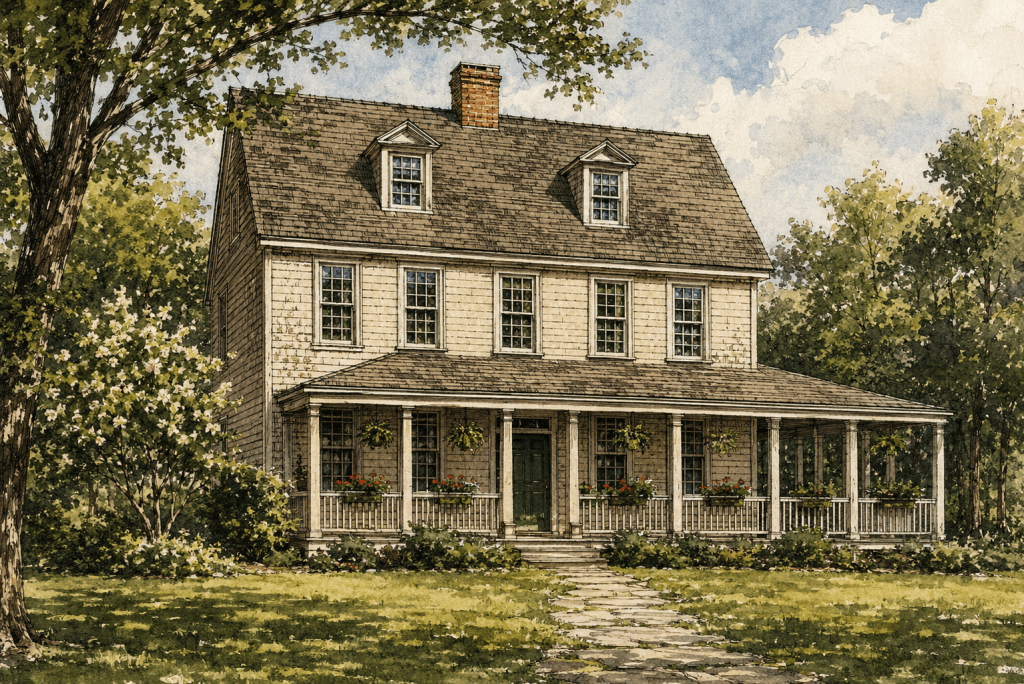
The process was semi-custom: pick a base model, modify it to fit your needs and site. We ended up with a 28’x36′ two-story colonial. For context, that’s 1,008 square feet per floor, 2,016 square feet total not counting the basement and attic.
Coming from NYC apartments, this seemed ENORMOUS. Palatial, even. Room for everything! Space we wouldn’t know what to do with!
It was not enormous. It was, in fact, tight.
Here’s what we lost to necessary structural elements:
- 3 feet in the center for the chimney (more on this disaster in Part 16)
- 3 feet in the center for the stairs
- Various walls that needed to exist for, you know, structural integrity
What we should have done: gone 3-6 feet bigger in each direction. Jennifer knew this—she’d worked on enough residential projects to understand spatial needs. But coming from apartments where a galley kitchen felt normal, we couldn’t wrap our heads around actually needing more space. We had no frame of reference for how we’d live in a real house.
“Trust me,” Jennifer said, “we should go bigger.”
I looked at the floor plan and thought, “This is already huge! We don’t need more space!”
I was wrong. Jennifer was right. This will be a recurring theme.
The Customization Process
To Connor Homes’ credit, they were flexible. We made changes:
- Moved windows around for our specific site
- Adjusted the kitchen layout
- Added a small covered back porch (the first one, which we’d later rip off and replace—Part 17)
- Specified 9-foot ceilings on the first floor
- Planned for finishing the attic and basement later
What we didn’t change but should have:
- Made it bigger
- Made it bigger
- Seriously, made it bigger
- Thought harder about where the mechanicals would go
- Considered how we’d actually use the space
- Made it bigger
Jennifer did the design work—she has a background in interior design and architecture. She drew up floor plans in CAD, figured out how we wanted to live in the space, thought about furniture placement and traffic flow.
I nodded along and said things like “yes, that makes sense” while secretly thinking about whether I could figure out how to pour our own foundation. (Spoiler: I did not pour our own foundation, thank god.)
The Deal and the Delivery
We signed the contract. The house kit would be delivered once we had the foundation ready. Everything would arrive on a truck (or several), along with the plans and instruction manual.
The timeline seemed reasonable. The price seemed fair. The quality looked good from what we’d seen.
Connor Homes would later become Connor Mill Built Homes, and then eventually go out of business entirely. At the time, though, they seemed solid and established.
We were thrilled. We had our house design. We had our plan. We had optimism and determination.
All we needed now was land to put it on.
Grade: B+. Connor Homes delivered what they promised—the kit itself was solid. The historical details were authentic, the pre-cut lumber saved time, the primed trim was smart. The minus is on us: we sized the house like apartment dwellers, didn’t think hard enough about where the mechanicals would go, and assumed “kit” meant “easy.” It does not.
Next up: Part 3 — Land, Surveys, and Driveway Drama. In which we discover that “five acres” can be divided in unfortunate ways, temporary driveways become permanent problems, and topsoil costs more than you think.
 Even that's Odd
Leave a comment