
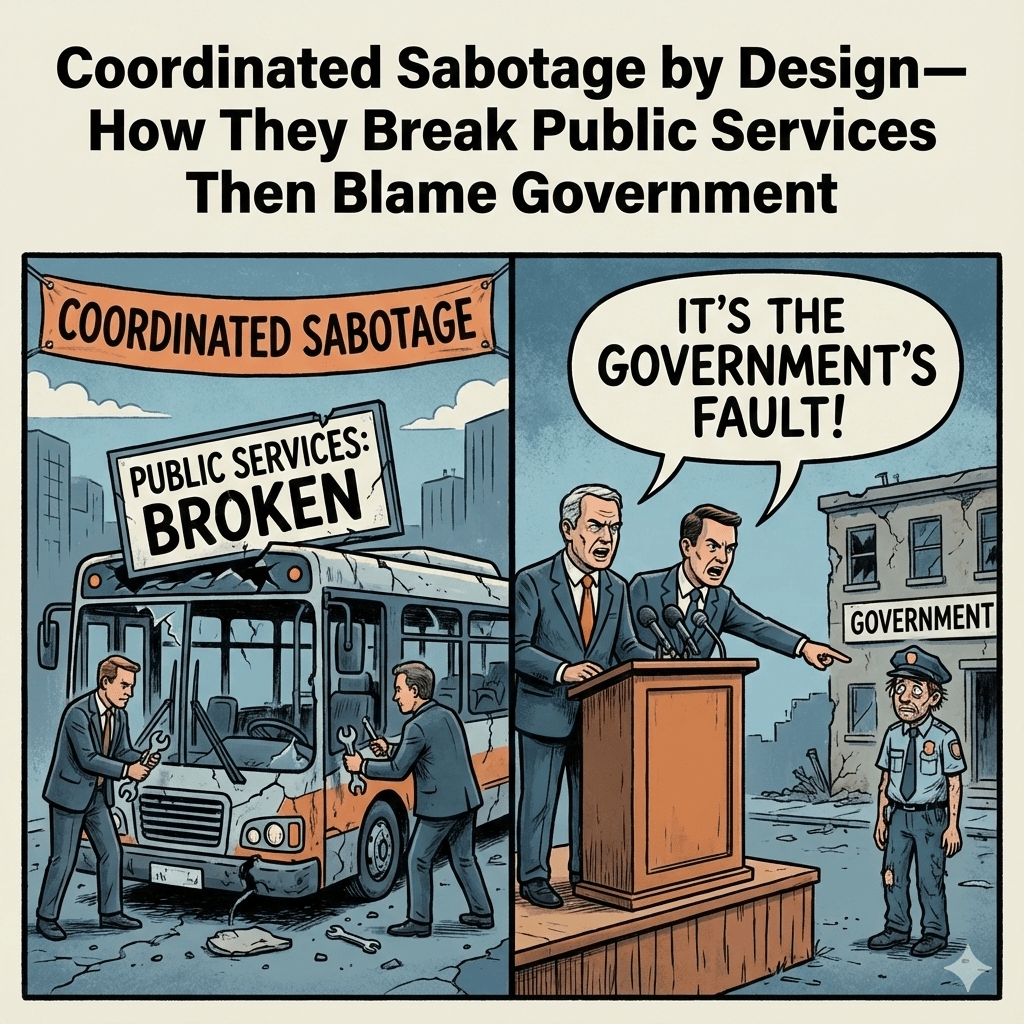
Let me start with the USPS example as the opening, since it’s the clearest case of deliberate sabotage.
In 2006, a Republican Congress and a Republican President did something remarkable. They passed a law requiring the United States Postal Service to do something no other government agency, and no private company in America, has ever been required to do: pre-fund 75 years of retirement benefits. In ten years.
Let me say that again, because it sounds insane: Congress required the USPS to pre-fund retirement benefits for employees who haven’t been born yet. In a decade.
The Postal Accountability and Enhancement Act of 2006 mandated that USPS set aside $5.6 billion per year—every year—to pre-fund health benefits for future retirees through 2056. Not current retirees. Not current employees. Future employees. Some of whom are currently in elementary school.
No private company does this. Not FedEx. Not UPS. Not Amazon. Not Apple, not Google, not ExxonMobil, not General Motors. No company in the Fortune 500 pre-funds 75 years of retirement benefits in 10 years, because it’s financially impossible and completely insane.
But the USPS was required to do it.
And when this impossible requirement caused USPS to report “losses”—losses that were entirely the accounting fiction of this pre-funding mandate—politicians and pundits and think tanks all started screaming the same thing: “See? The Post Office is failing! Government doesn’t work! We need to privatize it!”
This wasn’t incompetence.
This wasn’t bureaucratic dysfunction.
This wasn’t “government just doesn’t work.”
This was coordinated sabotage.
And the USPS is just one example. Once you see the pattern, you see it everywhere: in our schools, our transit systems, our tax collection, our veterans’ healthcare, even Social Security itself. The same playbook, over and over:
Defund it. Watch it struggle. Point at the struggle. Privatize it. Profit.
And the same networks—the same think tanks, the same donors, the same politicians taking money from the same corporations—coordinate every step.
They’re not trying to make government work. They’re trying to make it fail. Because when public services fail, private companies can charge you for what used to be free or cheap. And those private companies donate millions to the politicians who sabotaged the public service in the first place.
It’s not a conspiracy theory. It’s a business model.
Let me show you exactly how it works.
The Playbook: Five Steps to Privatization Profits
The sabotage follows the same pattern every time:
Step 1: Defund the public service
Cut budgets. Cut staff. Impose impossible requirements. Starve it of resources while demand stays the same or grows.
Step 2: Wait for predictable dysfunction
Of course an underfunded, understaffed service struggles. That’s basic math. But pretend you’re shocked.
Step 3: Amplify the dysfunction
Think tanks write papers. Media (owned by the same companies that want to privatize) runs stories. Politicians hold hearings. “Government doesn’t work! We need solutions!”
Step 4: Propose privatization
The “solution” is always the same: Let private companies do it. Give them contracts. Give them subsidies. Give them the revenue stream that used to fund the public service.
Step 5: Profit and repeat
Private companies charge more and deliver less, but they donate to politicians, so nobody stops them. Then they move on to the next public service to sabotage.
This isn’t a conspiracy theory. It has a name. Conservatives call it “starve the beast”—deliberately defunding government to make it fail so you can then claim government doesn’t work.
But what they don’t advertise is who profits when the beast dies.
Let me show you the playbook in action.
USPS: The Poison Pill That Almost Killed the Post Office
The United States Postal Service is in the Constitution. Article I, Section 8 gives Congress the power “To establish Post Offices and post Roads.” The Founders thought mail delivery was important enough to put it in the founding document, right alongside the power to declare war and coin money.
For most of American history, the USPS did exactly what it was designed to do: deliver mail to every address in America, no matter how remote, no matter how unprofitable. Rural Alaska? USPS delivers there. Tiny town in Wyoming with 50 people? USPS delivers there. FedEx and UPS won’t touch those routes—they’re not profitable enough.
The USPS was a public good, not a profit center. And it worked.
But starting in the 1990s, private delivery companies—UPS, FedEx—started lobbying Congress to cripple their competition. They couldn’t compete with USPS on rural routes (too expensive) or on price (USPS didn’t need to generate profits for shareholders). So they decided to make USPS fail instead.
The 2006 Poison Pill
The Postal Accountability and Enhancement Act passed in 2006 with overwhelming bipartisan support:
- Senate: Voice vote (no individual votes recorded)
- House: 410-20
Both parties voted for it. Bush signed it.
The bill required USPS to pre-fund $5.6 billion per year for retiree health benefits through 2016, covering benefits through 2056. Again: 75 years of benefits, funded in 10 years, for people who don’t work there yet.
The result was exactly what was designed to happen:
- Before 2006: USPS was profitable or broke even most years
- After 2006: USPS reported massive “losses”—but the losses were the mandatory pre-funding payments, not operational failures
- 2007-2016: USPS reported $62.4 billion in losses. Of that, $54.8 billion was the pre-funding mandate. Without the mandate, USPS would have lost $7.6 billion over a decade—during the worst recession since the Great Depression and the collapse of first-class mail volume due to email.
The USPS didn’t fail. It was sabotaged.
Who Lobbied for the Sabotage?
Follow the money:
- UPS: Spent $13.6 million lobbying Congress from 2006-2020
- FedEx: Spent $46.8 million lobbying Congress in the same period
- Private delivery associations: Millions more
What were they lobbying for? Restrictions on USPS. Preventing USPS from expanding services. Making sure USPS couldn’t compete effectively.
And it worked.
The Louis DeJoy Finishing Move
In 2020, Donald Trump appointed Louis DeJoy as Postmaster General. DeJoy had donated $1.2 million to Trump’s campaign and $2.5 million to the RNC. He also—and this is the important part—owned a $30-70 million stake in XPO Logistics, a USPS contractor. He had a direct financial interest in USPS using private contractors instead of doing work in-house.
As Postmaster General, DeJoy:
- Removed mail sorting machines (671 machines removed in 2020)
- Eliminated overtime for postal workers
- Removed collection boxes from streets
- Cut hours at post offices
Mail slowed to a crawl. People’s medications didn’t arrive. Veterans didn’t get prescriptions. Ballots for the 2020 election were delayed.
DeJoy, when questioned by Congress, said he was making USPS “more efficient.”
But his decisions didn’t make USPS more efficient. They made XPO Logistics—his company—more necessary. The more USPS struggled to deliver mail in-house, the more it needed contractors like XPO.
That’s not incompetence. That’s sabotage for profit.
DeJoy still runs USPS as of 2024. Biden couldn’t fire him—the Postmaster General can only be removed by the Board of Governors, which Trump had stacked with his appointees. And Congressional Democrats, despite controlling both houses in 2021-2022, didn’t force the issue.
The Truth: USPS Works When You Don’t Sabotage It
Here’s what nobody tells you:
- USPS delivers to 163 million addresses, including rural routes that FedEx and UPS won’t touch
- USPS charges $0.68 for a first-class stamp. FedEx charges $9.50 minimum for a letter.
- USPS operational costs (when you remove the pre-funding poison pill) are lower per piece than private competitors
- Customer satisfaction with USPS is consistently high—people love their mail carriers
The problem was never that “government doesn’t work.” The problem was that private companies wanted USPS to fail so they could profit from the pieces.
And Congress—both parties—helped them do it.
The IRS: Gut It, Then Complain It Doesn’t Work
Let’s talk about an agency everyone loves to hate: the Internal Revenue Service.
“The IRS is inefficient!”
“Tax filing is too complicated!”
“You can’t get anyone on the phone!”
“Audits take forever!”
All true. And all deliberate.
The Defunding
Since 2010, the IRS budget has been cut by 20% in inflation-adjusted dollars. Meanwhile, the U.S. population grew, the economy grew, tax law got more complex, and the IRS was given new responsibilities (administering Affordable Care Act subsidies, processing pandemic stimulus payments, etc.).
The results were predictable:
- Staff reduced from 94,000 (2010) to 79,000 (2021)—15,000 fewer employees
- Audit rates for millionaires dropped 71% between 2010 and 2018
- Customer service collapsed: In 2021, the IRS answered only 11% of phone calls. The average wait time for the other 89%? 23 minutes before people gave up.
- Refund delays: Processing times went from weeks to months
And then politicians—the same politicians who voted to cut IRS funding—held hearings to yell at the IRS Commissioner about how terrible the IRS is.
Who Benefits?
Two groups:
1. Tax cheats (especially rich ones)
When the IRS doesn’t have enough auditors, who doesn’t get audited? The wealthy.
Auditing a low-income person claiming the Earned Income Tax Credit is simple—it’s mostly automated. Auditing a rich person with offshore accounts, complex trusts, and shell companies requires experienced agents who understand sophisticated tax avoidance schemes.
The IRS used to have those agents. Then Congress cut funding, and the IRS couldn’t afford to keep them. Audit rates for people earning $1 million+ fell 71% from 2010 to 2018.
Meanwhile, audit rates for the working poor claiming the EITC stayed roughly the same, because those audits are automated and cheap.
The IRS became more aggressive toward the poor and less aggressive toward the rich—not because of political bias, but because of resource constraints created by Congress.
The Treasury estimates that the “tax gap”—the difference between what’s owed and what’s collected—is about $600 billion per year. Most of that gap is at the top of the income distribution.
Every $1 spent on IRS enforcement returns $6-12 in revenue. Cutting IRS funding doesn’t save money. It costs money. It just costs the government and benefits tax cheats.
2. The tax preparation industry
Here’s something that might shock you: In most developed countries, you don’t file your own taxes. The government already knows what you earned (your employer reports it), what you paid in mortgage interest (your bank reports it), what you donated to charity (nonprofits report it). So the government just sends you a pre-filled tax return. You check it, sign it, done. Takes 15 minutes.
This is called Return-Free Filing, and it works in Japan, the UK, Germany, Denmark, Sweden, Spain—basically everywhere except the United States.
Why doesn’t America do this?
Because Intuit (TurboTax) and H&R Block lobby Congress to prevent it.
- Intuit revenue (2022): $12.7 billion
- Intuit lobbying spending (2003-2023): $36 million
- H&R Block revenue (2022): $3.1 billion
- H&R Block lobbying spending (2003-2023): $16 million
These companies profit from tax complexity. The more complicated filing your taxes is, the more likely you are to pay TurboTax $60-120 to do it for you (even though the “Free File” program exists but is deliberately hidden).
In 2019, ProPublica exposed that Intuit was using deceptive tactics to trick people into paying for TurboTax when they qualified for free filing. Intuit’s internal documents literally called customers “dumb” for not realizing they were being scammed.
Congress could pass a law tomorrow requiring the IRS to offer free, simple, pre-filled tax returns like the rest of the world. It would save taxpayers billions of dollars and hundreds of hours.
But Intuit and H&R Block donate to both parties, so it doesn’t happen.
The Sabotage Playbook in Action
Watch how it works:
- Congress cuts IRS funding → IRS can’t answer phones, can’t process returns quickly, can’t audit the wealthy
- Politicians complain: “The IRS is terrible! It’s inefficient! Filing taxes is too hard!”
- Think tanks propose solutions: “We should privatize tax collection!” or “We should keep tax filing complicated but let private companies profit from it!”
- Intuit and H&R Block donate to politicians, keeping free filing from happening
- Nothing changes, except the IRS gets even less funding next year
The dysfunction is the point. They don’t want the IRS to work. They want you to hate it so you won’t support funding it.
And while you’re angry at the IRS, rich people are hiding $600 billion a year in unpaid taxes, and Intuit is charging you $100 to file a return that should be automatic.
Public Schools: The Defund-to-Charter Pipeline
If you want to see sabotage in action, watch what happens to public schools in poor neighborhoods.
The playbook is so obvious it’s almost insulting:
Step 1: Tie school funding to local property taxes
Rich neighborhoods = high property values = lots of tax revenue = well-funded schools
Poor neighborhoods = low property values = little tax revenue = underfunded schools
Step 2: Watch poor schools struggle with outdated textbooks, crumbling buildings, and underpaid teachers
Step 3: Standardized test scores are lower in poor schools (because poverty affects educational outcomes, which is not controversial)
Step 4: Politicians declare poor schools are “failing”
Step 5: Propose “school choice”—vouchers and charter schools that siphon public money to private operators
Step 6: Charter schools open, often run by for-profit companies or real estate developers who profit from the buildings
Step 7: Public schools lose funding as students leave, making the remaining public schools even worse
Step 8: Repeat until public schools collapse and all education is privatized
This isn’t a conspiracy theory. This is explicit policy in dozens of states.
The Funding Inequality
The United States spends about $15,000 per student on K-12 education—high compared to other countries. But that average hides massive inequality:
- Wealthy districts: $23,000+ per student
- Poor districts: $12,000 or less per student
Why? Because 60% of school funding comes from local property taxes. Rich neighborhoods can afford to fund great schools. Poor neighborhoods can’t.
This isn’t an accident. This is by design.
After Brown v. Board of Education (1954) ordered school desegregation, white families in many areas didn’t want their kids going to school with Black kids. So they:
- Moved to suburbs (white flight)
- Made sure school funding was local, so suburban schools would be well-funded and urban schools wouldn’t be
- Fought busing, integration, and any attempt to equalize funding
Sixty years later, we still have a system where your education depends on your parents’ zip code.
Teacher Pay: A National Disgrace
The average teacher salary in the U.S. is about $65,000. That sounds okay until you realize:
- Teachers work 10-12 hour days (teaching, grading, lesson planning)
- Teachers spend their own money on classroom supplies—average $750/year
- Teachers need master’s degrees in many states (which cost $30,000-60,000)
- Teachers in wealthy suburbs make $100,000+, while teachers in poor urban or rural districts make $40,000-45,000
Many teachers work second jobs to make ends meet. Teachers. People we trust to educate our children are working at Target on weekends because we don’t pay them enough.
This isn’t because we can’t afford to pay teachers. It’s because we choose not to.
We choose to give tax breaks to corporations and billionaires, and then claim we can’t afford to pay teachers a living wage.
The Charter School Scam
When public schools in poor areas struggle (because we defunded them), politicians propose “school choice” as the solution. This means:
- Vouchers: Give parents public money to send kids to private schools
- Charter schools: Publicly funded but privately operated schools
The pitch sounds good: “Let parents choose! Competition will improve schools!”
The reality is extraction:
Charter schools:
- Are not required to accept all students (can reject kids with disabilities or behavior problems)
- Are not required to follow the same transparency rules as public schools
- Often pay teachers less (no union protections)
- Sometimes operate as for-profit businesses
- Frequently close suddenly, leaving kids scrambling
- Show no better outcomes on average than public schools
But they do one thing very well: Extract public money into private hands.
Charter school operators get public funding, pay themselves and their executives well, cut costs on teachers and facilities, and pocket the difference. When the school fails, they close it and move on. The kids go back to the public school system—which now has even less funding because money was siphoned to the charter.
The DeVos Family: Professional School Saboteurs
If you want to understand school privatization, you need to understand the DeVos family.
Betsy DeVos was Trump’s Secretary of Education from 2017-2021. Before that, she and her family spent $200 million+ lobbying for school privatization:
- Funded campaigns for school vouchers
- Donated to politicians who supported charter schools
- Founded organizations pushing “school choice”
- Lobbied in Michigan and nationally to redirect public money to private schools
Why? Because the DeVos family profits from education privatization.
The family owns Amway (multi-level marketing), but they’ve also invested in education companies, charter school real estate, and student loan servicing. When public education dollars go to private companies, the DeVos family is positioned to profit.
And then Trump made Betsy DeVos the Secretary of Education—putting her in charge of the very system she spent decades trying to privatize.
During her tenure:
- She pushed vouchers and “school choice”
- She tried to cut Special Olympics funding (backed down after backlash)
- She weakened protections for students defrauded by for-profit colleges
- She made it harder for students to get loan forgiveness
She didn’t try to make public schools better. She tried to dismantle them.
The Bipartisan Element
Here’s the uncomfortable truth: Democrats do this too.
Charter schools are heavily pushed by Democrats in cities:
- Chicago: Rahm Emanuel (Obama’s chief of staff) aggressively expanded charters as mayor
- New York City: Bloomberg (Republican-turned-Democrat) and de Blasio both supported charters
- Los Angeles: Democratic mayors and city council supported charter expansion
- Newark: Cory Booker championed charters as mayor
Why? Because charter school operators and education reform groups donate to Democrats too.
Democrats tend to support “nonprofit” charters rather than explicitly for-profit ones, but the distinction is often meaningless—”nonprofit” charter management organizations still pay their executives six-figure salaries and hire for-profit companies for services.
Both parties take money from people who profit from privatization. Both parties enable the sabotage of public schools.
The Truth: Public Schools Work When You Fund Them
Here’s what nobody talks about:
Wealthy public schools are excellent.
In rich suburbs with high property taxes, public schools have:
- New buildings and facilities
- Small class sizes
- Well-paid teachers with master’s degrees
- Art, music, drama, sports programs
- Advanced Placement classes
- High college acceptance rates
Those are public schools. They’re not failing. They work great.
Because they’re funded.
The problem isn’t “public schools don’t work.” The problem is we only fund public schools in rich areas.
If we funded all public schools the way we fund schools in wealthy suburbs, they would all work well.
But that would require:
- Equalizing funding across districts (rich people don’t want to pay for poor kids’ schools)
- Raising taxes on the wealthy (they definitely don’t want that)
- Not siphoning public money to charter operators (charter operators donate to politicians, so that won’t happen)
So instead, we keep the system rigged, watch poor schools fail, and then use that failure as an excuse to privatize.
Public Transit: The Century-Long Sabotage
Most Americans don’t realize that we used to have excellent public transit. In the 1920s, almost every major American city had extensive streetcar systems. Los Angeles, Detroit, even small cities had electric trolleys running on dedicated tracks.
Then the auto and oil industries destroyed them. Deliberately.
The General Motors Conspiracy (Yes, Really)
This sounds like a conspiracy theory, but it’s actually a proven conspiracy that resulted in convictions.
In the 1930s and 1940s, General Motors, Firestone Tire, Standard Oil, and Phillips Petroleum formed a company called National City Lines. NCL went around the country buying up streetcar systems in more than 45 cities, including:
- Los Angeles
- Philadelphia
- Baltimore
- St. Louis
- Oakland
- Salt Lake City
- Tulsa
- San Diego
Once they owned the streetcar lines, they:
- Ripped up the tracks
- Scrapped the electric trolleys
- Replaced them with buses (made by GM)
- Made the bus service bad enough that people bought cars (made by GM, running on gas from Standard Oil, with tires from Firestone)
In 1949, General Motors, Firestone, Standard Oil, and others were convicted of conspiracy to monopolize transit systems. The penalty? A $5,000 fine for GM (about $65,000 in today’s dollars) and $1 for each individual executivefound guilty.
That’s not a typo. One dollar.
For destroying the transit systems of 45 American cities and restructuring American society around car dependency, the punishment was $5,000 and symbolic fines.
The conspiracy paid off massively:
- GM became the largest automaker in the world
- Standard Oil became ExxonMobil
- Firestone dominated tire sales
- American cities built around cars and highways, not transit
We could have had the transit systems of Europe or Japan. Instead, we have Los Angeles traffic because auto and oil companies sabotaged the alternative.
Modern Transit Sabotage
The historical destruction of streetcars set the pattern, but the sabotage continues today:
Underfunding:
- U.S. transit systems are chronically underfunded
- Politicians approve $billions for highway expansion while transit gets scraps
- Result: Aging infrastructure, delayed maintenance, service cuts
New York City Subway: The MTA (Metropolitan Transit Authority) is $48 billion in debt, largely because the state government borrowed against future transit revenues and never paid it back. Deferred maintenance has caused:
- Signal failures
- Train breakdowns
- “Subway hell summers” where trains break down in the heat
- Politicians then point at the dysfunction and say “See? Public transit doesn’t work!”
But the issue is funding, not concept.
California High-Speed Rail: California has been trying to build high-speed rail since the 1990s. The project is decades behind schedule and billions over budget. Why?
- Constantly changing political support (governors who supported it followed by governors who oppose it)
- Funding commitments pulled back
- Lawsuits from NIMBYs and car interests
- Requirements to build segments that don’t make sense (political compromises)
Result: California still doesn’t have high-speed rail, and opponents point at the dysfunction as “proof government can’t build things.”
But China built 26,000 miles of high-speed rail in the same time period. It’s not that government can’t build rail. It’s that we sabotage our own projects.
Who Benefits?
Same industries that sabotaged transit a century ago:
- Auto manufacturers: Car sales
- Oil companies: Gas sales
- Suburban developers: Sprawl only works with cars
- Highway construction companies: Billions in contracts
Every year, Americans spend an average of $10,000+ on car ownership (payments, insurance, gas, maintenance, parking). A monthly transit pass costs $1,200-1,800/year.
If we had good public transit, Americans would save $8,000+ per year.
But auto and oil companies make money when you’re forced to own a car, so they make sure public transit stays bad.
The Truth: Public Transit Works When You Fund It
International examples:
- Tokyo: Trains every 2-3 minutes, clean, efficient, used by everyone
- Switzerland: Train coverage to tiny mountain villages, punctual, comfortable
- Copenhagen: Integrated bike and transit system, most people don’t own cars
- Singapore: World-class metro system, affordable, clean
These aren’t magical. They’re funded and maintained. They work because those countries invest in public transitinstead of sabotaging it.
American cities had excellent transit once. We destroyed it deliberately. We could rebuild it. But that would require:
- Funding transit instead of highways
- Reducing car dependency
- Hurting auto and oil company profits
So it doesn’t happen. And every year, Americans waste 8.8 billion hours sitting in traffic, polluting the air, and paying $10,000+ for car ownership.
All because the auto industry won the sabotage game a century ago.
VA Healthcare: Sabotage Veterans, Then Privatize
Let me tell you about another sabotage operation: the Department of Veterans Affairs healthcare system.
The VA is one of the largest healthcare systems in America, serving 9 million veterans. It operates 1,298 healthcare facilities, including 171 medical centers and 1,113 outpatient clinics.
For decades, the VA has been a political punching bag. Politicians from both parties love to run on “fixing the VA” because veterans are sympathetic and because VA problems make for good news stories.
But here’s what they don’t tell you: The VA healthcare system actually works pretty well when measured by patient outcomes and satisfaction.
The Data Nobody Mentions
Patient satisfaction:
- VA hospitals consistently score higher than private hospitals in patient satisfaction surveys
- Veterans prefer VA care to private care in multiple studies
- VA has better outcomes for many conditions (heart disease, diabetes management, post-surgical infections)
Cost effectiveness:
- VA provides care at lower cost than private system
- Administrative overhead at VA: ~5-7%
- Private insurance administrative overhead: 12-18%
Innovation:
- VA pioneered electronic health records (used decades before private hospitals)
- VA leads in telemedicine for rural veterans
- VA research programs have led to major medical advances
So if VA healthcare is actually good, why does everyone think it’s terrible?
Because it’s deliberately sabotaged, and the sabotage is amplified while the successes are ignored.
The Sabotage: Insufficient Capacity
The VA’s problems are almost entirely about capacity and funding, not quality:
Wait times: After the Iraq and Afghanistan wars, the number of veterans using VA healthcare surged. Congress didn’t increase funding proportionally, so wait times increased. Politicians then held hearings screaming about wait times, while voting against funding increases.
Staffing shortages: VA hospitals can’t compete with private hospital salaries:
- VA doctor salary: $150,000-200,000
- Private practice doctor salary: $250,000-400,000
- Result: VA struggles to recruit, leading to understaffing
But the solution—raising VA salaries—requires funding. Congress doesn’t provide it.
2014 Phoenix Scandal: The Phoenix VA was found to have hidden wait times and falsified records. This became a national scandal (rightfully—people died waiting for care).
But here’s what got less attention:
- Phoenix VA was severely understaffed because of budget constraints
- The falsification was wrong, but it happened because administrators were being measured on wait times while not being given resources to actually reduce them
- The scandal was used to push privatization, not to fund proper capacity
The Privatization Push
Following the 2014 scandal, Congress passed the Veterans Choice Act (2014) and later the VA MISSION Act (2018). Both laws expanded veterans’ ability to get care from private providers at government expense.
The pitch: “If the VA can’t see you quickly, you can go to a private doctor and the VA will pay for it!”
Sounds good. But:
1. It’s more expensive Private care costs more than VA care. Every veteran who goes to a private provider instead of a VA facility increases costs, which means either higher deficits or cuts elsewhere in VA.
2. It fragments care VA provides integrated care—your primary doctor, specialists, pharmacy, and mental health services all coordinate. Private care is fragmented. Your cardiologist doesn’t know what your psychiatrist prescribed.
3. It’s a stepping stone to full privatization Koch-funded groups like Concerned Veterans for America explicitly push for full VA privatization. The Choice Act and MISSION Act are steps in that direction.
4. Private providers profit Guess who lobbied for these bills?
- UnitedHealth Group
- Humana
- TriWest Healthcare Alliance
- Health Net Federal Services
These companies get contracts to coordinate VA community care. They take a cut of every dollar spent on private care for veterans.
Who’s Behind It?
Concerned Veterans for America (CVA):
- Founded and funded by Koch network
- Lobbied heavily for VA privatization
- Claimed to speak for veterans, but most major veterans organizations (American Legion, VFW, etc.) opposed their plans
- CVA spent millions on ads claiming VA is broken and needs privatization
Why would the Koch network care about VA healthcare?
Because the Koch brothers own Georgia Pacific, oil refineries, and a network of companies. They oppose government spending on principle (lower taxes = more profit). But also, privatization of VA healthcare creates a $90+ billion annual market for private healthcare companies.
The VA budget is about $300 billion, with roughly $90 billion going to healthcare. If that were privatized, it would be a windfall for UnitedHealth, Humana, and others.
The Bipartisan Failure
Republicans push VA privatization openly. But Democrats went along:
- Veterans Choice Act (2014): Passed with bipartisan support, signed by Obama
- VA MISSION Act (2018): Passed by Republican Congress, signed by Trump, but also supported by many Democrats
Why? Because veterans groups pushed for it (in response to the Phoenix scandal), and because healthcare companies donate to both parties.
Nobody wants to be seen as opposing veterans. So when CVA and private healthcare companies frame privatization as “supporting veterans,” politicians from both parties go along.
The Truth: Fund the VA Properly
The solution to VA wait times is simple: Fund sufficient capacity.
- Hire more doctors and nurses (pay them competitive salaries)
- Build or expand facilities in areas with growing veteran populations
- Improve IT systems for appointment scheduling
This isn’t complicated. But it requires Congress to actually fund the VA instead of using it as a political football.
Veterans prefer VA care when it’s available. VA outcomes are good. VA is cost-effective. The problem is capacity, not quality.
But privatization advocates don’t want to hear that, because there’s no profit in a well-functioning VA. There’s profit in sabotaging it and then replacing it with private contracts.
Social Security: The 75-Year Scare Campaign
Let’s talk about the big one: Social Security.
Since Social Security was created in 1935, there has been a constant drumbeat of propaganda trying to undermine it:
- “Social Security is going bankrupt!”
- “Social Security won’t be there when you retire!”
- “We need to privatize Social Security!”
- “We need to raise the retirement age!”
- “We need to cut benefits!”
This has been going on for 75 years straight. And Social Security is still here, still solvent, still the most successful anti-poverty program in American history.
But the attacks never stop. Because Wall Street wants to privatize it.
The Truth About Social Security’s Finances
Here are the actual facts:
Social Security is solvent through 2034 without any changes. After that, if nothing is done, it can still pay 83% of promised benefits from incoming payroll taxes alone.
That’s the “crisis.” Not bankruptcy. Not insolvency. 83% of benefits instead of 100%, and only if Congress doesn’t make any changes in the next decade.
Compare that to private retirement accounts, which:
- Lost 30-40% of their value in the 2008 crash
- Charge 1-2% annual fees that compound over decades
- Have no guaranteed benefit
- Run out if you live too long
Social Security:
- Never loses value (benefits don’t depend on stock market)
- Administrative costs: 0.6% (compared to 1-2% for private accounts)
- Guaranteed for life (you can’t outlive your benefit)
- Inflation-adjusted (benefits increase with cost of living)
- Disability and survivor benefits (private accounts don’t cover this)
Social Security is the most efficient, secure, reliable retirement program in the country. That’s why attacks on it always emphasize “solvency” (which can be fixed easily) and never compare it to private alternatives (which are objectively worse).
The Easy Fix Nobody Wants to Talk About
Social Security is funded by payroll taxes: 12.4% of wages (6.2% employee, 6.2% employer).
But here’s the catch: Only wages up to $168,600 (2024) are taxed.
If you make $168,600, you pay $10,453 in Social Security taxes.
If you make $1 million, you also pay $10,453—because the other $831,400 is exempt.
If you make $10 million, you still pay $10,453.
A teacher making $60,000 pays Social Security tax on every dollar.
A CEO making $20 million pays Social Security tax on less than 1% of their income.
If we removed the wage cap—made everyone pay the same rate on all income—Social Security would be solvent forever.
But nobody in Congress seriously proposes this. Why?
Because rich people don’t want to pay taxes, and rich people donate to politicians in both parties.
The Privatization Push
Every decade or so, there’s a major push to privatize Social Security:
1983: Reagan commissioned a study on privatization (didn’t pursue it)
2005: George W. Bush made Social Security privatization his second-term priority
- Proposed letting workers divert payroll taxes to “personal accounts” invested in stocks
- Massive backlash, plan failed
- Good thing it failed: If those accounts had been created in 2005, they would have lost 30-40% in the 2008 crash. Millions of retirees would have been wiped out.
2010-2016: Paul Ryan repeatedly proposed privatization in his budget plans
- Ryan wanted to turn Social Security into a voucher program
- Also wanted to privatize Medicare (Part 17 covered this)
- Never passed, but shows the persistence of the idea
2024: Some Republicans propose raising the retirement age to 70
- This is a benefit cut disguised as “reform”
- Disproportionately hurts manual laborers who physically can’t work into their 70s
- White-collar professionals who propose this can work at a desk until 70; construction workers, nurses, manufacturing workers often can’t
Who Wants Privatization?
Wall Street.
If Social Security were privatized into personal accounts, where would that money be invested? The stock market.
Current Social Security assets: ~$2.8 trillion
Annual Social Security taxes: ~$1.2 trillion
If that money flowed into private investment accounts:
- Wall Street management fees: $12-24 billion per year (at 1-2% fee on $1.2T)
- Trading commissions
- Financial advisor fees
- 401(k) provider fees
This would be the biggest windfall in Wall Street history.
And unlike Social Security, which is a guaranteed benefit, private accounts have no guarantee. When the market crashes (as it does periodically), retirees lose their savings. But Wall Street still collects fees.
Wall Street wins either way. Retirees lose when the market crashes.
The Bipartisan Element
Republicans openly propose privatization or benefit cuts. Democrats… don’t fight back very hard.
Obama (2011): Proposed changing Social Security cost-of-living adjustments to “chained CPI,” which would have reduced benefits. Only rejected after progressive backlash.
Biden: Has opposed benefit cuts, but hasn’t seriously pushed to remove the wage cap either.
Why? Because Wall Street donates to both parties, and Wall Street wants privatization to stay on the table as an option.
If Democrats actually removed the wage cap and made Social Security solvent forever, Wall Street’s dream of privatization would be dead. So Democrats leave the “solvency problem” unsolved, keeping the door open for future privatization discussions.
The Truth: Social Security Is the Solution, Not the Problem
Social Security cut elderly poverty from 35% to 10%.
Before Social Security, more than a third of elderly Americans lived in poverty. After Social Security, that dropped to about 10%. It’s the single most successful anti-poverty program in American history.
And it’s not a handout—workers pay into it their entire careers, then receive benefits based on what they paid in. It’s a mandatory retirement insurance program.
The problem isn’t Social Security. The problem is that Social Security is the ONLY retirement security most Americans have.
- Pensions are gone (replaced with 401(k)s that Wall Street fee-extracts from—see Part 17)
- Savings rates are low (because wages are stagnant—see every other part of this series)
- Housing wealth is unaffordable (see Part 7)
Social Security was designed to be one leg of a three-legged stool: pension, savings, Social Security.
We destroyed pensions. We made savings impossible. Now Social Security is the only thing keeping tens of millions of elderly Americans from poverty.
And Wall Street wants to privatize it.
The Coordinators: This Isn’t Random
You might notice that the same names keep coming up:
- Heritage Foundation pushes privatization of USPS, schools, Social Security, VA
- Cato Institute (Koch-funded) opposes government programs across the board
- American Legislative Exchange Council (ALEC) writes model legislation for state governments to defund public services
- Concerned Veterans for America (Koch-funded) pushes VA privatization
- Americans for Prosperity (Koch-funded) opposes public transit, clean energy, any government spending
These aren’t separate efforts. It’s a coordinated network.
The Strategy:
1. Think tanks write white papers
Heritage: “Government is inefficient”
Cato: “Privatization improves services”
ALEC: “Model legislation to defund X”
2. Donors fund politicians
Koch network, DeVos family, others donate to candidates who will push privatization
3. Politicians introduce legislation
Often ALEC model legislation, sometimes word-for-word
4. Media amplifies dysfunction
Corporate media (owned by same companies that benefit from privatization) runs stories about government failures
5. Public opinion shifts
“Government doesn’t work” becomes conventional wisdom
6. Privatization happens
Public service is privatized, donors’ companies get contracts
7. Profits flow back to donors and politicians
Cycle repeats
This isn’t a conspiracy theory—it’s documented, public information:
- ALEC membership and model legislation are largely public (after leaks)
- Koch network donor summits have been infiltrated and reported on
- Think tank funding is sometimes disclosed (though often hidden through donor-advised funds)
- Political donations are public (OpenSecrets tracks them)
The coordination is the point. One think tank writing one white paper is easy to ignore. Ten think tanks, funded by the same donors, all pushing the same privatization agenda across multiple issues, with politicians in both parties repeating the talking points—that’s how you shift public opinion and policy.
The Starve the Beast Ideology
Conservative activist Grover Norquist famously said: “I don’t want to abolish government. I simply want to reduce it to the size where I can drag it into the bathroom and drown it in the bathtub.”
This is the explicit goal: Make government so small and dysfunctional that it can’t regulate corporations or provide services that compete with private companies.
The strategy is called “starve the beast”:
- Cut taxes (reduce government revenue)
- Cut government budgets (make services dysfunctional)
- Point at dysfunction as proof government doesn’t work
- Privatize
- Profit
Norquist founded Americans for Tax Reform, which has gotten almost every Republican member of Congress to sign a pledge to never raise taxes. This pledge is why:
- IRS can’t be properly funded (would require taxes)
- Social Security wage cap can’t be removed (would be a “tax increase” on the rich)
- Infrastructure can’t be maintained (would require revenue)
The dysfunction is deliberate. They want government to fail so they can privatize and profit.
The Bipartisan Element
Here’s the uncomfortable part: Democrats enable this too.
Not because Democrats are ideologically opposed to government (though some “New Democrats” and “Third Way” types are), but because Democrats take money from the same corporations that profit from privatization.
Examples:
Charter schools: Heavily pushed by Democrats in cities (Chicago, NYC, LA)
VA privatization: Passed with bipartisan support
USPS sabotage: Passed with bipartisan supermajorities
Wall Street deregulation: Bill Clinton repealed Glass-Steagall
Deficit hawkery: Obama proposed Social Security cuts
Democrats aren’t as aggressive about privatization as Republicans, but they don’t fight it very hard either—especially when the corporations pushing privatization donate to them.
Part 12 thesis: Both parties agree on economic policies that hurt the bottom 90%, differ mainly on cultural issues. The sabotage-and-privatize playbook is a perfect example.
The Counter-Examples: When Public Services Work
Here’s what’s important to understand: Public services work when you fund them and don’t sabotage them.
Services Americans Love
Libraries:
Universally loved. Well-funded (mostly). Free books, internet access, community programs. Nobody proposes privatizing libraries because they work and people would riot.
Fire Departments:
Used to be private (1800s). Private fire companies would let buildings burn if the owner didn’t subscribe to their service. Sometimes they’d let competitors’ buildings burn to increase market share. We made fire departments public because private fire protection was a disaster.
Interstate Highways:
Built by the federal government. Funded by gas taxes. Maintained by state and federal governments. Works. Nobody wants to privatize it (though there’s increasing push for toll roads, which is privatization by another name).
National Parks:
Run by the National Park Service. Beloved. Well-maintained (when funded). People plan vacations around them. Nobody seriously proposes privatizing Yellowstone.
Military:
We don’t privatize the actual military (though we do use contractors way too much—see Part 11). Even conservatives agree that defense should be public.
What’s the pattern?
Public services that are popular, well-funded, and not actively sabotaged work great. Americans love them.
International Examples
If you want to see public services working, look at other developed countries:
Healthcare:
Every other developed country has universal healthcare (Parts 1-6 covered this extensively). It works. It costs less. People are healthier.
Transit:
Japan, Switzerland, Germany, France, Spain—excellent public transit. Not privatized. Works because funded.
Education:
Finland: Public schools, well-funded, high teacher pay, best education outcomes in the world. No privatization, no “school choice,” no charter schools.
Retirement:
Most European countries have robust public pension systems. Elderly poverty rates are much lower than in the U.S.
Mail:
Most countries have public postal services. They work fine. Nobody’s trying to privatize them with pre-funding poison pills.
The lesson: Public services work everywhere they’re properly funded and not sabotaged.
The United States is the outlier, not because our government is uniquely incompetent, but because we uniquely allow corporations to sabotage public services for profit.
The Solutions
Stopping the sabotage requires both immediate fixes and structural reforms.
Immediate: Reverse the Sabotage
1. USPS: Remove the pre-funding requirement
The Postal Service Reform Act (2022) finally removed some of the pre-funding burden, but not all. Remove the rest. Let USPS operate like a normal entity.
2. USPS: Remove Louis DeJoy
He owns stock in USPS contractors. This is a conflict of interest. Biden should have replaced the Board of Governors and had them fire DeJoy. Didn’t happen. Whoever’s president next should do it.
3. IRS: Restore funding
Every $1 invested in IRS enforcement returns $6-12. This isn’t spending, it’s revenue generation. Fund the IRS properly, hire enough auditors to actually audit the wealthy, and offer free tax filing like every other country.
4. Schools: Equalize funding
Stop tying school funding to local property taxes. Fund all schools from state and federal budgets, distributed equally per student. Rich kids will still have advantages, but at least poor kids won’t have crumbling schools and underpaid teachers.
5. Schools: Pay teachers like professionals
Minimum teacher salary should be $75,000, with higher pay in high-cost areas and for advanced degrees. Teachers shouldn’t need second jobs.
6. Public transit: Actually fund it
Stop spending $billions on highway expansions while transit gets scraps. Match the level of investment we give to car infrastructure.
7. VA: Fund adequate capacity
Hire more doctors and nurses (pay them competitively). Build facilities where veterans are. Stop pushing privatization and just fund the VA properly.
8. Social Security: Remove the wage cap
Make everyone pay the same rate on all income. Solves the “solvency crisis” permanently. Simple, fair, done.
Structural: Stop the Saboteurs
1. Ban revolving door conflicts
You can’t regulate an industry you just worked for. You can’t work for an industry you just regulated. Five-year cooling-off period, minimum.
Louis DeJoy regulating USPS while owning stake in USPS contractors is corruption. Betsy DeVos running Department of Education while her family profits from privatization is corruption. This should be illegal.
2. Disclosure requirements for think tanks
Heritage Foundation, Cato, ALEC—all should be required to disclose their donors. When a think tank pushes privatization, we should know if they’re funded by the companies that would profit.
3. Ban ALEC-style model legislation
Corporations shouldn’t be able to write laws and hand them to legislators word-for-word. All legislation should be written by elected officials or their staff, with full disclosure of any input from outside groups.
4. Ban the pledge
Grover Norquist’s “no tax increases ever” pledge is a promise to sabotage government. It should be illegal for politicians to sign binding pledges to outside groups.
5. Automatic inflation adjustment for public services
Public service budgets should increase with inflation automatically. Shouldn’t require a vote every year (where cuts can be slipped in). If you want to cut a public service, it should require an explicit vote to cut, not just failure to increase.
6. Constitutional protection
The Postal Service is in the Constitution. Education, healthcare, and transit should be too. Basic public services should be protected from sabotage.
Political: Organize Against the Saboteurs
This is where Part 24 (Synthesis and Call to Action) will come in, but briefly:
The bottom 90% all benefit from public services working:
- We all need mail delivery
- We all need functioning schools
- We all need transit options
- We all will need Social Security
- Many of us will need VA healthcare
The sabotage hurts all of us. This should be a unifying issue across left, right, and center.
The strategy:
- Expose the coordination: These aren’t separate issues. It’s the same donors, same think tanks, same politicians, same playbook.
- Follow the money: When a politician pushes privatization, check OpenSecrets. Who donated to them? Which companies benefit?
- Demand accountability: Politicians who vote to sabotage public services, then complain those services don’t work, should be called out explicitly.
- Support primary challengers: Both parties do this. Primary incumbents who enable sabotage and privatization. Replace them with candidates who commit to funding public services properly.
- Build coalitions: Rural conservatives need USPS, public schools, VA. Urban progressives need transit, schools, Social Security. Suburban moderates need all of it. The bottom 90% has unified interests here.
Conclusion: The Sabotage Is the Point
Let me bring this back to where we started: The USPS pre-funding requirement.
It was insane. It was impossible. It was designed to make USPS fail.
And it worked exactly as designed—USPS reported “losses,” politicians screamed about dysfunction, privatization advocates pushed to hand mail delivery to FedEx and UPS.
That’s the playbook.
Defund. Watch it struggle. Point at the struggle. Privatize. Profit.
They did it to the Post Office.
They did it to the IRS.
They did it to public schools.
They did it to transit.
They did it to the VA.
They’re trying to do it to Social Security.
And when you see the same organizations—Heritage Foundation, Koch network, ALEC, corporate donors—behind all of these efforts, you realize:
This isn’t incompetence. This isn’t “government doesn’t work.” This is coordinated sabotage.
They break public services so they can profit from privatized replacements. And they get politicians in both parties to help them do it.
The dysfunction you see in government isn’t inevitable. It’s not because “government is inherently inefficient” or “public services can’t work.”
It’s because they’re actively sabotaging public services, then profiting from the dysfunction.
Public services work everywhere they’re properly funded and not sabotaged. Libraries work. Fire departments work. The military (mostly) works. Interstate highways work. National parks work.
And in other countries, healthcare works, transit works, education works, mail works—because those countries fund their public services instead of sabotaging them.
The United States has the resources to have excellent public services. We’re the richest country in history. We can afford it.
We just choose not to. Because the people who profit from privatization donate to the politicians who make the choice.
Part 20 showed you that monopolies extract wealth from the bottom 90%.
Part 21 shows you how they maintain that power: by destroying the public alternatives that would compete with them.
In Part 22, we’ll talk about why you don’t hear about this coordination in the media. (Spoiler: The media is owned by the same corporations doing the extracting.)
But first, understand this:
When someone tells you “government doesn’t work,” ask who profits from that belief.
When someone proposes privatizing a public service, ask who benefits financially.
When a public service is failing, ask who defunded it and why.
The pattern is everywhere once you see it.
And once you see it, you can’t unsee it.
 Even that's Odd
Leave a comment