
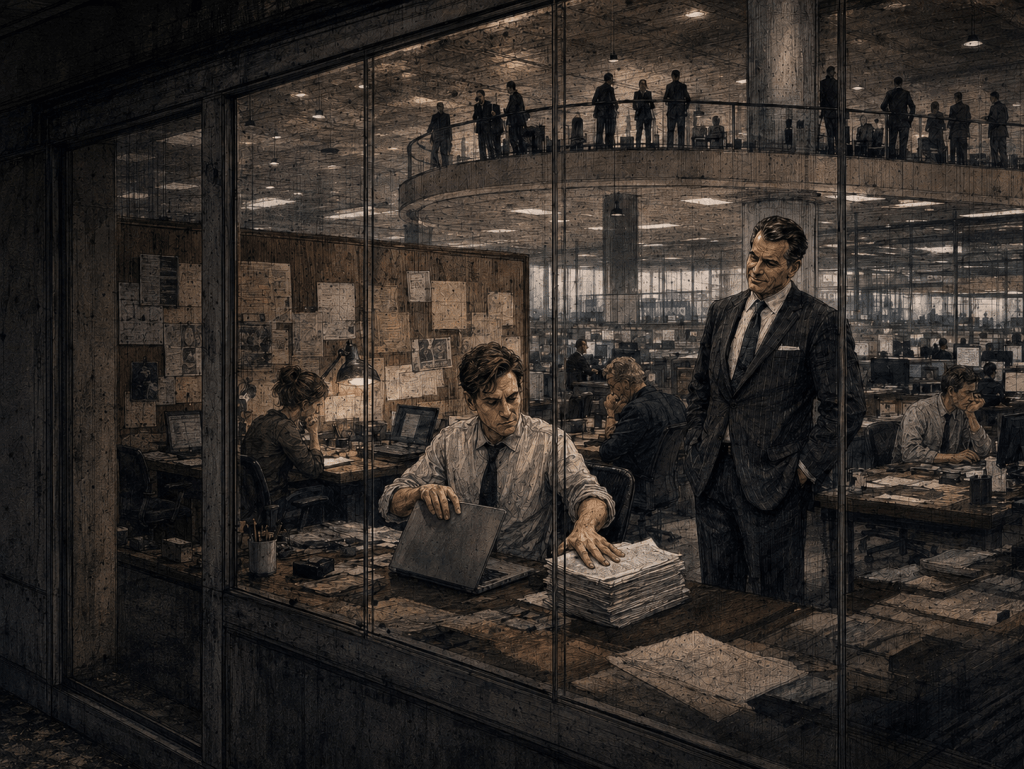
On a Sunday night in April 2025, 60 Minutes ended the way it always does, and then it didn’t. The stories had run. The stopwatch had ticked. And instead of the credits, Scott Pelley was still on camera, talking to the audience about the show itself.
He said the company that owns CBS was trying to complete a merger. He said the Trump administration had to approve it. He said that in recent weeks the parent company had begun supervising the broadcast’s content in ways it had not before, and that the executive producer had resigned because of it. Then the credits ran.
The producer was Bill Owens, who had been at CBS News for thirty-seven years and had run 60 Minutes itself. He quit a few days earlier, telling the staff he had lost his independence from corporate. The head of CBS News, who had also refused to apologize, was pushed out a few weeks after that. Ten weeks later the company paid the President sixteen million dollars to settle a lawsuit over an edit. Three weeks after the check, the same administration’s FCC approved the merger.
Here is the part Pelley was careful to say, and it is the part that matters most. None of the stories had been killed. Not one. The reporting kept airing all spring. Nothing had to be spiked, because the spiking was never the mechanism. The supervision was. The resignations were. The settlement was. The approval was. And the only reason you know the order they came in is that the broadcast, for thirty seconds, told on itself.
Twenty-two parts in, the picture doesn’t change. This is the part where the thing that is supposed to tell you how the government is doing is owned by, paid by, and now afraid of the same people who do well when the government gets called hopeless.
The Bias Fight Is The Part You’re Allowed To Have
The loud fight is the bias. The food fight on cable, the “fake news” chant, which anchor lied and which network is propaganda and which one you can still trust. That fight is real, it runs every night, and it is almost never where the decision got made. What you are handed is the argument going on inside the pipe. The argument about who owns the pipe, who pays for it, and what that quietly does to what flows through it does not get a segment, because the people who would have to run the segment work for the pipe.
So the whole post is a contrast, and it holds the way the last several have. There is the fight you’re given — slant, spin, who’s lying tonight — and there is the thing underneath it: a pipe owned by enormous companies, paid by enormous companies, and lately frightened of the government that reviews their mergers. The first is loud and on television. The second is on the public record, in FCC dockets and court filings, if you go look for it.
The last post ended on the obvious question. The public thing gets broken on purpose, and the wreckage gets read back to you as the verdict, so why is the verdict the only part you ever actually hear? This is the answer.
Before the cases, the honest part, because the argument is worthless without it. Plenty of real journalism still gets done, including by the big corporate outlets. Investigations that cost money and make powerful people miserable run every week, and anyone who tells you it is a blackout is lying to you the way the blackout people lie. The pressure here is a tilt, not a wall. Audiences did this too. Attention went where attention goes, and a story about who owns the local TV station loses to almost anything louder, every time. That is not only a supply problem. Some of the consolidation had ordinary business logic and no censorship in it at all, because papers were dying and scale was survival and not every merger is a plot. And “the media won’t cover this” is the favorite blanket of every person whose claim falls apart the second anyone checks it. Concede all of it. The pattern is still the tell.
And mostly the pattern is a consensus, and I’m not going to pretend it isn’t. The 1996 Telecommunications Act, the law that set the modern shape of who can own what, was signed by a Democrat, and it wrote the drift into itself: a clause ordering the FCC to go back every four years and repeal the ownership limits that competition had supposedly made unnecessary. Deregulation by appointment, on a timer. The same law had already let one company own as many radio stations as it could buy, and within a few years one had, on a scale the country had never permitted before. After that it ran through administrations of both kinds. The rule that had barred one company from owning the town’s newspaper and its television station since the 1970s was finally killed in 2017, and the Supreme Court blessed the killing nine to nothing in 2021. Not a party-line ruling. A unanimous one. The collapse of local news underneath all of it is mostly not a conspiracy either; it is an industry that lost its business and got picked over by hedge funds on the way down. There is no clean villain there, and inventing one would be its own kind of lie.
One stretch is not symmetric, though, and pretending it is would be the opposite lie. Starting in late 2024 the news companies began paying the President directly. Disney’s ABC handed fifteen million dollars to his future library to make a defamation suit go away, a suit its own lawyers thought it could win, the deal landing the day after a judge ordered the depositions. Then in July 2025 Paramount paid sixteen million over a 60 Minutes edit, weeks before the same administration’s FCC approved the eight-billion-dollar sale the company had chased for a year, a sale the government got a vote on only because CBS holds broadcast licenses. The people who ran the newsroom and would not apologize left instead. And in 2026 the FCC waived a ceiling Congress itself had written into law on how much of the country one broadcaster may reach, clearing a single company to operate the local stations of roughly eight in ten American households, weeks after the President called the networks the enemy and the chairman agreed with him in writing. The same months, on a vote that drew almost no one from the other side, Congress clawed back the already-approved funding for the public broadcasting system that has already come up here once — the first rescission of its kind in more than two decades, breaking a guardrail built on purpose to keep that system out of exactly this kind of reach. The structure is bipartisan and thirty years deep. This last turn is one-sided and barely a year old. You have to say both, and let neither cover for the other.
One more thing belongs here, because it is why none of this needs a smoke-filled room. There was never a meeting. There did not have to be. The company that owns the newsroom also owns the cable monopoly, or the studio, or the parks, or the thing the FCC is reviewing this quarter, and the newsroom knows it without being told. That is not a conspiracy you could expose. It is an organizational chart you could read.
The Conflict Is Not A Memo. It Is The Org Chart.
The cleanest way to see this is to walk it by how old the squeeze is and how one-sided. The first one was built over thirty years, in the open, by both parties, and it is the structure everything else sits on. The second drained out over twenty, mostly as a business dying rather than a plan, and it is the most honest of the three because so little of it was anyone’s intention. The third was built in the last year, by one side, fast, and it is the one with a date and a docket. Each has a beneficiary you can name. They get less deniable as you go.
The first is ownership, and the cover story is competition. The 1996 Telecommunications Act did not just loosen the limits on who could own what; it instructed the FCC to keep loosening them, on a four-year clock, by writing a standing review whose only available verbs were repeal and modify. A Democratic president signed it. After that, FCCs of both kinds did what the statute told them to do. The rule keeping one company from owning a town’s paper and its broadcast station, in place since 1975, was repealed in 2017, and when it reached the Supreme Court in 2021 the vote to uphold the repeal was nine to nothing. There is the bipartisan part, and it is real. Now watch the same machine run in 2026. The FCC waived the national audience cap — a ceiling Congress set in law, not an agency preference — to let one broadcaster, Nexstar, absorb a rival and operate something like two hundred sixty-five “local” stations reaching roughly eighty percent of American households, after the President posted that the deal should clear to fight the networks he called the enemy and the chairman agreed within hours. State attorneys general are in court over it and the agency now says the approval is not final. And the cap itself may not last the year: the same FCC has a proceeding open on whether to keep it, weaken it, or delete it, and a federal court has already thrown out a separate rule that stopped one company from owning two of the top stations in the same town. The ratchet the 1996 law built is not history. It is mid-stroke. The point is not the one company. It is what “local news” even means once one owner can write the script for eight in ten households. The conflict was never a memo somebody could leak. It is that the people who own the newsroom also own the businesses an aggressive newsroom would have to investigate, and answer to the same regulator for all of it. The org chart is the conflict. Nobody had to say a word.
The second is the empty newsroom, and there is no cover story at all, which is what makes it the honest one. By the count kept at Northwestern, the country has lost close to thirty-five hundred newspapers since 2005 and something like two hundred seventy thousand newsroom jobs. Two hundred thirteen counties now have no local news outlet of any kind. Another fifteen hundred have exactly one, usually a weekly. Around fifty million Americans live with little or none. And the newest closures are not chains being stripped for parts anymore; this past year it was the independent and family papers giving up, more than two a week. The same researchers put another two hundred fifty counties on a watch list, each with a real chance of losing its last newsroom inside ten years, so the line is still moving. Most of this is not sabotage. It is an industry whose model the internet took and whose carcass the hedge funds worked over, and saying otherwise would be the invented villain the honest version refuses. But follow what is actually gone. The reporter who used to sit through the county commission meeting, the school board, the zoning vote, the local hospital’s filings — that reporter is the one nobody replaced, and the counties that went dark are the poorer, less-educated, more rural ones. This is the watchdog for exactly the kind of quiet, local machinery this whole series keeps finding, and it is not being argued with. It is being removed. It does not matter that almost no one removed it on purpose. The result is a country where the decisions that depend on nobody watching have fewer people watching every year.
The third is the settlement, and it wears the thinnest disguise yet, because it barely bothers. Not “the market,” not “business logic,” just a check written to the government while the government held the thing the company wanted. In December 2024, Disney’s ABC paid fifteen million dollars to the President’s future library and a million more in his legal fees to end a defamation suit, the deal struck the day after a judge ordered the depositions, over a claim outside observers across the spectrum thought the network could beat; it also carried an on-air note saying ABC regretted the words, the closest thing to the apology its journalists had refused. Seven months later Paramount paid sixteen million over a 60 Minutes edit while the FCC sat on the merger CBS needed because CBS holds licenses; the chairman met the buyer privately nine days before the vote; the agency then approved the sale only after the new owner put in writing what its programming would carry — the range of viewpoints it promised, the bias it promised to root out — a regulator shaping the content of a newsroom it is forbidden by law from shaping, and announcing it in the press release. Here is the tell. Two different companies, two different lawsuits, the same year, and both reached for the check at the exact moment the government had leverage over something else they wanted. That is not a coincidence repeating. That is an incentive working. This is the one example where you can see the receipt. It is not the structure quietly producing an outcome. It is the bill, the regulator, and the silence, in that order, and the newsroom told you so itself on its own air.
What’s Real
A few honest qualifications, because the strongest version of this is the one that doesn’t pretend the other side has nothing.
Real journalism still gets done, including by the companies named here, and that is not a throwaway. The same CBS newsroom kept running hard reporting on the administration straight through the months its parent was negotiating with that administration. Big outlets break the stories that end careers. A tilt is not a blackout, and the person who tells you the press is uniformly captured is doing the same thing the captured press does: flattening a complicated picture into the one that flatters their argument.
And the settlements were, for the people who run those companies, arguably the rational call, which is the uncomfortable part. A board looking at an unpredictable jury, a deal worth billions sitting in front of the same government, and a lawsuit that could drag for years is not being cowardly when it writes the check. It is doing the math its job tells it to do. That is exactly the problem, not the exception to it. When the rational move for a media company is to pay the official it covers, the structure is the story, and “they should have been braver” is a wish, not an argument. Access dependence belongs here too: going easy on the powerful to keep the interview is an old, bipartisan failure that long predates any of this, and pretending it began in 2024 would be its own dishonesty.
Audiences are not innocent in this, and the structure did not invent their attention. People click the fight and skip the filing. A documented story about postal accounting or station ownership cannot out-pull outrage, and pretending the public was only ever a victim of supply is its own kind of flattery. The structure made the gap easy to widen. It did not have to manufacture the appetite.
And the collapse of local news is, in the main, not a plot, which is the concession this argument has to make and mean. Most of those papers were not strangled by anyone. Their advertising left for the internet and never came back, and the hedge funds that bought the wreckage were doing what hedge funds do, not running a censorship operation. A serious person can believe that and still notice what is gone and where. Intent was never the claim. The hole is.
One last honest note, on a number you have heard your whole life. People say six corporations own ninety percent of American media, full stop, as if that settles it. The real picture is messier than the slogan: streaming scrambled it, the giants are splitting and selling pieces of themselves, and a single tidy figure papers over the part that actually bites, which is local. You do not need the slogan. The plain facts are worse than it. A handful of companies owning most of what crosses your screen, with an FCC actively clearing the way for fewer, is bad enough without rounding it to a bumper sticker.
What They’re Paying For
So set what this actually produces against the fight you’re handed about bias. It is four things stacked together, and each one has a beneficiary you can name, which is the difference between this and yelling about “the media.”
It is a pipe whose owners are the companies an honest newsroom would have to cover. The beneficiary isn’t abstract. It is the conglomerate that gets the newsroom’s caution for free, never having to send a memo to get it, because the reporter already knows who signs the check and what else that signature is on. The silence costs the owner nothing and is worth a great deal, which is the cleanest kind of subsidy there is.
And it is a watchdog quietly deleted from precisely the rooms where the quiet decisions get made. The beneficiary is every local official, every contractor, every vote that used to have a reporter in the room and now does not, plus the chains and the funds that booked the savings on the way out the door and left the county to find out about itself later, if at all.
And it is a check written to a sitting President by companies that needed his government’s signature. The beneficiary is the library that banked the money, the merger that cleared right after, and the regulator who got to shape the coverage he is barred by law from shaping, all of it filed as unrelated by people who know exactly how related it was, and who will say so under oath only if a court ever makes them.
And it is the one pipe nobody owned, switched off on a vote almost no one from the other side joined. The beneficiary is everyone who needed the verdict to be the only thing on the air, including the political actors who took the donations, killed the cap, blessed the merger, and let the public station go dark, and then went on the surviving networks to be asked about it gently. That is the bill the fight about bias has been keeping you from reading.
The Fixes Are Boring
The fixes are structural, not slogans, and the popular ones are mostly traps. “Bring back the Fairness Doctrine” is the loudest of them, and it would not touch a single thing in this post: it only ever applied to broadcast, not to cable or the feed in your hand, and it is an applause line precisely because it sounds like a fix while leaving the pipe exactly where it is. “Break up the six companies tomorrow” is the populist version of the same thing — it polls well, it changes nothing about who the surviving newsroom answers to, and it lets the people who profit point at the wild idea so the boring ones never get a hearing. Several of these are things the country actually had and then loosened. Roughly cheapest and most immediate to genuinely hard:
- Make the national ownership cap a hard ceiling the FCC cannot waive. Congress set the limit; let it mean what Congress said, with no agency discretion to wave it through. The watered-down version is on the record this year: the agency simply waived the cap to clear one company to reach roughly eighty percent of households, and is now asking whether to delete the cap entirely.
- Strip the 1996 law’s repeal-on-a-timer clause and turn the ownership limits into floors. Stop ordering the FCC to deregulate every four years and set a bottom it cannot review its way under. The diluted version is the status quo: that clock is still running, the cross-ownership rule that stood from 1975 is already gone, and the Supreme Court blessed its going nine to nothing.
- Bar any company with a merger or license pending before the FCC from settling a sitting official’s personal lawsuit while it pends. If the government holds your deal, you cannot also be writing the government checks. The toothless version is what just happened twice: fifteen million in December 2024, sixteen million the following July, the regulator insisting all the while that none of it was connected.
- Make license and merger review blind to the applicant’s coverage, with no viewpoint conditions, ever. The agency reviews the deal, not the journalism, and writes nothing about programming into the order. The rigged version is current events: the last big approval came stapled to written promises about the viewpoints and the bias in the new owner’s newsroom.
- Tie a broadcast license renewal to an actual local newsroom, with real staffing, on the record. A license is the public’s airwaves on loan; make the loan cost local reporting. The diluted version is the trend: the local-ownership protections keep getting relaxed, and a federal court vacated the top-station limit in 2025, so owning more of a single market got easier, not harder.
- Fund public media several years ahead and make the money unrescindable. Put it past the reach of a simple-majority clawback so no administration can switch it off mid-stream. The watered-down version already ran and failed: it was funded two years ahead precisely to insulate it from exactly this, and it got rescinded by a bare majority anyway.
- Separate the newsroom from the conglomerate’s other businesses — and yes, this is the hard one. If the conflict is that the owner also owns the things the newsroom would have to investigate, the only fix that reaches the root is making the owner choose one or the other. It is last because it is genuinely hard, carries real questions about where the lines fall, and the firms it touches will fight it hardest. Saying that plainly is better than pretending the list is all easy.
Six of those seven are a statute, an appropriation, or an enforcement choice, things a Congress or an administration could do without inventing anything new, several of them just by undoing a loosening from the last few years. The seventh is the genuinely hard one, and it is more honest to say so than to pretend otherwise. None of them is the radical position. The radical position, measured against the simple idea that the thing telling you how the government is doing should not be owned by the government’s favorite donors, is the one we’re already living in: own the pipe, pay the pipe, frighten the pipe, and let the only one you didn’t own go quiet.
Who Is This For
Twenty-two parts in, you’ve now watched the public thing get broken, and then watched the room where you would have heard about it get emptied, and the pipe that was left get paid to look the other way. Which sets up the last big thing they tell you, the one underneath all of it: that none of this matters, because the private sector simply does everything better than the government anyway, so why bother defending any of it. That is the next post. Part 23 is the efficiency lie — where “private does it better” is true, where it is exactly backwards, and what the comparison actually looks like once you stop letting them rig it. Different layer. Same question.


Leave a Reply