
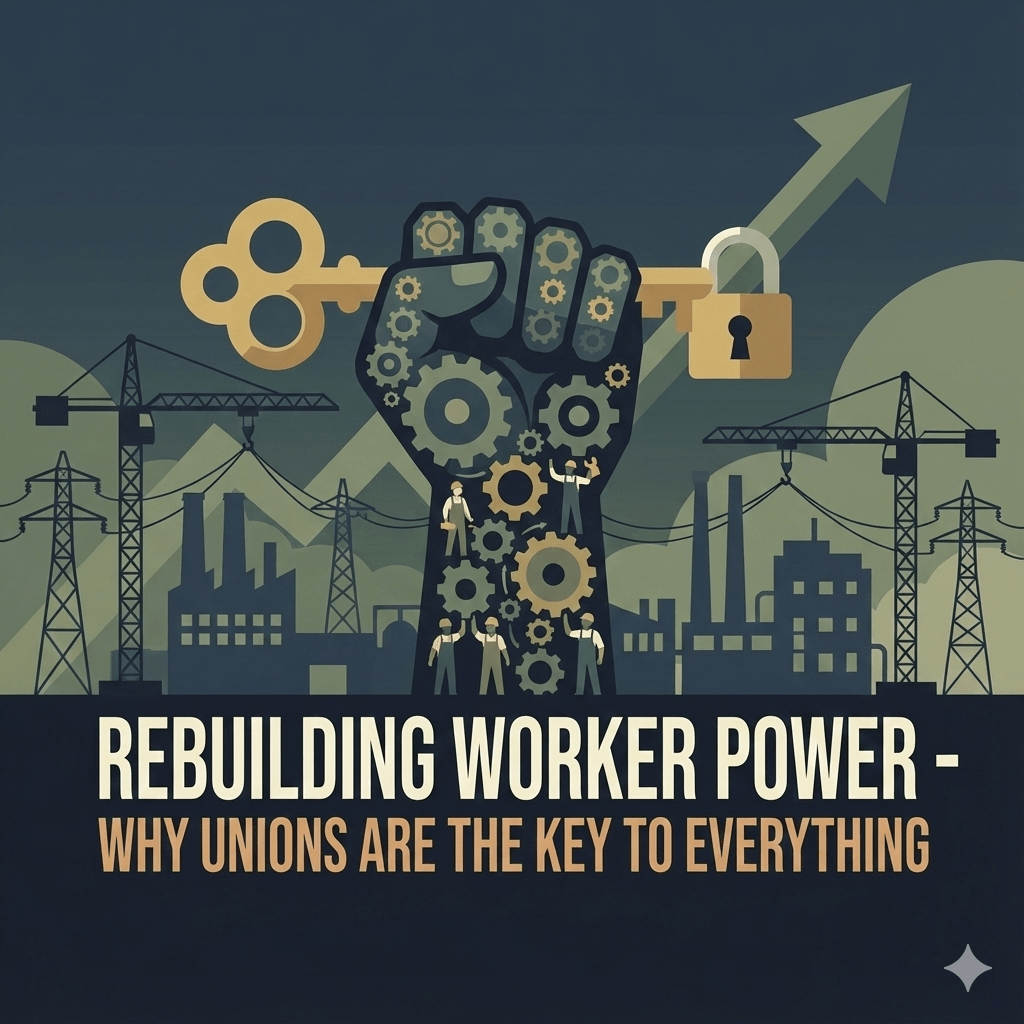
We’ve spent 24 parts documenting how the bottom 90% are systematically extracted from:
Healthcare, housing, education, prisons, military spending, taxes, monopolies, public service sabotage, media manipulation, environmental destruction, gig economy exploitation, financial system predation, and trade deals that ship jobs overseas.
Every system is rigged against workers.
Now here’s the question: How do workers fight back?
Individually? You have no power. Your employer can fire you, replace you, cut your wages, eliminate your benefits. You can quit, but there are ten people waiting for your job. You have zero leverage.
Collectively? That’s different.
When workers organize together—when they form a union—they have actual power:
• The power to negotiate wages, benefits, and working conditions
• The power to strike (withdraw labor until demands are met)
• The power to protect each other from arbitrary firing
• The power to organize politically and support pro-worker candidates
• The power to say NO to exploitation
This is why corporations spend billions fighting unions.
This is why union membership has been deliberately destroyed over the past 50 years.
And this is why rebuilding unions is absolutely essential to fixing everything else we’ve documented in this series.
You can’t win on healthcare, housing, education, taxes, or any other issue without worker power.
Unions ARE worker power.
Let me show you exactly why unions matter, how they were destroyed, and how we rebuild them for the modern economy.
THE DATA: UNIONS WORK
Before we get into the politics and the propaganda, let’s look at what the data actually shows.
Do unions help workers? Or are they outdated relics that hurt the economy?
The evidence is overwhelming:
Union Workers Earn More
The union wage premium is real and significant:
• Union workers earn 10-20% more than comparable non-union workers
• Union workers: Average $1,095 per week (2023)
• Non-union workers: Average $975 per week
• Union premium: ~$120/week = $6,240 per year
That’s $6,000+ more per year for doing the same job, just because you have a union contract.
Over a 40-year career? That’s $250,000+ in additional earnings.
But it’s not just wages:
• 94% of union workers have employer-provided health insurance (vs. 68% non-union)
• 91% of union workers have retirement benefits (vs. 64% non-union)
• Union workers have paid sick leave, paid vacation, family leave
• Union workers have job security protections (can’t be fired arbitrarily)
• Union workers have grievance procedures (due process if mistreated)
The value of these benefits? Easily $10,000+ per year.
Total union premium (wages + benefits): $15,000-20,000 per year.
That’s $15,000-20,000 per year that corporations extract from non-union workers by keeping them unorganized.
Multiply that by tens of millions of workers, and you’re talking about hundreds of billions of dollars per year transferred from workers to corporate profits.
This is extraction through union suppression.
The Union Threat Effect: Even Non-Union Workers Benefit
Here’s what’s really important:
Even workers who are NOT in unions benefit when unions are strong in their industry or region.
Why?
Because non-union employers have to compete for workers.
If the union shop down the street pays $25/hour with full benefits, the non-union shop has to pay $22-23/hour and offer some benefits to attract workers.
If unions disappear, the non-union shop can cut wages to $15/hour with no benefits. Workers have no alternative.
This is called the “union threat effect” or “union spillover effect.”
Studies by Jake Rosenfeld (Washington Center for Equitable Growth) and others show:
• In heavily unionized metros (1970s): Non-union workers earned 5-6% more than similar workers in non-unionized metros
• Union decline explains 20-33% of the rise in wage inequality since 1970s
• Non-union workers’ wages fell as union density declined in their industries and regions
• Even workers who never belonged to unions lost ground when unions weakened
Real-world example:
Your in-laws worked for a city in Pennsylvania. Some city workers were unionized. Your in-laws were NOT in the union.
But they got to retire at 55 with a pension and healthcare.
Why?
Because the union negotiated retire-at-55 with pension and healthcare for union members. The city then extended similar benefits to non-union workers (management, certain positions) to remain competitive and retain staff.
Your in-laws benefited directly from union bargaining power, even though they weren’t union members.
Now here’s the irony: They hate unions.
They don’t realize that the benefits they enjoyed—the early retirement, the pension, the healthcare—existed because unions were strong enough to negotiate them.
And their children and grandchildren won’t get those benefits, because unions have been destroyed.
This is the pattern everywhere:
When unions are strong, ALL workers benefit (union and non-union).
When unions are weak, ALL workers suffer (union and non-union).
The Correlation Between Union Decline and Inequality
The data here is striking:
1950s-1970s: Union membership ~25-35% of workforce
• Middle class thrived
• One income could support a family
• Wage growth matched productivity growth
• Income inequality relatively low
• Pensions standard
• Employer healthcare common
1980s-present: Union membership declined to ~10% of workforce
• Middle class hollowed out
• Two incomes barely support family
• Wages stagnated while productivity soared
• Income inequality exploded
• Pensions disappeared (replaced with 401(k)s that extract fees)
• Healthcare benefits declining
Look at the graphs: Union membership and middle-class prosperity track almost perfectly.
As unions weakened, worker share of income fell, corporate profits rose, and inequality exploded.
This isn’t coincidence. This is cause and effect.
Economic Policy Institute estimates:
If union membership had remained at 1979 levels (24% of workforce), the median worker would earn $3,000-4,000 more per year today.
That’s $3,000-4,000 extracted from EVERY worker because unions were destroyed.
Multiply by 150 million workers = $450-600 billion per year transferred from workers to corporate profits.
That’s wealth extraction through union suppression.
Pensions: Disappeared When Unions Weakened
1980 (union density ~20% of private sector):
• 38% of private sector workers had defined-benefit pensions
2020 (union density ~6% of private sector):
• 12% of private sector workers have defined-benefit pensions
Where did pensions go?
Replaced with 401(k)s, which:
• Put all risk on workers (market crashes, you lose retirement)
• Extract fees from workers (Wall Street takes 1-2% per year—Part 17 covered this)
• Often have no employer match or minimal match
• Run out if you live too long
Unions negotiated pensions. When unions weakened, corporations eliminated pensions and switched to 401(k)s.
Result: Workers bear all retirement risk, Wall Street extracts fees, corporations save billions.
International Comparison: Strong Unions = Better Outcomes
Countries with strong unions have:
• Higher median wages
• Lower income inequality
• Better worker protections
• More economic mobility
• Better work-life balance
• Stronger social safety nets
Examples:
Nordic Countries (Sweden, Norway, Denmark, Finland):
• Union membership: 60-80% of workforce
• Collective bargaining coverage: 80-90%
• Median wages: Higher than U.S. (purchasing-power adjusted)
• Inequality: Much lower than U.S.
• Poverty: Much lower than U.S.
• Worker protections: Paid vacation (5-6 weeks), paid parental leave (12+ months), job security
• Healthcare: Universal
• Education: Free through university
Germany:
• Union membership: ~18%, but collective bargaining covers 50%+ of workers
• Manufacturing wages: Higher than U.S.
• Job security: Strong protections, hard to fire workers
• Worker representation: Workers have seats on corporate boards (codetermination)
• Healthcare: Universal multi-payer
• Education: Free through university
• Apprenticeship system: Combines work and education
These countries aren’t socialist. They’re capitalist economies with strong unions.
The unions give workers power to negotiate fair share of prosperity.
Result: Capitalism works for workers, not just owners.
The Bottom Line on the Data:
Unions work. The evidence is overwhelming:
• Union workers earn more
• Union workers have better benefits
• Even non-union workers benefit when unions are strong
• Union decline directly correlates with inequality rise
• Strong unions = prosperous middle class
• Weak unions = hollowed-out middle class
Anyone who claims “unions hurt the economy” is either ignorant of the data or lying to serve corporate interests.
THE DELIBERATE DESTRUCTION: HOW UNIONS WERE KILLED
Union membership didn’t decline by accident. It was deliberately destroyed through coordinated attack by corporations and politicians.
Let me show you exactly how this happened:
The Powell Memo: The Blueprint for Union Destruction
1971: Lewis Powell (corporate lawyer, soon to be Supreme Court Justice) wrote a memo to the U.S. Chamber of Commerce.
The memo argued:
• Business was under attack from unions, environmentalists, consumer advocates, media
• Corporations needed to fight back
• Coordinate strategy: fund think tanks, influence universities, shape media, change laws, elect pro-business politicians
This memo became the blueprint for the corporate counter-offensive.
Result:
• Creation/expansion of Heritage Foundation, American Enterprise Institute, Cato Institute (all anti-union)
• Massive increase in corporate lobbying ($billions per year)
• Coordinated media campaign against unions
• Legal changes to weaken unions (Taft-Hartley enforcement, right-to-work expansion)
• Political donations to both parties (Democrats and Republicans)
The goal: Destroy unions. Restore corporate power over workers.
And it worked.
1947: Taft-Hartley Act – The Foundation
Before we get to the 1970s-onwards destruction, we need to understand Taft-Hartley (1947).
This law, passed over President Truman’s veto, fundamentally weakened unions:
What Taft-Hartley did:
• Banned secondary strikes and boycotts (workers at Company A can’t strike in solidarity with workers at Company B)
• Banned closed shops (requirement to join union before being hired)
• Allowed states to pass “right-to-work” laws (we’ll cover these below)
• Required union leaders to sign anti-communist affidavits
• Gave employers powerful tools to fight union organizing
• Restricted union political activity
Effect: Made union organizing much harder, gave employers weapons to fight unions.
Taft-Hartley was supported by:
• Republicans (overwhelmingly)
• Business interests (lobbied heavily)
• Southern Democrats (wanted to prevent Black workers from organizing)
This set the stage for union decline, but unions remained strong through 1970s due to existing membership.
The real destruction came later.
1981: Reagan Breaks PATCO – The Turning Point
August 1981: Air traffic controllers (PATCO union) went on strike for better pay and working conditions.
President Reagan’s response:
• Declared strike illegal
• Ordered controllers back to work
• When they refused: Fired all 11,000 striking workers
• Banned them from federal employment for life
• Hired replacements (scabs)
This was unprecedented. Previous presidents had negotiated with striking federal workers.
Reagan sent a clear message: Employers can break unions with impunity. Government will support employers, not workers.
Result:
Corporate America took note. If the President can fire 11,000 workers and break their union, so can we.
What followed:
• Wave of strikes broken by hiring replacements (Phelps Dodge, Greyhound, Hormel, etc.)
• Union-busting became acceptable corporate strategy
• Strikes declined precipitously (workers knew they could be permanently replaced)
• Employers emboldened to fight unions aggressively
Union membership began sharp decline after 1981.
This wasn’t coincidence. This was cause and effect.
Right-to-Work Laws: Defunding Unions
27 states now have “right-to-work” laws. These laws are brilliantly named propaganda.
What they actually do:
Allow workers to benefit from union contracts without paying union dues.
How this works:
• Union negotiates contract covering all workers in the workplace
• Contract provides higher wages, benefits, protections
• Non-union workers get the same contract benefits
• But they don’t have to pay dues
Result: Free-rider problem.
Why pay union dues if you get the benefits anyway?
Union membership declines → Union revenue declines → Union can’t afford organizers, lawyers, negotiators → Union weakens → Employer takes back gains
This is the goal: Defund unions so they can’t function.
The framing: “Right-to-work” sounds like freedom. “Freedom to work without forced union dues!”
The reality: Right to free-ride on union members’ dues while benefiting from their contract.
Evidence:
Workers in right-to-work states earn 3-4% less than workers in non-right-to-work states (even accounting for cost of living).
Right-to-work states have:
• Lower wages
• Fewer benefits
• Weaker workplace protections
• Higher workplace injury rates
• More worker deaths
“Right-to-work” means right to be exploited.
But it’s sold as freedom, so workers vote for it, and unions are defunded.
NLRB Gutting: Removing Enforcement
National Labor Relations Board (NLRB) is supposed to protect workers’ right to organize.
What NLRB is supposed to do:
• Oversee union elections
• Investigate unfair labor practices (employer interference, retaliation, illegal firing of union supporters)
• Punish employers who break the law
What actually happens:
NLRB has been systematically weakened:
• Budget cuts (can’t hire enough investigators)
• Republican appointments (board members who side with employers)
• Penalties are trivial (employer fires union organizer illegally, gets fined $10,000—worth it to kill union drive)
• Process takes years (by the time NLRB rules, union campaign is dead)
• Weak enforcement (employers know they can break law with minimal consequences)
Example:
Amazon fired multiple union organizers at Staten Island warehouse (2022). Clearly illegal.
NLRB found Amazon violated law. Penalty? Order Amazon to post a notice saying they won’t do it again.
No executives prosecuted. No massive fines. Just a notice.
Cost to Amazon of breaking the law: Trivial.
Benefit to Amazon of breaking the law: Discouraged union organizing (initially—though workers still won).
When penalties are trivial, breaking the law becomes a business decision.
Corporations calculate: Cost of fine < Cost of union. Break the law.
Corporate Union-Busting Industry: A Billion-Dollar Business
There’s an entire industry of consulting firms that specialize in defeating union drives.
Services they provide:
• “Union avoidance” consulting
• Anti-union campaigns
• Employee surveillance (identify union sympathizers)
• Captive audience meetings (mandatory anti-union presentations)
• Intimidation tactics
• Legal strategies to delay elections
Major union-busting firms:
• Labor Relations Institute (LRI)
• Kulture Consulting
• Adams Nash Haskell & Sheridan
• Many others
These firms charge corporations $millions per campaign.
Why do corporations pay this? Because unions would cost them more.
Tactics used:
• Captive audience meetings: Employees forced to attend anti-union presentations during work hours. Union can’t respond on company time.
• Surveillance: Monitor employees for union activity, identify organizers, isolate them.
• Intimidation: “If union comes in, we might have to close this plant” (illegal threat, but hard to prove).
• Delay tactics: Challenge every aspect of election, drag process out for months/years, wear down workers.
• Propaganda: “Union dues will cost you more than union will get you” (false—union premium averages $6,000+/year, dues are $400-800/year).
• Hiring: Fire union supporters (illegal), pay the fine (trivial), worth it to kill organizing.
All of this is legal or quasi-legal (illegal but penalties so small it doesn’t matter).
Result: Union organizing campaigns often fail, not because workers don’t want unions, but because employer opposition is overwhelming.
The Bipartisan Element: Democrats Too
While Republicans are openly anti-union, Democrats enabled union decline too:
Bill Clinton (1993-2001):
• Passed NAFTA (Part 24 covered this—destroyed union manufacturing jobs)
• Failed to pass labor law reform (card check)
• Prioritized corporate donors over labor
Obama (2009-2017):
• Had Democratic supermajority in 2009-2010
• Failed to pass Employee Free Choice Act (card check, stronger penalties for union-busting)
• Prioritized healthcare reform, Wall Street bailouts over labor law reform
• Continued free trade agenda (TPP)
Why?
• Both parties take corporate money
• Corporations oppose unions
• Democrats weak on labor despite union support
There are pro-labor Democrats (Bernie Sanders, Elizabeth Warren, some progressives). But party leadership often prioritizes corporate donors.
Result: No major pro-labor legislation since 1935 (National Labor Relations Act).
Union decline is bipartisan.
The Bottom Line on Union Destruction:
This wasn’t natural decline. This was coordinated attack:
• Powell Memo (1971) – blueprint
• Reagan breaking PATCO (1981) – signal that union-busting is acceptable
• Right-to-work laws (27 states) – defund unions
• NLRB gutting – remove enforcement
• Corporate union-busting industry – billion-dollar anti-union campaigns
• Bipartisan complicity – both parties enabled this
Goal: Destroy unions. Restore corporate power over workers.
Result: Union membership fell from 35% (1950s) to 10% today (6% private sector).
And with union decline came:
• Wage stagnation
• Benefit loss
• Inequality explosion
• Middle class hollowing
This is extraction through union suppression.
WHY THEY FEAR UNIONS: WORKERS WITH POWER
Let’s be clear about why corporations spend billions fighting unions:
Because unions work. Workers with unions have power.
What power?
Power to Negotiate Wages
Without union:
• Employer offers wage
• You accept or quit
• If you quit, they hire replacement
• You have zero leverage
With union:
• Union negotiates contract for all workers
• Collective bargaining: Union and employer negotiate wages
• If employer won’t agree, union can strike (withdraw all labor)
• Employer can’t operate without workers
• Employer has to negotiate
Result: Higher wages.
This is why companies fight unions. Every dollar in wages is a dollar not going to profits or executive compensation.
Power to Negotiate Benefits
Same dynamic: Union can negotiate healthcare, retirement, vacation, sick leave, parental leave.
Without union: Employer offers whatever benefits they want. Take it or leave it.
With union: Collective bargaining. Strike if necessary.
Result: Better benefits.
This costs employers money. Hence union opposition.
Power to Protect Workers
Without union:
• Employer can fire you for any reason (except illegal discrimination)
• “At-will employment” means arbitrary firing
• No recourse
With union:
• Contract specifies what you can be fired for
• Grievance procedure (due process)
• Union rep represents you if facing discipline
• Employer can’t fire arbitrarily
Result: Job security.
This limits employer control. Employers hate this.
Power to Improve Working Conditions
Without union: Work conditions are whatever employer dictates.
With union: Workers can negotiate:
• Safety standards
• Break times
• Workload limits
• Scheduling
• Dignity and respect
Amazon warehouse workers, for example, are monitored to the second. “Time off task” is tracked. Bathroom breaks are timed.
With union: Workers could negotiate reasonable breaks, less surveillance, humane treatment.
This costs Amazon money (slower productivity, less control).
Hence Amazon’s aggressive union-busting.
Power to Strike
The ultimate power: Withdraw labor.
If employer won’t agree to fair contract, workers strike. Production stops. Revenue stops. Employer loses money.
This gives workers leverage.
Example: 2023 UAW strike against GM, Ford, Stellantis
• Workers struck for 6 weeks
• Automakers lost billions
• Automakers agreed to 25% wage increases, restoration of benefits, job security
Workers won because they had power to strike.
Without union: Individual worker quits, replaced immediately.
With union: All workers withdraw labor simultaneously, employer can’t operate.
This is power.
Power to Organize Politically
Unions can:
• Endorse candidates
• Mobilize members to vote
• Contribute to campaigns (through PACs)
• Lobby for pro-worker legislation
This is why corporations oppose unions politically.
If workers organize politically, they can:
• Elect pro-worker candidates
• Pass pro-worker laws (higher minimum wage, paid sick leave, etc.)
• Block anti-worker laws (right-to-work, etc.)
Corporate power depends on workers being politically disorganized.
Unions organize workers politically.
Hence corporate opposition.
The Bottom Line: They Fear Worker Power
Every dollar corporations spend fighting unions is because unions work.
If unions were ineffective, corporations wouldn’t fight them.
The fact that Amazon spends millions per warehouse to defeat union drives proves unions would significantly benefit workers—at corporate expense.
They fear unions because workers with unions have power to negotiate fair share of profits.
That’s the whole game.
WHY DO PEOPLE HATE UNIONS? (EVEN WHEN THEY BENEFIT FROM THEM)
Given the data showing unions benefit workers, why do so many people oppose unions?
Why do people like your in-laws—who directly benefited from union bargaining—hate unions?
There are several reasons:
Legitimate Union Issues (Corruption, Protecting Bad Workers)
Let’s be honest: Some unions have had problems.
Historical Union Corruption:
Teamsters (Jimmy Hoffa era):
• Ties to organized crime
• Pension fund misuse
• Violence and intimidation
• Leadership enrichment at member expense
Longshoremen and construction unions (some locals):
• Mob influence in certain cities (NYC especially)
• No-show jobs, bid-rigging
• Corruption in hiring halls
This corruption was real and gave unions a bad name.
But context matters:
1. Corruption was confined to specific unions/locals, not universal. Most unions were and are clean.
2. Corruption often emerged in specific circumstances:
• Industries with cash businesses (trucking, docks, construction)
• Weak government oversight
• Organized crime infiltration (not inherent to unions)
3. Corruption has been largely addressed:
• Landrum-Griffin Act (1959) required democratic processes, financial transparency
• Federal prosecutions broke mob influence
• Internal reforms (Teamsters reformed in 1990s-2000s under government oversight)
• Modern unions generally much cleaner
4. Corporate corruption is far more extensive:
• Enron, WorldCom, Tyco (2000s)
• 2008 financial crisis (Wall Street fraud)
• Pharmaceutical price-fixing
• Wage theft (employers steal $50+ billion/year from workers)
• Tax evasion (corporations hide trillions offshore)
Union corruption is prosecuted. Corporate corruption is often legal or goes unpunished.
Protecting Bad Workers:
This is a common complaint: “Unions protect lazy workers who should be fired.”
There’s some truth here:
Union contracts often make firing difficult (due process, grievance procedures). Sometimes this protects workers who genuinely should be fired.
But:
1. Unions don’t protect workers who commit serious offenses (theft, violence, etc.). They can be fired.
2. Unions protect workers from arbitrary firing. This is the point. Without union, boss can fire you for any reason (didn’t like your tone, wanted to hire nephew, etc.).
3. The alternative—at-will employment—means employers can fire good workers arbitrarily too.
Is it worth protecting some bad workers to prevent arbitrary firing of good workers? Most workers say yes.
4. “Bad worker” is often subjective. Employer says worker is bad; worker says employer has unrealistic expectations. Union ensures due process to determine truth.
Still, this is legitimate frustration that feeds anti-union sentiment.
Solutions to Legitimate Union Issues:
Modern unions can and should:
• Democratic elections (direct membership vote for leadership, not convention delegates)
• Financial transparency (publish all finances, accessible to members)
• Term limits for officers
• Independent audits
• Whistleblower protections
• Accountability for corruption
• Balanced approach to discipline (protect workers from arbitrary firing while allowing termination for legitimate cause)
These reforms exist in many unions and should be standard.
The Corporate Propaganda Campaign (Bigger Issue)
Beyond legitimate issues, unions have been systematically demonized by corporate-funded propaganda.
The Powell Memo Blueprint:
After Lewis Powell’s 1971 memo, corporations launched coordinated anti-union campaign:
• Fund think tanks (Heritage, Cato, AEI) to produce anti-union “research”
• Media ownership and influence (amplify union problems, ignore corporate corruption)
• Cultural messaging (shape how people think about unions)
• Political donations (elect anti-union politicians in both parties)
The Tactics:
1. Language framing:
• “Union bosses” (not “union leaders” or “workers’ elected representatives”)
• “Union thugs” (emphasize rare violence, ignore corporate violence)
• “Forced unionism” (actually: democratic vote to form union)
• “Compulsory dues” (actually: voluntary—you can work elsewhere)
2. Cherry-pick examples:
• Emphasize corrupt unions (Teamsters), ignore clean unions (most)
• Emphasize strikes that hurt public (transit strikes), ignore successful strikes
• Emphasize union failures, ignore union successes
3. Economic myths:
• “Unions kill jobs” (data shows opposite—union industries are often strongest)
• “Unions hurt economy” (data shows opposite—strong unions = strong middle class)
• “Unions make U.S. uncompetitive” (Germany has stronger unions, strong manufacturing)
4. Right-to-work propaganda:
• Frame as “freedom to work”
• Actually: Free-ride on union members’ dues
• Defunds unions while claiming to protect freedom
5. Media amplification:
• Corporate-owned media runs anti-union stories
• Union corruption: Major story
• Corporate corruption: Page 6 or ignored
• Union successes: Ignored
• Union failures: Front page
The Result:
Decades of anti-union messaging made unions culturally unpopular, especially among people who would benefit from them.
People absorbed the message: “Unions are corrupt, greedy, kill jobs, hurt economy.”
Even when their own experience contradicts this (like your in-laws who benefited), the cultural message is powerful.
The Spillover Effect Paradox
Your in-laws are perfect example:
• Worked for city (some city workers unionized)
• Were not in union themselves
• Got to retire at 55 with pension and healthcare
• Hate unions
Why did they get retire-at-55 with pension and healthcare?
Because union negotiated it. City extended similar benefits to non-union workers to remain competitive.
They benefited from union bargaining power without being union members.
But they don’t make the connection:
“I earned this through hard work” ← What they think
“This exists because union negotiated it” ← The reality
And now:
Their children/grandchildren won’t get those benefits, because unions have been destroyed.
Retire at 55? Good luck. You’ll work until 70.
Pension? Nope. You get 401(k) with Wall Street fees.
Employer healthcare in retirement? Forget it.
These benefits existed when unions were strong. They disappeared when unions weakened.
But people don’t connect: Benefits ← Union strength.
Instead they think: “I got mine through hard work. Unions are for lazy people.”
Class Consciousness Problem
Many working-class people don’t identify as working-class:
• Think of themselves as “middle class” or “management”
• Identify with employers rather than workers
• See unions as “for other people” (blue-collar, manufacturing)
• Don’t recognize: If you work for a wage/salary and don’t own the business, you’re working class
This is cultural:
• American individualism (“I’m not working class, I’m temporarily embarrassed millionaire”)
• Professional identity (“I’m salaried, not hourly; I’m management, not labor”)
• Education divide (“Unions are for high school grads, not college grads”)
But economically:
If you sell your labor for wages/salary, you’re labor, not capital. Whether you’re factory worker, teacher, software engineer, or middle manager.
You benefit from collective bargaining. You need workplace protections. You’re subject to employer power.
Unions help all workers, not just blue-collar manufacturing (which is shrinking anyway).
Political Tribalism
If you’re conservative/Republican, anti-union is part of political identity:
• Republicans are anti-union
• Democrats are pro-union
• Therefore: If I’m Republican, I must oppose unions
Even if unions would benefit you personally, political identity overrides economic self-interest.
Cognitive dissonance resolution:
• “I benefited from union-negotiated benefits” + “I oppose unions” = Dissonance
• Resolution: “I didn’t benefit from unions, I earned this myself”
• Or: “Unions are bad despite benefiting me”
This is how political tribalism prevents workers from organizing in their own interests.
The Bottom Line on Why People Hate Unions:
Mix of:
• Legitimate issues (some corruption, protecting bad workers)—real but overstated
• Corporate propaganda (50 years of coordinated anti-union messaging)—main factor
• Not recognizing benefits (spillover effect—benefited without realizing it)
• Class consciousness problem (don’t identify as workers)
• Political tribalism (anti-union is part of conservative identity)
Result: People oppose unions even when unions would help them.
This is one of corporate America’s greatest victories: Convincing workers to oppose their own interests.
UNIONS FOR THE MODERN ECONOMY
Traditional unions organized manufacturing, construction, mining—industrial workers.
But economy has changed:
• Manufacturing: Declining (offshoring, automation)
• Service sector: Growing (retail, food service, healthcare, education)
• Gig economy: Growing (Uber, DoorDash, etc.)
• Tech sector: Growing (software, platforms, AI)
• Care work: Growing (childcare, eldercare, nursing)
Unions need to adapt to organize new economy workers.
Good news: It’s happening.
Service Workers: Starbucks, Amazon, Retail
Starbucks:
• 2021: Buffalo, NY Starbucks workers voted to unionize (first in U.S.)
• 2022-2024: Wave of organizing—over 400 stores unionized
• Despite aggressive union-busting by Starbucks (fired organizers, closed stores, refused to bargain)
• Workers won because: Solidarity, publicity, NLRB enforcement (eventually)
Amazon:
• 2022: Amazon warehouse in Staten Island, NY voted to unionize (first in U.S.)
• Amazon spent millions on union-busting
• Workers organized independently (not through established union)
• Proved: Even Amazon can be organized
Apple Retail:
• Multiple Apple stores unionized (2022-2024)
• Despite Apple’s “we’re a family” culture
• Tech retail workers want collective bargaining too
This is important: Service sector is now majority of economy.
If service workers organize, union density could rise significantly.
Gig Workers: Uber, Lyft, DoorDash Drivers
Gig workers are classified as contractors, not employees (Part 24 covered this).
This makes traditional union organizing difficult (contractors can’t form unions under NLRA).
But organizing is happening:
• Rideshare Drivers United (California): Organizing Uber/Lyft drivers
• Gig Workers Collective: Cross-platform organizing
• International organizing: UK ruled Uber drivers are employees (entitled to benefits)
Strategies:
• Legislative: Change law to classify drivers as employees (then they can unionize traditionally)
• Alternative models: Worker cooperatives, platform cooperatives (workers own the platform)
• Sectoral bargaining: Negotiate standards for entire industry (all rideshare companies), not individual companies
This is frontier of labor organizing. Models are still being developed.
But it’s happening.
Tech Workers: Google, Microsoft, Game Developers
Tech workers have traditionally opposed unions (high pay, good benefits, libertarian culture).
But that’s changing:
Google/Alphabet:
• Contract workers organizing (janitors, security, cafeteria workers)
• Google employees formed Alphabet Workers Union (2021)—minority union, doesn’t bargain but organizes workers
• Organizing around: Ethics (military contracts, AI ethics, harassment), not just wages
Microsoft:
• Activision Blizzard QA testers unionized (2022)—first union at Microsoft
Video Game Industry:
• Growing union movement (Raven Software, BioWare, etc.)
• Issues: Crunch time (80-hour weeks), job insecurity, harassment
Why tech workers organizing now:
• Layoffs (tech not immune—Google, Meta, Amazon all did mass layoffs 2022-2023)
• Ethics concerns (what products are we building? Who do they harm?)
• Inequality (even within tech—contractors vs. employees)
• Realization: We’re labor, not management
Tech workers have skills and leverage. If they organize, they could be powerful union force.
Care Workers: Childcare, Eldercare, Nursing
Care work is growing (aging population, more dual-income families).
Care workers are overwhelmingly:
• Women
• People of color
• Low-paid despite essential work
Organizing happening:
• Childcare workers unionizing
• Home care workers unionizing (SEIU has organized hundreds of thousands)
• Nursing home workers organizing
This is essential: Care work is foundation of economy (you can’t work if you don’t have childcare or eldercare).
Organizing care workers raises wages and improves care quality.
The New Models Unions Are Trying:
Traditional union model: Organize single workplace, hold election, negotiate contract for that workplace.
This works but is slow and vulnerable to employer union-busting.
New models:
1. Minority unions:
• Don’t wait for majority to form union
• Organize workers who want to organize, act collectively even without contract
• Build toward majority
2. Sectoral bargaining:
• Negotiate standards for entire industry, not individual workplaces
• Used in many European countries
• Would solve gig economy problem (set standards for all rideshare companies)
3. Wall-to-wall organizing:
• Organize all workers in a workplace (blue-collar and white-collar)
• Traditional unions often divided workers (separate unions for different crafts)
• Modern approach: Unity
4. Worker centers:
• Not traditional unions, but organizations that support workers
• Provide services, education, advocacy
• Help workers organize even in hostile legal environment
5. Platform cooperatives:
• Workers own the platform
• Alternative to gig economy exploitation
• Example: Drivers form co-op, create own rideshare app, keep all revenue minus operating costs
These models are experimental but show promise.
The key: Adapt unionism to modern economy while maintaining core principle (workers collective power).
THE REVIVAL: IT’S HAPPENING
Despite 50 years of decline, unions are starting to revive.
Signs of revival:
Public Approval at 50-Year High
Gallup polling:
• 2022: 71% of Americans approve of labor unions
• Highest approval since 1965
• This includes:
– 90% of Democrats
– 66% of Independents
– 47% of Republicans (!)
Even Republicans—the anti-union party—47% approve of unions.
Young workers especially:
• 18-34 year olds: 77% approve of unions
This is remarkable cultural shift after decades of anti-union propaganda.
Why?
• Wage stagnation (people realize they need power to get better wages)
• Inequality (people see executives making millions while workers struggle)
• COVID exposed essential workers’ treatment (low pay, no protections, risked lives)
• Gig economy exploitation visible (Uber/Lyft/DoorDash workers’ struggles publicized)
Organizing Victories Despite Corporate Opposition
Starbucks: 400+ stores unionized
Amazon: First warehouse unionized
Apple: Retail stores unionized
Google: Workers organized (even if not traditional union)
REI: Retail stores unionized
These happened despite aggressive union-busting.
Workers won because:
• Solidarity among workers
• Public support
• Social media (circumvent corporate messaging)
• NLRB eventually enforced law (slowly)
Successful Strikes
2023 was called “hot labor summer” because of multiple successful strikes:
UAW (United Auto Workers) strike:
• 46-day strike against GM, Ford, Stellantis
• Won: 25% wage increases over 4 years, restoration of benefits, job security
• Billions in new investment in U.S. plants
Hollywood writers and actors (WGA and SAG-AFTRA):
• Struck over AI, streaming residuals, working conditions
• Won: Protections against AI replacing writers, better residuals
UPS Teamsters:
• Threatened strike, won contract without striking (threat alone was enough)
• Won: A/C in trucks (heat safety), wage increases, no forced overtime
These strikes showed: Workers with power can win.
Political Momentum
Biden administration:
• Most pro-union president since FDR (low bar, but still)
• NLRB appointees more pro-worker
• Supported PRO Act (not passed, but signal of support)
• Walked picket line with UAW (first president ever)
State-level wins:
• Paid sick leave laws (14 states now)
• Higher minimum wages (many states)
• Ban on non-compete clauses (FTC rule, 2024)
Federal wins:
• NLRB rulings more favorable to unions (2023-2024)
• Joint employer rule (makes companies liable for subcontractor labor violations)
Not enough, but momentum is shifting.
The Bottom Line on Revival:
After 50 years of decline, unions are starting to come back:
• Public support highest in 50 years
• Organizing victories at Starbucks, Amazon, Apple, others
• Successful strikes (UAW, Hollywood, etc.)
• Political momentum (modest but real)
This is hopeful. Unions can be rebuilt.
But it requires:
• Workers willing to organize despite opposition
• Political support (pro-labor laws)
• Cultural shift (continued)
• New models for modern economy
It’s happening. Slowly. But it’s happening.
WHAT NEEDS TO CHANGE: LEGAL AND POLITICAL REFORMS
Rebuilding unions requires changing the legal and political landscape that currently favors employers.
Here’s what needs to happen:
Repeal Taft-Hartley
Taft-Hartley (1947) fundamentally weakened unions.
We need to repeal or substantially revise it:
• Allow secondary strikes and boycotts (solidarity actions)
• Eliminate “right-to-work” provisions (let unions negotiate union security clauses)
• Remove restrictions on union political activity
• Restore union power that existed before 1947
This is difficult politically (requires Congress and President willing to challenge corporate power).
But it’s essential.
Ban Right-to-Work Laws Nationally
27 states have right-to-work laws that defund unions.
Federal law should preempt these:
• Unions can negotiate “fair share” agreements (all workers covered by contract pay dues or fair-share fee)
• Eliminates free-rider problem
• Restores union funding
This would significantly strengthen unions in right-to-work states.
Strengthen NLRB Enforcement
NLRB needs:
• Larger budget (more investigators, faster case processing)
• Real penalties for employers who break law:
– Fired union supporter? Pay 5 years of wages, not just back pay
– Refused to bargain? Automatic contract imposed
– Committed multiple violations? Lose government contracts
• Faster elections (from petition to vote in 10-14 days, not months)
• Card check option (if majority signs cards, union forms—no election needed)
This would make organizing feasible even against corporate opposition.
Pass the PRO Act
Protecting the Right to Organize Act (PRO Act):
• Passed House in 2021, died in Senate
• Would implement many of the above reforms
• Needs to pass both chambers and be signed
This is the single most important labor law reform since 1935.
Implement Sectoral Bargaining
Allow unions to negotiate for entire industries, not just individual workplaces.
Examples:
• Fast food workers: Negotiate standards for all fast food chains in a city or state
• Rideshare drivers: Negotiate standards for all rideshare companies
• Retail workers: Negotiate standards for all retail in a sector
This is used successfully in many European countries.
Benefits:
• Easier to organize (don’t need majority at each individual workplace)
• Raises standards industry-wide
• Reduces employer ability to undercut unionized competitors
Worker Representation on Corporate Boards
Germany and Nordic countries require worker representatives on corporate boards (codetermination).
Example: In Germany, large companies must have 50% worker representatives on supervisory boards.
This gives workers direct input into corporate decision-making.
U.S. should implement similar requirements:
• Large corporations (1,000+ employees) must have 40% worker representatives on board
• Workers elect their representatives
• Representatives have same fiduciary duties as other board members but represent worker interests
This would fundamentally shift power from shareholders to stakeholders.
Public Sector Unionization Protection
Public sector unions are under attack (Janus v. AFSCME decision, 2018, weakened public sector unions).
Protections needed:
• Federal law protecting public sector collective bargaining
• Prevent states from banning public sector unions
• Restore fair share fees for public sector unions
The Bottom Line on Legal Reforms:
The law currently favors employers and disfavors unions.
Rebuilding unions requires changing the law:
• Repeal Taft-Hartley restrictions
• Ban right-to-work nationally
• Strengthen NLRB
• Pass PRO Act
• Implement sectoral bargaining
• Worker board representation
• Protect public sector unions
This is politically difficult. Corporations will fight it with billions in lobbying.
But it’s necessary. And it’s achievable if workers organize politically to demand it.
HOW TO SUPPORT UNION REVIVAL: WHAT YOU CAN DO
Okay, you’re convinced unions matter. Now what?
Here’s what you can actually do:
If You’re a Worker: Organize Your Workplace
This is the most direct action:
1. Talk to coworkers about workplace issues (wages, benefits, conditions)
2. Contact a union in your industry (AFL-CIO, SEIU, UFCW, etc. can connect you)
3. Form organizing committee (workers committed to unionizing)
4. Build majority support (need 50%+1 to win election)
5. File for election with NLRB
6. Win election
7. Negotiate first contract
Yes, employer will likely fight you. That’s why you need solidarity and external support.
Resources:
• AFL-CIO: aflcio.org
• Emergency Workplace Organizing Committee (EWOC): workerorganizing.org
• Union-specific contacts depend on your industry
If You’re Already Union: Stay Active
Union strength depends on engaged membership:
• Attend union meetings
• Vote in union elections
• Support shop stewards
• Participate in contract negotiations
• Vote to authorize strikes if necessary
• Show up for pickets and actions
Unions are only as strong as their active membership.
Inactive membership = weak union = employer takes advantage.
Support Unionization Campaigns Publicly
When workers at Starbucks, Amazon, Apple, etc. are organizing:
• Express support on social media
• Sign petitions
• Contact the company (tell them to recognize union, bargain fairly)
• Don’t cross picket lines if workers strike
• Boycott if union calls for it
Public pressure helps. Companies care about reputation.
Vote for Pro-Union Politicians
Politicians matter:
• NLRB members are presidential appointees
• Labor laws are passed by Congress
• State labor laws are passed by state legislatures
Vote for:
• Candidates who support PRO Act
• Candidates who support raising minimum wage
• Candidates who oppose right-to-work
• Candidates who don’t take corporate PAC money
Primary and general elections both matter.
Talk About Unions Positively
Cultural messaging matters:
• When someone says “unions are corrupt,” respond with data about how unions raise wages
• When someone says “unions killed manufacturing,” correct with reality (outsourcing killed manufacturing)
• When someone benefits from union-negotiated standards (weekends, 8-hour day, overtime pay), point out union origins
• Share union success stories (UAW strike win, Starbucks organizing, etc.)
Counter 50 years of anti-union propaganda with reality.
Don’t Cross Picket Lines
If workers are striking, don’t cross picket line:
• Don’t shop at that store
• Don’t order from that restaurant
• Don’t use that service
• Tell them why (support for striking workers)
Strikes work when they hurt company revenue. Your solidarity helps.
Support Worker Cooperatives and Platform Cooperatives
Alternative to traditional employment: workers own the business.
Support worker co-ops when you can:
• Co-op grocery stores
• Credit unions (member-owned banks)
• Platform co-ops (worker-owned alternatives to Uber, etc.)
This is worker power through ownership, not just collective bargaining.
Join or Support Organizations Fighting for Workers
Many organizations support workers and unions:
• Working Families Party (political organization)
• Democratic Socialists of America (has labor working group)
• Jobs With Justice (coalition supporting workers)
• Fight for $15 (minimum wage campaign)
• Labor Notes (media covering labor movement)
These organizations support union campaigns, lobby for pro-worker laws, organize politically.
The Bottom Line on What You Can Do:
Union revival doesn’t happen automatically. It requires:
• Workers organizing workplaces
• Public support for organizing campaigns
• Political action (elect pro-union politicians)
• Cultural shift (positive messaging about unions)
• Solidarity (don’t cross picket lines)
Every person can do something.
And collectively, these actions rebuild worker power.
UNIONS ARE THE KEY TO EVERYTHING
Let me bring this back to the core thesis of this series:
The bottom 90% are systematically extracted from through healthcare, housing, education, work, taxes, services, environment, finance, trade, media, and government.
We’ve documented 24+ extraction mechanisms.
Now here’s the key question: How do we stop this extraction?
Individual action isn’t enough. You can’t individually negotiate with UnitedHealth or Amazon or your landlord. They have all the power.
Political action is necessary but insufficient. Politicians take money from corporations. Even pro-worker politicians face massive corporate opposition.
The answer: Collective worker power. Unions.
Here’s why unions are the key to everything:
Unions Give Workers Economic Power
Without unions:
• Employers set wages (take it or leave it)
• Employers set benefits (take it or leave it)
• Employers set conditions (take it or leave it)
• Workers have zero leverage
With unions:
• Workers collectively negotiate wages (we won’t work unless you pay X)
• Workers collectively negotiate benefits (we won’t work unless you provide Y)
• Workers collectively negotiate conditions (we won’t work unless you treat us humanely)
• Workers have leverage (strike power)
This economic power is the foundation for everything else.
Unions Give Workers Political Power
Organized workers can:
• Vote as a bloc (politicians care about organized constituencies)
• Donate to campaigns (pool resources to support pro-worker candidates)
• Lobby for pro-worker laws (collective voice)
• Primary anti-worker incumbents (even in their own party)
• Strike politically (general strikes, political work stoppages)
Unions are how workers translate economic power into political power.
Unions Enable Every Other Reform
Look at the reforms needed from Parts 1-24:
• Universal healthcare: Won’t happen without workers organizing to demand it
• Fair taxes: Won’t happen without workers pressuring politicians
• Breaking up monopolies: Won’t happen without worker pressure
• Stopping privatization: Won’t happen without organized opposition
• Environmental protection: Won’t happen without workers demanding it (workers in extractive industries need union support to transition)
• Gig worker protections: Won’t happen without organizing
• Financial regulation: Won’t happen without workers demanding it
Every single reform requires political power.
Political power requires organization.
Unions are the organization.
The Historical Evidence
Look at when bottom 90% did best:
1930s-1940s: New Deal, Social Security, labor protections, minimum wage
• Union membership rose from 10% to 35%
• Workers organized, struck, demanded change
• Politicians responded (FDR: “I welcome their hatred” of economic royalists)
1950s-1970s: Middle class prosperity, rising wages, benefits expansion
• Union membership 25-35%
• One income supported family
• Pensions, healthcare, job security
• Inequality lowest in American history
What changed?
1980s-present: Union membership declined to 10%
• Middle class hollowed out
• Wages stagnated
• Benefits disappeared
• Inequality exploded
The correlation is undeniable: Union strength = worker prosperity.
The International Evidence
Countries with strong unions:
• Nordic countries (60-80% union membership): High wages, low inequality, strong social safety net
• Germany (50%+ collective bargaining coverage): Strong manufacturing, worker protections, codetermination
Countries with weak unions:
• United States (10% union membership): Stagnant wages, high inequality, weak safety net
It’s not subtle. Union strength directly correlates with worker well-being.
The Bottom Line: Unions or Oligarchy
Here’s the fundamental choice:
Without unions: Wealth concentrates at top. Workers have no power. Democracy becomes oligarchy (rule by wealthy).
With unions: Workers have power to negotiate fair share. Democracy can function (organized workers balance organized capital).
This isn’t about ideology (capitalism vs. socialism). This is about power.
In capitalism, capital has power. Workers need countervailing power. Unions provide that power.
Without unions, capitalism becomes extractive oligarchy. With unions, capitalism can work for workers too.
That’s the choice.
CONCLUSION: REBUILD UNIONS, REBUILD WORKER POWER
We started this series asking: What is wrong with us?
Why does the richest country rank 44th in life expectancy? Why is healthcare so expensive? Why can’t people afford housing? Why is education a debt trap?
The answer: Systematic extraction from the bottom 90%.
And the extraction is enabled by: Lack of worker power.
Workers have no power because unions were deliberately destroyed over 50 years.
The solution: Rebuild unions.
This isn’t the only thing we need to do. We need political reforms, legal changes, cultural shifts.
But unions are the foundation. Everything else depends on organized worker power.
The good news:
• Union approval is at 50-year high (71%)
• Workers are organizing (Starbucks, Amazon, Apple, etc.)
• Strikes are winning (UAW, Hollywood, UPS)
• Young workers support unions (77% of 18-34)
The momentum exists. Union revival is possible.
But it requires:
• Workers organizing workplaces (the hardest, most important work)
• Public support for organizing campaigns
• Political action (elect pro-union politicians, pass pro-labor laws)
• Cultural shift (positive messaging about unions)
• Legal reforms (PRO Act, repeal Taft-Hartley, strengthen NLRB)
If we do this—if the bottom 90% organize and build power—we can win on healthcare, housing, education, wages, benefits, taxes, services, environment, everything.
Without worker power, we lose on everything.
With worker power, we can win on everything.
That’s why unions matter.
That’s why unions are the key to everything.
In Part 25, we’ll synthesize all 24 parts of this series, show how the extraction systems connect, provide the framing to avoid “socialism” accusations, and give you the concrete roadmap for how the bottom 90% actually organize and fight back.
But understand this: Everything in Part 25 depends on the foundation we’ve laid here.
Worker power is the key.
Unions are how workers get power.
If you remember nothing else from this series, remember this:
Organize. Build power. Fight back.
That’s how we win.
 Even that's Odd
Leave a comment