
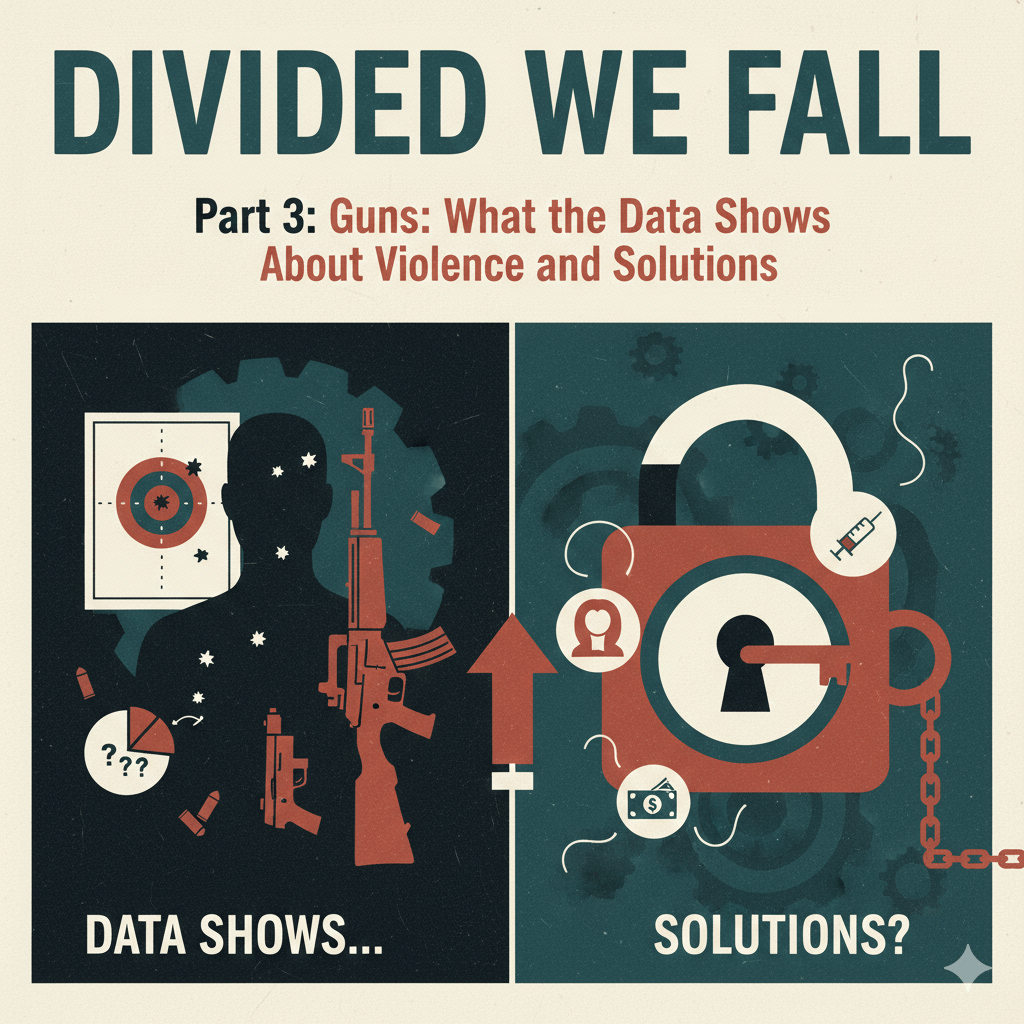
Regardless of Where You Stand on the 2nd Amendment, Here’s What Actually Reduces Gun Deaths
Gun ownership is deeply woven into American culture. For millions of Americans, guns represent self-reliance, personal protection, and a constitutional right they hold dear. Many families have hunting traditions going back generations. In rural areas where police response times can be 30 minutes or more, a firearm can be the difference between safety and vulnerability.
This isn’t about dismissing those realities or telling anyone what they should value. But we also can’t ignore what happens when we do nothing about gun violence. So let’s look at what the data actually shows about gun deaths in America and what works to reduce them.
The Numbers We Can’t Ignore
The United States has a gun death rate of about 12 per 100,000 people. Canada’s rate is 2 per 100,000. Australia’s is 1 per 100,000. Japan’s is 0.2 per 100,000. We’re not talking about small differences—we’re talking about six times higher than Canada, twelve times higher than Australia, and sixty times higher than Japan.
About 60% of gun deaths in the U.S. are suicides. The remaining 40% includes homicides, accidents, and police shootings. Both categories matter. A gun in the home increases suicide risk by three times and homicide risk by two times compared to homes without guns.
Every year, roughly 40,000 Americans die from guns. That’s more than car accidents. More than the entire Vietnam War—every single year.
What Actually Reduces Gun Deaths
Background checks: States with universal background checks have 15% fewer gun deaths. The data is clear—screening out people with violent criminal histories or severe mental health crises saves lives.
Waiting periods: A mandatory waiting period between purchase and possession reduces gun suicides by 7-11% and gun homicides by 17%. Most gun deaths are impulsive—a fight escalates, someone is in crisis. Even a short delay makes a difference.
Red flag laws: Extreme risk protection orders allow family members or law enforcement to temporarily remove firearms from someone in crisis. Connecticut’s law prevented an estimated 72 suicides over 14 years. Indiana’s law was associated with a 7.5% reduction in firearm suicides.
Safe storage requirements: Child access prevention laws reduce unintentional shooting deaths among children by 23% and youth suicides by 8%. Locked guns save lives, particularly children’s lives.
Permit-to-purchase laws: Requiring people to obtain a permit before buying a gun—which involves a background check and often safety training—reduces gun homicides by 11% and gun suicides by 27%. When Connecticut repealed its permit law in 1995, gun homicides increased by 15%. When Missouri repealed its law in 2007, gun homicides jumped 25%.
What Doesn’t Work
“Good guy with a gun”: FBI data shows that in 433 active shooter incidents between 2000-2021, armed civilians stopped the shooter 4.4% of the time. Unarmed civilians stopped the shooter 9.1% of the time. The heroic bystander with a gun is statistically rare and often dangerous—armed civilians can be mistaken for the shooter by police or other armed civilians.
Arming teachers: Teachers aren’t trained law enforcement officers. Introducing more guns into schools increases risk without reducing casualties. No data supports this as an effective solution.
Focusing only on mental health: People with serious mental illness commit only 3-5% of violent crimes. The vast majority of gun deaths are not committed by people with diagnosed mental illness. Better mental health care is important for many reasons, but it won’t solve gun violence on its own.
Arguments Against Gun Regulations—And What the Evidence Shows
“Criminals don’t follow laws anyway”: This argument gets repeated constantly, but it doesn’t hold up. By this logic, we shouldn’t have laws against murder, theft, or fraud because criminals will ignore those too. Laws don’t need to stop 100% of crime to be worthwhile—they need to make harmful behavior harder and less frequent. Background checks don’t stop every criminal from getting guns, but they stop many. That’s the point. Every other developed country demonstrates that gun regulations reduce gun deaths. The argument that laws can’t work contradicts the evidence from around the world.
“This leads to confiscation”: For decades, Americans have been told that any regulation is the first step toward government confiscation of all guns. This messaging has been incredibly effective, but it has no basis in reality. Countries like Canada, Australia, Switzerland, and many others have implemented various gun regulations without banning guns or confiscating them from law-abiding owners. Australia implemented stricter regulations in 1996 after a mass shooting—they required licensing, registration, and banned certain weapons—yet there are still millions of legal gun owners in Australia. Hunters still hunt. Sport shooters still shoot. What changed is that Australia went 29 years between mass shootings (until the Bondi Beach incident in December 2025). The slippery slope argument is a fear that gun rights organizations have spent billions promoting, not a pattern that evidence supports.
“We need guns to resist tyranny”: The idea that an armed citizenry prevents government tyranny is central to how many Americans think about the 2nd Amendment. But there’s a paradox here: the Americans most worried about government tyranny tend to support expanding police power, military spending, and surveillance. Meanwhile, many defend the police when they kill unarmed citizens—which is, by definition, government violence against the people. If the concern is government overreach, it’s worth asking why so much energy goes toward opposing background checks while actual government violence receives support. Additionally, no wealthy democracy with strong gun regulations has descended into tyranny. The correlation isn’t there.
“Guns don’t kill people, people kill people”: Yes, people pull triggers. But a person with a gun can kill 30 people in minutes. A person with a knife might kill 2-3 before being stopped. The tool matters enormously. That’s why we don’t allow civilians to purchase grenades, rocket launchers, or tanks. We already accept that some weapons are too dangerous for general ownership. The question is just where we draw that line—and whether we base that decision on evidence about what reduces deaths.
What Happened When Australia Acted
In 1996, a gunman killed 35 people in Port Arthur, Tasmania. Within weeks, Australia implemented strict gun regulations: licensing requirements, registration, mandatory safety training, and a ban on semi-automatic rifles and shotguns. The government bought back 650,000 guns.
The results: Australia went 29 years without another mass shooting (defined as 5+ deaths). Gun deaths dropped dramatically—firearm suicides fell by 65%, firearm homicides fell by 59%. There was no increase in other forms of homicide or suicide to compensate. People didn’t just switch to other methods at the same rate.
In December 2025, a stabbing attack at Bondi Beach in Sydney ended Australia’s 29-year streak. It was devastating. But compare that to the United States, where mass shootings are so frequent we’ve become numb to them. Australia had one mass casualty event in nearly three decades. We have multiple every year.
Australia didn’t ban all guns. Australians can still own firearms for hunting, sport shooting, and farming. What changed is that Australia treated guns like the dangerous tools they are and implemented evidence-based regulations. It worked.
Why Nothing Changes in America
After every mass shooting, we hear the same things: “Now is not the time to politicize this.” “We need more mental health resources.” “Guns don’t kill people.” Then nothing happens. A few weeks pass, the outrage fades, and we move on until the next shooting.
This isn’t an accident. It’s the result of a deliberate, well-funded strategy.
The NRA’s influence: The National Rifle Association isn’t primarily a gun owners’ group—it’s a gun manufacturers’ lobbying organization. Between 2005 and 2013, the NRA received between $20-52.6 million from gun manufacturers. Their goal isn’t protecting hunters or sport shooters—it’s maximizing gun sales. And their strategy is simple: convince Americans that any regulation, no matter how modest, is the first step toward total confiscation.
Republican obstruction: This isn’t “both sides.” Republicans consistently block even the most common-sense gun regulations. After Sandy Hook, 90% of Americans supported universal background checks. Senate Republicans filibustered it. After Parkland, Republicans blocked red flag laws. After Uvalde, Republicans blocked raising the age to buy AR-15s from 18 to 21. The pattern is clear and one-sided.
In 2023, Republican-led Tennessee expelled two Democratic lawmakers for protesting gun violence on the House floor. Think about that: children were murdered in their school, legislators protested, and they were expelled for it. The message is clear: don’t even talk about gun violence.
The Dickey Amendment: In 1996, the NRA successfully lobbied for the Dickey Amendment, which banned the CDC from using federal funding to “advocate or promote gun control.” This was interpreted so broadly that the CDC stopped researching gun violence entirely. For two decades, the federal government couldn’t even study the problem. That’s not an accident—it’s a strategy. If you can’t study it, you can’t solve it.
The result: 40,000 Americans die every year from gun violence, we have more guns than people, and we’re the only wealthy country where this happens at this scale. But we’re told the solution is thoughts and prayers, not policy.
Where We Could Find Common Ground
Most gun owners support background checks. Most support red flag laws. Most support safe storage requirements. Poll after poll shows that gun owners and non-gun owners agree on basic regulations.
The divide isn’t really between gun owners and non-gun owners. It’s between the majority of Americans who want sensible regulations and the gun lobby that profits from opposition. And it’s between voters who want change and the Republican politicians who block it.
We can respect the 2nd Amendment and reduce gun deaths. We can protect hunting traditions and keep guns out of the hands of domestic abusers. We can acknowledge rural realities and implement waiting periods. These aren’t contradictions—they’re just common sense backed by evidence.
The Bottom Line
We can disagree about values—how much weight to give 2nd Amendment rights versus public safety, whether gun ownership is central to American identity, how much individual freedom should be limited to protect others. Those are legitimate debates.
But we can’t disagree about facts. The United States has a gun violence problem that no other wealthy country has. We know what reduces gun deaths because we can see it working everywhere else. Background checks work. Waiting periods work. Red flag laws work. Safe storage laws work.
The question isn’t whether solutions exist. They do. The question is whether we’re willing to implement them—and whether we’re willing to hold accountable the politicians and organizations that block them.
Every other developed country figured this out. We can too.
 Even that's Odd
Leave a comment