
I spent most of my career inside the cable TV business, including a stretch at LOGO — Viacom’s LGBTQ-focused network, which launched in 2005 — and then at Bravo, whose audience and programming have skewed heavily LGBTQ for a long time. I later ran creative operations at Universal Kids. So I’ve watched the corporate diversity conversation up close, from inside, for about twenty years. I’ve seen the well-designed initiatives, the eye-rolling mandatory trainings, the genuinely useful structural changes, and the ones that mostly produced PowerPoint decks. I have actual opinions about what worked.
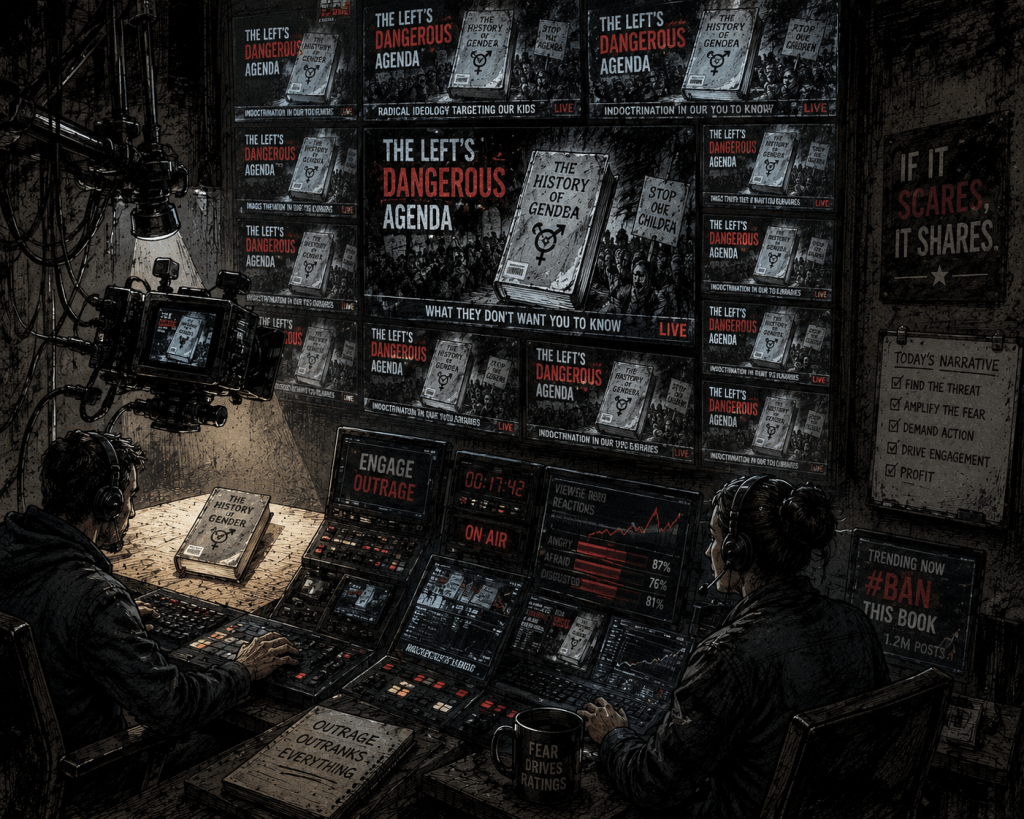
I bring that up because the public conversation about CRT, DEI, and trans rights has almost nothing to do with any of that. It is, with very few exceptions, a manufactured panic. I don’t mean that in a hand-wave way — I mean it is a documented strategy that the people running it have, on the record, explained out loud.
The most quoted version comes from Christopher Rufo, the conservative activist most responsible for turning “critical race theory” into a household phrase. In March 2021, he tweeted: “We have successfully frozen their brand — ‘critical race theory’ — into the public conversation and are steadily driving up negative perceptions. We will eventually turn it toxic, as we put all of the various cultural insanities under that brand category. The goal is to have the public read something crazy in the newspaper and immediately think ‘critical race theory.’”
He wasn’t whistleblowing. He was bragging. And it worked. Within months, an obscure academic legal framework that 99% of Americans had never encountered became one of the central issues in Republican politics. State legislatures rushed to ban from K–12 schools something that wasn’t being taught there. The same template has since been run on DEI and on trans rights, and it works the same way every time.
the template, briefly
Find something most Americans don’t directly encounter — a graduate-level legal theory, a workplace training program, a tiny minority population. Find or amplify edge cases. Run them on a loop through a coordinated media ecosystem. Redefine the term so it no longer means what it originally meant but instead becomes a container for everything you want to attack. Then pass sweeping legislation, much broader than the stated problem, against the redefined thing. Fundraise off it. When the panic fades, find the next target.
This isn’t a theory I’m constructing. Rufo described it, and the legislation that followed proves it works. After Bostock and Obergefell settled gay marriage at the Supreme Court level, the political infrastructure that had been organized around opposing them needed a new target. Trans people were already in the pipeline.
what’s actually under the panic
There are legitimate questions buried in each of these topics. I want to say that clearly because the panic strategy works partly by attaching itself to real things.
Some diversity training programs are poorly designed. Some are condescending. Some are expensive theater that doesn’t change outcomes. The research on what actually works in DEI — structural changes to hiring pipelines, mentorship programs, transparent promotion criteria — is reasonably clear, and a lot of the corporate programs that proliferated after 2020 weren’t doing those things. I watched several of those rollouts at close range. Some were excellent. Some weren’t. That’s a legitimate operational conversation any large organization should have.
Some questions about teaching American history are genuinely contested — not whether to teach slavery, Jim Crow, or the civil rights movement, all of which are settled curriculum in any serious framework, but how, at what age, with what framing. Reasonable adults disagree. That’s also a real conversation worth having, and good teachers have been having it forever.
Trans participation in women’s sports raises genuinely hard questions about fair competition, particularly at elite levels. Pediatric gender-affirming care involves weighing risks and benefits in ways that thoughtful clinicians and families take seriously. Different countries have reached different policy conclusions on parts of this. These are not trivial questions.
The reason none of those conversations are actually happening in our politics right now is that the panic strategy isn’t built to have them. It’s built to convert each legitimate question into a sledgehammer. One badly designed training session becomes “DEI is reverse racism.” One trans swimmer at one NCAA meet becomes “they’re destroying women’s sports.” One school librarian’s controversial choice becomes “they’re indoctrinating our children.” And then sweeping legislation gets passed against the cartoon version, not the actual underlying issue.
what the legislation has actually done
This is where I think the abstract argument has to give way to the receipts, because the legislative pace since January 2025 has been significant and a lot of people haven’t tracked it.
On critical race theory: by late 2024, more than two dozen states had restricted how race, racism, and history can be discussed in K–12 schools. The laws are routinely written so broadly that teachers self-censor on basic American history. Book bans in school libraries — concentrated overwhelmingly on books by or about Black, Latino, and LGBTQ authors — set records every year from 2021 through 2024.
On DEI: in his first two days back in office, Trump signed Executive Order 14151 (“Ending Radical and Wasteful Government DEI Programs and Preferencing”) and EO 14173 (“Ending Illegal Discrimination and Restoring Merit-Based Opportunity”), terminating federal DEI offices and instructing federal agencies to investigate private-sector DEI programs as potentially illegal discrimination. In March 2026, EO 14398 extended the requirement to all federal contractors and subcontractors. A federal district court in Maryland briefly blocked enforcement of parts of the original orders in February 2025; significant portions are still being litigated. The cumulative effect is that DEI programs across federal government, federally funded universities, and federal contractors have been dismantled — not the bad ones, all of them.
On trans rights: EO 14168, signed on Inauguration Day 2025, directed federal agencies to recognize only two sexes as determined at birth. The administration has banned trans people from military service, restricted gender markers on federal IDs, and moved to end federal funding for gender-affirming care under Medicaid. In June 2025, the Supreme Court ruled 6–3 in U.S. v. Skrmetti that Tennessee’s ban on gender-affirming care for minors does not violate the Equal Protection Clause. Twenty-five states currently ban hormone therapy and puberty blockers for trans youth; six make it a felony for medical providers to provide that care. On the same day the Skrmetti decision came down, the Trump administration announced it was ending federal funding for the LGBTQ+ specialized line at the Suicide and Crisis Lifeline operated by the Trevor Project.
You can argue about whether each of those moves is good or bad policy. What you can’t really argue is that this isn’t a sweeping use of state power to dictate medical decisions, school curriculum, library content, and corporate training programs. The party that spent decades campaigning on limited government and individual freedom has, since January 2025, used the federal government more aggressively to constrain what doctors prescribe, what teachers teach, what librarians shelve, and what HR departments do than any administration in living memory.
the freedom point most people are missing
The thing I find genuinely strange about this moment is that the easiest, most American-sounding argument against most of this legislation barely gets made. It’s not “let me explain critical race theory.” It’s not “let me defend every DEI program.” It’s: the government should not be deciding what teachers can teach, what doctors can prescribe, what books your kid can check out, or what trainings your employer can run.
That’s a small-government argument. That’s a personal-liberty argument. That’s the argument the people pushing this legislation have spent their careers claiming to make about everything else. And yet, on these particular topics, they’re comfortable using state power to override local school boards, override pediatricians and parents acting together, override boards of trustees at private universities, and override private companies’ HR decisions.
I get why people are uncomfortable with edge cases. Plenty of liberals are uncomfortable with edge cases too. But the legislative response is not edge-case-shaped. It’s a flamethrower aimed at any institution that might be insufficiently aligned, applied broadly, with the federal government as the enforcer. That’s worth saying clearly regardless of where you land on any of the underlying questions.
While we’ve been arguing about pronouns and corporate trainings and which books eight-year-olds can borrow, wages adjusted for inflation have barely moved in a generation, the median home price has roughly quadrupled since 1980, medical debt remains the leading cause of personal bankruptcy, and we have spent another decade not seriously addressing climate. I’m not saying culture-war fights are unimportant — actual people’s lives and rights are at stake in them. I am saying that the people stoking the loudest panic about CRT and DEI and trans kids are, with remarkable consistency, also the people blocking every policy that would materially improve the financial lives of the working- and middle-class voters they’re appealing to. That’s not an accident. It’s the trade.
I don’t have a clever closer for this one. I have a 25-year cable career, two boys in school, and a fairly long view of how American institutions actually changed when corporate America took diversity seriously in the 2000s and 2010s and how much of that progress is being deliberately reversed right now. None of it is hidden. The strategy was explained on Twitter five years ago. The legislation is in the Federal Register. The Supreme Court decisions are public. It’s all there if anyone wants to look.


Leave a Reply