
Winter 2009-2010
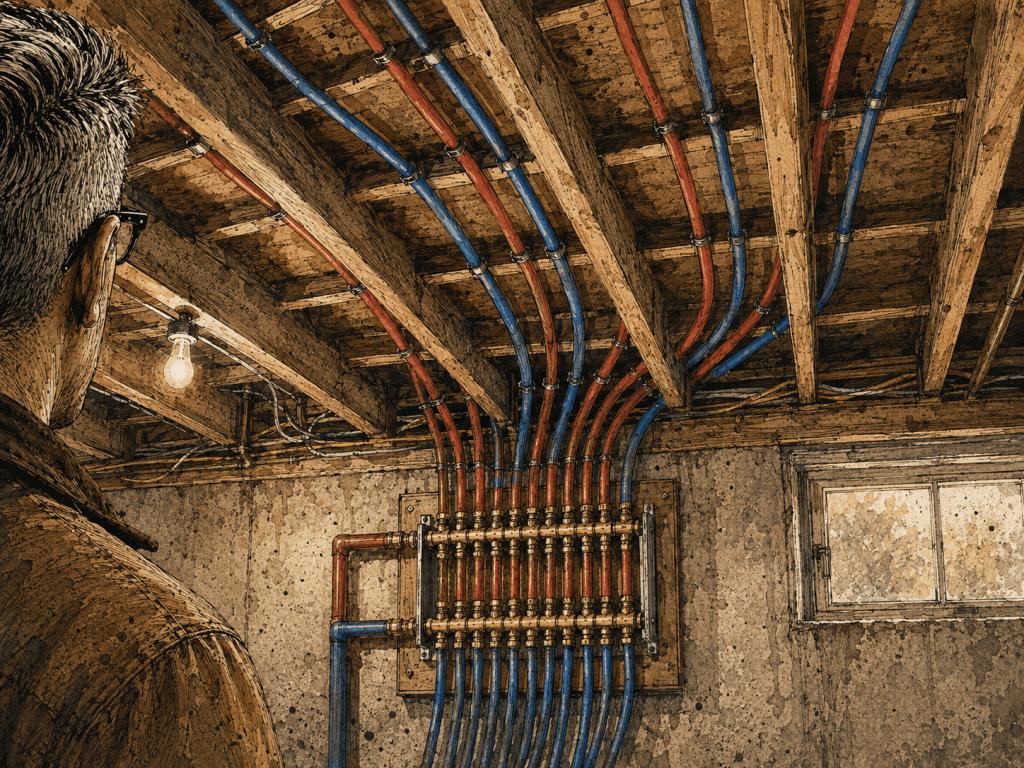
After electrical was complete, it was time for plumbing and HVAC. My friend, who had been coordinating most of the work, had apprenticed to learn plumbing and HVAC. But because of all the equations for sizing units and the complexity of the systems, he suggested we hire the professional he’d worked with.
Since I trusted my friend completely, I wanted him to do all the plumbing and HVAC work that he could. I told the plumber/HVAC contractor exactly that.
The contractor knew my friend well and was okay with the arrangement. He said he would deduct whatever labor my friend ended up doing from the bill.
This sounded like a great plan.
This was not a great plan.
Paying Twice for the Same Work
What became impossible to track was exactly how much work my friend did versus how much the contractor did. They worked together on various parts. My friend did prep work. The contractor did the technical work. Sometimes they overlapped.
In the end, I don’t think the contractor gave us any credit for all the work my friend did.
I ended up paying the contractor’s full rate while my friend was doing significant labor.
I paid twice for the same work.
If you pay a professional to do the work, just let them do the work. Don’t try to mix friend labor with paid contractor labor unless you have an extremely clear, written agreement about exactly who does what and how the billing will work.
The arrangement that seemed like it would save money probably cost us money. And it created awkward dynamics—my friend felt obligated to help, the contractor expected to be paid full price, and I got caught in the middle.
The Water Supply Mystery
I didn’t realize there was a problem with how the water supply lines were run until we lived in the house and I had a plumbing issue that required shutting off the water.
What I found puzzled me. I’m still not sure if this is standard practice, but if it is, it’s a dumb idea.
Here’s what they did:
We have a 2-story home. We also ran a line to the attic in case we ever wanted to add a bathroom if we finished it.
The way they ran the water lines: they ran ONE line up to the first floor ceiling and fed BOTH the 1st floor and second floor from that single run.
What this means:
- When you shut off the water for the first floor, it shuts off the water on the second floor
- When you shut off the water for the second floor, it shuts off the water on the first floor
- ANY plumbing problem ANYWHERE means NO water in the ENTIRE house
This is incredibly stupid for a homeowner like me.
For any plumbing problem on the second floor, we couldn’t use plumbing on the 1st floor until the second floor was repaired. Vice versa.
What is this? A plumber making sure they’ll get an emergency call in the future?
What Would Have Made Sense
Run TWO separate feeds with shutoffs:
- One for the 1st floor
- One for the second floor
If it was a one-story house, set up 2 different zones.
Is it really that much more pipe? I imagine if you think it through, it’s probably not. And anyway, it would be worth it because when you have an inevitable plumbing issue, you could shut off part of the system and still use the other plumbing in the house to get by.
Plumbers usually can’t come right away anyway. Being able to shut off the problem area while keeping the rest functional would let you still be somewhat comfortable while you wait.
But no. One line. Whole house water or no water. Thanks, plumber.
The Frost-Proof Faucet Problem
We had 2 outside faucets—the frost-proof kind that are supposed to prevent freezing.
The problem: They fed these from the same main supply line.
Why this is stupid:
- When things get really cold and they were to burst, you’d have no water again
- The entire house supply could be compromised by an outdoor faucet
- The water going outside gets treated by our water treatment system (softener, iron filter, particle filters)
- The grass and garden don’t care if the water is softened or has iron removed
- We’re wasting treatment chemicals and filter capacity on outdoor water
What we should have had:
- Separate line for outside faucets with its own shutoff
- Bypasses the water treatment system
- Can be shut off independently from house supply
- Protects the house if outdoor faucets fail
This seems like basic common sense, but apparently common sense isn’t common in plumbing design.
The Septic System We Poisoned
For waste water, we should have split the sewage from the grey water and bypassed our septic tank. Set it up so that if we ever wanted to recycle grey water, we could.
But the bigger issue: We needed a separate line for the water softener backwash that did NOT dump into the septic system.
We did not know this.
The salt backwash from water softeners kills the bacteria in septic systems. The bacteria that, you know, MAKE THE SEPTIC SYSTEM WORK.
We dumped softener backwash into our septic for years before we learned this was a problem.
What we should have done:
- Separate drainage line for softener backwash
- Grey water bypass option for potential future recycling
- Keep anything that kills bacteria away from the septic tank
This wasn’t even mentioned during installation. Not by the plumber. Not by the water treatment people. Not by anyone.
Research your own systems. Don’t assume the professionals will tell you everything you need to know.
The Triangle Tube Boiler Adventures
We went with a Triangle Tube boiler with an indirect water heater. We didn’t know anything about this system and I didn’t really research it. We just wanted a very efficient boiler.
My friend’s mother-in-law’s house (that he built) had one, so we trusted that recommendation.
The boiler was efficient. That part was fine.
Everything else about this boiler was a 15-year nightmare.
The Oil Tank Decision (That Was Actually Smart)
We had to install a 500-gallon oil tank in the ground. These apparently only last about 20 years, which seems absurd for something buried in your yard, but whatever.
We purchased the tank outright instead of leasing it from an oil company. This meant we weren’t stuck with one supplier in case something happened with them.
This turned out to be smart. Something DID happen with our supplier eventually, and we weren’t trapped.
The Repair Cycle from Hell
There were issues with the Triangle Tube boiler over the years. Different failures. Always on a Friday or Saturday when the call would be an emergency call and not during working hours.
After the first repair (which I now forget what it was), I ended up getting one of those service contracts from one of the larger local plumbing and HVAC services.
Boy, these things are a scam.
The first company offered “emergency service” but only during working hours. They did not understand that from my perspective, emergency service should be 24/7.
I tried many other of these companies. Each one had their own quirks. Not one repair would ever be under $1,000.
Not. One. Repair. Under. $1,000.
For a sensor. For a valve. For anything. Minimum $1,000.
The Frozen Pipes Disaster
There was a power surge/brownout during the first winter. The plumber did not install a surge protector for the Triangle Tube (which they sold for exactly this purpose). My friend did not install a whole house surge protector as he said we would not need it.
The boiler errored out, shut down, and did not restart.
We had a really cold snap while we were in the city. I had a Nest thermostat, so I would warm the house up before we arrived—usually it was super toasty.
Not this time.
When we made it up on the weekend, the house was freezing. I went in the basement and saw the error code. I restarted the boiler and it started up, but the house was not warming up.
I called my friend to ask what might be wrong. He came over to check.
Turns out the hydro lines had frozen to the air handler.
When they were running the water and hydro lines in the house, I asked them to make sure they didn’t run anything in the outside walls.
Guess what they did?
Even with spray foam insulation around the pipes, they froze in the outside walls.
Luckily they didn’t burst. The plumber had to come back and put glycol (antifreeze) in the system.
This seemed like a solution.
This would end up causing years of problems and thousands in expenses.
It could have been completely avoided if they had just kept the runs in inside walls.
Sheesh. But what do I know?
The Glycol Nightmare
I didn’t know this at the time, but glycol is very corrosive.
What the glycol corroded:
- Fittings on the Triangle Tube (had to be replaced)
- The pressure tank bladder (started leaking)
- Various sensors and connections
Thousands of dollars in repairs later, I had switched to my 3rd service company. They came to replace the pressure tank and told me the antifreeze (glycol) needed to be replaced.
“How often?” I asked.
“Every 5 years,” they said.
I asked for an estimate. Thousands of dollars. Again.
WHAT THE FUCK? Every 5 years?
This stuff was more trouble than it was worth. Maybe if this was a remote cabin I would have done it, but we’d solved the frozen pipe issue with insulation improvements.
I asked them to just take out the glycol and replace it with water.
Thousands of dollars later, some of it had been removed.
As I was to find out later at another failure, when a sensor broke and I had to drain the boiler to replace it, there was still a lot of the glycol in the system.
They’d charged me thousands to remove glycol and hadn’t actually removed all of it.
Learning to Fix It Myself
I wouldn’t say the Triangle Tube was a bad boiler—some of the issues were caused by the antifreeze in the system. But it broke enough that I just took it upon myself to learn how to fix it.
I took over the repairs myself.
I saved thousands of dollars doing this. Replacing a blower motor. Replacing failed sensors. Fixing valves.
It wasn’t worth DIY when the motherboard died. At that point, it was just time for a replacement. (I’ll do another post about that.)
The Condensate Pump Flood
With high-efficiency condensing boilers, the condensation they make is very corrosive.
I did not know this.
I found out when the condensate pump for the boiler seized because it was corroded and I had a flood in my basement.
Turns out you can’t just use a condensate pump like you can for an AC. You need to treat the condensate and run it through media to reduce the corrosiveness so it doesn’t destroy the pump.
I asked my latest service company what that would cost.
“About $1,300,” they said.
Nah bro, that’s okay. I’ll figure it out.
$250 in parts and half an hour of labor later, I was done.
Fuck you and your $1,300.
The Anode Rod I Didn’t Know Existed
With our indirect water tank, the boiler would heat hot water through this storage tank (SuperStor). Overall it worked really well for hot water.
But there were 2 problems with this system I didn’t discover until later.
I knew that electric water heaters had anode rods. I thought it was because they had heating elements in the water itself. I assumed since this was a different system and I did not see an anode spot on the tank, we didn’t have one.
I was wrong.
All the water issues with iron and sediment led me to flush the tank (which you’re supposed to do annually, but oh well). I researched what might be causing the iron buildup.
“Check your anode rod,” the internet said.
Maybe I better check. I looked closer at the tank.
Sure enough, the tank we had DID have an anode rod.
It was supposed to have been replaced—like everything else in this house—every 5 years.
It was completely gone.
The replacement anode rod for this SuperStor tank was almost $300.
I did this myself. A plumber later told me they were all the same and I could have used a $50 rod.
Mistakes were made. Lessons learned.
I also found out that this tank was NOT a lifetime tank. They actually do make lifetime tanks that don’t use anode rods.
More mistakes. Because I did not know any better.
Don’t be like me.
The Long-Term Verdict
Fifteen years later, I’ve learned to fix most of this stuff myself. The plumbing works (mostly). The water supply design is still stupid but we live with it.
The Triangle Tube boiler eventually got replaced (more on that later). The glycol is gone. The anode rod gets checked. The condensate pump has proper treatment.
But I spent years and thousands of dollars learning these lessons the hard way.
Grade: C-. Functional but poorly designed. We paid the contractor full freight AND let my friend do significant labor—no credit given for the overlap. The water supply runs as a single line to both floors, so any leak anywhere shuts off water everywhere. Outdoor faucets feed off the main treated supply, wasting softener salt and filter capacity on the lawn. We dumped softener backwash into the septic for years, poisoning the bacteria that make it work. The plumber ran hydro lines in outside walls despite me specifically asking otherwise—they froze, we got glycol in the system to fix it, and the glycol corroded fittings for the next decade. I eventually learned to fix everything myself, which is the only thing keeping this from an F. Research your own systems. Trust no one. Verify all work.
Next up: Part 10 — HVAC: The Radiant Floor Mistake? In which we discover that radiant floor heating is lovely but slow, that glycol causes years of problems, and that European-style radiators might have been the better choice.


Leave a Reply