
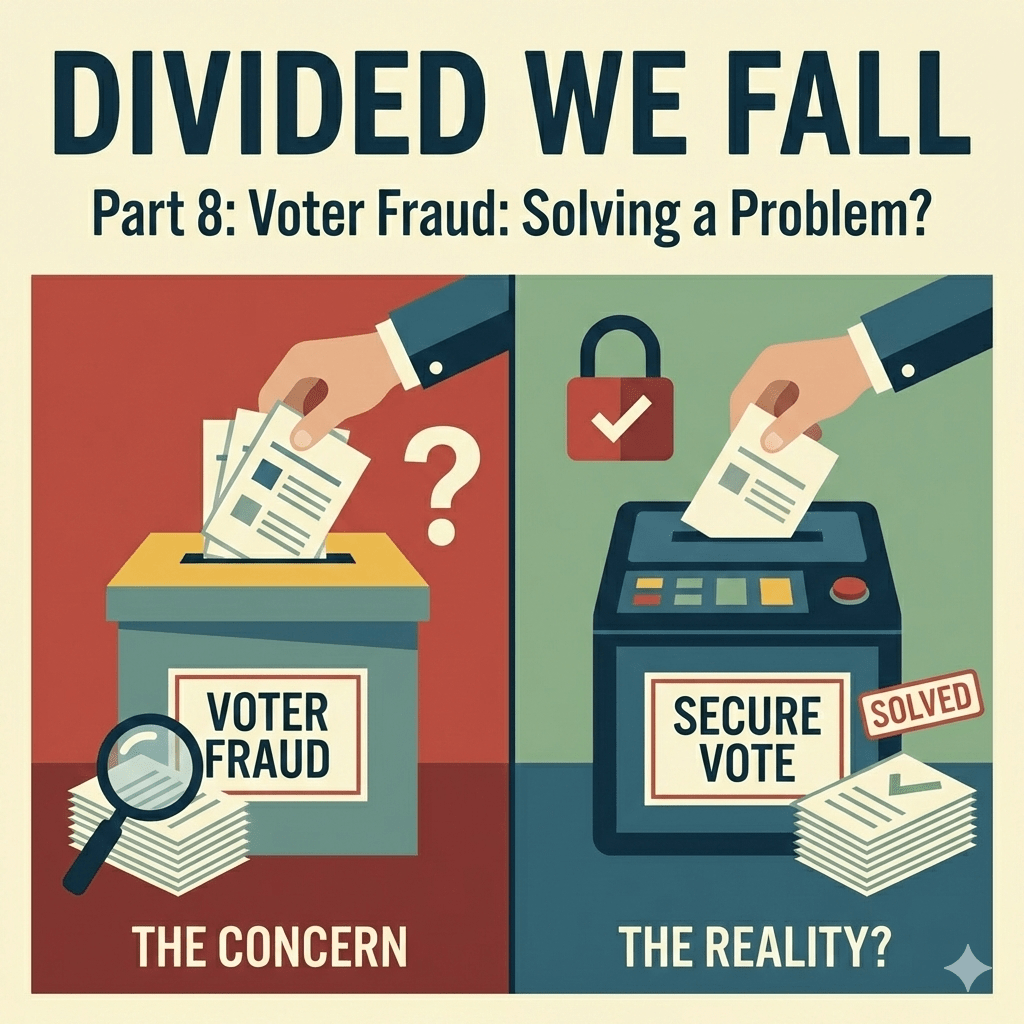
What the Data Actually Shows About Fraud and Election Integrity
After the 2020 election, allegations of widespread voter fraud dominated conservative media and Republican politics. Dozens of lawsuits were filed. Investigations were launched. Audits were conducted. Millions of dollars were spent searching for evidence of fraud that would explain Donald Trump’s loss.
What did they find? Almost nothing. Out of 159 million votes cast, investigations identified a handful of cases—mostly mistakes, not fraud. Trump’s own Attorney General, William Barr, said there was no evidence of fraud that would change the outcome. Dozens of judges, including Trump appointees, rejected fraud claims for lack of evidence.
But here’s what happened next: Republican-controlled states passed sweeping voting restrictions, claiming they were necessary to prevent fraud and ensure “election integrity.” The restrictions made it harder to vote, particularly for specific groups of people. And all of it was justified by a problem that doesn’t exist.
Let’s look at what the data actually shows about voter fraud, who these restrictions affect, and what this is really about.
The Reality of Voter Fraud
The claim driving voting restrictions is that widespread voter fraud threatens election integrity. So what does the evidence show?
The numbers: A comprehensive study by the Brennan Center for Justice analyzed data on voter fraud and found the rate of fraud is between 0.0003% and 0.0025%. You’re more likely to be struck by lightning than to encounter voter fraud.
A Washington Post investigation of the 2016 election found four documented cases of voter fraud out of 135 million votes cast. Four. That’s 0.000003%.
After the 2020 election, the Associated Press contacted election officials in every state asking if they had evidence of voter fraud. The officials, both Republican and Democrat, reported no evidence of widespread fraud. The total number of suspected fraud cases identified across all 50 states? Fewer than 475 out of 159 million votes—and most of these were errors, not intentional fraud.
The Heritage Foundation, a conservative think tank, maintains a database of election fraud cases going back decades. As of 2023, their database contains about 1,400 proven cases of fraud across all elections since 1982. That sounds like a lot until you realize it spans 40+ years of federal, state, and local elections involving billions of votes. The fraud rate is microscopic.
In-person voter fraud specifically: In-person voter fraud—the kind that voter ID laws are designed to prevent—is virtually nonexistent. A study of elections from 2000-2014 found 31 credible allegations of in-person voter fraud out of more than 1 billion votes cast. Thirty-one.
Why is in-person fraud so rare? Because it makes no sense. To commit in-person voter fraud, you would need to:
• Know the name and address of a registered voter who hasn’t voted yet
• Show up to their polling place
• Pretend to be that person
• Cast one vote
• Risk a felony charge (up to 5 years in prison)
• Do this at scale to actually affect an election outcome
The risk-to-reward ratio is absurd. You risk years in prison to cast one fraudulent vote that won’t change an election outcome. Nobody does this at scale because it’s stupid, risky, and ineffective.
The data is clear: voter fraud exists, but it’s exceedingly rare, it’s usually caught, and it doesn’t affect election outcomes. This is not a real problem at the scale being claimed.
The Conspiracy Theory: “Millions of Illegal Immigrants Are Voting”
One of the most persistent claims in the voter fraud debate is that millions of illegal immigrants are voting in U.S. elections, swaying results toward Democrats. This claim connects immigration panic to election denial, making it a powerful culture war weapon. So what does the evidence show?
The claims: In 2016, Donald Trump claimed that between 3 and 5 million people voted illegally, costing him the popular vote. He created the Presidential Advisory Commission on Election Integrity, led by Kris Kobach, to investigate. The commission had full access to state voter data and federal resources. After months of investigation, they disbanded without releasing a report. Why? Because they found nothing.
Conservative activists and politicians continue to claim that “motor voter” laws (which allow people to register when getting driver’s licenses) enable non-citizens to vote, that sanctuary cities facilitate illegal voting, and that Democrats deliberately register illegal immigrants to vote.
The evidence: A comprehensive 2017 study analyzed 23.5 million votes cast in 42 jurisdictions. They found approximately 30 suspected cases of non-citizen voting. Thirty out of 23.5 million. That’s 0.0001%.
The Heritage Foundation’s database of proven election fraud cases—maintained by a conservative organization actively looking for fraud—contains minimal cases of non-citizen voting over 40+ years of elections.
Multiple academic studies using different methodologies have found non-citizen voting rates of less than 0.01%. Even the highest estimates from studies that have been criticized for methodology issues suggest rates far below what would affect any election outcome.
Georgia conducted an audit of their voter rolls in 2022 specifically looking for non-citizens. Out of 8.2 million registered voters, they found 1,634 suspected non-citizens who had registered—and of those, only 9 had actually voted. That’s 0.0001%.
Why this doesn’t happen: Non-citizen voting is extremely rare because it makes no sense from a risk-reward perspective:
Registration barriers: Voter registration requires documentation. States verify citizenship through databases like SAVE (Systematic Alien Verification for Entitlements). Getting through this verification as a non-citizen is difficult.
Illegal immigrants avoid government: Illegal immigrants specifically avoid government interaction because it risks deportation. The idea that they would voluntarily show up at a government office to register to vote, provide identification, and then show up at a polling place—all while risking exposure—is absurd.
The penalties are severe: Voting illegally as a non-citizen carries severe penalties: up to 5 years in prison, a $10,000 fine, and deportation with permanent inadmissibility to the U.S. You risk everything to cast one vote that won’t change an election outcome.
Audits catch violations: States conduct post-election audits and cross-reference voter rolls with citizenship databases. Non-citizen voting gets caught. It’s not a secret, invisible crime—it leaves a paper trail that audits detect.
The conspiracy would be massive: The claim that millions of non-citizens vote would require a massive, coordinated conspiracy involving thousands of poll workers, election officials, and database administrators across multiple states. No evidence of any such coordination exists. No whistleblowers have come forward. No documents have leaked. Because it’s not happening.
The real agenda: The claim that illegal immigrants are voting in massive numbers serves multiple political purposes:
Connects two culture wars: It links immigration panic to voting restrictions. If you can convince people that illegal immigrants are stealing elections, you justify both harsh immigration enforcement AND voter suppression.
Undermines democratic legitimacy: It delegitimizes Democratic electoral victories. If Democrats win, it must be because of illegal votes, not because more citizens voted for them.
Provides cover for voter suppression: It justifies sweeping voting restrictions that disproportionately affect legal voters. The restrictions don’t stop non-citizens from voting (that’s already illegal and rare). They stop poor citizens, minority citizens, and elderly citizens from voting.
Divides workers: It divides working-class Americans along citizenship and immigration status lines, preventing them from recognizing shared economic interests.
The irony: Here’s the irony: politicians claiming widespread illegal immigrant voting are the same ones making it harder for legal citizens to vote. They’re solving a problem that doesn’t exist (non-citizen voting at 0.0001%) while creating a problem that does (millions of legal citizens unable to vote due to restrictions).
The bottom line on non-citizen voting: Non-citizen voting is illegal, it’s extremely rare, and it doesn’t affect election outcomes. The claim that millions of illegal immigrants are voting is a conspiracy theory with zero evidence. It’s used to justify both harsh immigration policies and voting restrictions that prevent legal citizens from voting.
Addressing Other Legitimate Concerns
Beyond the non-citizen voting conspiracy, there are other points often raised in this debate that deserve direct response.
Voter ID sounds reasonable: Having some form of identification when voting sounds reasonable. Most people have ID. Many states already require some form of ID to vote. The question is what kind of ID is required, how easy is it to obtain, and what happens to people who don’t have it.
Here’s where it gets complicated: about 11% of eligible voters don’t have government-issued photo ID. That’s about 21 million people. These people are disproportionately poor, elderly, minority, and urban. They’re also disproportionately likely to vote Democratic.
If getting ID were free, easy, and accessible to everyone, voter ID requirements might be reasonable. But in practice:
• Many states charge for IDs ($20-50), making them effectively a poll tax
• DMV offices are often far from public transit, closed on weekends, have limited hours
• Getting ID requires other documents (birth certificate, Social Security card) that cost money and time to obtain
• For elderly people who never drove or poor people who don’t have cars, getting ID is genuinely difficult
So yes, voter ID sounds reasonable in theory. In practice, the way it’s implemented creates barriers that prevent more legitimate voters than fraudulent ones.
Election security matters: Elections should be secure. Chain of custody for ballots matters. Observers should be allowed. Audits should happen. Absolutely. And these things already happen. Elections are already quite secure. The question is whether the new restrictions being imposed actually increase security or just reduce access.
What the Restrictions Actually Do
Since 2020, Republican-controlled states have passed laws that:
• Strict photo ID requirements (even though in-person fraud is nearly nonexistent)
• Reduced early voting days and hours
• Restricted mail-in voting (even though mail fraud is also extremely rare)
• Closed polling locations, particularly in urban and minority areas
• Purged voter rolls more aggressively
• Banned giving water to people waiting in line to vote
• Made it illegal to collect and drop off other people’s ballots
• Given legislatures power to overturn election results
Let’s be clear about who these restrictions affect:
Poor people: They don’t have driver’s licenses at higher rates. Getting ID requires money, transportation, and time off work that they may not have.
Hourly workers: Long lines at polling places matter more when you work hourly jobs and can’t take time off. Reduced early voting matters more when you work multiple jobs. Restrictions on mail voting matter more when you lack transportation.
Minority voters: Polling place closures disproportionately occur in minority neighborhoods. Voter ID requirements affect Black and Hispanic voters more because they’re less likely to have driver’s licenses. Voter roll purges affect people with common names (like Maria Garcia) more than uncommon names.
Elderly voters: May not drive anymore, may have lost documents over decades, may have difficulty getting to DMVs, may be in nursing homes without easy access to polling.
All of these groups lean Democratic. Which brings us to the real point.
The Real Agenda
If voter fraud is nearly nonexistent, why pass laws to prevent it? The answer becomes clear when you look at who these laws affect and who benefits.
They sometimes admit it: In 2012, Pennsylvania’s Republican House Majority Leader Mike Turzai said at a Republican State Committee meeting: “Voter ID, which is gonna allow Governor Romney to win the state of Pennsylvania: Done.” He said the quiet part out loud: voter ID was about helping Republicans win, not about fraud prevention.
In 2016, a federal court struck down North Carolina’s voting restrictions, saying they “targeted African Americans with almost surgical precision.” The court found that North Carolina had requested data on voting patterns by race, then implemented restrictions that disproportionately affected Black voters.
The effect on turnout: A 2016 study found that strict voter ID laws reduce turnout by 2-3 percentage points overall, with larger effects on minorities. In close elections, that’s enough to change outcomes.
Research consistently shows these laws reduce Democratic turnout more than Republican turnout. That’s not an accident—it’s the goal.
The timing is telling: After the Supreme Court gutted the Voting Rights Act in 2013 (Shelby County v. Holder), states previously required to get federal approval for voting changes immediately began implementing restrictions. Within 24 hours of the decision, Texas announced it would implement strict voter ID. Mississippi and Alabama followed. This wasn’t about fraud—it was about taking advantage of removed oversight.
How We Got Here: Gutting the Voting Rights Act
The Voting Rights Act of 1965 was one of the most important civil rights achievements in American history. It addressed systematic disenfranchisement of Black voters, particularly in the South.
What it did: Section 5 of the Act required certain states and jurisdictions with histories of discrimination to get federal approval (called “preclearance”) before changing voting laws. This prevented discriminatory changes before they could affect elections.
Shelby County v. Holder (2013): In 2013, the Supreme Court ruled in Shelby County v. Holder that the formula determining which jurisdictions needed preclearance was unconstitutional because it was based on decades-old data. Chief Justice Roberts wrote that “our country has changed” and the formula was no longer justified.
Justice Ginsburg’s dissent warned: “Throwing out preclearance when it has worked and is continuing to work to stop discriminatory changes is like throwing away your umbrella in a rainstorm because you are not getting wet.”
What happened next proved her point. States immediately began implementing voting restrictions that would have been blocked under the Voting Rights Act. Within years, hundreds of polling places closed in areas that had been covered by preclearance, almost all in minority neighborhoods.
The Court didn’t strike down preclearance entirely—it said Congress could update the formula. Congress has not done so, because Republicans block it. The result: no preclearance, no federal oversight, and a wave of state-level voting restrictions.
How Other Countries Do It
If you believe voting restrictions are about security, look at how other democracies handle elections:
Australia: Elections are run by independent commissions, not partisan legislators. Voting is compulsory. Registration is automatic. Every citizen gets a voter card mailed to them. Polling places are everywhere and well-staffed. Voter fraud is nearly nonexistent, turnout is ~90%, and nobody claims elections are rigged.
Oregon: Automatic registration. Mail voting is the default for most voters. Signature verification handles security. Voter fraud is nearly zero. Turnout is high. Elections are secure and accessible.
Canada: Automatic voter registration. Election day is a holiday. Voting is easy and accessible. Same-day registration allowed. Fraud is nearly nonexistent. Turnout is among the highest in democracies.
The pattern: other democracies make voting easier, not harder. They register everyone automatically. They make election day a holiday or hold elections on weekends. They put polling places everywhere. They make mail voting simple. And guess what? Voter fraud remains rare, turnout increases, and elections are secure.
The United States is one of the few democracies actively making it harder to vote. And we’re doing it while claiming it’s about security, even though countries with easier voting have equal or better security.
What Would Actually Increase Election Security
If the goal were genuinely to secure elections while maintaining access, here’s what we’d do:
• Everyone gets registered automatically at 18, updates when they move, no bureaucratic barriers
• Make election day a federal holiday or hold elections on weekends
• Fund adequate polling places so nobody waits hours to vote
• Make mail voting easy with signature verification for security
• Paper ballot backups for all electronic voting
• Risk-limiting audits after every election
• Independent, nonpartisan election administration
• If voter ID is required, make state ID free and easily accessible to everyone
Notice what’s not on this list: closing polling places, restricting early voting, purging voter rolls, or banning water for people in line. Because those things don’t increase security—they decrease access.
The Bottom Line
Voter fraud exists, but it’s exceedingly rare. In-person voter fraud—the kind voter ID laws are supposed to prevent—is virtually nonexistent. Non-citizen voting is even rarer, occurring at a rate of 0.0001%. The evidence for widespread fraud is not there. Investigations haven’t found it. Courts haven’t found it. Even Trump’s own Attorney General and his hand-picked commission found nothing.
The voting restrictions being passed are not about preventing fraud. They’re about making it harder for specific groups to vote—groups that tend to vote Democratic. The restrictions disproportionately affect poor people, minorities, hourly workers, and the elderly.
We know this because:
• The restrictions target the voting methods these groups use most (mail voting, early voting, Sunday voting)
• Polling closures happen in their neighborhoods
• ID requirements affect them disproportionately
• Republican legislators have admitted the goal is partisan advantage
• Courts have found the restrictions target minorities “with surgical precision”
This isn’t about election security. Other democracies show you can have secure elections with easy access. The United States is choosing to make voting harder while claiming it’s about security, even though the security threat doesn’t exist at the scale claimed.
Some concerns about election integrity are legitimate. Only citizens should vote—and they already do, almost exclusively. Elections should be secure—and they already are, with audits, chain of custody, and oversight. But the restrictions being imposed don’t address these concerns—they use them as cover for making it harder for millions of legitimate voters to participate in democracy.
The question isn’t whether you think voter ID sounds reasonable or whether you think elections should be secure. The question is whether you’re okay with solving a nearly nonexistent problem by making it harder for millions of legitimate voters to participate in democracy.
Because that’s what’s actually happening. And it’s working exactly as intended.
 Even that's Odd
Leave a comment