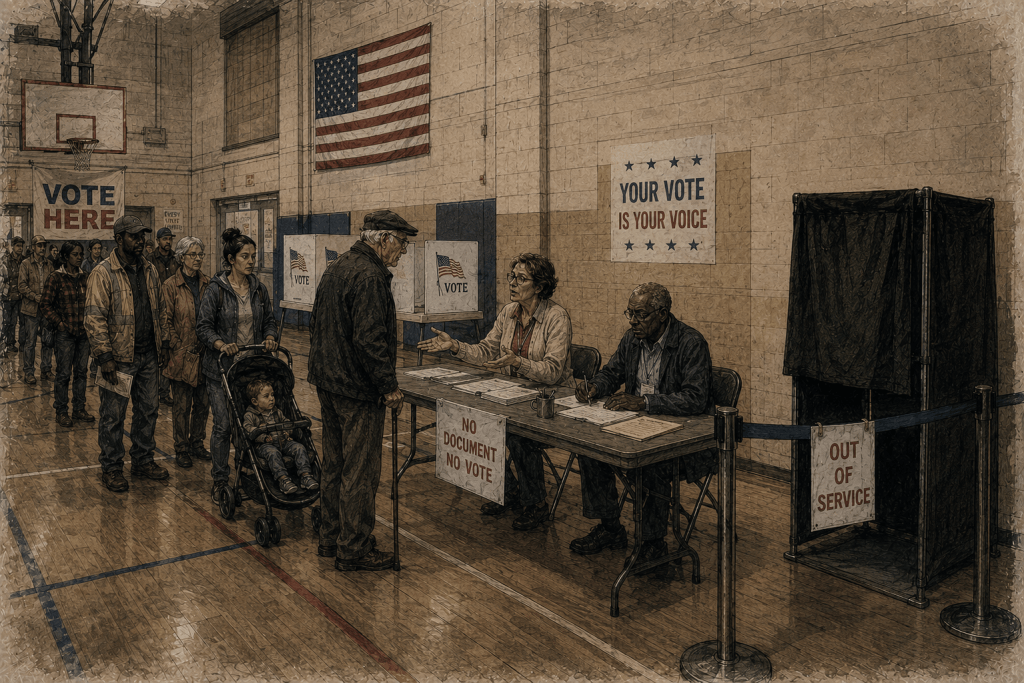
I’ve voted in every election I’ve been eligible to vote in since I turned 18. That’s a stretch of decades that covers multiple states — I spent most of my adult life voting in New York City before moving up to Gardiner — and a fair number of polling places, school gyms, library basements, and the occasional firehouse. Jennifer and I now mostly vote at the Gardiner town hall. Henry will be voting in a couple of years. I’m one of those people who actually looks forward to it. I find polling places sort of moving, honestly. Old people, young people, neighbors I’ve never met, all standing in the same line to do the same simple thing.
I bring that up because the conversation about voter fraud in this country has gotten so heated that it sometimes obscures what the actual experience of voting looks like — which is, in almost every American polling place, a small, competently-run, multiply-checked, deeply boring process. I want to walk through what the data actually says about fraud, what’s being done about it in 2025 and 2026, and what I think is actually going on.
what the evidence shows
The claim driving the last decade of voting restrictions is that widespread voter fraud is a serious threat to the integrity of US elections. Several extensive investigations have looked for it. Here’s what they’ve found.
A Brennan Center for Justice analysis put the rate of voter fraud somewhere between 0.0003% and 0.0025% of votes cast. A Washington Post review of the 2016 election identified four documented cases of fraud out of 135 million votes. After the 2020 election, the Associated Press contacted election officials in every state, Republican and Democrat. Their combined count of suspected fraud cases came in under 475 out of 159 million votes cast — and the great majority of those were errors, not intentional fraud.
The Heritage Foundation, a conservative think tank that actively maintains a fraud database and has every incentive to find as many cases as possible, has documented roughly 1,400 proven cases of all types of election fraud since 1982. Across more than 40 years and billions of votes, that’s a microscopic rate.
In-person voter fraud — the specific kind that voter ID laws are designed to prevent — is the rarest type. A widely cited study of elections from 2000 through 2014 found 31 credible allegations of in-person voter fraud out of more than one billion votes cast. The reason is straightforward: to pull this off, someone would have to know the name and address of a real registered voter who hasn’t voted yet, show up to that person’s polling place, pretend to be them, and risk a felony with serious prison time, all to cast one vote that has effectively zero chance of changing an outcome. Nobody runs that math and concludes it’s worth it. It does happen, occasionally. It doesn’t happen at scale, because it’s a terrible plan.
The closely related claim that millions of non-citizens are voting in US elections has been investigated repeatedly and found to be approximately as common as in-person fraud — that is, vanishingly rare. After his 2016 popular-vote loss, Trump created the Presidential Advisory Commission on Election Integrity under Kris Kobach, gave it federal resources and access to state voter data, and the commission quietly disbanded without producing a report. A comprehensive 2017 academic study of 23.5 million votes across 42 jurisdictions identified about 30 suspected cases of non-citizen voting — roughly 0.0001%. Georgia’s 2022 audit of its 8.2 million registered voters found 1,634 suspected non-citizens had ever registered, of whom 9 had actually voted. Multiple independent studies have produced similar figures.
This isn’t a partisan finding. The data is consistent across academic researchers, journalists, government investigators, conservative think tanks, and election officials of both parties.
what the restrictions actually do
If fraud is this rare, the question becomes: what are the restrictions for?
Since 2020, Republican-controlled states have passed sweeping voting laws, and since January 2025 the federal government has joined in with executive orders and an active congressional push. The pattern of those laws is consistent: stricter photo ID requirements, reduced early voting days and hours, restrictions on mail-in voting, increased polling place closures (particularly in urban and minority neighborhoods), more aggressive voter roll purges, bans on volunteers giving water to people waiting in long lines, restrictions on collecting and dropping off other people’s ballots, and in some states, legislative power to override election results.
The people most affected by all of those provisions are predictable. About 11% of eligible US voters — roughly 21 million people — don’t have government-issued photo ID. They are disproportionately poor, elderly, rural or inner-city, and disproportionately people of color. Hourly workers without paid time off are hurt more by long lines and reduced early voting than salaried workers. Voter roll purges affect people with common names more than uncommon names. Polling place closures land harder in dense urban neighborhoods than in suburbs. Restrictions on mail-in voting affect older voters and disabled voters most. Almost every group that bears the brunt of these restrictions leans Democratic.
That correlation could in theory be a coincidence. The legislators who passed the laws have sometimes told us it isn’t. In 2012, the Pennsylvania House Republican Majority Leader said publicly that the state’s new voter ID law was “gonna allow Governor Romney to win the state of Pennsylvania: Done.” In 2016, a federal appeals court struck down North Carolina’s voting restrictions, finding that the legislature had specifically requested racial data on voting patterns and then crafted restrictions that targeted Black voters “with almost surgical precision.” The motive is, in those cases, not a matter of inference. It’s part of the record.
The academic research backs that up. Strict voter ID laws reduce overall turnout by roughly 2–3 percentage points, with disproportionate effects on minority voters. In a close election, that’s an outcome-shifting amount.
what’s happening at the federal level right now
This is where the 2025–2026 picture matters, because a lot of people who haven’t tracked it closely are unaware of how active the federal government has been on elections this year.
On March 25, 2025, Trump signed Executive Order 14248, “Preserving and Protecting the Integrity of American Elections.” It directed the Election Assistance Commission to add a documentary proof-of-citizenship requirement to the federal voter registration form — meaning a passport, naturalization papers, or similar — to register to vote. It conditioned federal election funding on state compliance. It directed federal agencies to give states access to federal databases to verify voters and instructed enforcement of a federal-law interpretation that ballots received after Election Day shouldn’t be counted.
That order has been partially blocked by federal courts. In April 2025, the District Court for DC, in LULAC v. Executive Office of the President, preliminarily enjoined parts of it. In a parallel case, California v. Trump, the District Court for Massachusetts agreed that the new documentary citizenship requirements were likely outside the president’s authority. The Election Assistance Commission is, by statute, an independent bipartisan body — the president can nominate commissioners but cannot compel its decisions. Litigation is ongoing.
On April 10, 2025, the House passed the SAVE Act, which would require documentary proof of citizenship to register to vote in federal elections. As of this writing, the Senate companion bill has not passed.
On March 31, 2026, Trump signed Executive Order 14399, “Ensuring Citizenship Verification and Integrity in Federal Elections,” which restates and expands the citizenship-verification requirements and again ties federal election funding to state compliance. Earlier in 2026, a 17-page draft executive order proposing federal control of significant election mechanics — including potentially declaring a national emergency to override state authority — was reported on by PBS and other outlets. The administration publicly denied that the document represented a planned action; the document itself was real.
The cumulative effect of two years of state-level restrictions and federal executive orders aimed at the same target is significant. None of it addresses a documented fraud problem at any scale. All of it makes voting harder for specific categories of legal voters.
how other democracies handle this
The interesting comparison is with other countries that have lower fraud rates than we do.
Australia uses an independent national elections commission, automatic registration, compulsory voting, and a voter card mailed to every citizen. Turnout runs around 90%. Fraud is functionally nonexistent. Canada uses automatic registration, holds elections in ways that maximize access, and treats election day as a national event. Turnout is consistently high. In the US, Oregon’s all-mail voting system has run for decades with extremely low fraud rates and high turnout. Signature verification handles the security side. The system works.
The pattern across functioning democracies is that they make voting easier, not harder, and they treat election security as a question of audits, paper backups, and chain of custody rather than as a question of which voters to keep out. Our 2024 and 2025 elections were already, by every nonpartisan assessment I’ve read, among the most secure in our history. The infrastructure works. Risk-limiting audits work. The bipartisan election officials I have any visibility into take their jobs seriously.
What we are doing instead — closing polling places, restricting voting hours, purging rolls, requiring documents many citizens don’t have, and conditioning federal funding on compliance with citizenship verification rules — is a set of choices unique among wealthy democracies. They are not what countries with lower fraud rates do. They are what countries with worse turnout do.
why this is actually serious
I don’t usually like end-of-piece urgency. But I want to be honest about how I read this one.
There are policy disagreements where reasonable people on both sides have a legitimate case. Voter ID, in theory, is one of those — a lot of people across the political spectrum think showing some kind of ID to vote is reasonable, and I understand the intuition. The argument against most current voter ID laws isn’t really about the ID itself. It’s about whether the state is willing to make ID free, accessible, and easy enough that the requirement doesn’t function as a barrier. Where states have done that, the laws are less of a problem. Where they haven’t, the laws function as a poll tax by design.
What’s happening at the federal level right now is in a different category. The combination of executive orders that exceed presidential authority, attempts to condition federal funding on compliance with new voter restrictions, a House-passed bill that would require documentary citizenship proof tens of millions of legal voters can’t easily provide, and a public floating of executive orders that would let the president “take over” election administration adds up to something that the country has not historically considered normal. The fraud problem these moves are nominally responding to is, on the evidence, microscopic. The harms they would do to legal voters are not.
I will keep voting. So will Jennifer. So will my neighbors. So will most of the people who have always voted, because we have the resources and the time and the documents. The people most likely to be turned away or discouraged are the people who already vote at lower rates because their lives are harder than ours. I don’t think we should organize a democracy around that, and I don’t think most Americans, when the question is put to them plainly, do either.
The question worth asking, when you hear the next round of voter-fraud rhetoric, is just: what problem is this actually solving, and who specifically can’t vote if it works the way its sponsors want it to? Once you can answer those two questions, the rest of the noise around this issue gets a lot quieter.


Leave a Reply