
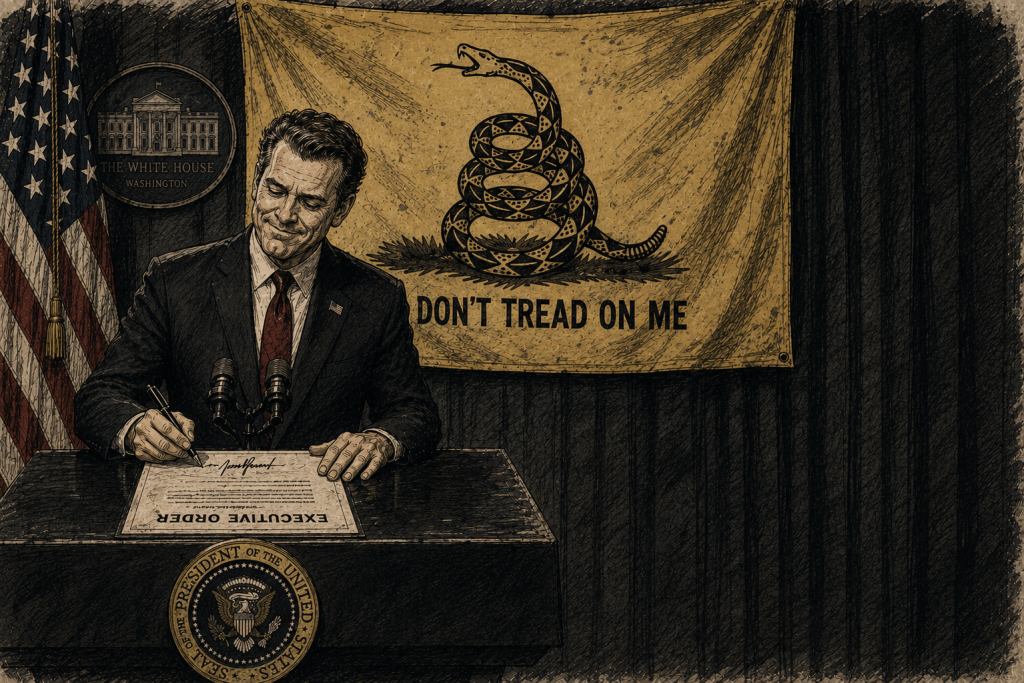
I was raised on a fairly standard American small-government instinct. Don’t tread on me. The government that governs least governs best. Local control. Keep Washington out of your business. I grew up with that as background music, and a lot of it I still mostly agree with. I prefer that decisions about my kid’s school be made by the school district. I’m skeptical of federal mandates that override local judgment. I don’t love handing more power to any government than it needs to do its actual job.
So this post is being written from inside the worldview a lot of people on the right say they share. It’s not an attack on small-government conservatism. It’s a complaint that the people loudest about small-government conservatism have, over the last several years, used government power in a way that doesn’t square with the rhetoric at all. I want to walk through three places where that gap has gotten obvious — policing, corporations, and schools — because I think the gap is the actual story, not the rhetoric.
crime and “back the blue”
I want to start with policing, because this is the one where I think the conversation has gotten most stuck and where the data is most lopsided against the standard narrative.
The dominant story in conservative media for the past several years has been that crime is exploding in Democrat-run cities and that “blue America” has become unsafe. President Trump has, in 2025, deployed the National Guard to Washington DC and threatened similar deployments to Chicago, Oakland, and Baltimore on the grounds of urban crime.
The actual 2024 data, released by the FBI, tells a different story than the one on cable. The national murder rate dropped 14.9% in 2024 — the largest single-year drop in modern record-keeping. Overall violent crime fell 4.4%. Property crime fell 8.1%. The national murder rate of about 5 per 100,000 is the lowest since the Obama administration. When you look at where the remaining violence is concentrated, the picture is even more inconvenient for the standard frame: of the twenty US cities with the highest 2024 murder rates, thirteen were in Republican-run states. Of the top ten, eight were. The top four murder-rate cities — St. Louis, Birmingham, Memphis, and similar — are all in red states. Across multiple years of CDC and FBI data, the red-state murder rate has averaged roughly 33% higher than the blue-state murder rate. The state with the highest murder rate is Mississippi. The lowest is in New England.
None of that means cities don’t have crime problems. They do. Baltimore had a murder rate of 34.8 per 100,000 in 2024, which is high even though the city’s mayor noted it was the lowest figure in five decades. But the framing that crime is uniquely a “blue” problem isn’t survivable against the actual numbers.
The other piece of the picture is what “back the blue” has come to mean in practice. I support good policing. Most Americans do, including most people on the left. What “back the blue” tends to mean as a legislative agenda is something narrower: preserving qualified immunity (which shields officers from civil liability even for constitutional violations), opposing body camera requirements, blocking independent oversight, restricting public access to misconduct records, and continuing the Pentagon’s transfers of military equipment to local police departments. None of those are pro-good-policing measures. They are anti-accountability measures, which is a different thing.
And the irony, if you grew up on limited-government instincts, is that police are agents of the state. Empowering them while removing oversight is the precise definition of expanding state power. The intellectually coherent small-government position would be the one that says state agents should be accountable when they use force, that their actions should be documented, and that citizens harmed by them should have legal recourse. The standard “back the blue” position turns out to be the opposite of that.
What the evidence shows actually reduces crime, separately, is not where most of the rhetoric points either. It’s economic opportunity and employment. Education and youth programs. Mental health and addiction treatment. Community investment. De-escalation training. Those things look more like investment than enforcement, which is part of why they don’t track politically the way they should. We spend roughly $182 billion a year on policing and incarceration. We have the highest incarceration rate in the world. If enforcement alone were the answer, we’d be the safest country on earth. We’re not.
corporations and the “free market”
The second place the gap between rhetoric and practice has gotten too wide to ignore is corporate regulation.
The standard line is that businesses should be free from government interference. The market decides. Regulations are tyranny. I broadly believe a version of this. I run a small business — Fig.3 Ltd, my consulting outfit — and I have a separate apparel brand called Crooked Number. I have a strong personal preference for not having a state agent involved in my routine business decisions.
But that principle, like the limited-government one, has been doing some odd work lately. In 2022, after Disney publicly criticized Florida’s “Don’t Say Gay” bill, Governor DeSantis used the Florida legislature to strip Disney of its self-governing tax status — a status Disney had held since 1967 — explicitly because of the criticism. DeSantis was open about the motive: “If Disney wants to pick a fight, they chose the wrong guy.” When the largest employer in the state speaks publicly on a political issue and the governor uses state authority to punish them for it, “free markets” isn’t the right frame for what’s happening.
The pattern has spread to other states. Texas passed a law requiring state agencies to create blacklists of financial companies that “boycott” fossil fuels and prohibiting them from state contracts. Several other states — West Virginia, Louisiana, Oklahoma, Arkansas — have passed similar laws. State treasurers and attorneys general have pressured banks and asset managers to back off of ESG investing criteria, threatening to divest state pension funds. Anti-DEI legislation in multiple states now restricts corporate diversity policies, sometimes by conditioning state contracts on companies dismantling them.
You can have any view you want about ESG investing or corporate diversity policy. The point I’m making is structural: state legislatures and state officials are now actively directing private business decisions through their leverage as customers, regulators, and fund managers. The Trump administration is doing the same at the federal level, with EO 14173 and related orders telling federal contractors and subcontractors to scrub their DEI programs.
That isn’t a free market. It’s the state telling private companies what they’re allowed to do internally. The fact that the directive is coming from the political right doesn’t change the structure. If a Democratic governor were stripping a company of its tax status because the CEO criticized a Democratic priority, the people currently silent about Reedy Creek would, correctly, be losing their minds.
schools and “parental rights”
The third place the rhetoric and the practice have come apart is education, and this one I’ll be brief about because I’ve covered pieces of it elsewhere in this series.
“Parental rights” has been the slogan. In practice, the laws being passed are not about expanding any individual parent’s ability to make decisions for their own kid. They’re about empowering a small organized minority of parents — often coordinating with national groups using identical complaint templates — to use government power to remove books, restrict teachers, and dictate curriculum for everyone else’s kids. The American Library Association documented in 2023 that about 40% of book challenges came from organized groups rather than individual parents. The same handful of book titles get challenged repeatedly across states using the same talking points.
In Florida, the state has rejected an AP African American Studies course and required changes to AP Psychology removing material on sexual orientation and gender identity. State curriculum standards now require teaching that slavery offered enslaved people “personal benefit” through the development of skills. Teachers across multiple states have been fired or disciplined for what they had in their classroom libraries, or for what they said in class about current events, or for being openly LGBTQ. Librarians in several states face criminal exposure if they refuse to remove challenged books. School library book bans hit record numbers every year from 2021 through 2024.
That isn’t parental rights. It’s the government telling parents what their kids can read, what their teachers can say, and what history they’re allowed to learn. A parent who actually wants their kid to read The Bluest Eye or learn about Jim Crow has no rights under these laws. A parent who wants those things banned for everyone has the full power of the state.
Voucher programs, separately, have continued to move public money into private and religious schools that can refuse to admit students based on disability, religion, or sexual orientation, don’t have to follow public-school academic standards, don’t have to hire certified teachers, and face very limited accountability for results. Arizona’s universal voucher program ballooned past $900 million annually, almost all of it pulling money out of the public schools that still educate the majority of the state’s kids. Multiple academic reviews of voucher programs have shown either no effect or a negative effect on academic outcomes. The framing is parental choice. The mechanism is a public-money transfer to a privately controlled, lightly regulated system.
what I think is actually going on
The pattern across all three of these is the same, and I’ll say it plainly because it’s the part the rhetoric is designed to obscure. The version of “freedom” being defended here is freedom for the people in alignment with the people currently holding power, and state-enforced restriction for the people who aren’t. That’s not a small-government project. It’s just power, dressed in language that used to mean something else.
I find this annoying as someone who genuinely values limited government. The argument for federalism, for local control, for keeping the state out of private business and personal decisions and family choices — that’s a serious philosophical tradition and a useful counterweight to the natural tendency of any government to expand. It’s getting buried under a movement that uses its vocabulary while doing the opposite of what it nominally stands for. The “Don’t Tread on Me” flag in the background of a press conference announcing that the state is going to dictate what an employer can include in its diversity training is something I notice every time I see it.
I don’t think this is permanent. Movements that develop a serious gap between what they say and what they do tend to lose people who took the original claims seriously. I think a lot of Americans across the political spectrum, when shown the receipts side by side with the rhetoric, will eventually decide they want the rhetoric to mean what it says. I’d like to be in the coalition that decides that sooner rather than later.


Leave a Reply