
Part 1 of Do Unto Others, a 5-part series. Read the complete series →
The way I’d planned to start this was with a list of names. Then I tried it and it read like an indictment, which isn’t what I’m going for. Let me back up.
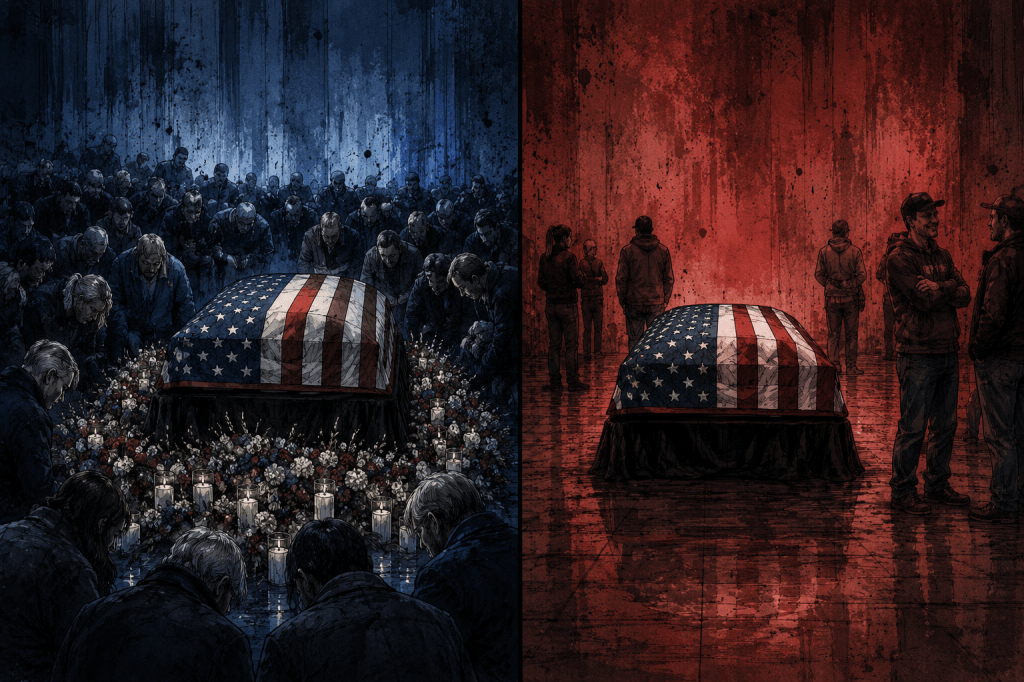
What got me writing this was noticing, over the past year or so, that I could often guess in advance how the President was going to respond to a violent death. Not from any reporting. Just from who the dead person was. If they were politically useful — a flag at half-staff and a Medal of Freedom by morning. If they weren’t — silence, or worse, mockery.
I tried to write this like a documentarian would. I looked for examples across the political spectrum of any president giving the Medal of Freedom to one assassinated person while pretending not to remember another’s name. Of saying “horrific violence” about a murdered lawmaker and three months later asking “the who?” when she came up. Of calling video evidence “fake” when it contradicted the official line. Of threatening American protesters with military force in the same week the same person cheered foreign protesters doing the exact same thing. I could not find the comparable case from before. Previous presidents had hypocrisy and double standards and favorites. They didn’t have this volume of it or this brazenness about it. So if the receipts here look one-sided, it’s because the volume is one-sided. (Part 3 in this series gets into Democratic failures specifically. It’s coming.)
What this series is actually about is how empathy in our politics has become transactional. How moral standards have become a coupon you clip when it helps your team and tear up when it doesn’t. How “do unto others” — which I grew up understanding as the baseline floor for being a person — has turned into “do unto others if they’re on my team, and if they’re not, here is what we will do to them instead.”
Five things from the past year, in order.
Melissa Hortman and Charlie Kirk
On June 14, 2025, Minnesota House Speaker Melissa Hortman and her husband Mark were murdered in their home by Vance Boelter, an evangelical preacher dressed as a police officer who had a hit list of nearly 70 people, mostly Democratic lawmakers and abortion providers. Boelter’s wife described his actions as “a betrayal of our Christian faith.” His political motivation was documented in federal charging papers.
Trump issued a one-sentence statement that day: “Such horrific violence will not be tolerated in the United States of America.” The day after, asked if he would call Governor Walz, Trump said the governor was “so whacked out” that calling him would “waste time.” He went golfing on the day of the Hortman funeral. Walz publicly requested federal flags be lowered in Minnesota; either the request never reached Trump or he ignored it. Three months later a reporter asked Trump why he had lowered flags for Charlie Kirk but not for Hortman, and he answered: “I’m not familiar. The who?” Six months later he shared a conspiracy theory claiming Walz himself was complicit in Hortman’s murder. Her children publicly asked him to take the post down. He did not respond.
Now compare that to September 10, 2025. Conservative activist and Turning Point USA founder Charlie Kirk was shot during a campus speaking event at Utah Valley University. Tyler Robinson was arrested the next day. Within six hours, Trump issued a video statement from the Oval Office calling Kirk “a martyr for truth and freedom.” Within twenty-four hours he posthumously awarded Kirk the Presidential Medal of Freedom. Within forty-eight hours flags were at half-staff, more than 600 people had been fired from their jobs for social media posts about Kirk’s death, ABC pulled Jimmy Kimmel’s show for a week, foreign students had visas revoked, and federal prosecutors had opened investigations into “conspiracy to silence conservative speech.”
So the line had been drawn at the highest possible level of federal seriousness. Mocking or celebrating a political opponent’s death was fireable. Potentially criminal. That was the standard. Remember it.
Rob Reiner
December 14, 2025: Rob Reiner and his wife Michele were found stabbed to death in their Brentwood home. Their 32-year-old son Nick, who had talked publicly for years about his struggles with drug addiction and mental illness, was arrested and charged with first-degree murder. Not political assassination. Not part of any movement. A family tragedy a hundred years in the making, the kind that has nothing to do with politics and everything to do with mental health and addiction and grief.
The morning after the bodies were found, the President posted on Truth Social:
“A very sad thing happened last night in Hollywood. Rob Reiner, a tortured and struggling, but once very talented movie director and comedy star, has passed away, together with his wife, Michele, reportedly due to the anger he caused others through his massive, unyielding, and incurable affliction with a mind crippling disease known as TRUMP DERANGEMENT SYNDROME, sometimes referred to as TDS.”
He stood by it that afternoon in the Oval Office: “I wasn’t a fan of his at all. He was a deranged person as far as Trump is concerned.”
YouGov polled it. 72% of Americans said the response was inappropriate, including 43% of Republicans. Marjorie Taylor Greene called it “a family tragedy, not about politics or political enemies.” Thomas Massie called it “inappropriate and disrespectful discourse about a man who was just brutally murdered.” Three months earlier, when Charlie Kirk was killed, Rob Reiner himself had told Piers Morgan that Kirk’s death was “an absolute horror” and “beyond belief. That should never happen to anybody. I don’t care what your political beliefs are.”
Six hundred Americans had been fired in two days three months earlier for being insufficiently somber about Charlie Kirk. Zero consequences for the President of the United States for mocking a murdered critic by name, with his wife’s name attached, the day after.
That is the standard he set and the standard he walked away from, in the same season.
Renee Good and Alex Pretti
January 7, 2026: Renee Nicole Good, a 37-year-old US citizen, poet, and mother of three, was shot and killed by ICE agent Jonathan Ross on a residential street in south Minneapolis. The Department of Homeland Security said she had tried to “weaponize her vehicle” to run over an agent. Trump posted that evening: “Another radical leftist tries to kill our brave ICE agents. Domestic terrorist ELIMINATED.”
Then four videos came out, including the agent’s own bodycam, verified by ABC News. They show Good’s car stopped sideways in the street. An officer reaches through her open window to try to open her door. She backs up briefly, then turns the wheel sharply to the right, away from the officers, and starts to pull past. Ross fires three shots into the car as it goes by him. Frame-by-frame analysis put 399 milliseconds between the first two rounds. The car crashed into a pole. She was hit in the head and died at the hospital.
Minneapolis Mayor Jacob Frey watched the video and said: “Having seen the video myself, I want to tell everybody directly that is bullshit. To ICE, get the fuck out of Minneapolis.”
Trump’s response to the video evidence was that it was “manipulated.” “Fake news.” “Don’t believe what you see.”
Three federal prosecutors in Minneapolis resigned, citing pressure to manufacture evidence against Good’s widower. Five more resigned over what they described as the Justice Department’s reluctance to investigate the shooter. The DOJ opened investigations — not of Agent Ross, but of the prosecutors who had resigned. Ross was not charged, not suspended, was back on duty within seventy-two hours, and received a commendation from DHS. A fundraiser for him raised $375,000.
Seventeen days later, on January 24, federal CBP agents shot and killed Alex Jeffrey Pretti, a 37-year-old ICU nurse who worked for the VA, at a protest of Renee Good’s killing. Pretti was himself a federal employee, a member of the federal employees’ union, a lawful Minnesota carry permit holder with no criminal record. Stephen Miller called him a “domestic terrorist.” Kristi Noem said he had “brandished” a gun. Border Patrol Commander Gregory Bovino said Pretti had wanted to “massacre law enforcement.”
Then the bystander videos came out, verified by Reuters, BBC, the Wall Street Journal, the New York Times, AP, and CNN. They show Pretti filming with his phone, not holding a gun. They show a federal agent pushing a woman to the ground. They show Pretti stepping between the agent and the woman, the phone in his right hand and his empty left hand raised. They show the agent pepper-spraying him. They show six federal agents wrestling him down. They show an agent removing a gun from him. One second later, they show a different agent shooting him at least ten times.
Police Chief Brian O’Hara pointed out that this had been the third federal shooting in Minneapolis in under three weeks. The city had three homicides in 2026 so far. Two of them were federal officers killing American citizens. He noted that his department had recovered about 900 guns from the street the previous year, arrested hundreds of violent offenders, and shot no one.
The National Rifle Association issued a statement saying responsible public voices should wait for a full investigation rather than demonize law-abiding citizens. Chris Madel, the Republican lawyer who had represented Agent Ross in the Renee Good case, dropped out of a Minnesota gubernatorial race after Pretti’s killing. He said he could not support a Republican Party engaged in what he called “retribution.”
Two American citizens. Seventeen days. Both labeled domestic terrorists before any evidence was public. Both federal narratives contradicted by video within forty-eight hours. The lawyer who had defended the first shooter quit his own party over the second shooting.
Iranian patriots vs. Minneapolis insurrectionists
This is the one I keep coming back to because the timing is so tight you can’t argue with it.
January 2, 2026 — Trump on Iranian protesters protesting Iranian government violence:
“The brave patriots of Iran are rising up against their oppressor government. We stand with them. America is LOCKED AND LOADED to rescue our people and support freedom fighters. Help is on the way!”
January 7 — Renee Good is shot in Minneapolis.
January 13 — Trump again, on Iran:
“To the Iranian people: KEEP PROTESTING. TAKE OVER YOUR INSTITUTIONS. We support your fight for freedom. Your government is illegitimate. Rise up!”
January 15 — Minneapolis protesters are in the streets demanding accountability for Agent Ross. Trump:
“The insurrection in Minneapolis must end immediately. I am prepared to invoke the Insurrection Act and send military forces to PUT AN END TO THIS TRAVESTY. These domestic terrorists will face justice.”
Same weeks. Same president. Same situation in both cases. Citizens protesting government violence and demanding accountability. Iranians protesting their government were patriots and freedom fighters who should take over their institutions with American military support. Americans protesting our government were insurrectionists and domestic terrorists who should be put down by the US military.
The only difference is whether the people getting protested are them or us.
That is the pattern. Empathy as a coupon. Standards as a costume. “Patriot” and “terrorist,” “freedom” and “insurrection,” used not as descriptions of what people did but as labels assigned based on which side they were on. Video evidence is fake when it contradicts the official narrative and gospel when it supports it. Six hundred Americans get fired in two days for one set of comments, and the President does the same thing on a national stage with zero consequence at all.
This isn’t a small thing. This is the thing.
When the same act is treated as heroism or terrorism based on whose team the actor is on, when evidence stops mattering, when mocking a murdered critic is presidential conduct and joking about a different murder is a fireable offense, what’s left of the idea that we are all in the same country playing by the same rules?
That’s what the rest of this series is about. Part 2 gets into what Trump means when he says his own morality is the only thing limiting him, and how that lines up — or doesn’t — with the Christian framework his strongest supporters claim to hold.


Leave a Reply