
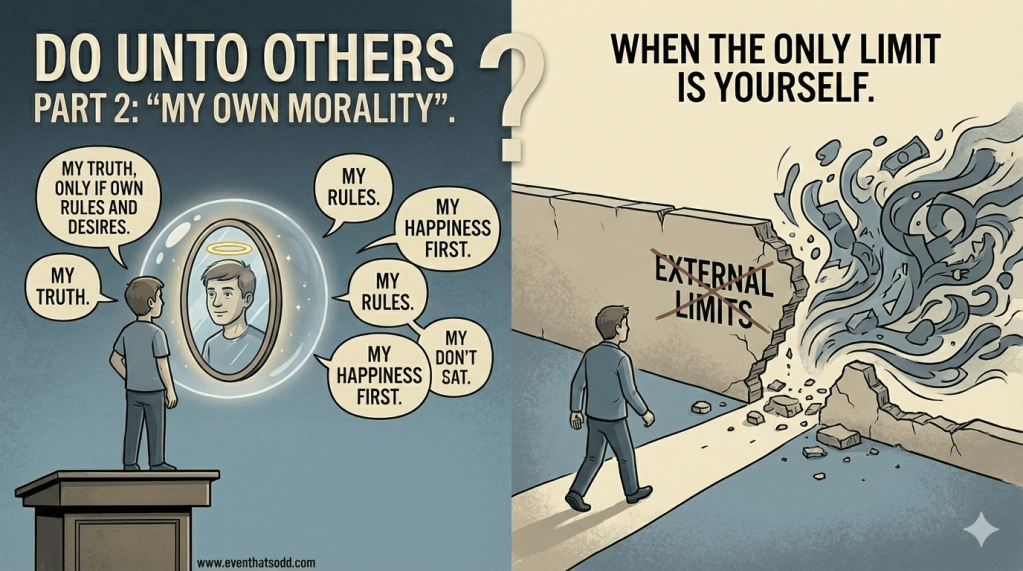
When the Only Limit Is Yourself
On January 8, 2026, President Trump sat down with The New York Times. Asked about constraints on his power, he gave an answer that deserves examination:
“Yeah, there is one thing. My own morality. My own mind. It’s the only thing that can stop me. I don’t need international law.”
Not the Constitution. Not Congress. Not the courts. Not international treaties or democratic norms. His own morality.
So let’s examine what that morality looks like in practice.
What Trump Has Said About His Values
Trump has consistently positioned himself as a defender of Christian values and the evangelical community has embraced him as their champion. In 2020, 81% of white evangelicals voted for him. That support remains steady in 2024.
At Charlie Kirk’s memorial service on September 21, 2025, Trump spoke about Kirk as “a warrior for traditional values” and “a defender of Christian principles.”
But in that same speech, Trump said something that contradicts core Christian teaching:
“He did not hate his opponents. He wanted the best for them. That’s where I disagreed with Charlie. I hate my opponent and I don’t want the best for them.”
This wasn’t a slip. It’s consistent with what Trump told Jimmy Fallon in 2015:
“When people are disloyal to me, I don’t forgive them. I don’t believe in turning the other cheek.”
So what are Christian values, and how do they compare to Trump’s stated framework?
The Beatitudes vs. Trump’s Framework
The Beatitudes from Matthew 5 are considered foundational Christian teaching. Let’s compare them to documented statements and actions.
| Christian Teaching | Trump’s Statements/Actions |
| “Blessed are the meek, for they shall inherit the earth.” | “I think I’m much more humble than you would understand.” (2016) “Nobody is more humble than me.” (2017) |
| “Blessed are the merciful, for they shall receive mercy.” | Rob Reiner murdered by son (family tragedy). Trump’s response day after death: Blamed him for his own murder via “Trump Derangement Syndrome.” |
| “Blessed are the peacemakers, for they shall be called children of God.” | At Kirk memorial: “I hate my opponent and I don’t want the best for them.” (September 21, 2025) |
| “Forgive seventy times seven.” (Matthew 18:22) | “I don’t forgive people.” (2015) “I don’t believe in turning the other cheek.” (2015) |
| “Love your enemies and pray for those who persecute you.” (Matthew 5:44) | “Get even with people. If they screw you, screw them back 10 times as hard.” (Think Big, 2007) |
| “He who is without sin, cast the first stone.” (John 8:7) | 34 felony convictions, sexual abuse finding (E. Jean Carroll), fraud conviction, two impeachments. When asked about personal failings: “I don’t think I’ve done anything wrong.” (2024) |
| “Judge not, lest ye be judged.” (Matthew 7:1) | Melissa Hortman murdered by right-wing extremist. Trump shares conspiracy theory blaming Gov. Walz for her death. Her children beg him to remove it. He refuses. |
This isn’t about holding Trump to a standard he doesn’t claim. He explicitly positions himself as a defender of Christian values. 81% of white evangelicals support him precisely because of his claimed commitment to those values.
So either:
1. These aren’t actually Christian values (they are—Matthew 5-7, direct quotes from Jesus)
2. Trump doesn’t actually hold these values (his statements and actions suggest he doesn’t)
3. His supporters don’t actually care about Christian values (possible, but then why the emphasis?)
What His Morality Actually Looks Like
When Trump says “my own morality,” what framework is he describing?
Developmental psychologist Lawrence Kohlberg identified six stages of moral development. Most adults operate at Stage 4 or 5—conventional morality based on social norms or principled ethics.
Stage 2 is called “Instrumental Purpose and Exchange.” The core question at Stage 2 is: “What’s in it for me?”
At Stage 2:
• Right action is what satisfies one’s own needs
• Relationships are transactional
• Fairness is concrete reciprocity: “You scratch my back, I scratch yours”
• Rules matter only when they benefit you
• Others’ perspectives considered only for strategic advantage
Dr. Dan P. McAdams, professor of psychology at Northwestern University, wrote in The Atlantic (June 2016):
“Trump’s moral development appears arrested at Kohlberg’s second stage. He evaluates people and situations primarily through the lens of personal gain and loss. The idea of universal ethical principles seems foreign to his thinking.”
Let’s test that assessment against Trump’s own statements:
On forgiveness: “I don’t forgive people.” (Transactional: what benefit is forgiveness to me?)
On revenge: “Get even with people. If they screw you, screw them back 10 times as hard.” (Concrete reciprocity)
On loyalty: “I expect loyalty. I’m very loyal to people who are loyal to me.” (Transactional relationship)
On empathy: Charlie Kirk gets Medal of Freedom within 24 hours. Melissa Hortman gets “I’m not familiar. The who?” three months later. (Empathy based on what benefits Trump politically)
On rules: “My own morality… I don’t need international law.” (Rules matter only when they benefit me)
This isn’t speculation. This is pattern recognition based on documented statements and behavior.
The Evangelical Paradox
So why do 81% of white evangelicals support someone whose stated morality contradicts every core Christian teaching?
The explanation offered by evangelical leaders is surprisingly honest: It’s transactional.
Robert Jeffress, pastor of First Baptist Dallas, told Texas Monthly in 2016:
“I don’t want some meek and mild leader or somebody who’s going to turn the other cheek. I’ve said I want the meanest, toughest SOB I can find to protect this nation.”
When asked about Trump’s violations of Christian teaching, Jerry Falwell Jr. said in 2016:
“We’re not electing a Sunday school teacher here. We are trying to elect someone to run the country.”
Franklin Graham has repeatedly emphasized that Trump appointed Supreme Court justices who overturned Roe v. Wade, calling it the answer to prayers.
This is Stage 2 moral reasoning: “What’s in it for me?”
The deal is explicit:
• Evangelicals deliver votes
• Trump delivers judges who will overturn Roe v. Wade
• Both parties get what they want
• Christian values optional
This explains the pattern from Part 1. If empathy, morality, and values are all transactional—applied based on what benefits you politically—then:
• Charlie Kirk gets Medal of Freedom (benefits Trump: energizes base, punishes left)
• Melissa Hortman gets “Who?” (doesn’t benefit Trump: politically inconvenient)
• Rob Reiner gets mocked (benefits Trump: punishes critic, demonstrates power)
• Renee Good gets called “terrorist” (benefits Trump: defends ICE, attacks left)
• Iranian protesters get praised (benefits Trump: undermines geopolitical opponent)
• Minneapolis protesters get threatened with military (benefits Trump: protects administration from accountability)
Stage 2 moral reasoning explains everything. The question isn’t “What’s right?” but “What’s in it for me?”
What This Means for Democracy
When Trump says “my own morality is the only thing that can stop me,” he’s describing Stage 2 moral reasoning as the limit on presidential power.
Not constitutional constraints.
Not ethical principles.
Not universal human rights.
Just: “What’s in it for me?”
When that’s the framework, outcomes become predictable:
• Laws apply selectively (only when they benefit me)
• Empathy is transactional (only for those who serve my interests)
• Values are negotiable (abandoned when inconvenient)
• Truth is malleable (facts that don’t benefit me are “fake”)
• Power has no external limits (“my own morality”)
Democracy requires leaders who operate at higher stages of moral development. Stage 4 at minimum: “I follow rules because they’re necessary for society.” Ideally Stage 5 or 6: “I follow principles of justice and human rights even when it costs me.”
Stage 2 moral reasoning—”What’s in it for me?”—is fundamentally incompatible with democratic governance.
Because if the only limit on power is personal calculation of benefit, there is no limit at all.
________________________________________________________________________________
Next in Part 3: Both Sides Use Manipulation – But how do they differ? A documented comparison of Democratic hypocrisy versus Republican systematic contradiction.
________________________________________________________________________________
Part 2 of 5 in the “Do Unto Others” series
________________________________________________________________________________
Sources and Documentation:
• Trump NYT interview: The New York Times, January 8, 2026
• “I don’t forgive people”: The Tonight Show with Jimmy Fallon, September 2015
• “I hate my opponent”: Charlie Kirk memorial service, C-SPAN video, September 21, 2025
• Charlie Kirk memorial: September 21, 2025 at State Farm Stadium, Glendale, Arizona
• Christian teachings: New Testament, Matthew 5-7 (Sermon on the Mount), Matthew 18:22, John 8:7
• Kohlberg’s moral development: Lawrence Kohlberg, “Stages of Moral Development” (1958), Journal of Moral Education
• McAdams assessment: Dan P. McAdams, “The Mind of Donald Trump,” The Atlantic, June 2016
• Evangelical support: Pew Research Center, “Religious Landscape Study” (2020, 2024)
• Robert Jeffress quote: Texas Monthly, November 2022: “One of Donald Trump’s Most Ardent Defenders is Dallas Pastor Robert Jeffress”
• Jerry Falwell Jr. quote: Multiple sources including WJLA (November 2024) and Fox Business (January 2016)
• Franklin Graham statements: Christianity Today, CBS News, PBS News (2020-2024) regarding Supreme Court justices and Roe v. Wade
• Court records: 34 felony convictions (New York), E. Jean Carroll civil judgment, Trump Organization fraud conviction
• Trump quotes on revenge: Think Big (2007), various interviews archived on C-SPAN, campaign rally transcripts
________________________________________________________________________________
Fact-Checking Invitation
If any facts in this article are inaccurate, please provide sources and I will correct them immediately. This series is about documented patterns, not partisan narratives. Every claim is checkable. If something is wrong, show me the evidence.
 Even that's Odd
Leave a comment