
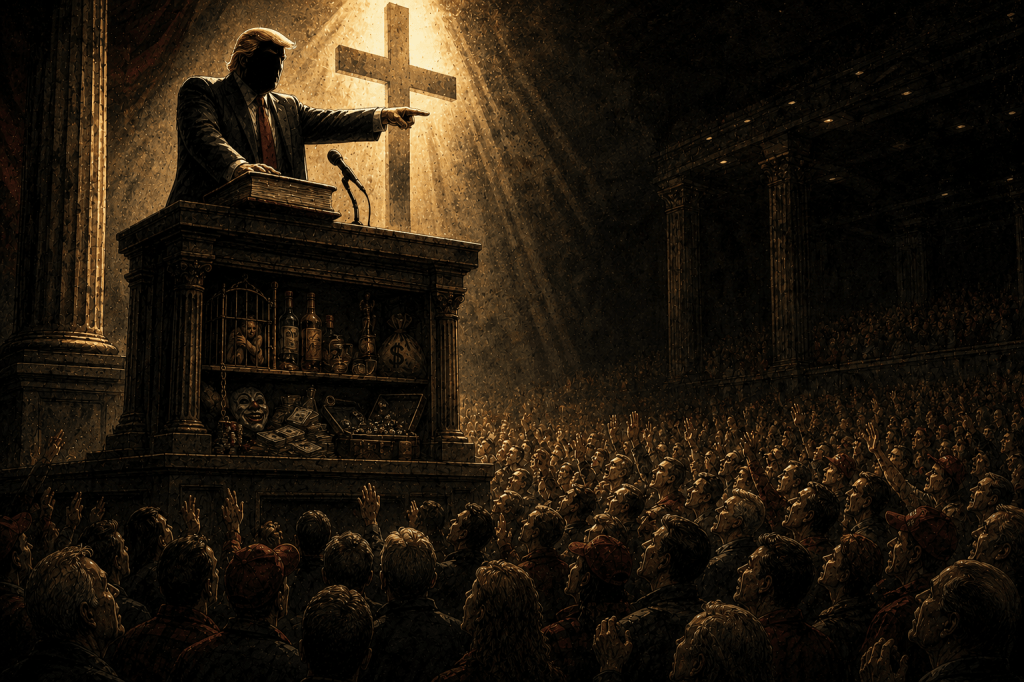
Part 2 of Do Unto Others, a 5-part series. Read the complete series →
In the New York Times interview published January 8, 2026, Trump was asked whether anything constrained his power on the global stage. He answered:
“Yeah, there is one thing. My own morality. My own mind. It’s the only thing that can stop me. I don’t need international law.”
A few days later, in a CBS Evening News interview with Tony Dokoupil, he extended this to his power inside the United States. Dokoupil asked if there were any limits domestically. Trump said: “It’s limited by my morality, and I have a very high grade of morality, so therefore it’s limited.” Dokoupil pressed: “Not the Constitution? Not the courts?” Trump allowed that yes, those too — and then added: “we’ll never get to the courts, we’ll never get to the Constitution because I want to see what’s good for our country.”
So: his own morality. Not the Constitution. Not Congress. Not the courts. Not international treaties. Not the document he swore an oath to defend. Just whatever, in any given moment, sits in his head as right.
It seems worth taking him at his word here, and looking at what that morality actually looks like — since he is the one telling us it’s the only check on what he can do.
What he says about it himself
He doesn’t make us guess. On the question of forgiveness, Trump told Jimmy Fallon in 2015: “When people are disloyal to me, I don’t forgive them. I don’t believe in turning the other cheek.” On the question of revenge, he wrote in Think Big in 2007: “Get even with people. If they screw you, screw them back ten times as hard.” On loyalty, he’s said versions of the same thing for thirty years — he expects it, and he’s loyal back to people who are loyal to him. It’s a transaction, both ways.
The cleanest single line, though, came on September 21, 2025, at Charlie Kirk’s memorial in Glendale, Arizona. The crowd had just heard from Kirk’s widow Erika, who said she forgave her husband’s killer and that “the answer to hate is not hate.” When Trump took the stage, he praised Kirk’s missionary spirit, and then said this:
“He did not hate his opponents. He wanted the best for them. That’s where I disagreed with Charlie. I hate my opponent, and I don’t want the best for them. I’m sorry. I am sorry, Erika.”
The next day, White House Press Secretary Karoline Leavitt was asked about it. Her answer was: “The president is authentically himself.”
I don’t want to skate past how unusual that is. The President of the United States stood at the memorial service of his closest political ally, who had been assassinated eleven days earlier, and used his eulogy to tell the man’s widow that he disagreed with her husband’s signature moral principle. The next morning, his own spokeswoman said the quiet part out loud from a White House podium. This is who he is.
The framework he’s claiming to defend
This matters because Trump’s electoral base, particularly the white evangelical Christian portion of it, is built on the claim that he’s a defender of Christian values. 81% of white evangelicals voted for him in 2020, and that share held in 2024. He leans into the framing constantly. At Kirk’s memorial he called Kirk a warrior for traditional values and a defender of Christian principles.
I’m not a regular churchgoer, but I know the framework as well as any American who grew up in this culture does. The text being defended here is the Sermon on the Mount, which is the closest thing the New Testament has to a manifesto. A handful of the actual lines:
“Blessed are the meek, for they shall inherit the earth.”
“Blessed are the merciful, for they shall receive mercy.”
“Blessed are the peacemakers, for they shall be called children of God.”
“Love your enemies and pray for those who persecute you.”
“Forgive seventy times seven.”
“Judge not, lest ye be judged.”
“He who is without sin, cast the first stone.”
Compare that list of seven against what Trump has actually said and done in the past year, and the contradiction is total. He has said he hates his opponents and doesn’t want the best for them. He has said he doesn’t forgive and doesn’t turn the other cheek. He has said his framework is to hit back ten times as hard. He responded to Rob Reiner’s murder by mocking the dead man’s “Trump Derangement Syndrome” by name, with his wife’s name attached, the day after. He responded to Melissa Hortman’s murder by sharing a conspiracy blaming her governor for her killing, and then refusing to take it down when her children begged.
It isn’t a partial match. It isn’t a 70% match with some rough edges. It is the inverse.
What his supporters say about the trade
What I find more interesting than the contradiction itself is that his evangelical supporters have never tried to hide it. When asked, they answer the question directly.
Robert Jeffress, pastor of First Baptist Dallas, in 2016: “I don’t want some meek and mild leader or somebody who’s going to turn the other cheek. I’ve said I want the meanest, toughest SOB I can find to protect this nation.”
Jerry Falwell Jr., in 2016: “We’re not electing a Sunday school teacher here. We are trying to elect someone to run the country.”
Franklin Graham, across many appearances: Trump appointed the Supreme Court justices who overturned Roe v. Wade. That was the deal. The judges were the point.
That is a transaction, and it’s an honest one. They get the meanest, toughest SOB and the judges. He gets the votes. Neither side has to pretend the Beatitudes are part of the arrangement. The deal is what the deal is. I am not arguing here that they shouldn’t have made it — that’s between them and their God. What I want to point out is how clean a transaction it is, and what it implies about what the values actually are.
If the values are real, then violations of them are something the church has to push back on, including from a President they otherwise support. If the values are negotiable in exchange for the political outcomes you want, then they are not really values. They’re a brand.
Why this goes past the religious question
I’m not dwelling on the evangelical piece to score points off Christians. I am not running a gotcha on anybody’s faith. I’m pointing it out because Trump has stated, in his own words, that the only check on his power is his own internal moral compass. He has not been coy about this. He said it to the New York Times and then said it again to CBS a week later, with the helpful addition that he has a “very high grade of morality” so the rest of us shouldn’t worry. The Constitution and the courts, he allowed, technically exist — but in practice “we’ll never get to” them.
So the question on the table is: when this man says he is limited by his own morality, what is he limited to?
The receipts from Part 1 answer that question. Empathy delivered or withheld depending on whose team the dead person was on. Revenge framed as the operating principle. Forgiveness ruled out. Loyalty defined as personal allegiance to him, not to the country or to any law or to any creed. Opposition treated as enemy combatants, not fellow citizens. And the right to define the meaning of words — patriot, terrorist, freedom, insurrection — held entirely in his own head, applied however helps him in the moment.
That is the morality. He said it would limit him. By the standard he set, it is not limiting much.
Part 3 takes up the question I keep hearing, including from people whose company I keep at the Little League field: but Democrats do this too. Yes, they do. Not the same way, not at the same volume, and not with the same structural impact. But yes. That’s next.


Leave a Reply