
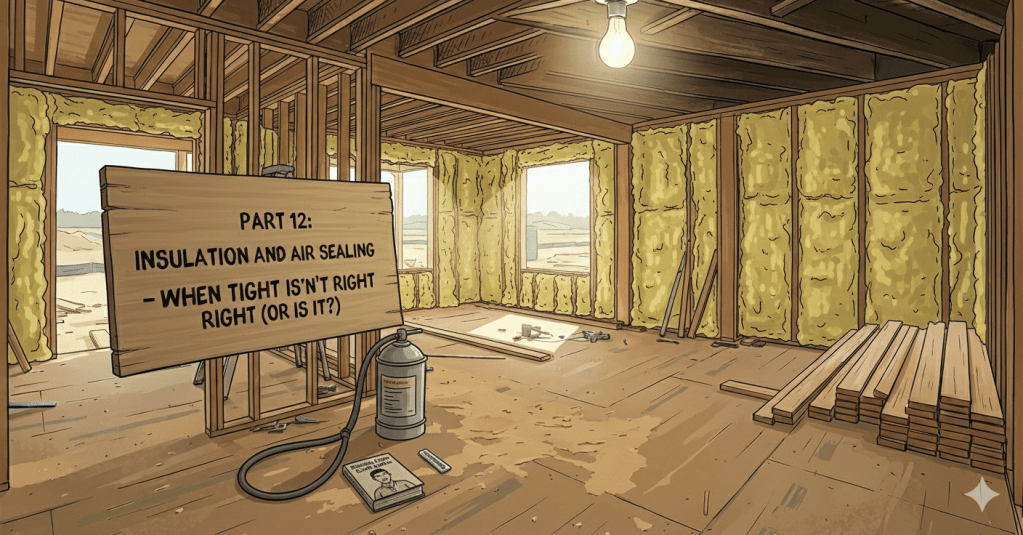
When we decided to build our Connor Homes kit house, we had visions of a super-efficient, modern home wrapped in the latest insulation technology. We’d read all about spray foam insulation, tight building envelopes, and energy efficiency. We were going to do this right.
Spoiler alert: We sort of did. Maybe. I’m still not entirely sure.
The Plan: Go Modern, Go Tight
Coming from NYC apartments where you could feel the draft through the windows in winter and hear every conversation from the apartment next door, we wanted our new house to be different. We wanted it quiet, comfortable, and efficient. So we decided to go with spray foam insulation and create a tight building envelope.
The building code required pretty high R-values for our house because we had so many windows. And by “so many,” I mean depending on how you count (do you count the triple window in the kitchen as one window or three?), we had 27-29 windows, plus French glass doors and two entry doors. Our house was basically a glass box that needed to compensate with serious insulation everywhere else.
We decided to use soy-based foam, which sounds very environmentally friendly until you realize it’s still polyurethane foam with a tiny bit of soy oil in it. The marketing materials made a big deal about it being “plant-based” and “renewable.” They also claimed rodents don’t like it, which seemed important given that we were building in a field surrounded by woods. Whether the soy actually repels rodents or attracts them is one of those things I never quite got a straight answer on.
The Hot Attic vs. Cold Attic Dilemma
Here’s where things got confusing fast. We needed to achieve R-38 in the attic, and we had to decide whether to do a “hot attic” or “cold attic” — industry terms that nobody bothered to explain to us in plain English until we were already knee-deep in the decision.
A cold attic (the traditional approach) means you insulate the attic floor, vent the attic space, and basically treat the attic as outside your building envelope. A hot attic (the newer approach) means you spray foam directly to the underside of the roof deck, seal everything up, and bring the attic inside your conditioned space.
The internet was full of conflicting information. Some sources said you needed closed-cell foam for hot attics because it works as a vapor barrier. Others said open-cell was fine if you vented between the rafters. Still others said venting wasn’t necessary at all with spray foam. It was like trying to solve a puzzle where everyone insisted they had the answer but nobody’s answer matched.
Our contractor added to the confusion. He told us he didn’t recommend closed-cell foam on the rafters because the rafters would shrink over time and the rigid closed-cell foam wouldn’t move with them, leaving gaps. Instead, he suggested doing a layer of closed-cell first, then filling the rest with open-cell.
Looking back at my notes now, this doesn’t make much sense to me. If the rafters are going to shrink and create gaps with closed-cell foam, why would putting a layer of it down first help? Wouldn’t you still get gaps at that layer? And if moisture could penetrate those gaps, wouldn’t that defeat the whole vapor barrier purpose of the closed-cell layer?
But what did we know? We were two people from Manhattan trying to build a house while working in the city all week.
The Hybrid Solution (We Think)
We ended up going with what the contractor called a “heavier” open-cell foam that would work as a vapor barrier. I’m assuming we did the right thing, but fifteen years later, I’m still not 100% confident.
Here’s what actually got installed (thanks to the invoice I saved):
Attic Rafters: Agribalance Open Cell Foam, R-38 at 8.5 inches thick, from peak to plate Attic Gable Walls: Same Agribalance open-cell foam
Exterior Walls (1st and 2nd floors): Sealection 500 Open Cell Foam, R-21 at 5.5 inches
Band Joists: Sealection 500 Open Cell Foam, R-21 at 5.5 inches
Basement: We used traditional Ecco batt insulation by Knauf (R-19), which was formaldehyde-free. In the basement, we could use batts because we weren’t trying to create an air seal.
Floor/Ceiling Insulation: R-13 between floors
The crew from Sealrite Spray Foam did good work. They carefully protected all the windows and mechanical systems with plastic sheeting, foamed around all the window and door jambs with low-expanding window foam, caulked all the plates and jack studs, and installed cardboard baffles at the eaves.
One nice detail: they left the window covering up after they finished. This meant that later, when we painted the walls with a sprayer, we didn’t have to mask off the windows again. Small win.
The Radiant Floor Surprise
Here’s something we didn’t anticipate: because we were doing radiant floor heating, we had to insulate between the floors and ceilings to make the system work efficiently.
This added unexpected cost, but worse, it prevented the heat from spreading naturally through the house the way we’d wanted. We’d imagined the radiant heat would warm the basement and attic a bit, making the whole house more comfortable. Instead, the insulation trapped the heat on each floor, which was more efficient but less… generous? Is that the right word? The basement stayed cold, the attic stayed cold, and each floor was its own thermal island.
Would they have recommended floor/ceiling insulation anyway if we’d gone with European radiators instead? Probably. But that wasn’t what we wanted to do, and it definitely wasn’t what we’d budgeted for.
What We Wish We’d Had (But Didn’t)
Looking back, I would have preferred to use cellulose insulation. It’s less expensive, it’s actually made from recycled materials (not just “plant-based” with quotation marks), and it doesn’t have the flammability concerns I still worry about with foam.
But here’s the problem: you can’t spray cellulose on rafters. You can only blow it onto attic floors. Since we were doing a hot attic with the insulation at the roof deck, we had no choice but to go with spray foam.
I also wish the ZIP System had been available back in 2009. The Connor Homes kit came with traditional house wrap, which was fine for the time, and combined with the spray foam it probably worked well. But the ZIP System — which is basically structural sheathing with a built-in weather barrier — would have been better. One less thing to worry about.
The real weak points of our house, though, are the windows and doors. The spray foam did its job. The walls are tight. But we cheaped out on Pella windows (see Part 11 for that disaster) and went with Simpson wooden doors for the “old house vibe.” The result is that all our air leakage happens at the windows and doors.
Here’s proof: when there’s snow piled up against the windowsills, blocking the air infiltration, our house is extra toasty and there’s no moisture condensation on the windows at all. The rest of the time? Moisture city.
Damn you, Pella.
The Great Winter Moisture Disaster
Once we had the spray foam installed, the house became incredibly tight. Which is exactly what we wanted, right?
Well, yes. But also no.
The problem was timing. The spray foam went in during winter — specifically, late winter 2009/early 2010 — and the house was immediately full of moisture. This wasn’t a leak. This was all the moisture from the spray foam curing, from the wood framing drying out, from everything in a new house releasing water vapor into the air.
In a normal house with air leaks, this moisture would have escaped naturally. In our super-tight spray-foamed house, it had nowhere to go.
We couldn’t just open the windows to vent it out because it was the middle of a very cold winter and the pipes would freeze. So the moisture just… stayed. And built up. And made everything damp.
This, by the way, is why you need mechanical ventilation in a tight house. Which we planned for with an HRV (Heat Recovery Ventilator). But remember from Part 10? Our contractor undersized the HRV, so even running it 24/7 wasn’t enough to manage the moisture.
The lesson here: the best time to build is so your framing is done by late spring. That gives the wood a few months to dry out over the summer before you insulate and seal everything up. Then you can keep the windows open as you drywall and paint to help get rid of all that additional moisture before you close up the envelope for good.
We did not do this. We did the opposite of this.
Air Sealing: Did We Actually Succeed?
The spray foam company did their job well. The foam is in place, it’s not sagging or deteriorating, and it’s definitely created an air barrier in the walls and roof.
The only places I’ve noticed air leaking are — surprise! — the windows and doors. When winter storms pile snow against our windowsills, blocking the gaps, the house is noticeably warmer and drier inside. When the snow melts, the cold drafts come back and the windows start condensing again.
So in terms of the building envelope, the spray foam worked exactly as intended. We created a tight, well-insulated shell. The problem is that we then punched 27-29 holes in it and filled them with substandard Pella windows.
You can have the best walls in the world, but if your windows leak like sieves, you’re still going to lose energy and have comfort problems.
Environmental and Safety Concerns (That I Still Have)
I said earlier that we chose soy-based foam because it sounded environmentally friendly. Fifteen years later, I have serious questions about whether spray foam — any spray foam, soy-based or not — is actually good for the environment.
It’s made from petrochemicals. It off-gasses during installation (which is why the installers wear full protective gear and you can’t be in the house during application). And while it’s recyclable in theory, in practice it’s never getting recycled because it’s permanently adhered to your house.
The “plant-based” marketing always felt like greenwashing to me, and time hasn’t made me feel any better about it.
I also worry about flammability. Spray foam is combustible — it will burn if exposed to direct flame. The installers and manufacturers will tell you it has flame retardants and meets building code fire ratings, which is true. It’s covered by drywall, which acts as a 15-minute thermal barrier. And in a real fire, lots of things in your house will burn (including wood framing, furniture, carpets, basically everything).
But still. It’s foam. Made from petrochemicals. In my walls. That feels different than wood studs.
Is this a rational concern? Probably not. Would I make a different choice today? I honestly don’t know.
Would We Do It Again?
If I were building today, I think I’d do something very similar on the insulation, but with a few key changes:
What We’d Do the Same: – Spray foam for air sealing (it really does work) – Hot attic design (brings HVAC and ductwork inside the envelope, more efficient) – Hiring professionals to install it (not a DIY project)
What We’d Do Differently: – Time the build better — frame in spring, dry over summer, insulate in fall – Size the HRV correctly from day one (get a real HVAC engineer, not just the contractor’s gut feeling) – Invest in better windows — spend the spray foam savings on triple-pane windows that actually work – Maybe consider closed-cell on the roof deck, despite the cost, just for peace of mind about moisture – Ask more questions about the vapor barrier strategy instead of just trusting the contractor
The spray foam itself has been fine. No issues with it after fifteen years. It’s doing its job. The problems we’ve had with moisture and efficiency have been almost entirely because of the undersized HRV and the terrible Pella windows.
So did we do insulation and air sealing right?
Yes and no. The execution was good. The materials were appropriate. The result is a tight, well-insulated house that’s comfortable and relatively efficient.
But we got unlucky with timing (winter installation), we got bad advice on mechanical ventilation sizing, and we made poor window choices that undermined the whole point of air sealing in the first place.
It’s like buying a really nice safe and then leaving the door open.
Grade: B
The spray foam work itself deserves an A. It’s well-installed, it’s performed flawlessly for fifteen years, and it created the tight building envelope we wanted. But the overall insulation and air sealing strategy — considering the window choices, the HRV undersizing, and the winter timing that caused moisture problems — gets knocked down to a B.
We succeeded at making a tight house. We just didn’t succeed at making a tight house with good windows and adequate ventilation to actually manage that tightness properly.
Still, it could have been worse. At least the foam is still there, still working, fifteen years later. Unlike certain windows I could mention.
Next up: Part 13 – Drywall (The Most Boring Post, But There Are Lessons)
 Even that's Odd
Leave a comment