
March-April 2025
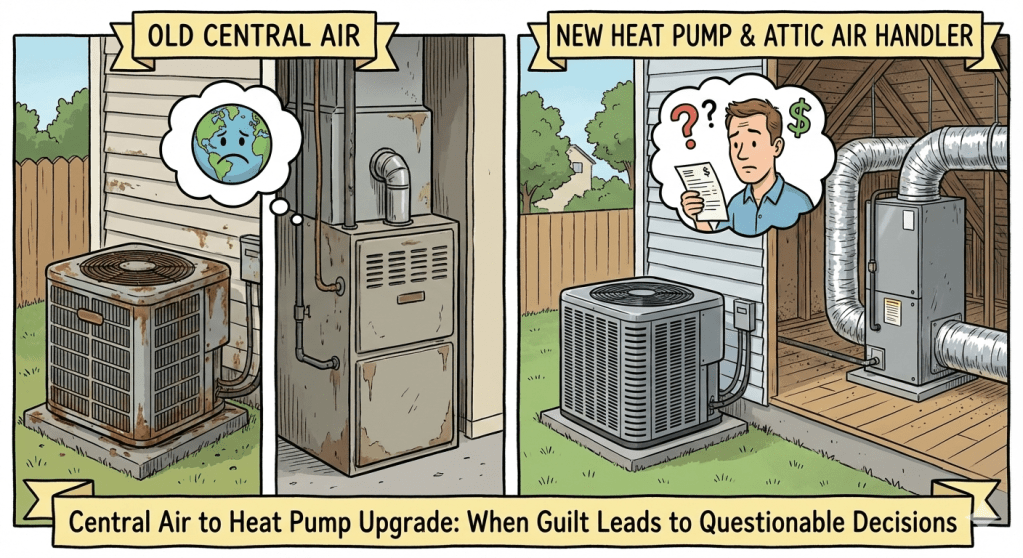
If you read my previous post about the emergency boiler replacement, you know that Company PPH didn’t exactly shine during that crisis, while Company NCS stepped up and saved Thanksgiving. You also know that I felt guilty about the miscommunication and decided to give PPH the heat pump job to make it right.
This may have been a mistake.
The Leak That Started It All
At the start of the 2024 cooling season (June), our house was taking forever to cool down. I called PPH—my service company at the time—to take a look. They diagnosed low coolant and a likely leak.
They offered to inject dye to find the leak, but couldn’t guarantee it would be the only leak. That was pricey, and I’d been down that road before. Since the system was aging anyway and there were federal tax credits for heat pumps, I decided on a short-term fix: add more coolant (also expensive) and plan to replace the whole system after cooling season.
We’d always planned to get solar panels and there were big incentives at the time, so we decided to do it all together. Well, I decided, and then I had to convince Jennifer it was a good idea.
I also liked the idea of having backup heat if our boiler went out. The heat pump would at least give us something even in cold weather. At least, that’s my assumption—there are all different kinds of heat pumps and I got a little lost in the research. Knock on wood, we haven’t had to test it in extreme cold yet.
Timing and Estimates
I decided to wait until February to reach out to PPH about scheduling. They were a partner with our utility company for heat pump installations and I already had a service contract with them. I wanted to wait until the end of heating season and before AC season started, when they wouldn’t be super busy and could focus on the install.
I’d gotten estimates from both PPH and NCS (the guy who did our emergency boiler replacement). I was actually considering using NCS for the heat pump since he’d been so great with the boiler, but then the miscommunication happened and I felt bad. So I decided to give PPH the business.
This decision to go with PPH may have been a mistake, because the owner handled this project much differently than he’d handled previous jobs. You can read about the boiler experience in that post for context.
Payment Negotiations
PPH and their project manager wanted 50% up front. I’d paid someone 50% up front before on a metal roof job for my parents’ house (after I’d purchased the materials myself on a building supply company’s recommendation), and that was an incredible mistake. The guy took forever to show up and did the worst job possible. I had to pay my friend to fix his mistakes.
I told PPH I could pay for materials, but wouldn’t pay for labor until the work was completed. We negotiated: I’d give them a $100 deposit (which would basically cover materials since they had a supplier relationship and could return the unit if needed), then pay the bulk of it when the system was installed and mostly working, and the final payment when everything was finished.
They weren’t happy about it, but they reluctantly agreed.
Installation Day: March 31, 2025
Three guys showed up and they were great. They didn’t do too much damage and had the system almost working by the end of the day.
The Cooling Line Complication
With these new heat pump installs—especially split units—they typically run the cooling lines up the side of the house and cap it with a plexiglass box to hide everything. Jennifer and I didn’t want that aesthetic disaster, so we were going to have to do a very complicated interior run if they couldn’t reuse our existing cooling lines.
Fortunately, they said they could reuse the existing lines. That may have saved a big headache, but we’ll see if a leak develops down the road.
The Wire Run Disaster
The bigger issue was that our old unit was AC-only, and the new heat pump needed a new wire run. The first technician thought the run needed to go to the attic, so he cut holes in the walls trying to figure it out. They also drilled holes in the attic floor without measuring first and were way off—ended up close to a shower pipe. I think they missed it, but maybe they just nicked it and the leak will develop later. Why they didn’t measure before drilling is beyond me. Maybe they’re on the “ask for forgiveness” model? Not the approach you want for this type of work.
The Thermostat Battle: Nest vs. Ecobee
There was a whole debate about which thermostat to use. I had an earlier version of the Nest—before Google took it over—and I absolutely loved it. The app worked perfectly (before Google broke it) and the tactile feel of the unit itself was design and engineering perfection.
PPH recommended the Ecobee because they’d had trouble with newer Google Nests, but I insisted on trying the Nest. This was before I realized Google had completely ruined it.
After installation, they couldn’t get the unit to function properly with the Nest, so they switched to the Ecobee. They got it mostly working on installation day, except the aux heat with the hydronic air handler wouldn’t work. It was getting late and we were out of heating and cooling season, so the heat pump itself would be fine. I told them to go home and come back to figure it out later.
Maybe that was a mistake?
At the end of installation day, I paid them the $9,400 as agreed.
The Month-Long Wait
After the installation, PPH kept putting me off about coming back to finish the wire run. I kept getting told they needed to have a “tech meeting” to get me on the schedule.
This sounded ridiculous. They’re a service company—scheduling repairs is the core of their business. And they needed a meeting to figure out how to schedule me? That was the first time I’d ever been told by a contractor they needed a meeting before sending someone.
After calling a few times and waiting, I finally started pushing harder when we got close to a month later and they still hadn’t come back. I called, got a little more forceful, and another technician came out.
Getting It Finished: April 30, 2025
The second technician figured out that everything actually connected at the boiler in the basement—no attic run needed. He just had to cut a hole by the thermostat and, of course, in the basement ceiling that we’d just finished a few months earlier. Yay, I get to patch holes already.
At least this guy cut the hole behind the baseboard so I wouldn’t have to patch it. But I still had three significant holes to patch from where the first guy had been searching for an attic route he didn’t actually need.
This technician got the wires pulled and everything working in about three hours. The Nest still wouldn’t work, so I told him to just stick with the Ecobee.
While I was waiting for them to come back, I did get my old Nest to work with the setup (without the hydronic connection), but as I researched more, I found out Google was going to stop supporting my thermostat and the Nest app, switching everything to Google Home. Which sucks. Google ruins everything.
I went back to the Ecobee. I’ll figure it out. Google (or was that Amazon?) already ruined my Blink cameras with problematic WiFi, so let’s try something else. Especially since they took away the tactile interface that made the original Nest so good.
I paid the final $500 when the job was complete.
The Complex Heating Setup
Our situation is somewhat complex. We have radiant floor heat as our primary heating system, plus a hydronic air handler connected to the boiler for supplemental heat. I wanted to be able to use the heat pump in milder weather so the boiler wouldn’t have to fire for the hydronic air handler. But when it was mild enough that we had the radiant floor turned off or really low, we still needed a setting where the heat pump wouldn’t try to heat and the hydronic system could work on its own.
The technician set it up so “Aux” was the hydronic system and “Heat” was the heat pump. “AC” was obviously AC. This works fine, though I’m not sure it’s actually saving us any money over the old unit.
The Equipment: Bosch 5-Ton M18 Heat Pump Inverter
They installed a Bosch 5-Ton M18 Heat Pump Inverter, which works differently than our old central AC for cooling.
The old AC had one compressor speed—it was either on at full blast or off. The Bosch senses cooling load and has two different compressor speeds. When it’s not as hot outside, it runs at the lower speed, which makes the air coming out not as cold, which condenses moisture slower, which makes the house feel more humid.
I had to adjust the Ecobee to cool based on humidity level instead of just temperature. Now what seems to happen is our house feels a bit hotter, and because of how the unit works, both the air handler and outdoor unit run longer. It seems to me that any savings from the more efficient compressor is just being offset by it running longer and more often. I don’t know for sure, but that’s what it feels like.
They also replaced our air handler with a new version of the same unit so everything would fit and match—even though the last unit’s coil failed after only five years. They said they’re all pretty much built the same way, so it really comes down to luck of the draw.
The Final Tally
Total cost: $14,650
Payment breakdown:
• $100 deposit
• $9,400 on installation day (March 31)
• $500 when finished (April 30)
• $4,650 financed at 0% for 18 months through PPH
We’re hoping to get a $2,000 tax credit back.
What Actually Improved
I don’t notice anything significantly better with the new unit, honestly. The outdoor unit is incredibly quiet, especially on the slower setting, and the vibration noise in the wall went away. Those are nice improvements.
Being a heat pump, they also made it much taller so it would be above snow level. That’s theoretically good.
But there’s a new rumble in the air handler system that makes me think it’s thundering outside. It didn’t make that noise when they were here during installation, so we’re just living with distant thunder sounds when the unit runs.
Reflections
Would I have been better off giving this job to NCS, the guy who stepped up during our boiler emergency? Probably. He understood customer service. He understood urgency. He didn’t need “tech meetings” to schedule a follow-up visit.
But guilt is a powerful motivator, and I made my choice. The system works. It’s installed. We have cooling and backup heat. The 0% financing and tax credit paperwork were helpful.
But next time? I’m listening to my gut instead of my guilt.
Lessons Learned
1. When someone shows you who they are during a crisis, believe them the first time.
2. Measure before drilling holes in the attic. Just… measure.
3. Google ruins everything they touch. Miss you, original Nest.
4. Variable-speed heat pumps are more efficient in theory, but if they run twice as long, where’s the actual savings?
5. Sometimes the right decision isn’t the one that makes you feel less guilty—it’s the one that makes practical sense based on past performance.
Up next in the This New Old House series: Spray foam insulation adventures, or why every contractor experience teaches you something (mostly patience).
 Even that's Odd
Leave a comment