
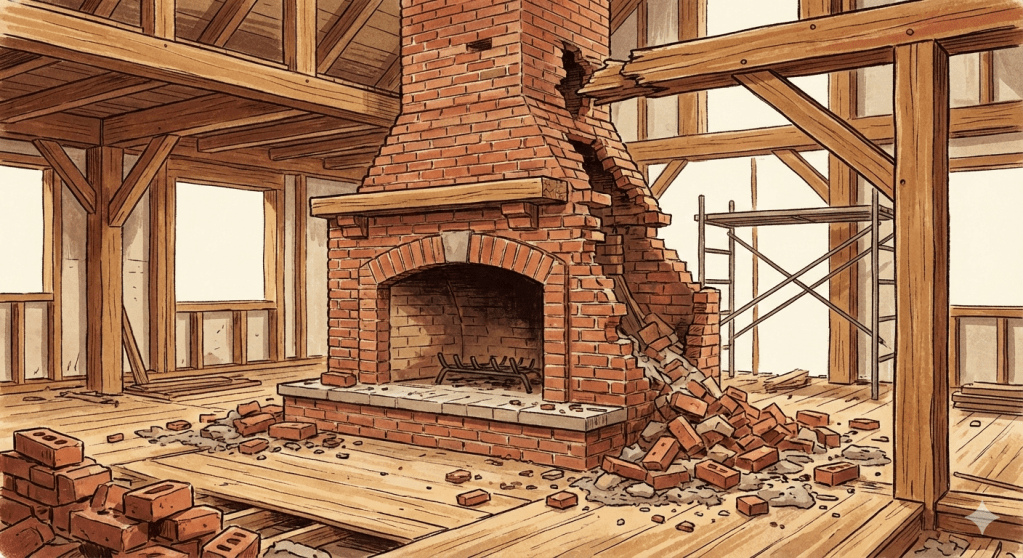
Some mistakes cost money. Some cost time. The chimney cost both, repeatedly, for years.
If you’ve been following along, you know that this build had its share of “we didn’t know what we didn’t know” moments. The windows. The spray foam learning curve. The drywall saga. But the chimney — the chimney was different. Those other things hurt once. The chimney kept hurting. It was less of a mistake and more of an ongoing punishment that stretched across years and required me to become, against my will, an amateur chimney expert.
Let me back up to the beginning.
The Vision
When you’re building a home designed to look like it belongs to an earlier century, you think about chimneys. Older homes — your 1700s and early 1800s farmhouses — were built around the fireplace. It was the heat source, the cooking source, the social center. And crucially, those chimneys were placed in the middle of the house so the masonry mass would absorb heat and radiate it outward, warming multiple floors. It was elegant, pre-industrial engineering.
We wanted that. We wanted the chimney centered in the house, rising up through the middle of the floor plan so you’d see it framing the hallway on the second floor — a genuine architectural feature, not a decorative afterthought stuck on an exterior wall. The architect worked it into the Connor Homes plans, the foundation included a proper chimney base poured with everything else, and we were off to the races.
Now, the aesthetic part. Jennifer had been doing high-end interior architecture in the city for years, and one thing she’d absorbed from those Brooklyn brownstone and Manhattan renovation projects was an appreciation for tight, precise masonry work — narrow mortar joints, clean lines, craftsmanship you could actually see and appreciate up close. We wanted traditional brick to match the period of the home. We had a photo of exactly what we were going for. Tight joints. Clean face. Something that would look at home in 1850.
That was the vision. Now let me tell you what we got instead.
The Mason (Who Was Actually a Concrete Guy)
Finding a mason turned out to be harder than expected. I made calls, asked around, got some estimates. There weren’t a lot of options, and the one legitimate chimney and fireplace company I found quoted us a number that our budget absolutely laughed at. Like, the budget heard the number and walked out of the room.
Our concrete contractor — the guy who’d poured our foundation, who we knew and trusted — mentioned almost offhandedly that he used to do some masonry. He’d built the fireplace in his own house. We could come look at it if we wanted.
We went. His fireplace was fieldstone, not brick, so we couldn’t directly evaluate the kind of work we were hoping for, but it was neat. Clearly cared about. He seemed to know what he was doing. And he was cheaper than the real mason. So we said yes.
I want to pause here and acknowledge that “he built his own fireplace once and it looks fine” is not the same as “he is a skilled mason who builds chimneys and fireplaces for a living.” I understand that now. I did not fully understand it then.
The Brick Mistake (The First of Many)
We went to the brick supplier together to choose material. We found something we loved — a reddish-orange brick with a slightly handmade, rustic look. Variation in the face, some texture, the kind of thing that reads as authentic and old. We showed it to the concrete guy. He said it was fine. We ordered a pallet.
Here is something nobody told us: brick is porous. Obviously brick is porous — it’s a fired clay product, and you see it on the exterior of buildings getting rained on constantly, so in retrospect it seems like basic information. But nobody said “by the way, if you use this on an interior chimney, water will soak through the brick and migrate inward unless you seal it.” Nobody said that. Not the brick supplier, not the concrete guy, not the architect. We just picked what looked good.
The rustic, varied brick was also, it turned out, inconsistent in its dimensions. Different bricks, slightly different sizes. This became the concrete guy’s justification for the mortar joints.
The Mortar Joint Situation
We came back one weekend and he’d laid out the first several courses. The mortar joints were thick. Not what we’d discussed at all. We showed him the photo again — the tight, precise Brooklyn brownstone work Jennifer had been referencing for months.
“Well,” he said, “these bricks are all different sizes. I have to compensate.”
Would a truly skilled mason have found a way to make it work? Probably. Did we have enough leverage to make him tear it out and start over with better brick? No — we were already committed. The pallets were there, he’d started, and we were not in a position to blow up that relationship or eat the cost of starting over. So we watched the chimney rise with thick mortar joints and the slightly sloppy face that comes from inconsistent brick, knowing it was going to be in the center of our house forever.
He also built the firebox in the traditional way — smoke shelf, metal damper, the whole standard setup — despite my research and our conversations about building for a tight house. I’d done my homework on this. Spray-foamed, well-sealed modern homes need modified fireplace design: no smoke shelf, shallower firebox, smaller opening calculated by formula rather than eyeballed, and ideally a top-mounted damper with a cable pull rather than a throat damper. I’d explained all of this. He’d said “yeah yeah yeah.”
What he built was none of that.
He said I could just take the damper out if I wanted. He said his house was tight too and it was fine. He said the fresh air vent he added (which was probably undersized) would handle it.
I let it go. I shouldn’t have.
The Crown
When he finished and I was up on the roof checking things out — and I want to remind you that our roof is a 12/10 pitch, which is basically a cliff with shingles — I looked at the chimney crown and felt uneasy. A proper chimney crown has an overhang so water sheds away from the brick and the mortar joint between crown and chimney. His did not have a meaningful overhang.
I mentioned this. He said he’d been doing this for years, and I should just go up every couple years and check for cracks and fill them.
“Just go up on the roof every couple years” on a 12/10 pitch is not a maintenance plan. That’s a liability. But he said it with such confidence that I let that go too. This was a mistake.
The Smoke. Oh, The Smoke.
We’re in the house. We have a fire. It’s wonderful. I go upstairs.
The upstairs hallway is full of smoke.
Not like a little haze. Smoke. I’m tracking it and I can see it coming out around the chimney in the second floor ceiling and up into the attic space. I make a video. I call the concrete guy. He comes, watches the video, shrugs, pokes around the smoke chamber, patches something. It doesn’t fix it.
So I find a chimney lining company that does a ceramic spray application — they come in, coat the interior of the flue with a ceramic sealant, and you’re supposedly done. It wasn’t cheap. They did their inspection first, and that inspection revealed what I’d suspected: the mortar joints inside the flue were not solid. There were gaps. There were holes. Of course there were.
They did the ceramic spray. I waited for the cure time. I had a fire. Still smoking.
I called another chimney company for an independent inspection, explaining I just needed eyes on the situation without committing to anything. He came. He looked. The ceramic spray was a joke — a little here, a little there, nothing like a solid coating. I disputed the charge with my credit card company, sent the photos from the independent inspector, and eventually got my money back. That part worked out. The chimney still didn’t.
The Liner
By this point Jennifer, who was still doing projects in the city, had connected with a high-end carpenter who had a weekend place across the river in Rhinebeck. He didn’t do chimneys, but his uncle was a mason, and through that connection we found someone willing to install a stainless steel liner. Liner goes in, smoke stays in the flue, problem solved. That’s the theory.
He quoted us a price, asked for 50% upfront for materials, installed the liner. Before paying the balance, I said I wanted to have a fire first.
Still smoking.
I climbed up into the smoke chamber and looked at how he’d terminated the liner at the bottom. It was — and I mean this literally — some of the sloppiest work I’d ever seen. The liner was just kind of… left there. Propped. Not sealed. Not transitioned properly into the smoke chamber. Just stuck in there like he was hoping nobody would look.
I didn’t pay him the balance.
The Part Where I Became a Chimney Expert Against My Will
At this point I had spent significant money on people who were supposed to fix this problem and had not fixed this problem, and I started doing the kind of deep research that only genuine desperation produces.
I found a product — a high-temperature, castable refractory material that you can apply to the smoke chamber to create a smooth, aerodynamic transition from the firebox up into the liner. There’s also a stainless steel form that gives you a clean edge where it meets the liner. This is actually a real thing that chimney restorers use. It’s called smoke chamber parging and it matters enormously for draft.
I bought the materials. I got into the smoke chamber — which is, in case you’ve never been inside one, a claustrophobic, soot-covered, extremely unpleasant space — and I chiseled out as much of what the liner guy had done as I could get. I also discovered that the concrete guy had used the old throat damper as structural support for the smoke chamber, which meant I couldn’t remove it, which meant I was working around it. I bought an electric chisel to get through some of what needed to come out. I parged the smoke chamber with the refractory material. I installed a proper stainless steel cap and termination at the top and bottom of the liner.
I also found a metal plate insert to reduce the fireplace opening size, since I’d never gotten the aerodynamically-correct smaller opening we should have had from the start.
My friend helped me at the top — going up on that terrifying roof to deal with the cap and damper situation. Between the two of us, we got a proper termination with a drip edge that would actually shed water.
The Water
Right. Because there was also water.
While all of this was happening, I noticed water in the attic coming from around the chimney. The flashing, as it turned out, had been done in a way that doesn’t hold up long-term — mortar-cut into the brick rather than the proper step flashing method. We went up on the roof with a hose and confirmed it: water was coming through both the flashing and through the brick itself.
Because the brick is porous. Because nobody told us that.
The independent chimney company that had done the honest inspection — the one who’d revealed the ceramic spray fraud — agreed to come back and address the exterior. He repointed the mortar, redid the flashing the right way, rebuilt the crown with a proper drip edge, and applied a waterproofing sealer to the brick. He used some of his own brick to blend in where repairs were needed. It looked better than the original when he was done, which says something.
He also gave me credit for the smoke chamber work I’d done. “You did a nice job in there,” he said. Fifteen-years-later me considers this one of the more satisfying compliments I’ve received.
The Remaining Smoke (A Humbler Problem)
After all of this, we still occasionally get some smoke in the house when we use the fireplace. Not the billowing clouds of before — this is a whisper of it, sneaking out around the mantle surround and drifting up.
The diagnosis: tight house, undersized fresh air vent, and physics. When the house is sealed up well and the fireplace is pulling air, the makeup air has to come from somewhere, and sometimes it comes back down the flue carrying a little smoke with it. You also absolutely cannot run the kitchen exhaust fan while the fireplace is going. Forget once — just once — and you’ll spend the next hour opening windows and explaining to guests that this is a “feature.”
The fresh air vent should be bigger. That’s a project for another day.
What We Learned (The Hard Way)
Here’s the math that still stings: the legitimate chimney and fireplace company’s quote — the one that made our budget laugh and walk out of the room — was probably cheaper than what we actually spent. Add up the ceramic spray (fraudulent, money back after a fight), the liner guy (didn’t pay the balance, but lost the deposit on materials), the refractory materials I bought for the smoke chamber parging, the caps, the tools, the repointing and flashing and waterproofing work at the end, plus years of the concrete guy’s time coming back to look at his own mess… we almost certainly exceeded that original estimate. And we’d have a properly built chimney. Big “had” on the “if he did it correctly” — given the craftsmanship we encountered across every contractor on this project, there’s no guarantee the expensive guy was actually good either. But at least we’d have had a real mason with a real reputation to hold accountable.
The brick is porous — seal it before installation or apply a penetrating waterproofer after. This is apparently common knowledge in the chimney world and no one told us.
Brick variation matters enormously. The inconsistent handmade look we loved made close mortar joints nearly impossible. If you want tight joints, you want consistent, uniform brick. Machine-made doesn’t have to look sterile — it just has to be dimensionally reliable.
I still don’t know with certainty whether a tight house requires a fundamentally different firebox and smoke chamber design. I found research suggesting it does — shallower firebox, no smoke shelf, smaller opening calculated by formula, top-mounted damper — and it seemed logical enough that I tried to have that conversation with the concrete guy, who said “yeah yeah yeah” and built the traditional version anyway. Whether a properly-designed firebox would have prevented our smoke problems, or whether the real culprits were the bad mortar joints and sloppy liner termination, I honestly can’t say. Probably both mattered. Probably the undersized fresh air vent matters too. I suspect the tight-house design principles are real and worth following — but I never got a controlled experiment.
The chimney in the center of the house takes up roughly 2.5 x 4 feet of floor space on every level. It does not, in practice, radiate meaningful heat to the second floor. The masonry does absorb heat in the firebox and release it slowly in the living room — that part works — but the dream of a warm hallway upstairs that glows from the chimney within? Not happening. Walls too thick, mass too far from where you’re standing.
We should have made the house four feet longer. Those four feet — wherever they went, whatever they held — would have been useful. The chimney footprint in the middle of the plan is the reason every room is a little smaller than it should be.
Grade: D+
The fireplace works now. Water doesn’t come in anymore. Those are the positives, and I don’t want to minimize them because getting there required years of effort and money we didn’t have. But the grade reflects the original work, the series of contractors who took money and made things worse, and the fact that I had to become an amateur chimney restorer to solve a problem that a competent mason should have prevented in the first place. The plus is for the fireplace being genuinely beautiful when it’s going — the brick glows, the fire crackles, and for a few minutes you forget everything that it cost to get there.
Next time: Part 17.
 Even that's Odd
Leave a comment