
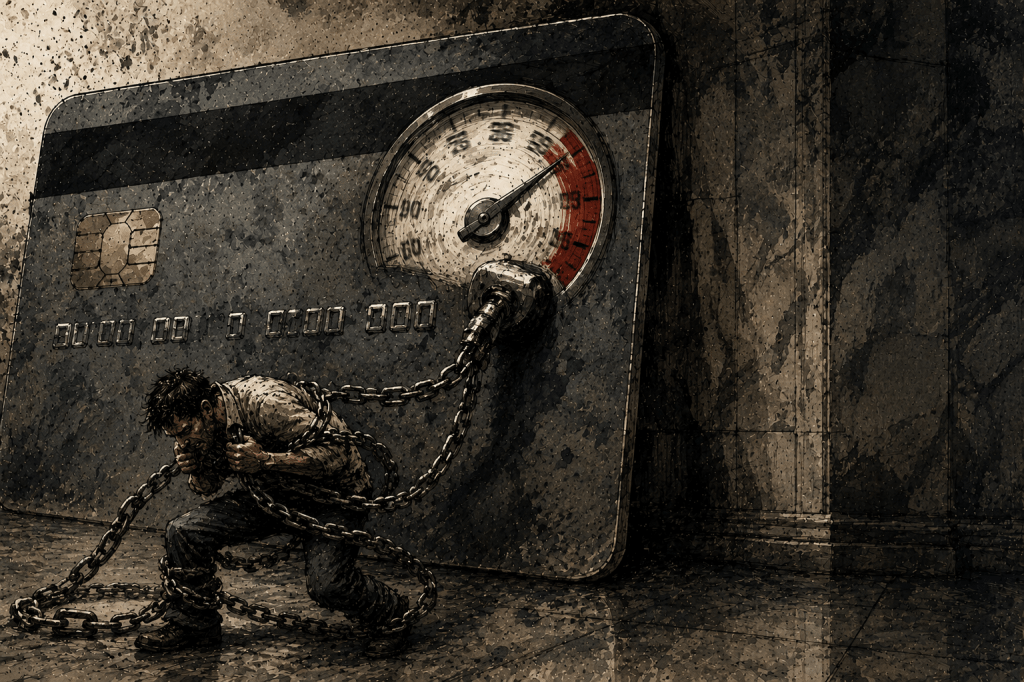
Part 4 of Passing the Buck, a 15-part series on why we make less but pay more.
Part 3 looked at the overdraft side of consumer banking. This one looks at the other side of the same relationship — the credit card. Most of the largest credit card issuers in the United States are also the largest retail banks: JPMorgan Chase, Bank of America, Citi, Capital One, plus American Express and Discover. The customer borrowing on the right side of the ledger is, in many cases, the same customer being charged a fee on the left side.
I want to be careful in this installment, because credit cards are a place where there has been genuine reform in the last fifteen years that the populist version of this story often skips over. Some of the most predatory practices that defined credit card lending in the 1990s and early 2000s were actually outlawed in 2009. The picture is still problematic, but it is problematic in a different way than it used to be, and the difference matters if we want to think clearly about what to do.
The shape of the market
The Federal Reserve Bank of New York’s Household Debt and Credit Report puts total U.S. credit card balances at $1.21 trillion at the end of 2024, up 7.3 percent year over year, and that number has continued to climb through 2025. The average balance for borrowers who carry one runs between roughly $6,400 and $6,700, depending on which credit bureau you cite — Experian put it at $6,730 in their most recent reading; TransUnion has it in the low-$6,000s.
The rates are the part most people would not have predicted. The Federal Reserve’s series on the interest rate paid on accounts that are actually assessed interest — the rate that matters if you carry a balance — hit a record high of 23.37 percent in August 2024. That is the highest the Fed has measured since it began tracking the series in 1994. The CFPB’s most recent Consumer Credit Card Market Report, released in early 2026 covering 2024 data, put the average APR on general-purpose cards at 25.2 percent and on retail or private-label cards at 31.3 percent — both the highest the agency has measured since 2015. Consumers were assessed roughly $160 billion in interest charges in 2024, up from about $105 billion in 2022, a roughly fifty-percent increase in two years.
The share of cardholders who carry a balance month to month sits in the 45 to 50 percent range, depending on the survey. Bankrate’s most recent reading is 47 percent. The Federal Reserve’s 2025 survey put it at 45 percent. About forty percent of people Bankrate surveyed report using credit cards to cover what they describe as basic necessities — groceries, utilities, medical bills — rather than discretionary purchases.
That is the size of the market. About one in two American adults holding a card carries an interest-bearing balance, at a rate above twenty percent that often runs closer to twenty-five, with a meaningful share of the borrowing being to cover ordinary monthly survival. The interest assessed against that borrowing in a single year is now larger than the entire federal Pell Grant program, for context. It is real money, and it is moving in one direction.
What used to happen, and what stopped
Through the 1990s and into the late 2000s, the credit card industry developed a set of practices that even a generous reader would call predatory. Universal default — if you missed a payment on a different card, or even on your phone bill, every card you owned could jack its rate to twenty-nine percent. Retroactive rate hikes — the bank could raise the interest rate on the balance you already owed, not just on new purchases. Double-cycle billing — a method of calculating interest that effectively charged you on balances you had already paid down. Pay-to-pay fees. Pay-by-phone surcharges. Trailing interest after you thought you had paid the card off.
Most of that was banned by the Credit CARD Act of 2009, signed into law by President Obama on May 22 of that year. The Act outlawed retroactive rate increases on existing balances except in narrow circumstances, banned universal default, banned double-cycle billing entirely, required forty-five days’ notice before any rate change, capped over-limit fees, mandated twenty-one days between statement mailing and the due date, and — the part I always remember — required every monthly statement to show the borrower how long it would take to pay off the balance at the minimum payment and how much they would pay in total interest doing it. That disclosure alone, by CFPB’s own subsequent analysis, measurably shifted borrower behavior toward larger payments.
The CARD Act passed the House 357 to 70 and the Senate 90 to 5. It was a real piece of consumer protection legislation, passed with deep bipartisan support in a period when that kind of thing was still possible. It is on a short list, with Dodd-Frank’s establishment of the CFPB itself in 2010, of things that made a measurable difference in how the consumer credit market treats borrowers. The post-2009 credit card is not the pre-2009 credit card. The worst hooks are gone.
What is still happening
The headline numbers, though, are larger than they were even in the pre-reform era. $160 billion in interest in a single year, on $1.2 trillion in outstanding balances, half of which is being carried indefinitely by people whose monthly budget cannot absorb a faster paydown, is a transfer of wealth from working households to bank shareholders that dwarfs almost any other line item in mainstream consumer finance. The structural fact has not gone away. The mechanics by which it gets extracted are cleaner than they were, but the volume is larger, because the underlying need that drives a household to carry a balance month to month — the gap between income and survival costs that I have been documenting throughout this series — has grown.
A few specific things still happen that are worth knowing about.
Variable-rate cards remain the rule rather than the exception, and the rate is tied to the Prime rate plus a margin. When the Federal Reserve raises rates, the cost of your existing card debt goes up roughly in lockstep, even though the Fed’s own funding costs are nowhere near twenty percent. The spread the bank captures between the rate at which it borrows and the rate at which it lends to a cardholder is the largest spread in mainstream consumer banking, by a wide margin.
Rewards programs are not a gift. They are a marketing expense, paid for primarily by the interchange fees merchants pay on transactions and secondarily by the interest charged to revolvers. CFPB and academic research has consistently found that rewards programs disproportionately transfer value from cardholders who carry balances to cardholders who pay in full. The household paying twenty-five percent interest on its grocery bill is effectively subsidizing the points-and-miles account of the household that pays off its statement every month.
Credit utilization — the percentage of your available credit you are using — is roughly thirty percent of the calculation in most credit scoring models. This creates a perverse effect: if you need to use credit because your income does not cover an emergency, the act of using it lowers your credit score, which can raise your interest rate or affect your access to housing, insurance, and in some states employment. The system penalizes you for needing it.
None of this is the cartoonish predation of the 1990s. It is something quieter — a structural disadvantage that compounds at the household level when income does not cover monthly costs and credit becomes the smoothing mechanism.
The small-business angle
I have been on both sides of this. I run a small apparel business out of the Hudson Valley, and like most small businesses, our short-term cash flow runs through a business credit card. There is a window every month where the goods have been ordered and produced but the customer payments have not yet cleared, and that window gets bridged with the card. I am one of the customers who pays the statement off at the end of every cycle, so the interest rate is irrelevant to me; what I actually use is the float between the purchase date and the statement date.
That is how credit cards were originally designed to work — as a short-term smoothing mechanism, paid off in full, with the bank making its money on interchange fees and the cardholder making their money on convenience and float. For households that can do this, the card is a useful product. For households whose income does not cover their monthly costs, the same card becomes a long-term debt at a rate that compounds against them. Same product, two very different effective deals, depending on which side of the income-versus-costs line you are on.
That is the part of this story that I keep coming back to. The credit card industry is not, at this point in its evolution, primarily extracting value through tricks the consumer cannot see. The CARD Act took most of the tricks off the table. What it is doing instead is offering the same product to two very different populations and capturing twenty-plus percent of the borrowing of the population that cannot pay it back in thirty days, which is roughly half of the cardholders in the country. The mechanism is the math, applied honestly. The reason it generates so much revenue is that so many households are in the position of needing it.
That, in turn, is just another instance of the pattern that runs through this whole series. The cost did not go away. It moved. The household whose budget no longer covers an emergency car repair pays the bank twenty-five percent on that emergency, for as many years as it takes to clear. The total interest paid over the life of that one car repair, at minimum payments, will often exceed the cost of the repair itself. That is the design of the system as it now exists, post-reform. It is not predation. It is the math.
The next installment looks at student loans, which is the same pattern with one extra wrinkle: the federal government, not just private lenders, has been an active party in the extraction.


Leave a Reply