
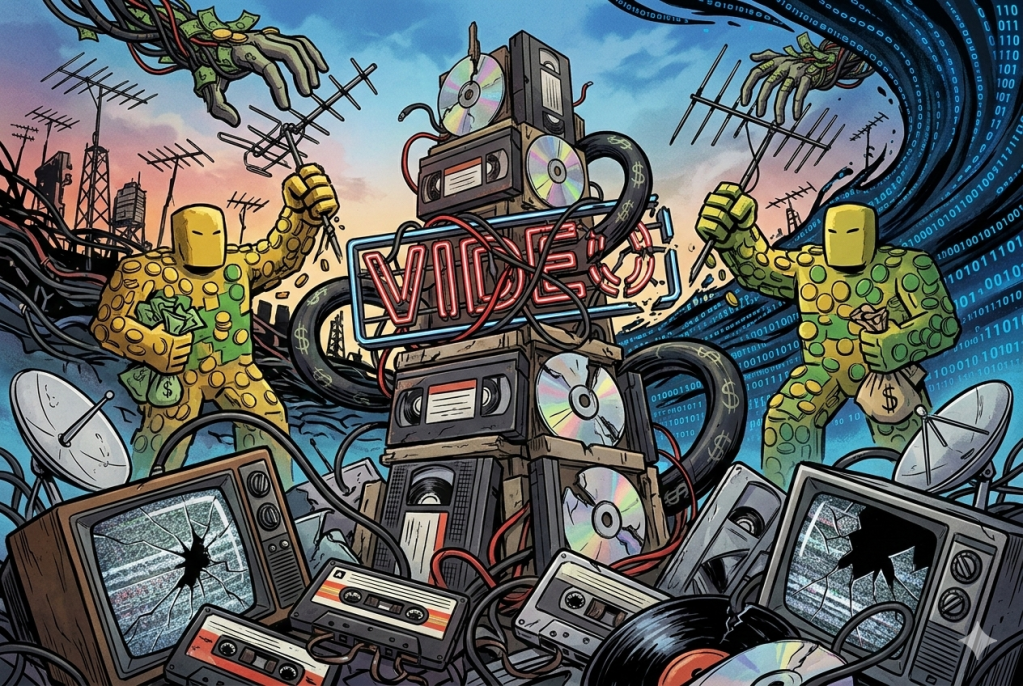
I’m not a media analyst. Smarter people than me — like Evan Shapiro, who you should follow on LinkedIn immediately — dissect this industry for a living. But I spent years working inside broadcast television, and I’ve been chewing on this particular problem for over a decade. So here’s my humble, slightly obsessive take on how television drove itself off a cliff while everyone inside the building kept arguing about the curtains.
It Started With Too Many Commercials
Before I ever set foot in a TV network, I was just a regular person watching TV and slowly losing my mind.
Not because the shows were bad. Because by the time a commercial break ended, I’d forgotten what I was watching, seen the same car ad four times, and developed a deep personal grudge against a pharmaceutical company whose product I didn’t need and couldn’t pronounce. You know the ones. Side effects may include everything up to and including death, delivered cheerfully over footage of people on a picnic.
This was before DVRs. Before streaming. Before you could just opt out. You either sat there and took it, or you got up and did something productive with your life. Most people sat there and took it. But the seeds of rebellion were already planted.
Here’s the number that matters: a one-hour show on American television runs about 42 to 44 minutes of actual content. The rest — 16 to 18 minutes — is commercials. On cable it got even worse, with some networks cramming nearly 20 minutes of ads per hour by the mid-2010s. That’s a third of your time. Gone. And not even good ads. The same three ads, cycling through on a loop, like some kind of cognitive endurance test.
The industry thought this wasn’t an issue, there was no alternative and they were making tons of $$. And that was the problem.
To understand just how much ground was ceded to viewer frustration over the decades, here’s how the commercial load grew from that very first ad to where it ended up:
| Era | What it looked like | Ads per hour |
|---|---|---|
| 1941 | First-ever TV commercial: a 10-second Bulova watch spot during a Dodgers game, cost $9, reached 4,000 households | Basically none — single sponsors funded entire shows |
| 1940s–50s | Companies sponsored whole programs; hosts read ads in-character as part of the show. The “commercial break” barely existed yet | Minimal; ads were woven into programming |
| Late 1950s | Networks took over ad sales, began selling time in segments to multiple advertisers. The commercial break as we know it was born | ~6–8 minutes |
| 1960s | The golden age of TV advertising; jingles, storytelling, celebrity endorsements | ~9 minutes |
| 1980s–90s | Cable explodes, more channels competing for ad dollars, breaks get longer | ~12–14 minutes |
| Early 2000s | DVRs arrive; industry response is to add more ads rather than fewer | ~14–16 minutes |
| 2013–2014 | Cable channels speed up reruns of shows like Seinfeld to squeeze in extra ads | ~15–16 minutes (broadcast); 16–18 (cable) |
| 2019 | Peak cable ad load; some networks hitting the ceiling | ~17–20 minutes (cable); A&E hit 17:49 per hour |
| Streaming today | Netflix, Max, Disney+ ad tiers | Under 5 minutes |
| FAST channels today | Tubi, Pluto, free streaming | ~4–9 minutes |
In roughly sixty years, the industry went from almost zero commercial interruption to nearly 20 minutes per hour on cable — and then lost its entire audience to platforms running a fraction of that load. If that isn’t a slow-motion self-inflicted wound, I genuinely don’t know what is.
What Viewers Actually Want (They Already Told Us)
Here’s the part that should have been obvious to anyone paying attention — and actually was, to anyone willing to ask: viewers don’t hate ads. They hate bad ad experiences.
Research backs this up clearly. Two thirds of U.S. viewers now say they prefer ad-supported streaming over paying for ad-free. And 81% say watching some ads is just an expected part of getting free or lower-cost content. People understand the deal. They’ve always understood the deal.
What they won’t tolerate is abuse of the deal. According to a YouGov survey across 17 markets, 32% of viewers say the absolute maximum they’ll accept is 2 minutes of ads per hour. Another 21% cap it at 3-5 minutes. Only about 2% are willing to sit through 16-20 minutes per hour — roughly the cable load. And the number one complaint across every study isn’t even the quantity. It’s the repetition. 87% of viewers say they see too much of the same ad. Seeing the same Chevy truck spot four times in one hour doesn’t make anyone want to buy a truck. It makes them want to cancel their subscription.
The research also landed on something that would have saved the entire industry if anyone had thought to study it twenty years earlier: 60% of viewers say they’d prefer one longer ad break before the show starts, with the rest of the program uninterrupted.
That is the 1950s single-sponsor model. That is literally what existed before the industry dismantled it in pursuit of more slots and more revenue. They spent sixty years breaking something that worked, lost the audience completely, and the audience turned around and told researchers they want the original version back.
The sweet spot, according to actual platform data from services that have done the testing: 4 to 6 minutes of ads per hour, with no more than three ads per break, and at least a six-minute gap between pods. At that load, viewers stay engaged, they actually watch the ads, and they respond to brand messages. Fewer ads, properly placed, perform dramatically better than the wall-to-wall load that drove viewers to Netflix in the first place.
The industry had 60 years to figure this out. Netflix figured it out in about five minutes.
How I Ended Up Inside the Machine
My path into television was a winding one. It started in music video production — which, in the MTV era, was a legitimate and booming field. MTV needed videos. Artists needed videos. So people like me made videos. That work led to commercials, which led to visual effects and graphic design, which eventually landed me on a TV rebrand project with Lee Hunt and Razorfish for ZDF in Germany. We were in Frankfurt making graphic packages for a network rebrand, and that was my doorway in.
Not long after, I got a call to work on a rebrand for VH1 — funny enough, right inside the MTV building. We updated their logo, built out style guides, and mapped the brand across every surface of the network. It’s the kind of project where you quickly discover how many places a logo actually lives. Spoiler: it’s everywhere. Absolutely everywhere. Someone, somewhere, has a sticky note with your logo on it and you will not find it until six months after launch.
From there I moved into the broader network world — on-air graphics, motion packages, the visual language of television. I was inside the system. And from inside the system, I could see exactly what was happening. And exactly what nobody wanted to do about it.
The DVR Arrives. The Industry Panics. Does Nothing Useful.
In the early 2000s, TiVo showed up. DVRs went mainstream. And viewers did exactly what you’d expect: they started skipping commercials like it was a competitive sport.
Advertisers — who had been spending billions at the annual upfronts — started asking uncomfortable questions. Why are we paying you this much if people are fast-forwarding through our ads? Completely fair question.
The obvious answer was sitting right there on the table: shorten the commercial breaks. Make them short enough that skipping feels like more effort than just watching. Keep people in their seats. Give advertisers viewers who are actually present, instead of phantom eyeballs clicking past at 4x speed.
They didn’t do that.
Instead, what we came up with were tricks. Drop a piece of the program in the middle of the break so DVR users think the show has started again and hit play. Run a cliffhanger tease right before the break to keep people from flipping. Little Band-Aids applied to a severed artery.
Here’s the part that really gets me though: they knew. The people running these networks watched television too. They had DVRs. They skipped the commercials just like everyone else did. This wasn’t some mystery they couldn’t diagnose. Cutting ad time was simply the third rail of broadcast — touch it and you die, at least as far as your quarterly earnings report was concerned. So the unspoken strategy, as best I could tell from the inside, was to hope the whole reckoning landed after you’d collected your bonus and retired. Kick the can far enough down the road that it becomes someone else’s catastrophe.
Which is exactly what an addict does. You know the drug is killing you. You can see it happening. But the high is so good and the withdrawal so painful that you just keep using and hope you outlast the consequences. The irony is that the very cash flow that made them feel invincible — those 50% margins, that golden goose — was the same thing destroying their ability to adapt. The money wasn’t saving them. It was the addiction.
I get why they didn’t want to cut ad time. The money was genuinely insane. A one-hour cable show was generating 16 to 18 minutes of ad revenue per episode, per airing, across dozens of channels, around the clock. EBITDA margins for cable networks were running 38 to 42 percent. Cable operators — the Comcasts of the world, the people running the wire into your house — were hitting close to 50 percent on the broadband side. For context, the average profit margin across the entire U.S. economy is around 15 percent.
Evan Shapiro, who came in to give a talk at our company during this period, made a point that stuck with me ever since. He noted that no other legitimate industry comes close to margins like that — the only comparison that really held up was drug dealers. Which, when you think about it, explains a lot about how they treated their customers.
So yeah. Nobody was volunteering to give that up.
The Corporate Socialism That Built the Golden Goose
Here’s something worth understanding about how cable got so rich in the first place — because it didn’t happen purely through innovation or superior service. If you’ve ever wondered why your cable company is terrible and also somehow the only option in your neighborhood, there’s a reason for that.
Cable was built on government-granted local monopolies. Cities handed out franchise agreements — exclusive rights to run cable in a given area — and most communities only issued one. Of roughly 9,000 cable franchises across the U.S., only about 120 faced any real head-to-head competition. One legal observer at the time called a cable franchise “the next best thing to a license to print money.” After the 1984 Cable Act deregulated pricing, rates jumped 32% in just four years. Because why wouldn’t they? There was nobody else to go to.
So these companies built enormous fortunes — not by being better, but by being the only option. And then, flush with that cash, they started buying media companies. Comcast bought NBCUniversal in 2011. AT&T bought Time Warner for $85.4 billion in 2018. The motive was straightforward: own both ends of the transaction. Collect subscription fees from customers on the distribution side, collect advertising and carriage fees on the content side, and stop writing massive checks to creators and programmers when you could just own them instead. It was a pure revenue play. Nobody was sitting in those boardrooms talking about making better television.
And that’s exactly where it quietly broke the actual product. The cable bundle meant networks got paid per subscriber whether anyone actually watched their channel or not. Industry insiders literally called it “the golden goose.” When your revenue doesn’t depend on whether the content is actually good, the content gradually stops being the priority. And when the media division is answering to a cable company parent that measures success in broadband subscribers and quarterly earnings — not Emmys — the creative mission is the first thing to get deprioritized.
The result was a slow, invisible decay. Not a sudden collapse. Just a gradual drift away from the thing that was supposed to matter most: keeping people genuinely engaged with what was on their screen.
The Napster Warning Nobody Heeded
Before streaming finished the job, it’s worth pausing on a parallel that played out in real time in the music industry — because the script was almost identical.
Napster launched in 1999 and within a couple of years had tens of millions of people sharing music for free. The record labels, whose business model depended entirely on selling physical CDs, responded by suing teenagers and trying to legislate the internet out of existence.
The thing is, Napster had actually built a functional digital music distribution platform. The infrastructure was there. The audience was there. The labels could have bought it, licensed it, figured out a monetization model, and owned the future of music distribution. Instead they fought it, won in court, and watched as the audience they’d alienated moved on to the next file-sharing platform. And then the next one. You can’t put water back after the dam breaks.
Eventually the music industry got streaming — but on someone else’s terms, at a fraction of what they once made, long after the leverage had shifted away from them permanently.
Television was watching all of this happen in real time. And drew no conclusions whatsoever.
MTV and the Beginning of the End
MTV launched in 1981 and it was genuinely great. A whole channel dedicated to music videos? Brilliant. It captured pop culture in a way nothing had before. But MTV also planted a seed that would eventually undermine the whole ecosystem.
Because MTV proved that niche programming worked. Suddenly you didn’t need to be everything to everyone across three broadcast channels. You could be one specific thing to one specific audience, and that was a business. Cable ran with this and launched a hundred channels: history, cooking, learning, comedy, sports, nature. Niche everything.
And then, slowly, they all became the same channel.
The Learning Channel became TLC and started airing reality shows about cakes. MTV stopped playing music. History Channel discovered that aliens were apparently involved in most of human civilization. Every niche channel drifted toward generic entertainment because generic entertainment is cheaper to produce and easier to sell ads against. The differentiation that had made cable compelling evaporated. Now you had 200 channels of roughly the same thing — each of them running 18 minutes of commercials per hour.
Netflix, YouTube, and the Empire They Gave Away
Netflix launched its streaming service in 2007. Hulu followed. And the audience — the one that had been sitting through 18 minutes of commercials per hour for decades, the one that had been speed-running through DVR breaks for years — discovered they could just… not do that anymore.
But it wasn’t just Netflix. YouTube quietly became one of the biggest TV screens in America. People watch full-length content, news, sports highlights, documentaries, and creator programming on their televisions every day now — and YouTube’s reach has grown to the point where it regularly tops Nielsen’s streaming charts. That audience? It belonged to cable once. Every one of those eyeballs was a viewer the networks trained, cultivated, and then drove away with 18-minute commercial loads and 500 channels of the same thing.
And YouTube is making some of the exact same mistakes. Ad placement on YouTube has become increasingly disruptive — unskippable interruptions dropped into the middle of videos with the same blunt-force logic that killed cable. They’re big enough right now that viewers tolerate it. But the lesson of this whole story is that audiences tolerate things right up until they don’t, and then they leave and don’t come back.
Then there’s the full explosion of independent OTT — Tubi, Pluto TV, the FAST channels, the connected TV platforms. These are businesses that exist entirely because there was a massive, trained audience sitting there with nowhere to go once cable drove them away. The content relationships were already established. The brand trust was already built. Had the networks simply adjusted the commercial model when the DVR was telling them to — shortened the breaks, kept the viewers — they would have been positioned to own that space. Instead they vacated it, and outsiders moved in.
The networks’ response, when it finally came, was to launch their own streaming services — Peacock, Max, Paramount+, Disney+. But by then they were chasing, not leading. And they did it the worst possible way: by cannibalizing the content libraries they’d spent decades building, gutting their cable channels in the process, laying off experienced staff, and replacing them with cheaper labor in a “newer space.” The classic move of a dying industry — cut costs, call it a pivot, wonder why the product keeps getting worse.
The cable bundle had trained viewers to expect a lot of content for one monthly price. What they got instead was a dozen separate subscriptions for content that used to live in one place, at prices that collectively add up to more than the cable bill they cancelled. Now you need Netflix for their originals, Max for HBO, Paramount+ for Yellowstone, Disney+ for the Marvel and Star Wars content, Peacock for the NFL games NBC used to just air — and still a separate live TV package if you want sports in real time. Congratulations. You’ve reinvented cable. But worse, more expensive, and with more login screens.
As of late 2024, Comcast announced it’s spinning off most of its cable networks — MSNBC, CNBC, USA, SYFY, E!, and others — into a separate company. Because cable networks are, in the words of analysts now being paid to say what was obvious fifteen years ago, “structurally broken.”
Structurally broken. That’s the technical term for “we had it and we blew it.”
What Would Have Actually Worked
This is the part I’ve been thinking about for over ten years. And I promise it’s not complicated.
Shorten the breaks.
Genuinely. That’s the core of it. If they had cut commercial time from 16-18 minutes down to 4-6 minutes per hour — a sponsor billboard at the open, a short break or two in the middle, a quick close — here’s what would have happened:
- Viewers wouldn’t have needed to skip, because there wasn’t enough to skip
- Advertisers would have been reaching actual, present, engaged eyeballs instead of phantom DVR traffic
- Fewer ads seen by more attentive people is actually better for the advertiser
- People wouldn’t have had a reason to flee to Netflix, because the experience of watching cable wouldn’t have been something you needed to escape
Was there a short-term revenue hit? Yes. Would it have required convincing shareholders to accept lower margins for a couple of years? Yes. Was any executive in that era equipped to have that conversation with a straight face? Apparently not.
Because the margins were 50%. And you don’t walk away from 50% margins. Not voluntarily. Not with quarterly earnings calls and shareholder expectations and a cable company parent that views your media division as a subscriber-retention tool rather than a creative endeavor with its own health to protect.
So they didn’t fix it. They put Band-Aids on it. And now they’re spinning off the cable channels and everyone is framing it as strategy rather than consequence.
The Artery, Revisited
If you sever an artery, Band-Aids don’t stop the bleeding. Everyone knew this. The people running these networks knew the commercial load was pushing viewers away. They knew DVRs were a signal. They knew Netflix was a signal. They knew the music industry was a cautionary tale playing out in real time in the adjacent building.
They chose the quarterly earnings over the long game. Every. Single. Time.
And look — I genuinely understand it. It’s hard to say no to that kind of money in the moment. The structure wasn’t built to reward long-term thinking. The incentives were pointed in the wrong direction at every level, made worse when cable operators bought media companies and started running creative businesses like infrastructure.
But the result is an industry that had every advantage — the content, the distribution, the audience, the decades of trust — and handed all of it to Netflix while debating commercial break placement.
The golden goose didn’t die of natural causes. They ate it themselves. And then they charged you a streaming fee for the leftovers.
Have thoughts? Worked in the industry? Watched this happen from your couch in real time? Drop it in the comments.
 Even that's Odd
Leave a comment