
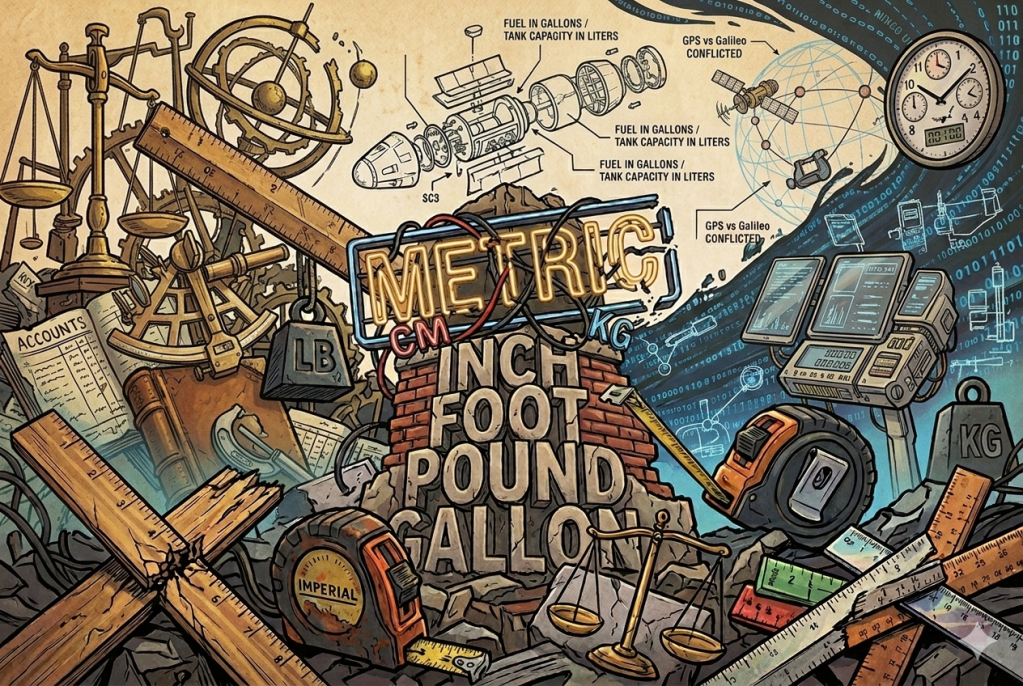
When I was a kid, we started learning the metric system in school. There was an actual plan. America was going to join the rest of the world and switch from the imperial system — you know, the one built on the length of some king’s foot — to a logical, base-ten system that scientists, engineers, and pretty much every other country on earth had already figured out. It made sense. It was going to happen.
And then it just… didn’t.
I was too young to fully understand why at the time. Now that I look back at it — and actually dig into the history — it’s a story that tells you pretty much everything you need to know about how this country makes decisions. Or more accurately, how it fails to make them.
The Three Countries That Held Out
Here’s the fact that stops people cold when they hear it. Only three countries in the world have not officially adopted the metric system as their primary standard: The United States, Myanmar, and Liberia. That’s the list. Every other country on Earth uses metric.
Three countries.
And before you bring up England — they’re officially metric. Have been since the 1960s and 70s. They’ve got some cultural holdovers (road signs still in miles, beer still in pints at the pub, people still saying “a stone” when they talk about body weight), but the official system is metric. Brexit had nothing to do with it, and if anything, post-Brexit there was a brief push by some British conservatives to bring back imperial measurements as a symbolic middle finger to the EU — which tells you something about who tends to romanticize old, clunky measurement systems and why.
So yes: us, Myanmar, and Liberia. Proud company.
What Actually Happened
The US has technically been legal metric since 1866. The Metric Act of that year made it legal to use metric in commerce, so this isn’t a new debate. The real push — the one I half-remember from school — came from the Metric Conversion Act of 1975, signed by Gerald Ford. It declared metric the “preferred” system and created the US Metric Board to manage the transition.
The fatal word in that legislation was voluntary.
Congress stripped out any enforcement before passing it. No mandates, no deadlines, nothing binding. It was the legislative equivalent of saying “you really should clean your room” and then leaving for a week. Predictably, not much happened. Then Ronald Reagan dissolved the US Metric Board in 1982 — quietly, with little fanfare — on the grounds that it wasn’t accomplishing anything. He wasn’t wrong that it wasn’t accomplishing anything. He was wrong about what the solution was.
There was a follow-up attempt. The Omnibus Trade and Competitiveness Act of 1988 actually re-designated metric as the preferred system for federal agencies and required federal contractors to use it. So legally, on paper, the US federal government prefers metric. Go ask someone at a construction site how that’s going.
The Road Sign Number
One of the arguments that killed the transition — and kept killing it every time someone tried to revive it — was the cost of replacing highway signs.
Here’s the real number, sourced from an actual GAO report to Congress: nobody knew. No comprehensive national estimate was ever developed. Most states didn’t even do preliminary estimates. One exception: Alabama calculated about $70 per sign in 1995, and working from a federal estimate of roughly 6 million signs on state and local roads, the GAO ballparked a national total somewhere between $334 million and $420 million. And they were careful to call that a soft guesstimate.
So the number that killed American metrication — the scary, too-expensive-to-even-think-about number — was a rough estimate, developed from one state’s data, never verified nationally, and always cited by people who didn’t want to do it anyway.
But let’s take the high end and say $420 million. Hold that number.
The Mars Orbiter
In 1999, NASA lost a spacecraft.
The Mars Climate Orbiter had been traveling through space for nine months. It reached Mars, attempted orbital insertion, and burned up in the atmosphere. Gone. $327 million, destroyed.
The reason? One engineering team at Lockheed Martin was sending thruster data in imperial units. The navigation team at NASA’s Jet Propulsion Laboratory was receiving it and assuming it was metric. Nobody caught it. The spacecraft approached Mars at the wrong angle and was never heard from again.
So we spent $327 million on a spacecraft that could have been saved by the metric system. And we’ve spent decades refusing to spend $420 million — spread across all 50 states, phased over years, with signs that need to be replaced on routine maintenance cycles anyway — to actually adopt the metric system.
You want to talk about expensive? That’s expensive. The road sign math was never the real reason.
The Bonus Absurdity: The One Highway That Went Metric
There is exactly one stretch of continuous highway in the United States where road signs are in metric: Interstate 19 in Arizona, running 63 miles from Tucson down to the Mexican border. The signs went up in 1980, right at the peak of the metric push. Then the push died, the rest of the country moved on, and I-19 just… stayed metric.
Here’s the part that makes it perfect: Arizona has been trying to convert it back to miles, and it keeps failing — because hotels and restaurants along the route advertise using the kilometer-based exit numbers and don’t want to change their marketing.
We have one highway that went metric and now can’t go back. The country went the other direction entirely. There’s a metaphor in there somewhere, and I’m not sure if it’s funny or depressing. Probably both.
Okay, But Why Did It Really Die? (Here’s Where It Gets Political)
The construction and trades industries lobbied hard against it — legitimate concerns about retooling costs, retrained workers, standardized plumbing fittings and lumber dimensions. Small business owners didn’t want the expense of recalibration. State highway officials were alarmed by sign replacement costs they couldn’t afford without federal help, and Congress wasn’t offering federal help. These were real objections, even if the dollar amounts were often overstated.
But there was something else running underneath all of it.
The Reagan era brought with it a particular brand of American exceptionalism: the idea that adapting to the rest of the world was inherently a concession, a sign of weakness, an elitist project dreamed up by technocrats who didn’t understand real Americans. Metric became a proxy. Not consciously, not in an orchestrated way, but in that ambient, cultural way where politicians read the room, see what’s making their base angry, and quietly let the thing die rather than spend any capital defending it.
It was arguably one of the earlier examples of a move that would become very familiar: taking something practical and evidence-based and reframing it as a culture war flashpoint. “They want to change how we measure things” slides easily into “they want to change who we are.” And once it’s framed that way, the actual merits stop mattering. You’re not debating centimeters anymore. You’re defending your identity.
We’ve seen that playbook run on bigger stages since then. Climate science. Public health. Education standards. The metric fight didn’t invent the tactic, but in hindsight it looks like an early rehearsal — proof that you could get regular people genuinely angry about abandoning something objectively more complicated in favor of something objectively simpler, if you packaged the resistance correctly.
And by the way: the name itself should have been the tell. Imperial. It’s right there. The system we’re so attached to was formalized by the British Empire in 1824 — the British Weights and Measures Act — explicitly to standardize measurements across the colonies. We fought a revolution to get out from under that empire, then kept its rulers. The US doesn’t even use the original British imperial system exactly; it’s drifted enough over the centuries that what we call “imperial” and what Britain historically called “imperial” aren’t quite the same thing anymore. We’re preserving a colonial measurement system that the former colonizers themselves have mostly abandoned.
That’s not heritage. That’s just stubbornness with a historical costume on.
The Part That Actually Gets Me
Here’s what I keep coming back to: the metric system is easier. That’s not an opinion. It’s base ten. Everything scales by factors of ten. There’s one unit of length, one unit of volume, one unit of mass — and they all relate to each other in a logical way. Water freezes at 0 and boils at 100. The whole thing was designed to make sense.
Imperial is a historical accident. Inches, feet, yards, miles — twelve inches to a foot, three feet to a yard, 1,760 yards to a mile. Teaspoons to tablespoons to cups to pints to quarts to gallons. Ounces that mean different things depending on whether you’re measuring weight or liquid. It’s a system that exists because that’s what we inherited, not because anyone sat down and thought it was a good idea.
The rest of the world figured this out. The generation that grew up metric in France or Germany or Japan doesn’t think in metric — they just think. The conversion happens automatically, the way it happens for any language you grow up speaking. We decided that wasn’t worth the transition cost for our kids and their kids and their kids after that.
Canada — our neighbor, sharing the longest border in the world with us — converted their highway signs in 1977. The whole country. It took two months.
Two months.
We’ve been “thinking about it” since 1866.
So Here We Are
I don’t know that we’re ever going to do this. The moment has probably passed in a way that would take a generational, coordinated effort to reverse. Science, medicine, military, international trade — all metric, all the time. The average American just doesn’t encounter the collision between the systems unless they’re working in a technical field, traveling abroad, or trying to figure out why their car’s torque specs are in Newton-meters while the hardware store sells bolts by the inch.
But every once in a while, I think about that Mars orbiter. $327 million, tumbling through space, destroyed by a unit conversion error. And I think about the highway sign estimate — the scary number that helped kill metrication — which was at best a rough guess extrapolated from one state’s data.
We refused to spend $420 million (maybe) to do the smart thing. Then we spent $327 million (definitely) because we hadn’t done it.
That’s not a measurement problem. That’s a us problem.
Even That’s Odd is a blog about the things that make you stop and say “wait, really?” — politics, culture, history, and occasionally the spectacular ways humans choose to make easy things harder. Subscribe if you’re into that sort of thing.
 Even that's Odd
Leave a comment