
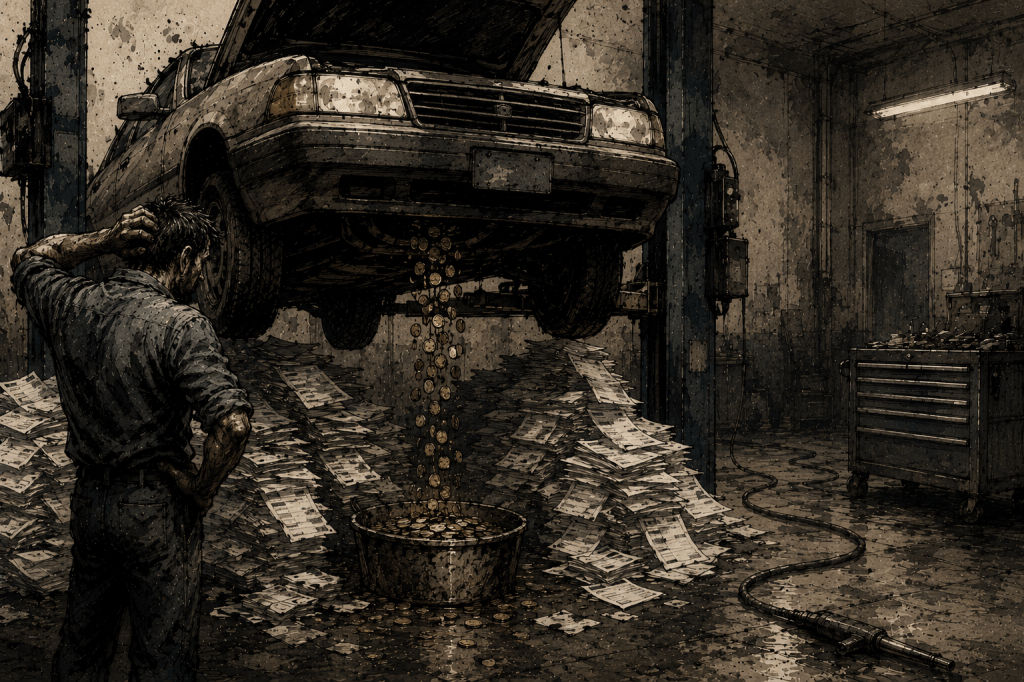
Part 5 of Passing the Buck, a 15-part series on why we make less but pay more.
The first four installments traced cost shifts inside relatively well-defined transactions — wages versus productivity, employer-to-worker benefit transfers, overdraft fees, credit card interest. This one is harder, because the cost being passed to households is built into the physical layout of the country. There is no individual transaction to point to. There is a road system, a zoning code, and a set of choices that were made in the middle of the twentieth century, and the bill for those choices arrives in the form of a car payment that almost every American household now writes.
I live in Gardiner, New York, an hour-and-change north of the city in the rural Hudson Valley. There is no train station within walking distance. There is no bus that goes where I need to go. My wife and I share two cars between four drivers, more or less, depending on which of our sons is home and what their schedules look like. We are not a transit-poor household by choice or by ideology; we are one by geography. If we did not own cars, we could not work, take the kids to school, get groceries, or visit our parents. The same is true for the overwhelming majority of households in the United States, including most that live in cities that nominally have transit. The car is not, for most people, a consumer preference. It is a precondition for participation in the economy.
That precondition is expensive, and it just got more so.
The number
AAA’s Your Driving Costs study, which has been published every year since 1950, put the total annual cost of owning and operating a new vehicle at $12,297, or $1,024.71 a month, in its September 2024 edition. The 2025 update, released last September, came in slightly lower — $11,577, or $964.78 a month — mostly because gasoline and finance charges drifted down briefly. Both figures include depreciation, finance charges, fuel, insurance, maintenance, license, and registration. They assume 15,000 miles a year and the average top-selling new model in each category. They do not include parking, tickets, or the occasional uninsured-motorist accident that totals the car.
Pickup trucks are the most expensive category, running roughly $6,400 a year more than the cheapest small sedan. Sedans are the cheapest. SUVs sit in the middle. The household that buys what the market mostly sells — a midsize SUV or pickup — is paying $13,000 to $15,000 a year for the privilege of having a vehicle in the driveway.
Two more numbers frame the rest of this. According to the Census Bureau’s American Community Survey, 92 percent of U.S. households have at least one vehicle available, and only about 8 percent do not. The Bureau of Labor Statistics’ Consumer Expenditure Survey consistently shows transportation as the second-largest line item in the average household budget, behind only housing, at roughly 15 percent of total spending. For lower-income households the share is higher, sometimes meaningfully higher, because the fixed costs of owning a car — the loan, the insurance, the registration — do not scale down for people who earn less.
In other words: nearly every household in the country pays roughly the same large fixed cost for transportation, regardless of income. It is one of the most regressive line items in the American household budget, and it is regressive by design.
The 2026 spike
The 2025 dip in the AAA number was a head-fake. The 2026 figure, when it gets published this fall, is going to be considerably worse, for two reasons that are both within the direct control of the same administration.
The first is the tariff regime. Starting in early 2025, the administration imposed a twenty-five percent tariff on imported vehicles and a separate set of tariffs on imported auto parts, on top of steel and aluminum levies that flow through to assembly costs. Some of those tariffs were later negotiated down to fifteen percent under trade deals with Japan, South Korea, and the European Union. The Supreme Court struck down the broader IEEPA-based tariffs in February of this year in a 6-3 ruling, and the Court of International Trade later ruled the ten-percent global import tariff unlawful. But the auto-specific Section 232 tariffs were left intact, and the price increases that have already worked their way into the supply chain do not reverse instantly. Audi raised prices across its 2026 lineup by $800 to $4,100 per model. The average new vehicle built in the United States now starts at roughly $53,000, against an industry-wide average of around $49,000. Sixty percent of replacement parts used in U.S. auto repair are imported, which means tariff costs flow through into the average repair bill and, on a one- to two-quarter delay, into the average insurance premium. Insurify projected that auto insurance premiums would rise seven to thirteen percent by the end of 2025 on tariff effects alone. That projection appears to be playing out. The Tax Foundation estimates that the tariffs amount to the largest U.S. tax increase as a percentage of GDP since 1993, with an average cost of roughly $1,500 per household this year.
The second is the war. On February 28 of this year, the United States entered military conflict with Iran. The Strait of Hormuz, through which roughly twenty percent of global oil moves, has been disrupted ever since. West Texas Intermediate crude, the benchmark for U.S. oil prices, went from $67.02 a barrel the day before the war started to $102.68 a barrel by May 18, a 53.2 percent increase in eighty days. The national average price of regular gasoline is now north of $4.50 a gallon, the highest in four years; in seven states it is over $5. The median state has seen prices jump $1.19 a gallon since the war began. April CPI hit 3.8 percent, the highest in three years, against wage growth of 3.6 percent — which means real wages, by the official measure, are once again declining.
The president who campaigned on lower prices and on being a peace president is, as of this writing, conducting a multi-front trade war and an active shooting war, and the bill for both is landing in the average household’s car expenses. New car: more expensive. Repair: more expensive. Insurance: more expensive. Gas: more expensive. The line item that was already the second-largest in the household budget, behind only housing, has gotten worse on every component at the same time.
How we got here
The American car-dependent landscape was not the natural outcome of consumer choice. It was, in the most literal sense, built. Three things mattered.
The first is the 1956 Federal-Aid Highway Act, signed by Eisenhower, which authorized the Interstate Highway System and committed the federal government to pay ninety percent of the cost of building it. There was no comparable commitment to rail. The Act funded the routes that ran through downtowns and cut neighborhoods in half — disproportionately Black and immigrant neighborhoods, which is well documented and not really contested anymore — and the routes that ran out to the suburbs and made it possible to live far from where you worked. The interstate system is one of the largest infrastructure investments in American history. It is also the single largest reason that the American development pattern is what it is.
The second is zoning. Beginning in the 1920s and accelerating after World War II, most American municipalities adopted what is called Euclidean zoning — named for the Supreme Court case Village of Euclid v. Ambler Realty (1926) — which separated residential, commercial, and industrial uses from one another. The corner store in the residential neighborhood, the apartment above the shop, the small office building on the same block as the houses — all of those became illegal in most of the country. The result is a pattern in which you cannot walk to a grocery store, a school, or a job, because the grocery store, the school, and the job are not allowed to exist where you live. You have to drive.
The third is the General Motors streetcar case, which is the most mythologized of the three and the one I want to be careful about. The basic facts are these: between 1936 and 1950, a holding company called National City Lines, funded by General Motors, Firestone Tire, Standard Oil of California, Phillips Petroleum, and Mack Trucks, acquired transit systems in forty-four cities across sixteen states and converted many of them from electric streetcars to GM-made buses. In 1949, a federal jury in Chicago convicted GM and the other corporate defendants of conspiring to monopolize the sale of buses and supplies to those transit systems, in violation of the Sherman Antitrust Act. They were acquitted of the broader charge of conspiring to monopolize ownership of transit systems. GM was fined $5,000. The treasurer of GM, H.C. Grossman, was fined $1. The trial judge said on the record that he might not have convicted in a bench trial.
The popular version of this story, embedded in the cultural memory by Who Framed Roger Rabbit and a generation of conspiracy-adjacent writing, is that GM single-handedly destroyed American streetcars in order to sell more cars. The historians who have looked closely at this — Martha Bianco, Scott Bottles, Sy Adler, Cliff Slater, and others — argue that the actual story is more complicated. American streetcar systems had been declining for two decades before NCL got involved, because they were privately owned, regulated as utilities, locked into nickel fares while their costs rose, and competing against the rising convenience of private automobiles. Most of the systems NCL bought were already failing. NCL’s role was real but not single-handed.
What does it add up to? A conviction is a conviction, and GM clearly behaved in a way the federal government found illegal. The car, tire, and oil industries had aligned commercial interests in the disappearance of streetcars, and they acted on those interests. But the larger reason most American cities ended up car-dependent is not a single 1949 antitrust conviction. It is the Federal Highway Act, the zoning codes, and the broader political consensus, sustained for half a century, that the country would invest in highways and not in transit. That consensus is the bigger story.
The bill
What that consensus produced is the current household balance sheet: a $12,000-a-year fixed expense, charged to nearly every household in the country regardless of income, in exchange for participation in an economy whose physical layout makes it impossible to live without a car — and that fixed expense is currently being marked up by tariffs and a war neither of which the household had any say in.
The extraction is not coming from one industry. It is split across at least four.
The car itself, financed at roughly seven to eleven percent depending on whether it is new or used, with the auto-finance arms of the major banks and the captive lenders of the manufacturers collecting the interest. The average new-car loan in 2024 ran around seven percent for sixty-eight months; the average used-car loan was closer to eleven percent for sixty-five months. The longer terms — six- and seven-year auto loans are now common where five-year was the standard a generation ago — mean that more of the household’s monthly payment goes to interest, and the household is more likely to be underwater on the car when it needs to be replaced.
The insurance, which is mandatory in nearly every state, priced by a small number of insurers whose pricing power has expanded as the cost of repairing cars has gone up. Vehicle electronics, sensors, and software have made even minor collisions expensive to repair, and premiums have followed. Tariff-driven parts costs are the most recent accelerant.
The fuel, which is sold by a small number of oil companies whose pricing follows global markets that the average household cannot influence and whose policy positions, on transit funding and climate, have been consistent for decades. The Iran war is the most recent accelerant.
The maintenance, which is becoming more specialized and more expensive as vehicles become more complex. A “check engine” light that used to mean a thirty-dollar oxygen sensor now routinely means a thousand-dollar diagnostic and replacement of a sealed module.
None of these industries is doing anything illegal. Most of what they are doing is the same thing the credit card industry is doing in Part 4 — offering a product the household has no realistic ability to refuse and pricing it accordingly. The government action that is supposed to be a counterweight is, at the moment, an active accelerant on all four components at once.
What it looks like from here
I drive a Tesla Model Y. My wife drives a 2016 Audi Allroad that will eventually need to be replaced with something electric. Our older son will need his own vehicle within a couple of years, and our younger son after that. There is no scenario in which our household runs on fewer than two cars, and probably not on fewer than three for some period in the late 2020s. I have looked seriously at the Telo MT1, a small electric pickup that is the closest thing to a sensible right-sized vehicle I have seen offered to American consumers in twenty years, and I would buy one tomorrow if it shipped. I am not the household that needs convincing that cars are expensive.
What I will say is that the rural-New York version of this trap is different from the Phoenix or Houston version, but it is structurally the same. The transit option does not exist where I live, because the population density does not support it, because the development pattern produced by mid-century federal policy did not put population density where I live. The fact that I can afford to participate in that system does not make it any less of a system. It is the single largest line item, after the house itself, that I will spend money on for the rest of my life. The same is true for nearly every household in the country.
That is the design. The cost did not go away. It moved. The household whose grandparents could have walked to the streetcar now pays the bank, the insurer, the oil company, and the mechanic, every month, forever, for the privilege of getting to work. And in 2026, with the trade war and the shooting war both running, the household pays the tariff and the war premium on top of that.
The next installment looks at food.


Leave a Reply