
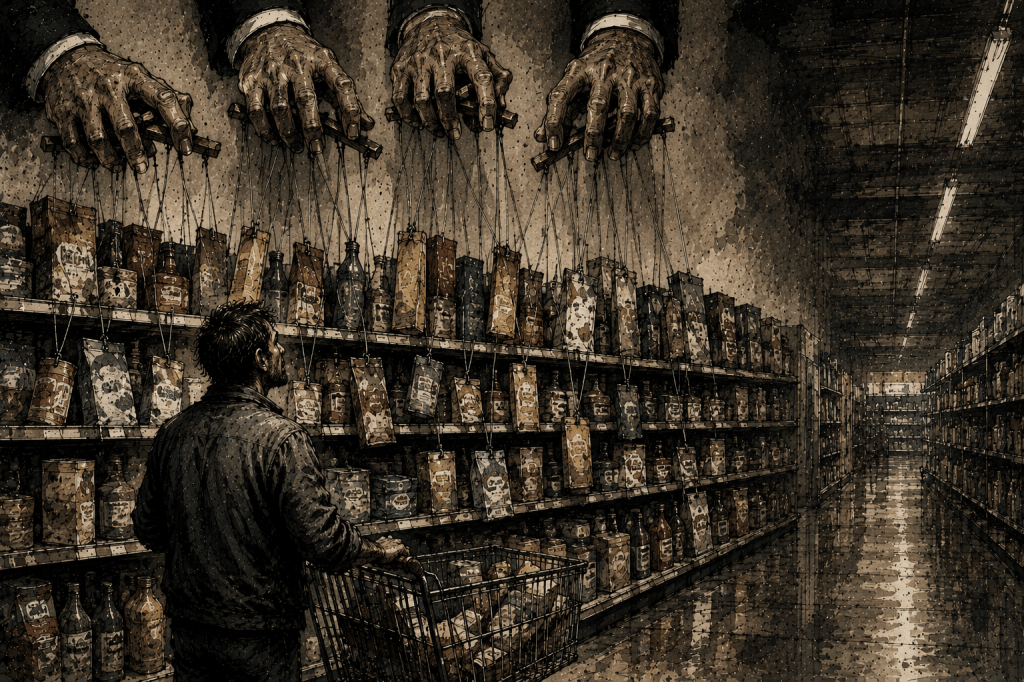
Part 6 of Passing the Buck, a 15-part series on why we make less but pay more.
This series has been working its way through the categories of household spending where the cost has been quietly shifted away from corporate balance sheets and onto households. Food is one of the larger ones, and one of the harder to think clearly about, because the inflation story of the last few years has been politicized to the point that the underlying structure is hard to see through.
So I want to start with the structure, before I get to the inflation.
The concentration
Four corporations process roughly 85 percent of the beef sold in the United States: Tyson Foods, JBS, Cargill, and National Beef. According to U.S. Department of Agriculture data, that share has more than doubled since 1980, when the same four-firm concentration ratio was 36 percent, and is more than triple the 1971 level of 25 percent. Two of the four are foreign-owned. JBS is Brazilian. National Beef is owned by the Brazilian conglomerate Marfrig. The Trump administration called for a Justice Department investigation of the four meatpackers in November 2025, citing those concentration figures and the foreign-ownership question. That investigation is, as of this writing, ongoing.
Pork is similar. Smithfield Foods, which is owned by China’s WH Group, is the largest U.S. pork processor. Tyson, JBS, and Hormel make up most of the rest. The top four control somewhere in the 65 to 70 percent range of U.S. pork processing.
Chicken is also concentrated, though less so. Tyson, Pilgrim’s Pride, Wayne-Sanderson (the Cargill–Continental Grain joint venture that absorbed Sanderson Farms in 2022), and Perdue together process roughly 60 percent of broiler chickens.
Seeds: three companies — Bayer (which acquired Monsanto), Corteva (which spun out of DuPont), and ChemChina (which owns Syngenta) — control more than half the commercial seed market.
Grocery retail: Walmart alone now sells roughly a quarter of all groceries in the United States. Kroger, Costco, and Albertsons together account for roughly another fifth. The top four retailers control somewhere around 45 to 50 percent of grocery sales nationwide, and in many regions a single chain or two will control most of what is available to a given shopper.
Farm equipment: John Deere holds more than half the U.S. market for large tractors.
Every one of those concentration numbers used to be much lower. The path that took them all from competitive markets to four-firm oligopolies runs through the 1980s relaxation of antitrust enforcement under the consumer-welfare standard, which judged mergers by whether they raised consumer prices in the short term rather than by whether they concentrated market power. The mergers got approved. The market power got concentrated. The prices, eventually, got raised.
The farmer share
The USDA’s Economic Research Service publishes a Food Dollar Series that tracks how each consumer dollar spent on food is divided across the supply chain. The latest update was released in March of this year, covering 2024 data. The headline number: farmers and ranchers received 11.8 cents of every dollar Americans spent on domestically produced food in 2024, down from 12.1 cents in 2023. After accounting for production expenses — seed, fertilizer, equipment, fuel, labor — what reaches the farm net of those input costs is 5.8 cents per food dollar. Less than six cents.
The remaining 88.2 cents goes to what the USDA calls the marketing bill: processing, packaging, transportation, wholesaling, retailing, and food service. That is where the consolidation lives, and that is where the margins go.
The farm share varies sharply by product. Eggs return roughly 69 cents per dollar to producers, because there is not much you can do to an egg between the farm and the carton. Beef returns about 52 cents. Fresh milk, about 51 cents. But the further you get from the raw commodity — boxed cereal, frozen entrees, soft drinks, restaurant meals — the further the farm share collapses. The food-at-home share for farmers averages 18.5 cents. The food-away-from-home share is 7.1 cents.
What that means for a household: nearly nine out of every ten dollars you spend on food goes to companies that did not grow it. What it means for a farm: the input costs are set by oligopolies on one end, the prices are set by oligopolies on the other end, and the producer in the middle is what economists politely call a “price taker.” There is no negotiation. The farmer either accepts what the processor is paying or shuts down. The number of U.S. farms has been declining for seventy years, and the structure of the food system is the reason.
The merger that didn’t go through
There has been one major exception to the consolidation trend in recent years, and it is worth flagging because it was a real piece of antitrust enforcement, the kind this series spends a lot of time arguing has been mostly absent.
In October 2022, Kroger announced a $24.6 billion acquisition of Albertsons that would have combined the two largest traditional supermarket chains in the country and created a company with roughly five thousand stores. The Federal Trade Commission under Lina Khan sued to block the merger in February 2024, joined by a bipartisan group of state attorneys general. After a three-week trial in Portland, a federal judge in Oregon issued a preliminary injunction blocking the deal on December 10, 2024. A Washington state court issued a permanent injunction the same day. Kroger terminated the merger agreement and announced a $7.5 billion share buyback as a consolation prize for its shareholders. Albertsons promptly sued Kroger for $6 billion, alleging that Kroger had not made a good-faith effort to close.
That was a real win for consumers. The case explicitly cited the impact on grocery prices and on grocery-worker wages as the reasons to block the deal. It is one of the cleaner examples in the last forty years of antitrust enforcement actually preventing a market from getting more concentrated than it already was. It is also, at this point, a rare one. The FTC under the new administration is staffed differently, and the next wave of large mergers — including in the food sector — is likely to face a more permissive review.
The 2026 spike
The first four months of this year have made the structural extraction story much more concrete, because the prices have just shot back up.
The April 2026 Consumer Price Index, released by the Bureau of Labor Statistics on May 12, showed food prices up 3.2 percent year over year, accelerating from 2.7 percent in March. Food-at-home prices — what you pay at the grocery store — were up 2.9 percent year over year and 0.7 percent in a single month, which is a sharp acceleration. Tomatoes alone were up 15.1 percent from March to April, on top of a 15.3 percent increase the month before, for a 39.7 percent year-over-year increase. The USDA’s Economic Research Service is now forecasting food-at-home inflation for 2026 toward the top end of its previous range, and the Food Industry Association is warning publicly that the 2026 number could top four percent. The twenty-year historical average is 2.6 percent.
Two things are driving this.
The first is the trade war. The tariffs on imported steel and aluminum, roughly half of which the United States imports from Canada and China, are flowing through to the cost of every can and every aluminum-bodied piece of food packaging in the country. The tariffs on imported food itself — produce from Mexico, seafood from Asia and the North Atlantic — are flowing through directly to the shelf price. The administration’s tariff regime, in the words of the Tax Foundation, amounts to the largest U.S. tax increase as a share of GDP since 1993, averaging roughly $1,500 per household this year.
The second is the war. Since the United States entered military conflict with Iran at the end of February, the Strait of Hormuz has been disrupted. Twenty percent of the world’s oil moves through that strait. The benchmark price of crude is up more than fifty percent since late February. Higher diesel costs flow through the food supply chain at every step — the tractor in the field, the truck to the processor, the truck to the distribution center, the truck to the store, the refrigeration the whole way through — and they flow through to the cost of fertilizer, much of which is made from natural gas. The food industry is one of the most fuel-exposed sectors in the economy, and the fuel cost just jumped.
The household paying for those tariffs and that war is the same household whose food budget is already the largest discretionary line item below housing and transportation. And the corporate intermediaries in the middle of the supply chain — the same four meatpackers, the same handful of grocery chains, the same three seed companies — have the pricing power, by virtue of their market concentration, to pass those costs through with a margin attached rather than absorb them.
What I see from here
I run a small apparel business out of the Hudson Valley, not a farm, but the structural problem is the same one I deal with on the manufacturing side. There are a small number of mills that produce the blanks I print on. There is a small number of decorators that can handle my volume. The pricing power runs in one direction. When tariffs or freight rates or input costs change, the small operator at the end of the chain absorbs them, because the alternative is to lose the order to whoever will absorb them. The big intermediaries set the terms.
The household at the grocery store is in the same position. The product is technically optional in the sense that you can buy a different brand, but the brands are mostly made by the same handful of companies, and the store carrying them is mostly owned by one of the same handful of chains. You can drive farther to a different store, but the cost of doing that is the cost we covered in the last installment.
The food cost did not move because of the war or the tariffs alone. It moved because the structure of the food system — concentrated processors, concentrated retailers, concentrated input suppliers — is built to pass shocks through to households and absorb them at the producer end. The war and the tariffs are real, and they are large, and they have made the pass-through visible in a way it usually isn’t. But the structure was there before either, and it will be there after.
The next installment looks at phone and internet service.


Leave a Reply