
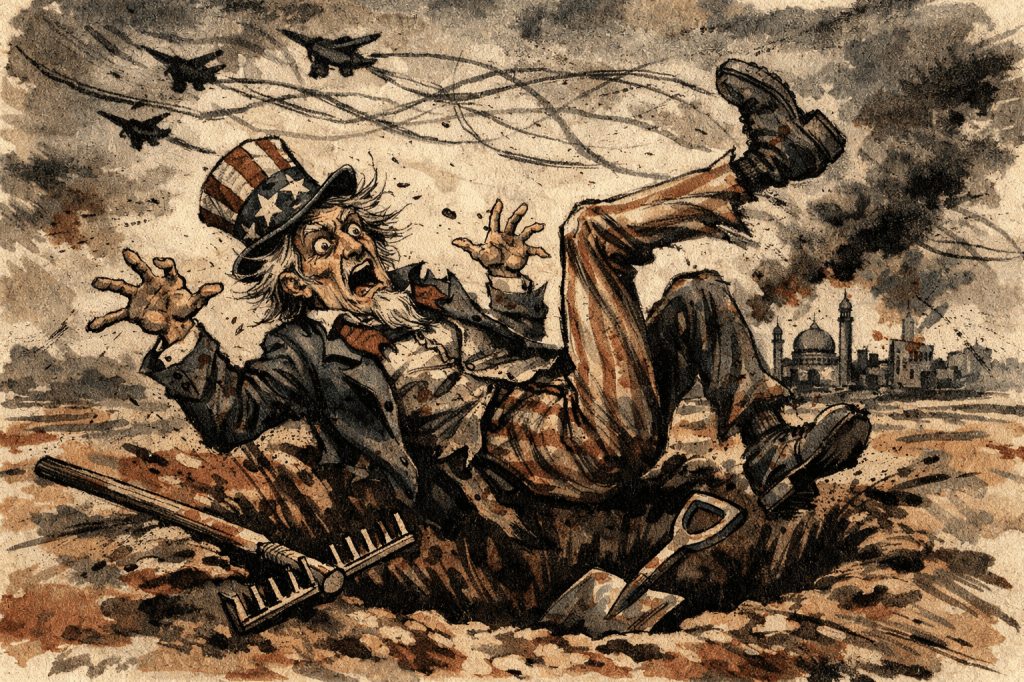
Three and a half weeks in. Twenty-four days of US and Israeli strikes on Iran, oil at $112 a barrel, thirteen American soldiers dead, the Strait of Hormuz effectively closed, and the administration now scrambling to lift sanctions on the very country we’re bombing — just to keep gas prices from completely destroying what’s left of the economy we went in with.
This is the self-own of all self-owns. And I’m not sure we’ve hit bottom yet.
The context here matters. Before the first missile flew on February 28th, Oman’s foreign minister — serving as mediator in nuclear talks between the US and Iran — announced a real breakthrough. Iran had agreed to never stockpile enriched uranium, accepted full IAEA verification, and committed to irreversibly downgrading its existing stockpile. Peace, he said, was within reach. Iran’s own foreign minister echoed it days before the attack. Talks were scheduled to resume on March 2nd. Then we bombed them anyway — during the negotiations — killing Khamenei and hundreds of civilians in the opening strikes.
The administration has offered so many different explanations for why we did this — imminent threat, preempting an Iranian attack, destroying their missile capability, regime change, securing natural resources — that you’d be forgiven for thinking they made up the reason after they’d already decided to do it. Pentagon officials and Iran both rejected the imminent-threat framing. Legal experts worldwide were nearly unanimous: the strikes were a clear violation of the UN Charter, which prohibits the use of force against another state unless authorized by the Security Council or in genuine self-defense against an armed attack. Neither condition existed. Iran wasn’t attacking us, wasn’t about to attack us, and was at the negotiating table when we hit them. Launching mid-diplomacy also violates the Charter’s good-faith requirement, a detail that seemed to trouble exactly nobody in this administration.
Trump told the New York Times in January that he doesn’t need international law. There you have it. The foundational rules that have kept major powers from bombing whoever they feel like since 1945 — rules the US helped write — are apparently optional now.
The Wall Street Journal reported that Lindsey Graham made the most compelling case to Trump to attack. The Washington Post reported that Saudi Arabia’s crown prince lobbied him in multiple phone calls. So we went to war because BB wanted it for years, MBS picked up the phone, and we had an impulsive leader surrounded by a cabinet whose job is to say great idea, sir.
Iran’s biggest strategic asset was always the Strait of Hormuz — a 24-mile chokepoint that roughly one-fifth of the world’s oil supply passes through every year. Anyone who spent ten minutes thinking about attacking Iran had to know that closing the strait would be Iran’s opening move. Apparently those ten minutes didn’t happen. The strait is effectively closed, Brent crude has hit $112 a barrel, US gas is approaching $4 a gallon and climbing, global markets had their worst day in nearly a year, and the UK Prime Minister called an emergency economic meeting over it.
The administration’s solution to a problem entirely of its own making was to lift sanctions on Iranian oil. And on Russian oil. While we are actively bombing Iran, the Treasury Department signed off on 140 million barrels of Iranian crude — already at sea — being sold on global markets. It also temporarily lifted sanctions on Russian oil, handing Putin a financial lifeline that European allies called very concerning for Ukraine’s survival. Democrats called it sickeningly, shamefully stupid. A former CIA director said it gives Iran a financial lifeline of its own. The two countries that should be getting choked off by sanctions are the two countries currently benefiting most from a war we started. Calling that ironic understates the strategic collapse.
Then there’s Venezuela, which was also about oil — supposedly. We went in, captured Maduro, and the administration seems to think the supply will just flow. It won’t. Even at full production it would take years for Venezuela to meaningfully offset what the Hormuz closure is doing to global supply. There is no quick fix for what we broke.
The Iran war isn’t a standalone disaster. It’s one entry on a list that would be funny if it weren’t terrifying. In the past year this administration has threatened or taken aggressive action against Canada (the “51st state”), Greenland (military force and economic coercion against a NATO ally), Panama (demanded the canal back, claimed we “reclaimed” it), Venezuela (military raid, Maduro captured), Cuba (Rubio all but promised they’re next), Colombia (“sounds good to me” when asked about military action), Mexico (pushed to send US troops over the border for the cartels), Nigeria (bombed ISIS inside the country on Christmas Day), Syria (large-scale airstrikes), Nicaragua (a senator openly floated it as next on the list), and now Iran. That isn’t foreign policy. That’s a playlist.
The common thread is the same philosophy applied at every scale. He wants it, he’s powerful enough to take it, so he takes it. Coercion isn’t an unfortunate side effect; it’s how the whole operation works. Consent — whether of a person, an ally, or a sovereign nation — is treated as an inconvenience to route around.
A jury found this president civilly liable for sexual abuse. He told us himself, on tape, that when you’re a star you can do whatever you want to women. The judge in the Carroll case wrote that what he did fits the common understanding of rape, even if New York’s narrow legal definition didn’t quite cover it. The pattern didn’t start with foreign policy. Now it’s just that the whole world is on the receiving end of it.
You don’t build coalitions through coercion, and you don’t earn loyalty by treating friends worse than enemies. When this administration needed allies — after insulting them, threatening their territory, and slapping tariffs on their goods — they weren’t there. The administration seemed genuinely surprised. That’s what happens when your worldview is the schoolyard bully’s. The ones who did stay close, Saudi Arabia and Israel, happened to be the same ones who lobbied us into a war that’s now directly costing American lives and American wallets.
The people who always get rich from war are getting rich. Defense contractors, oil interests, the right people in the right rooms. The rest of us are watching gas prices climb and a generation of goodwill with our actual allies evaporate — while we simultaneously bomb Iran and pay Iran for their oil.
History will have a lot to say about this moment. I just wish I weren’t living inside the part where it costs us.


Leave a Reply