
It started, as most things do in my house, with baseball.
My kids got into it around six years old — right past the T-ball phase where everyone’s just spinning in the outfield catching dandelions — and from there it was spring ball, fall ball, soccer mixed in, the whole blurry chaos of youth sports scheduling. I wasn’t playing. I was watching. And I was watching a lot of bad design.
Here’s the thing about recreational youth sports leagues: when you don’t have professional people doing the visual work, you get what you get. Town name, stock swoosh, whatever font felt exciting that day — probably something curling at the edges in a way that made it feel sporty to someone. I’m not saying it’s always a disaster. I’m saying restraint is not a guiding principle. And coming from a background in marketing and visual production — mostly motion design, but logos and branding were always in the mix — it was hard to unsee.
So I did what I tend to do. I decided to learn the software and mess around.
I landed on Inkscape specifically because I was trying to get off the Adobe subscription treadmill. The whole “you don’t own software anymore, you rent it” model genuinely bothers me. I get why Adobe does it — steady revenue, continuous updates, clean business model — but if you’re not earning a living with it daily, it’s hard to justify. Inkscape filled that gap, and more importantly, it pushed me fully into vector design. Which turned out to suit me perfectly.
Vector has a quality I find almost freeing. No resolution ceiling. Scale anything as big as you want without it falling apart. It pushes you toward clean and graphic over photographic and detailed, and I’ve come to love that constraint. It makes you commit to the idea instead of hiding behind texture.
I designed a new logo for the local baseball league. Before me, they had the standard issue: town name, generic swoosh, “Baseball” underneath. I went back to find the original artwork files and of course there were none. Nobody ever has the right files. So I rebuilt everything from scratch — primary mark, secondary pin logo, variations for different contexts. The kind of system a real organization would have. Which, in retrospect, was probably overkill for a rec league that didn’t ask me, wasn’t paying me, and was lukewarm about the result. The people running it weren’t sure about it. Some parents loved it. That ratio felt about right.
Then travel baseball entered the picture, and everything got more expensive and more absurd.
If you’ve been around travel ball in the last few years, you know what happened. Aria / Absolutely Ridiculous sliding mitts showed up — these padded hand guards with completely unhinged designs, melting ice cream drip patterns, wild colorways — and kids lost their minds. Then Baseball Lifestyle 101 ran with the same aesthetic and started cranking out ice cream drip shorts, and suddenly every 11-year-old at every tournament in Maryland and Ohio was wearing the same outfit. Drip shorts. Pit Vipers. Ice cream fade haircut. Every one of them thinking they were being different. All of them looking identical.
The internet eventually caught up to this phenomenon in the form of the Mason 67 meme — a Gen Alpha archetype: suburban kid named Mason, fluffy “ice cream hair,” baseball lifestyle drip from head to toe, yelling “six seven” at everything. As a travel baseball parent who spent multiple weekends a summer surrounded by exactly these children, I can confirm the meme is accurate. I also made a Mason 67 shirt. Nobody bought it. We’ll get to that.
The parents were spending $600 on bats and ordering custom gloves without blinking. The money flowing through youth travel baseball is genuinely staggering, and this was just one sport. I watched all of it and thought: if they can do this, why can’t I start a brand?
Ha.
So: Crooked Number.
The name came partly from trying to find something that connected back to my existing company, Fig.3 — I wanted a number reference, some kind of through-line. That constraint actually helped. Left to my own devices with no guardrails, I get overwhelmed by possibility. Give me a box and I’ll work. A crooked number in baseball is any score greater than one in a single inning. It’s the thing pitchers dread. It has built-in meaning for anyone who knows the game, and it’s just a good phrase regardless.
The URL “crooked number” was long gone. But “crooked numb” wasn’t. I started with crkdnbr.com, eventually settled on crdnbr.com — abbreviated, phonetic enough, and it stuck.
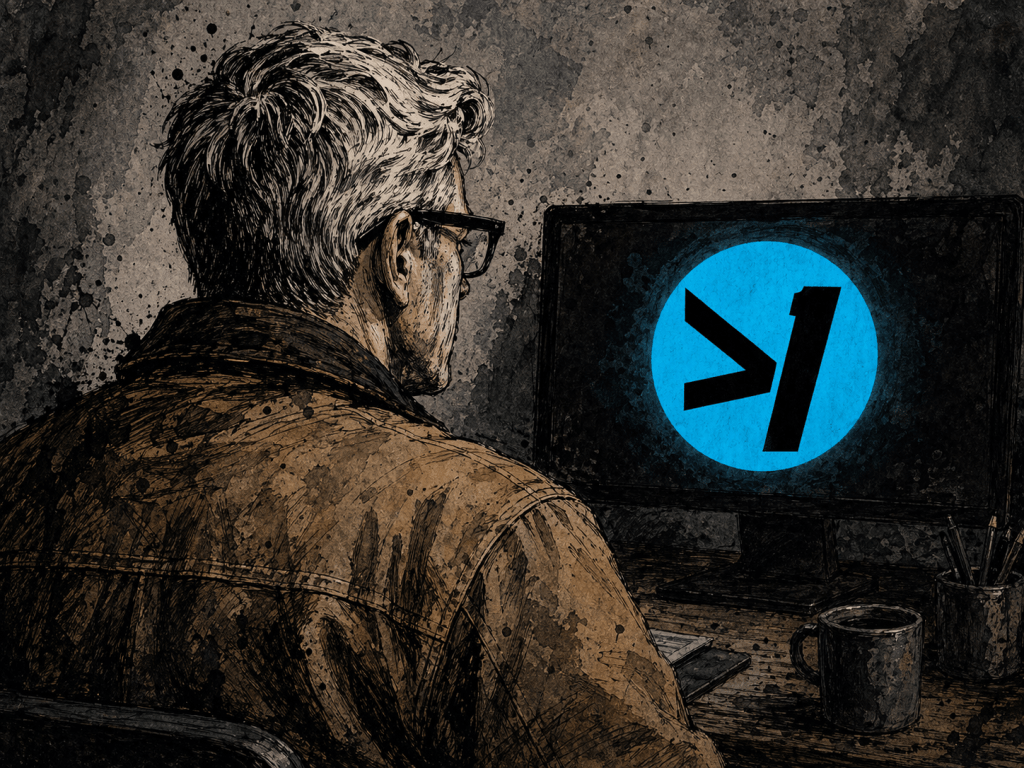
The logo took longer. Having a name doesn’t automatically give you a mark, especially when you’re trying to build something that can stand on its own visually, the way Nike’s swoosh or the Adidas stripes do. I bounced ideas around with Claude and ChatGPT, mostly as a way to eliminate options and get unstuck. AI doesn’t really generate design ideas so much as it helps you narrow faster. Somewhere in that process I landed on the right shape: the mark is a > symbol, which does two things at once. First and most importantly, it literally means “greater than 1” — which is the definition of a crooked number. Second, it reads as a K, which in baseball scorecard notation means strikeout. It’s a >1 that moonlights as a K. Probably too clever by half. But I like it, and it’s mine.
The designs came next — a whole collection. Baseball slang shirts. Some wordplay. A Cap-in-the-Gap shirt: you see “Cap” stacked on “Gap,” and if you look at it quickly you might think it’s a Gap parody, but it’s actually a “no cap” baseball reference. A layered joke for a niche audience, which is basically the whole brand philosophy. I also designed a Mason 67 shirt when that meme was peaking, because of course I did.
I built the store first on WooCommerce and WordPress, which is — and I say this with full awareness that millions of people use it successfully — a genuine nightmare to learn from scratch. Theoretically infinitely flexible, but achieving that flexibility requires approximately 50 plugins, some tolerance for interfaces that make no spatial sense, and a willingness to Google things you feel you should already understand. I eventually moved to Shopify, which is genuinely better organized, and the Printful print-on-demand integration made the pipeline actually work. Designs live in the store, someone orders, it gets printed and shipped. No inventory. No upfront cost. That part worked.
The sales part did not.
I ran ad campaigns. I put real thought into what would make someone feel seen enough to wear something. I sold two shirts on Etsy and nothing significant beyond that.
The diagnosis I’ve landed on: the designs aren’t necessarily the problem. The channel sequencing was wrong. You can’t drop into paid ads before you’ve built any organic audience — there’s nobody there yet to respond to them. That’s the lesson I’ve been sitting with. Not “my designs are bad” (they might be, I’m too close to them to know), but “I tried to skip the part where people actually find you first.”
I eventually moved back off Shopify — the cost structure doesn’t make sense for a brand doing minimal volume — and the store is back on WooCommerce, running more cleanly than the first time around because I actually know what I’m doing now. Mostly.
It’s a hobby. That’s what it is. A hobby with a real URL and over 100 products and a bernedoodle named Hobbes as the spokesdog, but still a hobby. I’ll come back to it. There’ll be another moment at a tournament watching kids all wearing the same thing, all convinced they’re the ones who found it first, and something will click. Until then, Crooked Number sits there, patient, waiting for its crooked number.


Leave a Reply