
I have two kids. Twelve and almost fourteen. And look — I know that whatever they are, that’s mostly on me. You are what you’re exposed to, right? I get that. But some of this is just kid behavior. And some of it is personality. And some of it, honestly, is just the particular era of extreme privilege we apparently decided to raise them in, so here we are.
If you have middle schoolers, or you survived middle schoolers, maybe you’ll relate to this. I genuinely hope your kids are more responsible and listen better than mine, because this is exhausting in a way I didn’t entirely see coming. But I’m guessing it’s fairly common. And I’m guessing it’s more common now than it was when we were growing up, because these kids have no idea what hard work looks like. And I’ll own that — somehow, somewhere, that happened on my watch.
I wasn’t doing things that differently from my parents, except that I was specifically trying NOT to pass on the baggage I grew up with. The anxiety. The pressure. The stuff I carried around for years. I was trying to go easier on them. And what I think happened is… I went too easy. It became simpler to just do things myself than to make them do it and deal with the complaining. So that’s on me too.
Anyway. The main thing right now is the screens.
We try — and I use “try” with full awareness of how pathetic it sounds — to manage their screen time. The deal is simple: do your obligations, earn your screens. Chores. Clean up after yourself. Basic human stuff. They’re not infants. And it consistently, almost impressively, does not happen.
So I’ve tried everything. And I want to stop here for a second and aim some real venom at Apple and Microsoft, because you have made it impossible to manage a child’s device. Impossible. I set up restrictions. I blocked servers. I blocked Spotify at the DNS level. They found a way around it. I don’t know how long it took them — ten minutes, maybe — but they did it, while I spent hours trying to stay one step ahead.
Apple, in particular: you could make parental controls that actually work. You have chosen not to. You have the capability, you have the resources, and you have decided this is not worth your time. And that is why you are a monopoly that needs to be broken up. You and Google both. You are not serving users — you are serving your own ecosystem, and parents with teenagers are just collateral damage. Side rant over. But I mean every word of it.
Back to the thing I’m actually trying.
Here’s what I’ve figured out about kids this age — and again, I hope yours are better, but if they’re not, you know exactly what I’m talking about: they cannot see what is right in front of them. You can send them into a room to get the only object in that room, and they will come back and tell you they couldn’t find it. With a straight face. It is a genuine psychological mystery and I refuse to believe it is unique to my household.
So I’m fighting visual with visual.
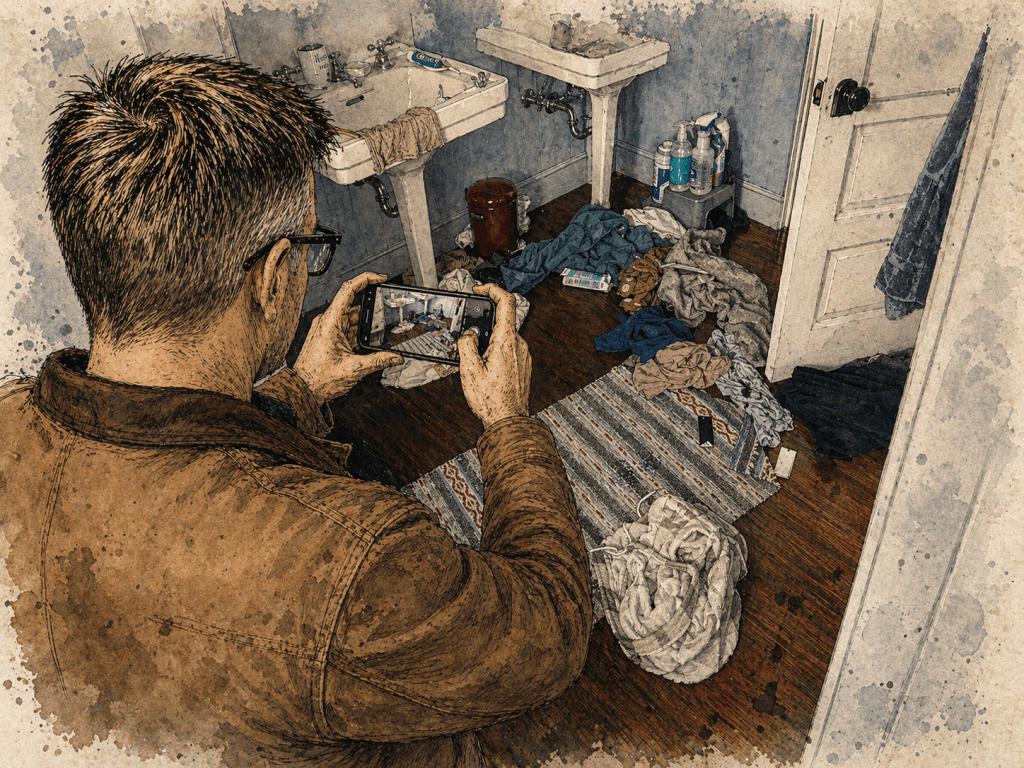
I started this yesterday. Instead of telling them things aren’t done — which produces a blank stare, then a shrug, then an argument — I’m taking pictures. They didn’t clean up after their second dinner last night. (And yes, there is a second dinner. Sometimes a third. I don’t understand their metabolism and I’ve stopped trying.) This morning I took a picture of the mess and sent it to them. The bathroom looks like a crime scene — photograph, sent. The pile of stuff that’s been sitting in the exact same spot for four days — photograph, sent.
And here’s the point: the picture replaces the conversation. I’m not adding another reminder to the pile. I’m not standing there waiting for eye contact that isn’t coming. I send the picture and I walk away. The image does the talking. I stay out of it. No argument, no back and forth, no “I told you already.” Just — here’s the thing that isn’t done. That’s it. That’s the whole message.
My theory is this: they’re already staring at the devices. The picture is going to show up. They will see it. And if I can make it specific and visual — this thing, right here, undone — maybe it removes the “I didn’t know” excuse. Maybe it bypasses whatever black hole activates in their brains the moment I ask them to do something out loud.
Maybe I’m an idiot for not thinking of this sooner. Maybe I’m an idiot for thinking it’ll work at all. Either way, I’m committed to the experiment.
Wish me luck.
Quick note, it’s been a few days and it hasn’t changed their behavior but it has helped me. Instead of getting frustrated, I just spam them with the images again and there is something satisfying about that childish response for me.
 Even that's Odd
Leave a comment