
I am a firm believer in snow tires and I think the fact that I have to say that out loud in 2025 is genuinely one of the more baffling things about living in the Northeast — like, we all agree the earth is round, right, so can we also agree that all-season tires in February on a hill that gets black ice are not a plan, they’re a prayer
The thing is it didn’t start as a tire philosophy it started as a wheel philosophy, which sounds more pretentious than it is, and it sort of evolved from there into something I now have Very Strong Opinions about and my wife Jennifer would absolutely confirm that this is one of those topics where I have somehow arrived at a framework
So let me back up
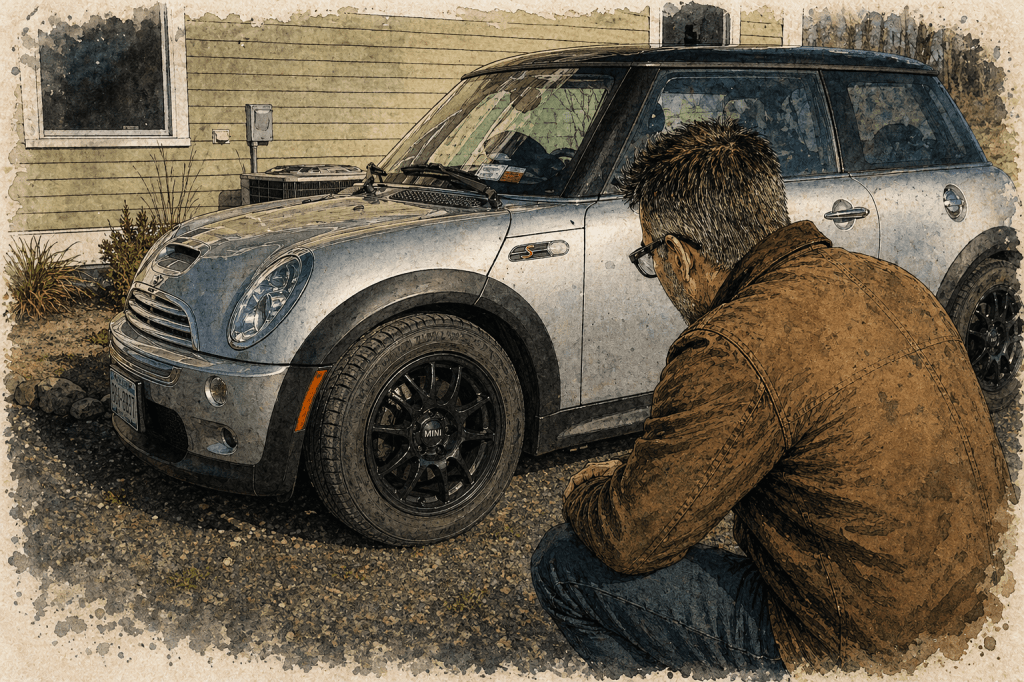
The first real moment of clarity was the Taconic — we had the Mini Cooper S, 2003, and I had already been through a whole thing with that car by that point — stock 17s with run-flats, which were genuinely punishing, and everyone online said just swap to regular tires on the same rims and the ride will transform, so I got Kumhos in 215/45-17 and it was better than the run-flats which is about the most honest thing I can say about it — then I went all the way down to the 15-inch Rota blacks with all-seasons, which people who write about Minis on the internet will tell you is a revelation, and those people are delusional, it was marginally better than the Kumhos on the 17s and my brother told me afterward that you’d really need to swap the shocks to feel an actual difference, which is the kind of useful information that arrives after you’ve already bought two sets of wheels — the car just rode the way it rode and that was that — and I didn’t do dedicated snows for it either, which the Taconic would later have something to say about
Because we were coming back from somewhere, I forget where, and it was snowing and icy and we started passing cars that had just spun off the road, plural, like a little collection of people who had made roughly the same tire decision I had, and the conditions had changed so quickly that it could have just as easily been us, and I could feel it, the car working harder than it should to do basically nothing, and that’s the moment I understood that all-seasons in a real winter situation aren’t worth the risk, for you nor the other people on the road
The second moment was the Subaru — 2012 Impreza, 215/45R17 stock, standard all-seasons that came with the car because that’s what Subaru gives you — and we had gotten it specifically because we had moved to Gardiner and were about to have a kid and needed something sensible and all-wheel-drive and responsible and we were taking friends back to the train, going up these hills on our road, not even deep snow, and the car was spinning, all-wheel-drive and everything, just couldn’t get traction, and I remember thinking oh this is embarrassing but also oh this is actually dangerous
The third moment is the one I don’t really like telling because it scared me in a different way — Jennifer was pregnant with Elias and he was late and we had to go do a check-up about 45 minutes from the house and it had been fine when we left but on the way back it was a white-out, a real one, and there’s a hill near our house where you come down and there’s a stop sign at the bottom and then a fairly major road and I was going so slow, I was not being reckless, and the car just would not stop — it slid, quietly and without drama, straight through the stop sign and out into the road and the only reason nothing happened is that it was late and it was a storm and nobody was coming, and I sat there for a second before driving home and I think I was extremely calm about it in a way that was probably just shock
The fourth one was the F150, different car, same lesson — coming down a hill with a light at the bottom, little bit of snow, truck just kept going, had to actually steer onto the shoulder a little to avoid the car in front of me, and at that point I was done being educated by my own near-misses
So from that point on, every car gets snow tires
But here’s where it became a wheel philosophy and not just a tire philosophy — the switch to a separate set of wheels for winter came from figuring out that if you just swap tires on the same rims you’re paying for mounting and balancing twice a year every year, and also the stock rims on most cars are increasingly ridiculous because there is this insane trend of putting lower and lower profile tires on everything, these tiny little sidewalls that look very sporty and perform beautifully in places where the ground does not freeze and thaw and destroy the road every single winter, but if you live somewhere with potholes — and we live somewhere with potholes — a 45-series sidewall is not a tire it’s a liability
So the philosophy became: get a separate set of winter wheels, size the rim down, go up on the sidewall, get real snow tires, and swap them each season
The Subaru I did right — went down to 16-inch steel wheels, 225/60R16, proper snow tires, and the difference was not subtle, that car became a completely different animal in winter
The Accord — Jennifer’s stepfather gave us his old Honda for the train commute — I got steelies for that one, kept it simple, 195/60R16
The Audi Allroad came next and that one I did properly — stock wheels are 18-inch, 245/45R18, and for winter I got 16-inch black aluminum wheels with Blizzaks, which are genuinely excellent snow tires — and here’s the thing, aluminum wheels are actually not significantly more expensive than steel wheels and they’re much lighter which matters — and Jennifer had a preference for black wheels, which I’d become partial to myself at that point, and the black wheel thing has a practical argument behind it anyway which is that brake dust absolutely destroys lighter wheels, silver especially, so black is not just an aesthetic choice it’s a maintenance one
The Ridgeline was a slightly different situation because the stock sidewall was thick enough that I didn’t need to size down, stayed with 18-inch, got black of course, and the funny thing is the Ridgeline’s stock wheels are kind of flat and weird-looking and the winter wheels ended up looking better so I actually flipped it — winter wheels got the all-seasons and the stock wheels got the snow tires since they’d be on less of the time anyway
And now we have the Tesla, 2024 Model Y with the third row and long range, and the stock wheel situation on that thing is — and I say this as someone who has been politely but firmly interested in wheels for a long time — it is aspirationally impractical, 20-inch wheels on something marketed as an SUV, which, fine, if you live somewhere without seasons, but I am not doing that to myself or to the car, so I sized down to 18-inch Turbine wheels which I think actually look better than stock anyway and went with the Nokian WR G4 SUV All Weather at 255/55R18, a little more sidewall than the recommended 50-series but I wanted the cushion
Which brings me to where the philosophy has shifted — both the Audi and the Tesla are now running all-weather tires, and I’ll be honest that it was partly circumstance as much as conviction, the Blizzaks on the Audi had aged out after seven or eight years and I didn’t have enough evidence yet on the all-weather performance to feel confident going back to dedicated snows, so I made the call on both cars at around the same time and went with the Nokian WR G4 all-weathers across the board
We had a lot of snow this past winter and it seemed to go OK
The Nokian all-weathers are genuinely good — not as good as dedicated snows, nothing is as good as dedicated snows — but significantly better than a standard all-season, which again I cannot stress enough is not a real plan for winter driving, and the goal is to avoid the seasonal swap and just rotate on a regular schedule
I’m cautiously optimistic and not ready to declare victory but also not ready to go back
 Even that's Odd
Leave a comment