
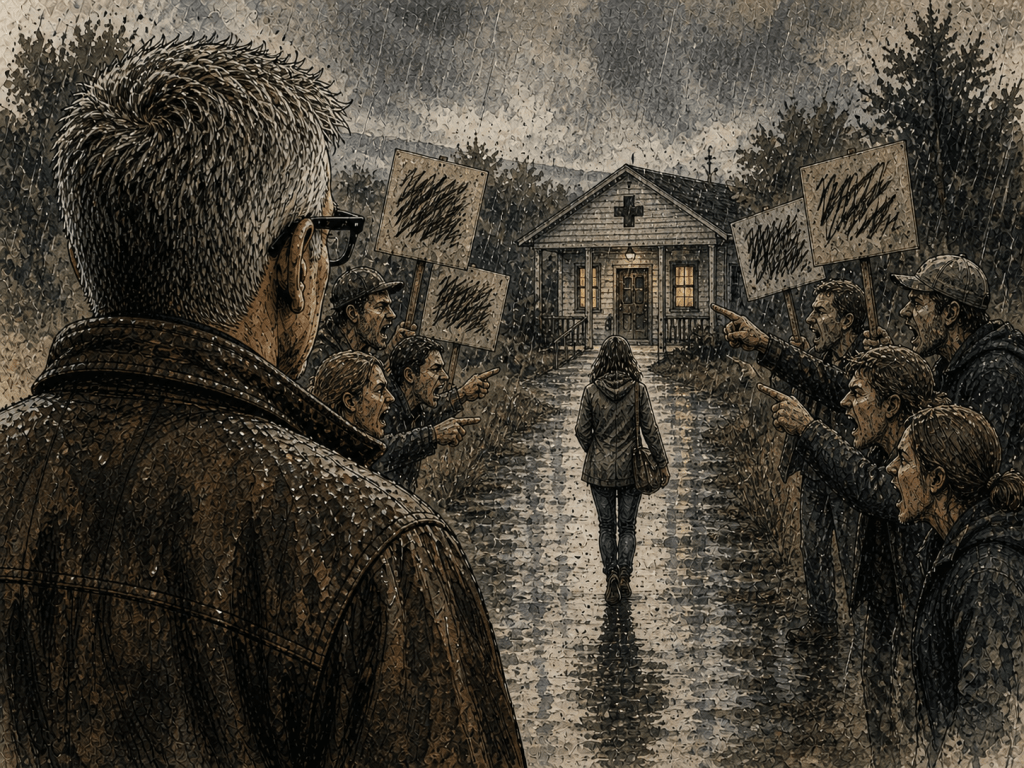
A federal appeals court just ordered the FDA to require in-person dispensing of mifepristone — the pill used in roughly 60% of abortions in this country — and it applied that ruling nationwide at the request of one state. Louisiana sued, the Fifth Circuit said sure, and now everybody from California to Vermont is supposed to live under Louisiana’s preferences. Justice Alito put the order on hold for a week while the Supreme Court figures out what it wants to do, but the message is clear enough: states’ rights are sacred until they aren’t.
So one state rules them all? Or is it states’ rights only when it’s what you believe or in your favor?
That alone is worth a post. But let me set the hypocrisy down for a minute, because it’s only part of what’s bothering me. The deeper thing I want to think through is what actually happens — to actual people — when you make abortion harder to get. Not the slogan version. The downstream version.
A couple of things I’m taking off the table first, because I refuse to have these arguments. If the mother’s life is in danger, or if the pregnancy isn’t viable, this isn’t a debate. We put horses down to end their suffering and somehow we’ve decided humans don’t get the same dignity. Same with rape and incest — the fact that grown adults have to defend exceptions for those is its own kind of madness.
And before I get into consequences, the other piece of hypocrisy I can’t quite let go of: the same political faction that wants to ban abortion to make sure every baby has the right to be born is the one that won’t move an inch on guns to make sure those same babies don’t get shot at school once they’re seven. There is a logic in there I keep missing. (Side note for myself: I really do need to look up why "the right" is called the right when most of the time they’re not.)
Setting all of that down. Let me walk through what I think happens. Then I’ll go check.
What I imagine happens
My starting assumption is that restricting abortion does not affect everyone equally. Women with money will always find a way — drive, fly, telehealth from a friendly state, fly to a country that lets adults make their own decisions. So this isn’t really a policy that hits "women." It’s a policy that hits poor women and girls. That’s where the actual coercion lives.
So set up the scenario: a poor woman, a healthy unwanted pregnancy, no legal way out. She delivers the baby. Now what?
Adoption is what the pro-life crowd will tell you. And I have my doubts about this. The image of the desperate would-be parents waiting for a baby gets trotted out every time, but my gut says that demand is for a very specific kind of baby — healthy, white, no prenatal drug exposure, no medical surprises. I don’t think the parents on the wait list are clamoring for the baby of a poor 19-year-old drug addict, or a Black or brown baby. So adoption-as-fallback feels to me like rhetorical cover more than a real plan.
If adoption isn’t really an option for a lot of these babies, then the mother keeps the baby. My guess is she’s a single mother most of the time. My guess is she falls below the poverty line, because she was probably already close to it, and a baby is the thing that pushes you over. My guess is rates of substance abuse go up, because despair does that to people. The kid grows up with worse nutrition, worse medical care, worse schools, and the taxpayer ends up paying for some piece of all of it through whatever’s left of the safety net.
That kid then has a higher chance of not finishing school, of getting in trouble, of becoming a teen parent themselves. The cycle restarts.
Second branch: the mother can’t or won’t raise the baby and it ends up in the system. Foster care. My guess is that’s worse than even a struggling mother would have been. My guess is wards of the state have higher rates of behavioral problems, lower academic performance, and end up disproportionately in the corrections system or pregnant young.
Now zoom out. What are the longer-term consequences of all of this at the population level? More children, sure. That’s the intended part. The unintended part is what I want to figure out.
I’m going to admit I cheated a little on this next one because I had this conversation with a friend and I don’t fully remember the exact argument. But the rough version: my guess is that crime and poverty go up significantly in places where abortion is heavily restricted, and quality of life for everyone — including the people who passed the restriction — gets worse. Although I suspect the people who voted for the ban are mostly insulated from the day-to-day effects, except in their tax bill. And even there, if the costs get shifted to federal dollars, then it’s the broader taxpayer footing it, which means the people who believe in choice end up paying for the consequences of policies they opposed.
The piece that really bugs me is this: the same people who scream about "welfare queens" and want to gut social programs are the ones writing laws that — by my guess — will dramatically grow the population of people who depend on social programs. That doesn’t read as a coherent policy posture. That reads as wanting to control women.
Those are my guesses. Now let me check.
What the actual research says
I went looking for numbers. Most of what I imagined turns out to be reasonably well-documented. One of my guesses is genuinely contested. Here’s how each one held up.
The first thing I checked was who gets hit hardest. Confirmed. The Turnaway Study — a five-year University of California at San Francisco study that followed about a thousand women, some who got abortions and some who were turned away by gestational limits — found that half of the women seeking abortion were already living below the federal poverty line, and three-quarters didn’t have enough money to cover basic living expenses. Separately, low-income women are more than five times as likely as affluent women to experience an unintended pregnancy, even though sexual activity rates are nearly identical across income groups. So the pregnancy gap is about contraception access, not behavior, and the abortion-restriction gap lands almost entirely on women who were already struggling.
On adoption, my guess held up and was actually worse than I thought. Infant adoptions in the United States are about half of one percent of live births. Roughly 1% of never-married women place a child for adoption, and for never-married Black women that figure has been statistically near zero for decades. Meanwhile, around 114,000 children are sitting in foster care waiting to be adopted, with the average waiting child nearly eight years old. The "loving family on a wait list" exists. But their wait list is for healthy newborns specifically. The kids who actually need families are getting older in the system every year.
On the mother and child if she keeps the baby — confirmed across the board. Women in the Turnaway Study who were denied abortions were three times more likely to be unemployed and four times more likely to live below the poverty line than women who got the abortion they sought. They were also more likely to stay tethered to abusive partners, more likely to suffer anxiety in the short term, and more likely to experience chronic pain and gestational hypertension years later. Their existing children showed worse developmental outcomes too — slower language and motor milestones. One honest counterpoint, courtesy of Americans United for Life: while the income and employment gaps were sharp at six months, some of those metrics narrowed by the end of the five-year study window. The poverty and food-and-housing-insecurity findings persisted. The employment gap shrank.
On foster care, confirmed and brutal. More than 30% of foster youth had spent time in a correctional facility by 17 and over 40% by 20, and 71% of young women formerly in foster care were pregnant by 21. Only 8 to 12% earn a college degree. And the part of the cycle I didn’t quite name out loud: one of the strongest predictors of a child entering foster care is having a mother who was in foster care herself.
The crime guess — the one I cheated on — is the one the data is least sure about. The famous Donohue-Levitt paper from 2001, the one that Freakonomics made everybody know about, argued that legalized abortion accounted for as much as 50 percent of the recent drop in crime. Donohue and Levitt re-ran the analysis with another seventeen years of data in 2019 and said the prediction held. But this is a contested claim, and not in a polite-academic way. Other economists have argued the methodology is flawed, that crack cocaine cycles explain what looks like an abortion effect, and that the regression results can be reversed by using arrest data linked to when the crime actually occurred rather than when the arrest happened. The honest version of my guess is that some serious economists find a strong link, others don’t, and it’s not settled.
Last guess, the welfare-and-hypocrisy one. Confirmed. The Turnaway Study found that women denied abortions had a significant increase in receipt of public assistance that persisted until they were timed out of those programs. Teen pregnancy alone — just teen pregnancy, not the broader population of unwanted births — costs U.S. taxpayers about $11 billion a year, with some estimates as high as $28 billion, driven by health care, foster care, increased incarceration rates among the children of teen parents, and lost tax revenue. So the political position "ban abortion AND cut welfare" doesn’t have a coherent budget story behind it. The costs go somewhere. They go to the safety net, which is the thing the same people are trying to dismantle.
Five out of six guesses survive. The sixth is a fight, not a settled answer.
The piece I keep coming back to is that none of this should be controversial in the consequentialist sense. We have decades of data on what happens when you make abortion harder to get. It makes poor women poorer. It makes their existing kids’ lives harder. It fills the foster system. It costs the taxpayer money. It does not, as far as anyone can show, reduce abortion as much as it just shifts who can afford to get one.
What it does, very effectively, is impose suffering on people who are already losing.


Leave a Reply