
I’m not a musician. I can’t read music, never learned to play, took percussion as a kid and got confused by the notation. So when I tell you I made five songs, I don’t mean I sat down at a piano. I mean something a lot stranger, and a lot more stubborn, than that.
This started as a marketing exercise. I’ve worked in marketing a long time, and I’d been staring at MAGA for months, trying to understand why something that simple works so well. And it does work — “Make America Great Again” is ambiguous enough to mean anything to anyone, and it’s been hammered home so many times it doesn’t need to actually say anything. Here’s the part people forget, though: it isn’t even original. Reagan ran on “Let’s Make America Great Again” in 1980. Trump just dropped the “Let’s” and reused it. The whole iconic slogan is a hand-me-down. Trump isn’t a genius, but he reads a room like a con man reads a mark. He remembers what worked before — the McCarthy stuff, the Nixon stuff — and he’s got a real instinct for what triggers people. Even the slogan has an ugly root: “America First” traces back to the America First Committee of 1940, the isolationist group that could never shake its antisemitism — Lindbergh’s Des Moines speech, Henry Ford on the board. Not a great foundation.
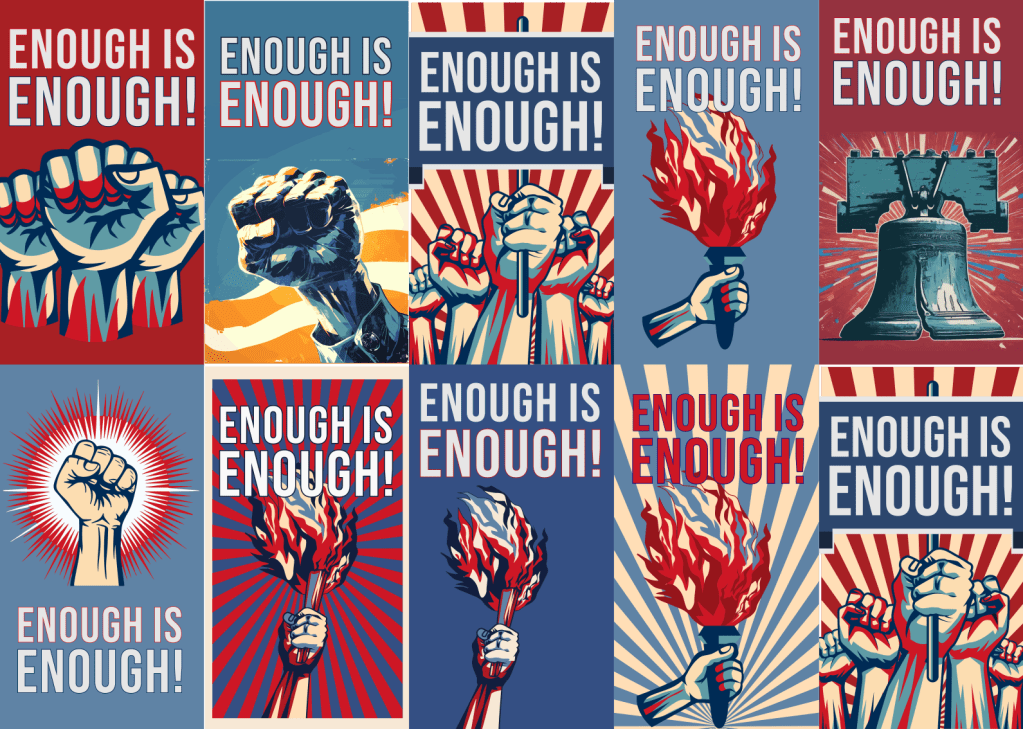
So I asked myself the marketer’s question: what’s the answer to that? Not a smarter slogan — a simpler one. Because I think most people in this country, across the board, are frustrated and exhausted, and a lot of MAGA folks got pulled into a fake movement that was never really about helping them. I wanted something that used the same simplicity but pointed at the truth. I did a bunch of searching so I wouldn’t accidentally lift someone else’s phrase, and the word that kept surfacing was enough. Enough already. Enough is enough.
Around the same time I was doing a deep dive on why nothing in this country ever gets fixed — housing, inflation, the supply chain, bird flu, gun violence, wealth inequality, an approval-of-Congress number in the basement. And it all kept collapsing into the same root cause: money in politics, a broken system, a media that’s been corrupted into echo chambers where people only hear what they already believe and treat real information as fake. We’re living in an alternate-reality world. I wrote a pile of posts about all of it, and somewhere in there I decided the way to break through wasn’t another essay. It was going to be a viral moment. I just needed the hook.
Here’s where it turned into songs. I was playing with the phrase and the letters — Enough Is Enough, It’s Over. E-I-E-I-O. That’s Old MacDonald. A song that traces back to 1706, sitting in the public domain, that every single person already knows. (The word for what I did there is a backronym — building words to fit letters you already have.) That was the way in. If I could write a version of Old MacDonald, I had a Trojan horse.
The actual process, honestly
I’m a slow typer and I struggle with spelling, so the way I work is: I dictate, and then I hand what I said to Claude to structure it into a post — and to fact-check me, so I’m not repeating something that isn’t true. I used Claude as a sounding board for the lyrics too. And I want to be clear about what that looked like, because it’s the honest version: Claude would give me something to react to, I’d say “that sucks” or “that line doesn’t work,” I’d feed it my own line, ask for options, throw most of them out. Back and forth, for a long time. Earlier versions of these tools were not good at coherent lyrics, so a lot of this was me pushing against a wall until something usable came loose. I used ChatGPT too, mostly for images. Claude ended up being the better writer for my voice; ChatGPT was better at pictures.
For the music, a friend of a friend had launched Suno, and eventually I tried it. This is the part people don’t understand: I can’t engineer a track. I can’t go in and fix a bad bar, because I’d break three things I couldn’t hear. So my whole craft was in the prompting and the picking — writing the genre and feel, generating a version, listening, going “no, that’s awkward,” adjusting, and going again. Hundreds of generations across the project. Old MacDonald alone was 50 or 60 takes. Is it a good song? I genuinely can’t tell you — I’ve heard each of these so many times I’ve lost all objectivity, which is exactly what happens when you work on music videos and hear the same track two hundred times a day. At some point you just have to pull the plug.
That’s the part I want to defend. These songs are not something a machine made. Nothing I have could produce exactly what was in my head — not Suno, not Claude, not ChatGPT. Every one of them fought me. What I brought was months of decisions: the concept, the research, the phrase, the backronym, the structure, the thousand rejections of lines and takes that weren’t right, the visual style, the editing. AI is the tool. It is genuinely a tool — I’m not going to pretend I hand-played a guitar I can’t play. But I’m also not going to let anyone tell me this was easy or automatic. It was weeks, and then months, of stubborn, distracted, obsessive work, because I get pulled off in ten directions every time the news does something new. This is where it landed.
The songs, in order
1. Old MacDonald — the way in. Old MacDonald as a character whose farm gets taken apart, a snapshot of how money runs the system. Stripped-down acoustic punk-folk.
2. Living the Dream — American exceptionalism, and where we actually rank against other wealthy countries. Raw acoustic folk-rock.
3. Party of One — the broken two-party machine, Citizens United, dark money, and how much we secretly agree on anyway. Raw acoustic punk.
4. Us vs Them — the left-vs-right distraction that hides the real story: wealth inequality and money in politics. Bare, piano-led, a song that travels.
5. Look Up — a “We Didn’t Start the Fire”-style list of everything that’s broken. Fast, frantic, angry strings. Meant to be the closer — probably the setup for a solutions song I still owe you.
The videos
I built these the same way I built everything — by hand, out of a propaganda/protest-poster style I keep coming back to, mostly as lyric videos because live footage never fit. The lyric videos were built in Filmora, and the raw material shifted as I went: hand-made vector protest-poster frames at first, then Adobe Firefly for generated elements, then ChatGPT stills with simple Ken Burns moves. For the redos I landed on a pipeline of Claude for prompts, ChatGPT for stills, and Kling for animation. Look Up was done in Neural Frames. It’s all a little buggy, the AI throws motion artifacts that make no sense, and because I work in an illustration style rather than photoreal, I can trim the worst of it and live with the rest. [FILL: any bigger-picture visual notes you want to add here]
That’s the whole thing. Five songs, one exhausted non-musician, and a pile of tools that never quite did what I wanted — which is exactly why it took so long.
[SITE LINK]
APPENDIX: The “Systemic Dissonance” spec — the science I tried to build into these
(the nerdy part — for the bottom of the process post)
Somewhere in all this I went down a rabbit hole on what actually makes a hit song — not the vibes, the math — and I tried to bake it into the writing. I won’t claim it fully stuck, but it was intentional, and here’s the framework I was working from. I called it “Systemic Dissonance”: pop-song math to keep you hooked, art-rock structure to keep it honest, and a deliberately unresolved ending to match the fact that none of this is actually resolved.
Narrative signal. The thesis across the songs: the political system is a bypass of its own checks and balances — a donor class funding both parties while 70-90% public consensus on economic issues goes nowhere. Tone: clinical, observational, tense. A snapshot, not a rant.
Lyrical physics. A 4+4 syllable split per line (binary symmetry) — the fact, then the consequence. Rhymes landing on the musical downbeat so the linguistic resolution and the harmonic resolution hit at the same instant (that double-resolution is where the brain lights up). Ending critical lines on hard consonants — plosives like -CK, -T, -P, -D — for a percussive “clunk” instead of pretty open vowels. And letting the third verse “glitch” into an asymmetric 5+3 split to simulate the chaos of the cultural distraction.
Structure. Placing the real revelation — the 70-90% consensus fact — at roughly the 61.8% mark (the golden ratio), where the brain is primed for the biggest “event.” A spoken-sung bridge to spike the information gain at the climax. Overall shape: verse-verse-chorus-verse-bridge-chorus-outro. And a chorus that’s deliberately repetitive (low entropy, Zipf’s-law-simple) so it lands as the earworm.
Sound. This is where Peter Gabriel comes in: strictly no cymbals. He banned them on his third album to force a more percussive, inventive sound, and that’s exactly the discipline I wanted — time kept by discrete transients (rimshots, metallic clinks, woodblocks, heavy thuds), the high frequencies left open so the vocal sits absolutely clear. And the ending unresolved on purpose — a suspended or dissonant chord, a hard cut mid-sentence, no return to the home key. Because the problem isn’t resolved either.
Did the machine actually obey all of that? Not fully — Suno fights you. But this is the guardrail I was aiming at, and I’m not sure if I was successful or not.


Leave a Reply