
It took me embarrassingly long to figure this one out.
For years, I’ve been annoyed by the same thing on every car I’ve owned: headlights that go cloudy and yellow long before the rest of the car looks old. It doesn’t matter how well you’ve taken care of the vehicle otherwise — foggy headlights make it look beat up and neglected. I tried the restoration kits. They sort of work. For about six months. Then you’re back where you started, buffing plastic in a driveway on a Saturday, wondering why you bothered.
I’ve never had a car with pop-up headlights or covered housings — no Miata, no Honda Prelude, no early Accord with the flip-up lamps. Every car I’ve owned has had exposed lenses sitting right out there in the weather, taking it directly. And it’s always the driver’s side that goes first. I have a theory — sand and salt kicked up in winter, made worse by oncoming traffic on that side of the road — but I’ll admit that’s a guess, not something I’ve actually verified. For the purposes of this post, I’m going to treat it as fact anyway, because it’s consistent across every car I’ve had.
The lightbulb moment came from an unrelated problem: Tesla paint. When I got the Model Y, I did the research everyone does before owning one and found out fast that the paint chips if you look at it wrong. The fix a lot of owners land on is paint protection film — either the whole car or at minimum the front end, which takes the brunt of the highway. I bought a kit and did the front bumper, hood, and headlights myself. There was a real learning curve. It is not a forgiving material the first time you’re working with it. But it’s held up well, and somewhere in the middle of that project it hit me: I can put this same film on headlights. That’s an available option. Why has no one told me this in twenty-five years of owning cars?
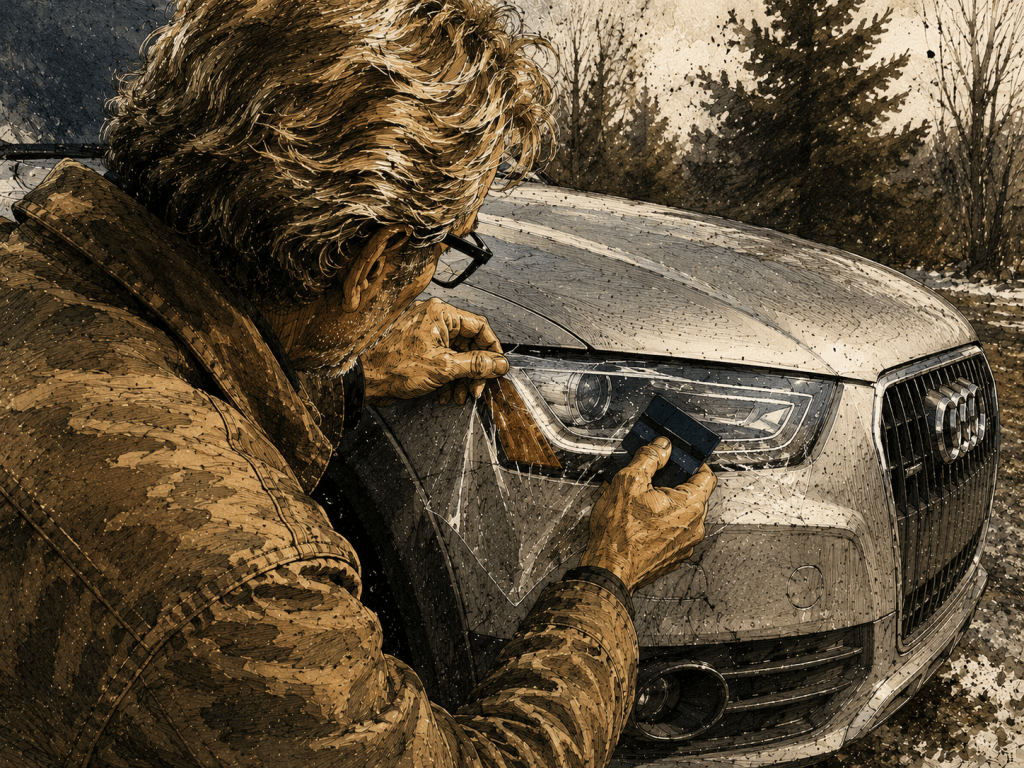
Once I knew what to look for, I went back and applied it retroactively. Our 2016 Audi Allroad had headlights that were already showing the early stages of degradation — that same pitted, hazing look starting to creep in from debris strikes. I restored them as best I could first, then put protective film over the top. It wasn’t just cosmetic. Cloudy headlights on that car had actually gotten bad enough that oncoming drivers were flashing my wife, thinking her brights were on. That’s not a small thing to fix.
Here’s the plain text — just paste this straight into a paragraph block:
Vehicle Headlight Protective Film (PPF). A must have I never knew was a must have.
It took me embarrassingly long to figure this one out.
For years, I’ve been annoyed by the same thing on every car I’ve owned: headlights that go cloudy and yellow long before the rest of the car looks old. It doesn’t matter how well you’ve taken care of the vehicle otherwise — foggy headlights make it look beat up and neglected. I tried the restoration kits. They sort of work. For about six months. Then you’re back where you started, buffing plastic in a driveway on a Saturday, wondering why you bothered.
I’ve never had a car with pop-up headlights or covered housings — no Miata, no Honda Prelude, no early Accord with the flip-up lamps. Every car I’ve owned has had exposed lenses sitting right out there in the weather, taking it directly. And it’s always the driver’s side that goes first. I have a theory — sand and salt kicked up in winter, made worse by oncoming traffic on that side of the road — but I’ll admit that’s a guess, not something I’ve actually verified. For the purposes of this post, I’m going to treat it as fact anyway, because it’s consistent across every car I’ve had.
The lightbulb moment came from an unrelated problem: Tesla paint. When I got the Model Y, I did the research everyone does before owning one and found out fast that the paint chips if you look at it wrong. The fix a lot of owners land on is paint protection film — either the whole car or at minimum the front end, which takes the brunt of the highway. I bought a kit and did the front bumper, hood, and headlights myself. There was a real learning curve. It is not a forgiving material the first time you’re working with it. But it’s held up well, and somewhere in the middle of that project it hit me: I can put this same film on headlights. That’s an available option. Why has no one told me this in twenty-five years of owning cars?
Once I knew what to look for, I went back and applied it retroactively. Our 2016 Audi Allroad had headlights that were already showing the early stages of degradation — that same pitted, hazing look starting to creep in from debris strikes. I restored them as best I could first, then put protective film over the top. It wasn’t just cosmetic. Cloudy headlights on that car had actually gotten bad enough that oncoming drivers were flashing my wife, thinking her brights were on. That’s not a small thing to fix.
At this point, headlight film is going to be the first thing I do to any car I own going forward — before wheels, before interior protection, before anything else. It’s a small, cheap step that has an outsized effect on how old a vehicle looks. People judge a car’s condition by its headlights whether they realize it or not. Cloudy lenses read as “neglected” even on a car that’s been meticulously maintained everywhere else.
I’ve sold a few vehicles over the years — an Impreza, an Accord, an F150 — and none of them had this film on the headlights when I let them go. I cleaned the lenses up as best I could before each sale, and none of them were hard to move. I don’t try to gouge anyone; I price fair for whoever’s buying. But looking back, I have to think a set of genuinely clear, film-protected headlights would have made every one of those sales a little easier, and probably worth a bit more.
It’s a strange thing to feel strongly about, but I do. A vehicle with clean, clear headlights just looks cared for — and that matters to me for reasons that go beyond resale. It’s the difference between glancing at a car in the driveway and feeling good about it, or noticing the haze and being irritated every single time. Might as well solve it once.


Leave a Reply